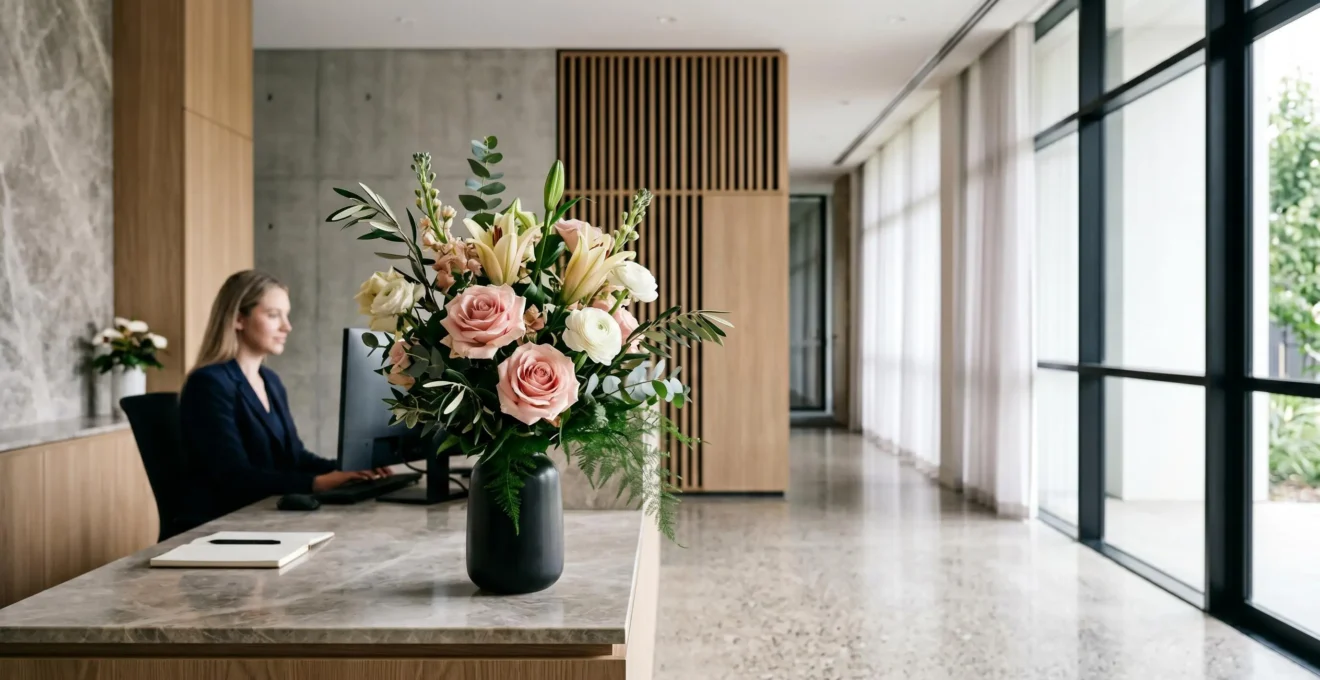
A £200/month floral budget isn’t an operational expense; it’s a strategic workplace investment with a measurable, data-backed ROI.
- Biophilic design is proven to boost employee productivity by 15% and significantly enhance workplace satisfaction.
- Professional management eliminates the hidden costs of DIY (failed plants, wasted time) and guarantees a 95% plant survival rate.
Recommendation: Use this data-driven framework to reframe your next budget conversation from “cost” to “performance investment.”
As an office manager, you understand the intrinsic value of a welcoming, vibrant workspace. You’ve seen the instant lift a fresh floral arrangement brings to the reception desk. Yet, when faced with the cold, hard numbers of a budget review, translating that “feeling” into a compelling argument for your Finance Director can feel like an impossible task. The usual justifications—”it improves morale,” or “it makes the office look nice”—often fall flat, dismissed as fluffy, unquantifiable expenses.
But what if the entire conversation could be reframed? What if that £200 monthly floral budget was positioned not as a decorative cost, but as a strategic, data-backed investment in measurable business outcomes? The truth is, the benefits of a professionally managed floral and plant program extend far beyond aesthetics. They touch upon productivity, employee retention, brand perception, and even direct cost savings through strategic implementation. This is the language of business, and it’s the key to unlocking that budget.
This guide moves beyond the platitudes. It is designed to arm you with the specific data, financial arguments, and operational strategies needed to build an irrefutable business case. We will break down how to demonstrate clear ROI, mitigate costs, and transform your floral program from a “nice-to-have” into a non-negotiable strategic asset.
To navigate this financial justification, we will explore the tangible returns on your floral investment, from quantifiable productivity gains to smart, cost-saving contract strategies. This structured approach will provide a clear roadmap for your discussion with any budget-holder.
Contents: The Business Case for Office Florals
- Why Offices With Fresh Flowers Report 15% Higher Employee Satisfaction?
- Which Flowers Survive a Week in Air-Conditioned Offices Without Daily Care?
- What Day Should Office Flowers Arrive to Stay Fresh for Monday Meetings?
- How to Save 20% on Annual Office Florals by Committing to a 12-Month Contract?
- How to Align Office Flowers With Quarterly Themes Without Increasing Budget?
- How to Rotate 4 Plants Monthly to Keep Your Office Green Without Losing Any?
- How to Redistribute Corporate Event Flowers to Staff Desks the Next Morning?
- Why Does Your Monstera Develop Yellow Leaves After 3 Months in the Office?
Why Offices With Fresh Flowers Report 15% Higher Employee Satisfaction?
The first and most powerful tool in your arsenal is data on human performance. A floral budget is not about decoration; it’s about creating a biophilic environment that directly impacts the bottom line through employee output and wellbeing. The concept of biophilia suggests that humans have an innate tendency to seek connections with nature. When introduced into a corporate setting, this connection yields quantifiable results. It moves the conversation from “expenditure” to “investment in human capital.”
While the title’s 15% satisfaction increase is a conservative figure, the impact on productivity is even more compelling. For instance, research from Exeter University demonstrates that enriching a lean office with plants can increase productivity by 15%. This isn’t just about feeling happier; it’s about employees being more focused, engaged, and ultimately, more effective in their roles. Imagine presenting that to your Finance Director: a direct link between the environment and the company’s output.
The famous Herman Miller “Greenhouse” factory provides a large-scale case study. By integrating biophilic design principles like natural light and views of nature, the company saw productivity double and a significant increase in employee retention. Workers felt more connected and valued, proving that environmental investment delivers a measurable Biophilic ROI. When you invest in fresh flowers and plants, you are deploying a proven tool for enhancing the very engine of your business: your people.
Which Flowers Survive a Week in Air-Conditioned Offices Without Daily Care?
A common objection to a floral budget is the perception of waste—beautiful flowers that wilt and die within days. A key part of your business case is demonstrating fiscal responsibility by maximising the lifespan of every arrangement. The secret lies in selecting species that are not only beautiful but also resilient enough to thrive in the challenging conditions of a modern, air-conditioned office with minimal intervention.
Choosing long-lasting flowers is a direct strategy for cost-neutral optimisation. You are extending the value of the initial investment across the entire week, ensuring the office benefits from Monday morning to Friday afternoon. This demonstrates strategic procurement, not just casual purchasing. Your florist partner should be an expert in this, but being knowledgeable yourself strengthens your position.
Here are some of the most resilient and cost-effective choices for an office environment:
- Orchids: Elegant and exceptionally long-lasting with minimal care. They prefer bright, indirect light, making them perfect for reception areas.
- Carnations: A workhorse of the floral world, these can last up to two weeks in a vase and are highly resilient in dry, air-conditioned spaces.
- Chrysanthemums: Available in many styles, they can stay fresh for up to two weeks and provide a modern look.
- Alstroemeria: Known as Peruvian Lilies, they boast an exceptional vase life and offer a striking appearance with minimal upkeep.
- Anthuriums: Their waxy, heart-shaped spathes are incredibly durable and long-lasting, adding a touch of the tropics.
- Peace Lilies: As a potted plant, they are a low-maintenance champion, requiring watering only once a week and actively purifying the air.
What Day Should Office Flowers Arrive to Stay Fresh for Monday Meetings?
Strategic timing is another form of cost-neutral optimisation that a Finance Director will appreciate. The impact of your floral budget isn’t just about having flowers; it’s about having them look their absolute best when it matters most. For many businesses, Monday morning is a critical time—for team meetings, client visits, and setting the tone for the week. An arrangement that looks spectacular on Monday has a much higher ROI than one that peaked on Friday afternoon.
Therefore, the delivery schedule is a strategic decision, not a logistical afterthought. Coordinating with your floral supplier to ensure arrangements arrive at the optimal time maximises their visual impact and perceived value. This demonstrates a level of operational savvy that elevates the program beyond mere decoration. It becomes a tool for impression management.
To guarantee peak freshness for critical periods, consider this optimal scheduling approach:
- Schedule Delivery for Late Thursday or Early Friday: This allows the flowers, particularly buds, to open up and “settle” over the weekend. They will be in their prime for that crucial Monday morning impression.
- Choose Long-Lasting Varieties: As discussed, flowers like carnations and chrysanthemums delivered on Friday will still look perfect the following Friday.
- Coordinate with Facilities: Ensure cleaning or facilities staff can check and top up water levels over the weekend to prevent wilting.
- Use Hydration Technology: Professional arrangements often use water-absorbing foam, which acts as a lifeline for flowers during non-business hours.
- Avoid Scent Overload: Be mindful of overly fragrant flowers like lilies in enclosed spaces, especially for staff working late or arriving early.
How to Save 20% on Annual Office Florals by Committing to a 12-Month Contract?
Now we arrive at an argument that speaks directly to a Finance Director: direct, predictable cost savings. Ad-hoc floral purchases are inefficient and expensive. Committing to a long-term contract with a reliable supplier is the single most effective way to reduce the overall cost of your floral program while simultaneously improving its quality and consistency. This shifts the perception from a series of small, uncontrolled expenses to a single, manageable, and discounted operational cost.
Suppliers reward loyalty and predictability. A 12-month contract allows them to plan their purchasing, reduce their own waste, and pass those savings on to you. As the data shows, these savings are not trivial. For a plant maintenance program, for example, a 12-month contract from Plant Sit demonstrates potential annual savings of £480 compared to a rolling monthly agreement. This is a hard number that proves the financial wisdom of commitment.
The below comparison illustrates how longer commitments directly translate into lower monthly and annual costs, making a compelling case for strategic planning.
| Contract Type | Monthly Cost | Annual Cost | Annual Savings vs Monthly |
|---|---|---|---|
| Monthly Rolling Contract | £260 | £3,120 | — |
| 6-Month Contract | £240 | £2,880 | £240 saved |
| 12-Month Contract | £220 | £2,640 | £480 saved |
| Based on one weekly visit for up to one hour. All prices plus VAT. | |||
Your Action Plan: Auditing Your Floral Supplier Contract
- Points of Contact: List all departments/individuals who currently order flowers and the suppliers they use. Is purchasing centralised or fragmented?
- Collect Data: Inventory all floral and plant invoices from the past 12 months. Calculate the total annual spend and the average cost per arrangement.
- Assess Coherence: Compare your current ad-hoc spending to the tiered pricing of a 12-month contract. Calculate the potential percentage and absolute pound savings.
- Evaluate Value: Does the contract include guarantees? Free replacements for failed plants? Free delivery? Quantify the value of these “soft” benefits.
- Plan Integration: Draft a proposal to consolidate all floral purchasing under a single, long-term contract, highlighting the projected annual savings and improved service.
How to Align Office Flowers With Quarterly Themes Without Increasing Budget?
Here, we transform the floral budget from a passive expense into an active strategic asset for internal communications and brand reinforcement. By aligning your floral arrangements with company-wide themes, you provide a subtle but powerful visual cue that supports key business objectives. The best part? This can be achieved without any increase to the existing budget, showcasing maximum creativity and resourcefulness.
Imagine a product launch quarter where the reception area flowers subtly incorporate the new product’s brand colours. Or a final quarter sales drive where the arrangements are bright, energetic, and bold to inspire the team. This turns the floral display into a dynamic part of the corporate narrative. It’s a sophisticated layer of communication that adds immense value for zero additional cost.
Here are cost-effective strategies to achieve this thematic alignment:
- Reinforce Brand & Comms: Use flower colours to support internal initiatives—company brand colours for a launch, or seasonal colours for holiday periods.
- Leverage Seasonality: Align your themes with nature’s calendar (e.g., “Spring Bloom,” “Autumn Harvest”). This gives you access to the most abundant and therefore most cost-effective flowers.
- Consolidate for Impact: Instead of small arrangements everywhere, focus the budget on one high-impact, themed statement piece in a key area like reception for maximum effect.
- Specify Moods in Your Contract: Give your florist creative freedom within the budget by specifying quarterly styles (e.g., “Q1: Minimalist,” “Q2: Vibrant”) in your annual contract.
- Rotate Weekly: Ask your supplier to rotate flower types weekly within the theme to maintain visual interest and freshness at no extra charge.
How to Rotate 4 Plants Monthly to Keep Your Office Green Without Losing Any?
This section directly counters the common “we can do it ourselves for less” argument from finance. The reality of office plant care is that the DIY approach is a false economy, leading to what can be termed aesthetic depreciation—the negative visual impact of sick or dying plants. A yellowing, neglected plant in the corner sends a subconscious message of carelessness that undermines the entire investment.
The data on this is stark. Research on DIY office plant management shows that survival rates can be as low as 40-60%. In contrast, professional rental and maintenance services boast a 95% survival rate, often with guarantees and free replacements built into the contract. When you factor in the cost of replacement plants and, more importantly, the cost of employee time spent (and wasted) on amateur care, the professional option is almost always cheaper in the long run.
A professional service that rotates plants monthly does more than just keep them alive. It ensures variety and visual interest, quarantines plants that need recovery, and guarantees that every plant on display is healthy and thriving. This maintains a consistent, high standard of quality that the DIY approach simply cannot match. The monthly fee for a professional service is an insurance policy against the hidden costs and negative impressions of failed DIY attempts.
How to Redistribute Corporate Event Flowers to Staff Desks the Next Morning?
This is a powerful, zero-cost strategy that multiplies the value of an existing expense. Corporate events often require a significant investment in floral decorations. Too often, these beautiful arrangements are simply thrown away the next day—a huge waste of resources. By implementing a simple redistribution system, you can extend the life of that investment and generate a second wave of goodwill and positive morale among staff.
Framing this initiative as part of the company’s Environmental, Social, and Governance (ESG) policy adds another layer of strategic value. It’s a tangible demonstration of a commitment to sustainability (reducing waste) and social responsibility (investing in employee wellbeing). This is a story you can proudly share both internally and externally, and it costs the company nothing extra.
Here is a simple system for turning event leftovers into a treasured employee perk:
- Set up a ‘Take-One’ Table: Place the arrangements in a communal area like the kitchen the morning after an event for fair distribution.
- Raffle High-Value Pieces: For large, valuable centrepieces, run a simple raffle to ensure equitable distribution and add a fun element.
- Provide Wrapping Materials: Encourage staff to create their own small bouquets to take home by providing basic materials like brown paper and twine.
- Communicate the ‘Why’: Frame the initiative as part of your company’s sustainability and employee appreciation efforts.
- Coordinate with Facilities: Ensure the event team or facilities staff have the arrangements ready for collection by 8 am to maximise freshness.
Key Takeaways
- Shift the conversation from “cost” to “investment” by focusing on measurable wellbeing, such as the proven 15% boost in productivity.
- Demonstrate fiscal prudence by showing how long-term contracts offer direct savings (e.g., £480/year) and crucial budget predictability.
- Highlight that professional management prevents the hidden costs of DIY (failed plants, wasted time), making it the more financially sound choice.
Why Does Your Monstera Develop Yellow Leaves After 3 Months in the Office?
The sight of a dying Monstera with yellowing leaves is a perfect metaphor for the hidden costs and ultimate failure of a poorly managed, DIY plant program. It represents more than just a dead plant; it represents wasted money, wasted employee time, and a tangible symbol of neglect that impacts both staff and visiting clients. This is the ultimate argument for why a professional, managed budget is not a luxury, but a financial necessity.
The initial saving from buying a plant at a garden centre is a mirage. Without expert knowledge of office-specific conditions—lighting, drafts, watering schedules—the plant’s decline is almost inevitable. The subsequent “hidden costs” begin to mount: the cost of the replacement plant, the employee time spent Googling remedies, and the negative “aesthetic depreciation” of having a sickly plant in a professional environment. A professional service at $125-150 per month, with a full warranty, eliminates all of these variables.
A professional floral and plant budget is, in essence, an insurance policy against these hidden costs. For a fixed, predictable fee, you are outsourcing the risk. You are guaranteeing a consistent, high-quality aesthetic. You are ensuring that every plant and flower is a positive reflection of the company’s brand and its commitment to excellence. The £200 budget isn’t for the flowers themselves; it’s for the peace of mind and guaranteed quality that only a professional service can provide. It’s the most cost-effective way to ensure your office environment is always an asset, never a liability.
Armed with this data-driven approach, your next conversation with the Finance Director is no longer a budget request; it is the presentation of a strategic growth initiative. It’s time to invest in a workplace that doesn’t just look better, but performs better. By framing the floral budget as a tool for measurable productivity gains, talent retention, and brand enhancement, you are speaking a language of value that is impossible to ignore.