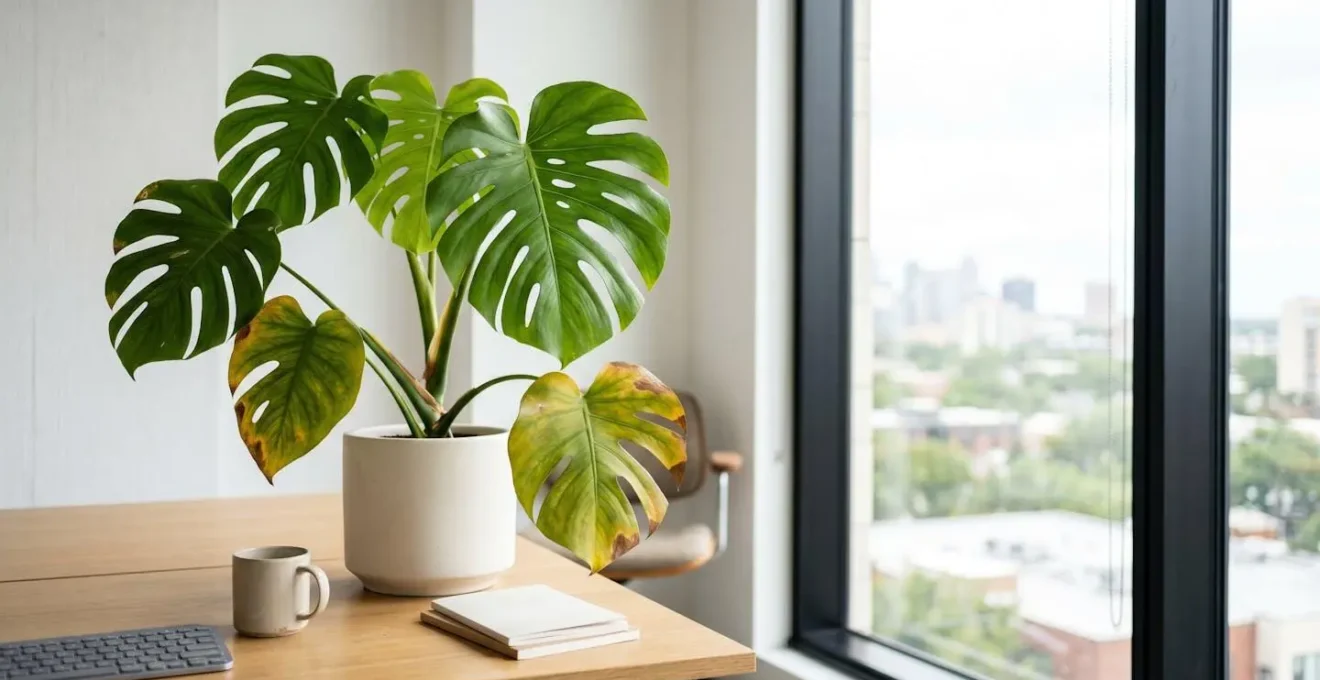
If your once-thriving Monstera is now yellowing in your office, the cause is almost certainly chronic light starvation, not just a simple care mistake. Typical UK office lighting is insufficient for tropical plants to photosynthesise effectively. The only sustainable solution is to diagnose the ‘environmental deficit’ with a light meter and implement a strategic rotation system that moves plants between your desk and a dedicated high-light ‘rehabilitation’ area.
You brought it into the office with pride: a vibrant, glossy-leaved Monstera, the perfect touch of green to brighten your workspace. For the first two months, it was a model of health. Now, three months in, the lower leaves are developing a sad, tell-tale yellow hue before turning brown and dropping off. You’ve followed the standard advice religiously—checking the soil for overwatering, looking for pests—but the decline continues. This frustrating experience is incredibly common and leaves many feeling like they simply lack a “green thumb.”
The internet is full of well-meaning but often incomplete advice that treats the symptoms rather than the root cause. You’ll be told to check for root rot or to apply a fungicide, but these are often secondary issues that arise once the plant is already weakened. The primary problem is far more fundamental and specific to the environment of a modern, often north-facing, UK office.
But what if the real issue isn’t what you’re *doing* to the plant, but the environment you’re asking it to *survive in*? The truth is, your Monstera isn’t just “unhappy”; it’s suffering from a chronic environmental deficit, specifically a lack of usable light energy. This article will shift the focus from blaming the caretaker to diagnosing the environment. We will provide a diagnostic framework and a sustainable system to not only save your current plant but to successfully manage a thriving collection of greenery in any office setting.
This guide will walk you through the precise science of plant light requirements, introduce a practical rotation system to prevent burnout, and even provide the data you need to justify a larger plant and flower budget to management. Let’s delve into the solutions that work.
Summary: A Systemic Approach to Office Plant Health
- Why North-Facing Offices Kill Monsteras: The 1,000 Lux Minimum Rule
- How to Rotate 4 Plants Monthly to Keep Your Office Green Without Losing Any?
- Monstera Deliciosa or Monstera Adansonii: Which Fits a Compact Office Desk?
- The Thrip Outbreak That Spread Through 12 Office Plants in 2 Weeks
- Why New Monsteras Drop Leaves for 6 Weeks: The Acclimatisation Window
- Why Do 70% of Houseplants Die Within 6 Months in UK Homes?
- Which Flowers Survive a Week in Air-Conditioned Offices Without Daily Care?
- How to Justify a £200/Month Office Flower Budget to Your Finance Director?
Why North-Facing Offices Kill Monsteras: The 1,000 Lux Minimum Rule
The single greatest factor leading to a Monstera’s decline in an office is light starvation. While we perceive office lighting as bright, it is often a fraction of what a tropical plant needs to maintain its foliage. Photosynthesis is a plant’s way of creating energy; insufficient light means the plant is in an energy deficit, slowly consuming itself to stay alive. It starts by sacrificing its oldest, least efficient leaves—the lower ones—which is why you see that bottom-up yellowing.
The key metric here is ‘lux’, a measure of light intensity. A Monstera deliciosa requires a minimum of 1,000 lux for several hours a day just to maintain its current state. For new growth and robust health, it needs closer to 2,000-5,000 lux. However, plants in typical office lighting of 300–500 lux will slowly decline, developing leggy growth and weakened immunity. A north-facing office in the UK can easily fall into this category, creating an environment where the plant is on a slow path to failure from day one.
Without measuring, you’re just guessing. To move from guessing to diagnosing, you must quantify the light your plant is actually receiving. This data is the foundation of a successful office plant strategy. The following checklist provides a simple, no-cost way to get an accurate reading and take corrective action.
Action Plan: Measure Your Office Light Levels
- Download a free smartphone lux meter app to measure light intensity at your desk.
- Take measurements at the plant’s leaf level, not the desk surface, during typical work hours to get an accurate reading.
- For north-facing offices measuring under 1,000 lux, you must supplement. Position a full-spectrum LED grow light 12-18 inches above the foliage.
- Run the grow light for at least 6-8 hours daily to compensate for the low ambient light and push the plant into a healthy growth zone.
- Re-measure after adding the grow light to verify you’ve reached a threshold of at least 1,500 lux for healthy Monstera maintenance and growth.
By understanding and managing this light threshold, you are treating the root cause of the problem, not just the symptoms of yellowing leaves.
How to Rotate 4 Plants Monthly to Keep Your Office Green Without Losing Any?
Since most office desks cannot provide the necessary light levels for long-term health, the solution is not to find a “miracle” low-light plant, but to create a sustainable rotation system. This strategy treats your office plants like a team, where some are “on-duty” at your desk while others are recovering in a “rehabilitation zone.” This prevents any single plant from becoming depleted to the point of no return. A four-plant system is ideal for monthly rotation, ensuring each plant only spends one month in a low-light area before getting three months to recover.
The system requires two locations. Location 1: The Display Area is your desk or the main office space, which has low to moderate light. Location 2: The Staging Area is an unused office, a bright storeroom, or even a dedicated corner equipped with a strong LED grow light. This is your plant ICU, where plants recharge their energy reserves. Each month, you simply swap the plant from your desk with one from the staging area.
As the illustration above shows, this staging area doesn’t need to be glamorous. A simple shelving unit and a well-positioned grow light are all it takes to create a life-sustaining environment. In this rehabilitation cycle, plants get the intense light they need to produce new leaves and store energy. When their turn comes to be on display, they are full, healthy, and resilient enough to handle a month in lower light. This approach transforms plant care from a constant battle against decline into a manageable, predictable process.
This systematic approach is the secret professional plant services use to keep offices looking perpetually green, and it is easily replicated on a smaller scale.
Monstera Deliciosa or Monstera Adansonii: Which Fits a Compact Office Desk?
When selecting a Monstera for an office, especially a compact one, it’s crucial to understand that not all Monsteras are created equal. The two most popular varieties, Monstera Deliciosa (the large, classic “Swiss Cheese Plant”) and Monstera Adansonii (with smaller, more perforated leaves), have vastly different growth habits and resilience levels that directly impact their suitability for a desk environment.
The Deliciosa is robust and its tougher leaves make it more resistant to common office pests like thrips. However, it has a wide, horizontal growth habit and needs significant airspace. An Adansonii, by contrast, has a much smaller footprint and can be trained to grow vertically up a small pole, making it ideal for a crowded desk. The trade-off is its fragility; its delicate leaves are more susceptible to pests and it shows stress (yellowing) much more quickly and dramatically than its tougher cousin. Choosing the right plant for your space and commitment level is key to success.
This comparative table breaks down the key factors to consider when deciding between these two popular office plants.
| Factor | Monstera Deliciosa | Monstera Adansonii |
|---|---|---|
| Minimum Light Tolerance | 75-100 foot-candles (800-1,000 lux) | 75-100 foot-candles (800-1,000 lux) |
| Pest Resilience | Lower risk – tougher leaves, more resistant to thrips and spider mites | Higher risk – more susceptible to infestations, less forgiving |
| Growth Habit | Upright with horizontal spread; requires clear airspace around leaves | Vining; can tangle in wires, requires vertical support (pole/trellis) |
| Footprint on Desk | Larger horizontal spread (2-3 feet); needs substantial desk space | Compact footprint with vertical growth if trained on pole |
| Aesthetic When Stressed | Maintains structural presence; drops single lower leaves gradually | Quickly develops multiple yellow leaves; appears sparse and sick |
| Initial Cost | £50-£100 (larger specimens) | £20-£40 (smaller, more affordable) |
| Long-term Replacement Cost | Lower – greater durability in office conditions | Higher – more frequent replacements due to fragility |
| Best for | Spacious desks, corner placements, lower-maintenance offices | Compact desks with vertical space, employees committed to daily monitoring |
Ultimately, for a low-maintenance, “set and rotate” system, the more durable Monstera Deliciosa is often the superior long-term investment, despite its larger size.
The Thrip Outbreak That Spread Through 12 Office Plants in 2 Weeks
A plant weakened by light starvation is an open invitation for pests. Its natural defences are down, making it highly susceptible to infestations that can quickly spread through an entire office. Among the most common and destructive office pests are thrips: tiny, winged insects that feed on plant sap, causing silvery stippling on leaves, distorted new growth, and eventual leaf drop. They are notoriously difficult to eradicate once established.
The danger of thrips in an office environment is the speed at which they multiply. According to horticultural research, visible signs of a thrips infestation often appear within about two weeks of the initial outbreak, by which time they have likely spread to neighbouring plants. This makes early detection and a rapid, coordinated response absolutely critical. A single infested new plant can trigger a crisis that costs hundreds of pounds in replacements and staff time.
Having an emergency protocol is not an overreaction; it’s a necessity. If you spot signs of pests, you must act immediately to contain the threat. The following steps form a clear and effective response plan:
- Isolate: Immediately remove the affected plant from all other healthy plants. Take it to a separate room or, if necessary, place it in a sealed clear bag.
- Identify: Use a magnifying glass or your phone’s camera to look for tiny, 1-2mm long insects on the undersides of leaves and check for the tell-tale black specks of their excrement.
- Communicate: Alert colleagues not to move or touch any plants. Cross-contamination by well-meaning coworkers is a primary vector for spread.
- Treat: In a shared office, avoid messy sprays. Use systemic insecticide granules added to the soil or take the plant outside to treat with a pre-mixed insecticidal soap.
- Monitor: Place yellow sticky traps near all office plants. These traps catch adult thrips and serve as an early-warning system for future issues. Inspect them weekly for at least a month.
Case Study: The Power of Quarantine
Prevention is always the best cure. Pest control experts universally recommend a mandatory quarantine period for any new plant entering an office. One firm implemented a simple protocol: all new plants were placed in a manager’s unused office for two weeks. During this time, they were inspected twice for pests and monitored with a yellow sticky trap. This protocol prevented three separate thrips outbreaks in one year, saving an estimated £800 in plant replacement costs and countless hours of staff dealing with the infestation.
By quarantining all new arrivals and acting swiftly at the first sign of trouble, you can protect your entire office collection from a devastating chain reaction.
Why New Monsteras Drop Leaves for 6 Weeks: The Acclimatisation Window
Sometimes, a new Monstera will start dropping leaves almost immediately, even if the light is adequate and there are no pests. This can be alarming, but it is often a normal and temporary part of a process called acclimatisation. The plant you bought was likely grown in a perfect, high-humidity, optimal-light greenhouse. Your office is, by comparison, a harsh and alien environment. The shock of this transition forces the plant to adapt.
This period of adjustment, or the “acclimatisation window,” typically lasts from four to six weeks. During this time, the plant may shed a few of its older, lower leaves. It is redirecting its energy from maintaining existing foliage to growing a new root system and leaves better adapted to the lower light and drier air of its new home. Panicking and making drastic changes—like repotting or over-fertilising—during this window will only add more stress and can be fatal.
The best course of action is patience and consistency. Provide the best possible light, water only when the top two inches of soil are dry, and wait. The key sign that acclimatisation has been successful is the emergence of new growth. A new, tightly furled leaf is the plant’s signal that it has stabilised and is beginning to thrive in its new environment.
Seeing that first new leaf unfurl is a rewarding moment, confirming that your patience has paid off and your plant has successfully made the office its new home.
Why Do 70% of Houseplants Die Within 6 Months in UK Homes?
The challenges faced by your office Monstera are not unique; they reflect a broader problem across the UK. The often-quoted statistic that a majority of houseplants die within the first year is not due to a nation of bad plant owners. It is a direct result of our specific climate and housing stock. The UK’s northern latitude means weaker sunlight, especially during the long, grey months from October to March.
The science behind this is measured in Daily Light Integral (DLI), which is the total amount of photosynthetically active light a plant receives over a 24-hour period. According to horticultural research, most common houseplants thrive with a DLI between 3 and 12 mol/m²/day. However, a plant sitting near a north-facing window in a UK home during winter may receive a DLI of less than 1. This is a starvation level of light, forcing the plant into a state of dormancy and decline from which it may not recover.
This “environmental deficit” is the silent killer. We purchase lush, vibrant plants in spring or summer when light levels are high, and they do well. But as autumn approaches and the light fades, the plant’s energy reserves are slowly depleted. The owner, unaware of the invisible light crisis, often misdiagnoses the resulting symptoms (yellowing leaves, lack of growth) as a watering issue. This frequently leads to overwatering a semi-dormant plant, which quickly causes root rot and seals its fate. This cycle explains the high mortality rate and the frustration felt by so many aspiring plant enthusiasts.
By acknowledging the light deficit and supplementing with grow lights or choosing genuinely low-light tolerant species, UK plant owners can dramatically increase their success rate.
Which Flowers Survive a Week in Air-Conditioned Offices Without Daily Care?
While live plants offer long-term biophilic benefits, fresh-cut flowers provide an immediate and vibrant boost to office morale. However, the typical office environment—with its dry, air-conditioned air and fluctuating temperatures—can cause many bouquets to wilt in just a few days. The key to longevity is choosing flowers that are inherently resilient to these specific stressors.
The primary enemy of cut flowers in an office is dehydration and ethylene gas (a natural ripening hormone). Air conditioning drastically lowers humidity, causing flowers to lose water from their petals faster than they can draw it up their stems. Your best defence is to select varieties with tougher, waxier petals or complex flower structures that are less prone to rapid water loss. Steer clear of delicate, thirsty flowers like hydrangeas or tulips, which will struggle without daily attention.
For a week-long display with minimal fuss, consider these robust options:
- Chrysanthemums: The undisputed champions of longevity. Their dense, multi-petaled heads are extremely durable and can last for two weeks or more.
- Carnations: Often underrated, carnations are incredibly tough and come in a vast array of colours. They are also less sensitive to ethylene than many other flowers.
- Alstroemeria (Peruvian Lily): Each stem holds multiple blooms that open sequentially, extending the life of the arrangement. They are very hardy once hydrated.
- Orchids (Cymbidium or Dendrobium stems): Cut orchid stems are exceptionally long-lasting, with waxy petals that resist wilting in dry air. A few stems can provide an elegant look for over a week.
- Anthuriums: Their glossy, heart-shaped “flower” is actually a modified leaf (a spathe) that is extremely durable and holds up exceptionally well in office conditions.
By opting for these hardy varieties, you can ensure the flower budget delivers consistent aesthetic value rather than a display that looks sad by Wednesday.
Key Takeaways
- Most office plant decline is due to ‘light starvation’ (under 1,000 lux), a problem that cannot be fixed by altering your watering schedule alone.
- A strategic rotation system, with a high-light ‘rehabilitation’ area, is the most effective method for maintaining healthy plants in a low-light office long-term.
- Justifying a plant and flower budget with data on productivity (a potential 15% increase) and well-being transforms the cost from a simple expense into a strategic investment in human capital.
How to Justify a £200/Month Office Flower Budget to Your Finance Director?
Presenting a £2,400 annual budget for “office decorations” can be a tough sell to a finance director focused on the bottom line. The key to getting approval is to reframe the conversation from an expense to an investment. You are not buying flowers; you are investing in a healthier, more productive, and more creative work environment. This argument is not based on feeling, but on robust, quantifiable data from scientific studies.
The concept of Biophilic Design—incorporating natural elements into the built environment—has been proven to have a direct impact on employee performance. For instance, a landmark study by the University of Exeter found that employees were 15% more productive when their previously lean workplaces were filled with houseplants. Similarly, a global study on the impact of biophilic design reported a 15% increase in well-being, a 6% rise in productivity, and a 15% boost in creativity in workspaces that incorporated natural features.
When you translate these percentages into financial terms, the return on investment (ROI) becomes clear. For a small team of 10 employees with an average salary of £40,000, the total annual salary cost is £400,000. A conservative 1% productivity gain—far less than the 6-15% shown in studies—already yields £4,000 in annual value. This alone provides a significant return on a £2,400 flower and plant budget. The following table puts the various investment options into stark financial perspective.
| Investment Option | Annual Cost (10-person office) | Productivity Gain Potential | Long-term ROI | Maintenance Burden |
|---|---|---|---|---|
| Weekly Cut Flowers | £2,400 (£200/month) | Minimal (aesthetic only) | Negative – disposable expense | Low – weekly replacement only |
| Professional Plant Rental Service | £1,800-£3,000 | Moderate (consistent biophilic presence) | Neutral – service cost offsets management | Very Low – fully managed by vendor |
| DIY Rotation Scheme (as outlined) | £400-£800 (initial investment + LED lights) | High (15% productivity boost) | 166% ROI (£4,000 value from 1% gain on £400k salary total) | Medium – requires designated plant manager |
| Permanent Low-Light Plants Only | £300-£500 (one-time) | Moderate (gradual decline in appearance) | Positive – low replacement cost | Medium – higher failure rate without rotation |
| Note: ROI calculations based on Exeter University findings that office plants increase productivity by 15%. Even a conservative 1% productivity gain for a 10-person team averaging £40,000 salary yields £4,000 annual value. | ||||
By presenting this business case, you demonstrate strategic thinking, transforming a simple request for flowers into a well-researched proposal for boosting team performance and well-being.