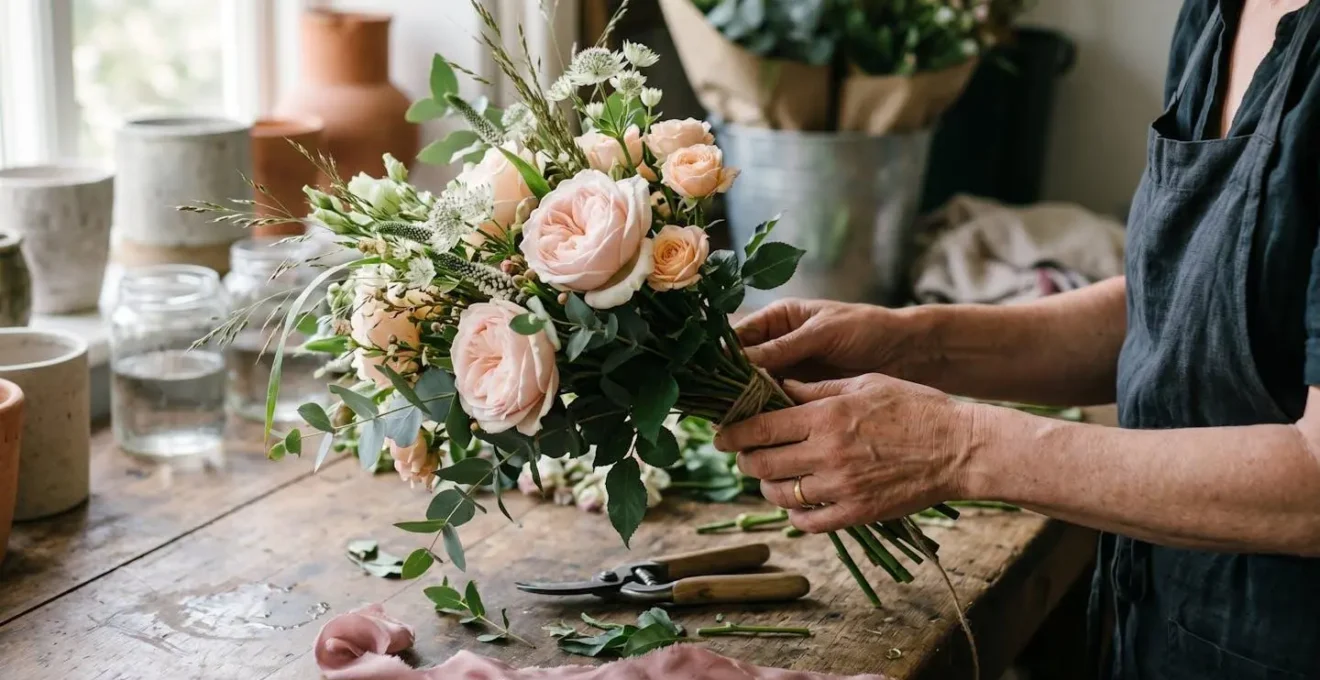
The £60 difference between a florist’s bouquet and a supermarket’s isn’t just profit; it’s the price of two fundamentally different products, supply chains, and service guarantees.
- Artisan florists buy flowers at the start of their life and use expert conditioning to guarantee peak freshness and longevity in your home.
- Supermarkets buy flowers nearing the end of their life, prioritising rapid logistics over quality, shifting the risk of poor performance to you.
Recommendation: For a gesture that truly counts—a significant gift, a wedding, or a corporate event—you are paying a florist for artistry, guaranteed quality, and peace of mind that a supermarket simply cannot offer.
It’s a question I hear often in my shop, usually whispered with a mix of genuine curiosity and sticker shock: why is there such a vast price chasm between a supermarket bunch of flowers and a hand-tied bouquet from an artisan florist? You see a vibrant bouquet for £85 and can’t help but compare it to the £25 offering you walked past in the grocery aisle. The common answers you’ll hear – “better quality,” “you pay for artistry,” “overheads” – are all true, but they are dissatisfyingly vague. They fail to capture the fundamental difference in the journey those flowers have taken to reach your vase.
The truth is, a supermarket and an artisan florist are not selling the same product. One is selling a perishable commodity, optimised for rapid, low-cost logistics. The other is providing a bespoke service that includes sourcing, expert conditioning, and artistic composition. To truly understand the £60 difference, we need to look past the petals and follow the stem. We must deconstruct the hidden costs, the invisible labour, and the complex cold chain management that separates a flower destined for a quick sale from one curated to create a lasting impression. This isn’t just about flowers; it’s about understanding the value of provenance, expertise, and a guaranteed emotional impact.
In this article, we will demystify the economics of the floral industry. We will explore the global forces that dictate a bloom’s price, break down the value you receive at different budget points, and provide the tools to communicate your vision effectively, whether for a wedding or a major corporate event. Let’s unravel what you’re really paying for.
Contents: The True Cost of Beauty
- Why Do British Florists Charge More for Peonies in January Than in June?
- How to Describe Your Vision to a Florist Without Sounding Vague or Demanding?
- Independent Florist or Online Box: Which Delivers Better Value for a £50 Budget?
- The Contract Clause That Costs Couples £500 When Their Florist Substitutes Blooms
- When to Order Flowers for a Saturday Wedding to Guarantee Peak Freshness?
- Where to Find British Flower Farms That Deliver Directly to Consumers?
- Why Does the Same Centrepiece Cost £150 for a Wedding but £450 for a Corporate Event?
- How to Brief Your Florist for a 200-Guest Corporate Gala Without Overspending?
Why Do British Florists Charge More for Peonies in January Than in June?
The simple answer is seasonality and the global supply chain, but the reality is a complex dance of logistics, demand, and atmospheric conditions. In June, peonies are in their natural British growing season. They are abundant, travel fewer miles, and their cost reflects this local availability. However, a client’s desire for a fluffy pink peony in January requires a florist to become a global sourcing agent. That peony is likely grown in a warmer climate, perhaps in South America or Africa, and then flown to the Netherlands. There, it joins a river of flowers flowing through the Dutch auctions.
A prime example is the Royal FloraHolland auction in Aalsmeer, the world’s largest flower marketplace. This is where a significant portion of the world’s cut flowers are traded daily. The sheer scale is staggering; it’s a city of flowers where prices fluctuate based on real-time supply and demand. Your January peony is competing for cargo space and auction bids against millions of other stems. This global journey requires a sophisticated cold chain—a continuous, temperature-controlled environment from farm to florist—to prevent the blooms from aging prematurely. The fuel, labour, and technology required to maintain this chain for a single peony from another hemisphere add significant cost before it even lands in a UK wholesaler.
Furthermore, demand surges around key dates create price spikes. At hubs like Aalsmeer, where daily sales of 43 million flowers can increase by 15% for Valentine’s or Mother’s Day, florists must bid competitively to secure top-grade stock. Therefore, the higher price in winter isn’t arbitrary; it represents the cost of defying nature, the complexity of global logistics, and the market forces of supply and demand.
How to Describe Your Vision to a Florist Without Sounding Vague or Demanding?
The most successful floral designs are born from collaboration, not a simple transaction. When you walk into an artisan florist’s studio, you’re not just a customer; you’re a client commissioning a piece of living art. The key to a brilliant result is translating your abstract feelings into a concrete, actionable brief. Vague requests like “something pretty” or “natural and wild” can be interpreted in countless ways. A demanding list of specific, out-of-season flowers, conversely, can stifle creativity and inflate costs.
The solution is to brief your florist on the feeling and atmosphere you want to create, not just the ingredients. A professional florist can then use their expertise to select the best possible blooms that fit your vision, season, and budget. Instead of showing a Pinterest picture and saying “I want this exactly,” use it as a starting point to discuss what you like about it. Is it the colour palette? The loose, airy shape? The specific texture of a particular foliage?
A powerful technique is to use non-floral inspiration. Share images of a favourite painting, a fabric swatch from a dress, or a photograph of a landscape that evokes the mood you’re after. This gives your florist creative freedom while ensuring the final design is deeply personal and aligned with your aesthetic. Remember to also state what you *don’t* like. Knowing you dislike the scent of lilies or prefer to avoid carnations is just as valuable. This process transforms the interaction from a simple order to a creative dialogue, ensuring the final bouquet isn’t just beautiful, but meaningfully yours.
Independent Florist or Online Box: Which Delivers Better Value for a £50 Budget?
At the £50 price point, the difference between an artisan florist and a letterbox flower service becomes a clear case of tangible versus intangible value. An online box service competes on quantity and the DIY experience. For your £50, you’ll receive a cardboard box packed with a high number of stems, often 15-20. The “value” is presented as a cost-per-stem metric. However, this model shifts all the labour and risk to you. You are responsible for unboxing, trimming, and hydrating the flowers (a process professionals call conditioning), and then arranging them yourself. The flowers have likely endured a stressful 24 hours in transit without water, which can significantly impact their vase life.
Conversely, an artisan florist offers a different kind of value. For the same £50, you will likely receive fewer stems (10-15), but what you are paying for is expertise, convenience, and a guaranteed aesthetic outcome. That price is calculated with a transparent industry model; standard florist pricing formulas often use a 3.5x markup on the wholesale cost of flowers, plus charges for hard goods and a percentage for labour. This covers the florist’s time spent sourcing from the market, expert conditioning to maximise vase life, and the skill involved in creating a balanced, beautiful composition. The bouquet is delivered ready-to-display, often in water, providing an immediate “wow” factor for the recipient with zero effort required on their part.
The following table breaks down this value exchange, showing that “value” isn’t just about the number of stems, but the overall experience and quality of the final product.
| Value Factor | Online Flower Box (£50) | Artisan Florist Bouquet (£50) |
|---|---|---|
| Stems per £ | High (15-20 stems) | Moderate (10-15 stems) |
| DIY Experience | Yes (45 min processing time) | No (ready-to-display) |
| Artistic Composition | Self-arranged (variable skill) | Professional design |
| Peak Freshness Guarantee | Moderate (transit stress) | High (conditioned by pro) |
| Emotional Impact on Delivery | Low (cardboard box) | High (hand-delivered, in water) |
| Recipient Effort Required | High (must arrange) | Zero (display immediately) |
| Vase Life Expectancy | 5-7 days (variable care) | 7-10 days (expert conditioning) |
The Contract Clause That Costs Couples £500 When Their Florist Substitutes Blooms
In the world of wedding planning, the floral contract is one of the most important documents, and the most misunderstood section is often the “substitution clause.” Many couples see it as a potential loophole for the florist to cut corners, but its true purpose is to protect the integrity of the design—and the budget—when faced with the volatile nature of the fresh flower market. The clause is not a license to swap premium roses for cheap carnations; it’s a vital tool for navigating last-minute supply chain disruptions.
Imagine you have your heart set on a specific variety of café-au-lait dahlia for your September wedding. Two weeks before the event, an unexpected frost in the growing region wipes out the crop. Without a substitution clause, your florist has two choices: either disappoint you with a major gap in your bridal bouquet, or attempt to source the same dahlia from an international market at a massively inflated price, a cost that would then be passed on to you. A well-written contract allows the florist to use their professional judgment to substitute with a bloom of equivalent or greater value, style, and colour palette, ensuring the aesthetic is preserved without incurring unexpected costs. This is risk management.
This professional judgment is crucial. As research from floral software provider Curate highlights, market availability is in constant flux. They explain the dilemma florists face:
Wholesale flower availability changes constantly. When a variety becomes unavailable two weeks before the wedding, you either source it at a premium from a different supplier or substitute with a comparable bloom — which may cost more than the original.
– Curate (Event Florist Pricing Research), Wedding Florist Pricing: The Math Behind Profitable Proposals
The potential £500 “cost” isn’t a penalty; it’s the hypothetical premium the couple might have to pay if the florist were forced to hunt down a rare bloom on the spot market. The substitution clause prevents this by empowering the expert you hired to make the best possible creative decision within the agreed budget.
When to Order Flowers for a Saturday Wedding to Guarantee Peak Freshness?
A common misconception is that wedding flowers are arranged the morning of the event. In reality, the work to ensure your bouquet is at its absolute peak for your walk down the aisle begins almost a week earlier. The timeline is a meticulously planned logistical operation designed to coax each bloom into opening perfectly on cue. This “hidden” labour is a significant part of what you are paying for when you hire a professional wedding florist.
The process doesn’t start with arranging, but with conditioning. This is where the florist’s expertise truly shines. Flowers arrive from the wholesaler tightly budded, thirsty, and dormant—”sleeping,” as we say in the trade. The florist’s job is to wake them up. Each variety requires a different treatment: roses need their guard petals removed and stems cut underwater, hydrangeas might need a special hydration treatment, and woody stems need to be split to drink more effectively. They are then left to rest in a cool, dark place with professional-grade flower food for at least 24 hours. This process ensures they are fully hydrated and will last through a long wedding day and beyond.
Arrangement creation itself is staggered throughout the week based on how different flowers behave. Hardy foliage and robust flowers like roses can be incorporated into designs on Thursday, while incredibly delicate blooms like sweet peas or ranunculus are often added on Friday evening, just hours before delivery. This careful timing ensures every single element of your arrangement is at its “peak of life” for the main event.
A typical wedding week workflow looks something like this:
- Monday: Florist sends final order confirmations to wholesalers and Dutch auction buyers, locking in varieties and quantities.
- Tuesday-Wednesday: Flower market/wholesaler deliveries arrive. Most UK-based Dutch wholesalers have order deadlines on Monday or Tuesday for weekend events.
- Wednesday-Thursday: Conditioning phase begins — stripping leaves, fresh cuts, hydrating stems in specialized flower food, cold storage management.
- Thursday-Friday: Arrangement creation. Delicate blooms worked closer to event day; hardy foliage and roses can be processed earlier.
- Friday evening: Final quality checks, packing arrangements for transport in water-filled vessels.
- Saturday: Early morning delivery and on-site setup, including any installations or ceremony styling.
Where to Find British Flower Farms That Deliver Directly to Consumers?
For consumers passionate about sustainability, seasonality, and supporting the local economy, buying directly from British flower farms is an increasingly popular and rewarding choice. The past decade has seen a remarkable resurgence in the UK’s cut flower industry. Spurred by a desire for flowers with lower air miles, stronger scent, and a more natural, “garden-gathered” aesthetic, local production is booming. Indeed, UK flower production surged to £179 million in 2023, a significant increase that signals a strong consumer shift towards local provenance.
While your local artisan florist is an excellent source for British-grown flowers, the most direct route is through networks that connect growers with the public. The leading organisation in this space is Flowers from the Farm, a non-profit association that has become the backbone of the UK’s artisan flower movement. By providing a central directory and a stamp of quality, they have made it easier than ever for consumers to find and buy from local growers.
Case Study: Flowers from the Farm – The UK’s Artisan Grower Network
Founded in 2011, Flowers from the Farm is a UK-wide non-profit trade association with over 1,000 members, stretching from Cornwall to the Isle of Skye. The network connects consumers with local, seasonal growers via an online directory searchable by postcode. Members are typically small-scale, artisan producers who select flower varieties for their charm and suitability to the local climate, rather than their ability to withstand long-haul transport. The association’s directory is the most reliable resource for sourcing authentic British-grown flowers, categorising farms by the services they offer, including DIY buckets for weddings, letterbox subscriptions, and farm gate sales for local collection.
Buying from these farms offers a unique experience. You are purchasing flowers that were likely in the field just a day or two before they reach your kitchen table, resulting in unparalleled freshness. You also gain access to unique and fragile varieties—like fragrant sweet peas, delicate cosmos, and heirloom narcissi—that are simply not robust enough to survive the long, complex supply chain of imported flowers.
Why Does the Same Centrepiece Cost £150 for a Wedding but £450 for a Corporate Event?
The pricing disparity between wedding and corporate florals is a frequent source of confusion and can feel unfair on the surface. Why would a centrepiece of similar size and flower content cost three times more for a corporate gala? The answer lies not in the flowers themselves, but in the entirely different service models, risk profiles, and logistical demands of each type of event. A wedding is a high-touch, deeply personal service, while a corporate event is a business-to-business transaction focused on brand impact and scale.
The planning process for a wedding is intensive and emotional, often involving months of consultations, multiple mood board revisions, and sometimes even a sample arrangement. This high level of client service is factored into the overall cost. Corporate work, by contrast, is usually more streamlined. The brief comes from a professional event manager, is tied to specific brand objectives, and requires less emotional hand-holding.
Wedding floristry involves high-touch, emotional, and extensive consultation (multiple meetings, mood boards, sample arrangements). Corporate work is often a more streamlined brief from an event manager.
– Industry Analysis, Florist Pricing Worksheet — Price With Confidence
More significantly, corporate events demand a different level of logistical precision and impact. A £450 centrepiece isn’t just larger; it’s designed to make a statement in a vast ballroom, often requiring a taller structure, more robust mechanics, and a greater density of flowers to have visual presence from across the room. Furthermore, corporate clients often require evening or weekend setups, specific liability insurance, and adherence to strict venue regulations, all of which add to the operational cost and risk for the florist. The pricing reflects the need for a seamless, professional execution where there is zero margin for error.
Key Takeaways
- Price Reflects Process: The cost difference is due to sourcing, expert conditioning, design labour, and service, not just flower quality.
- Two Different Products: A supermarket sells a DIY commodity; a florist provides a finished, guaranteed, and artfully designed product.
- Value is Contextual: The “best” choice depends on the occasion. A quick-fading supermarket bunch may be fine for your kitchen table, but a florist’s expertise is invaluable for significant events.
How to Brief Your Florist for a 200-Guest Corporate Gala Without Overspending?
Briefing for a large-scale corporate event requires a strategic mindset. While the budget may be larger than for a private party, the need for a strong return on investment is paramount. The goal is to create maximum visual impact and brand resonance without wasting resources on areas no one will notice. An experienced corporate florist can be your greatest ally in achieving this, but they need a clear, strategic brief from you. Simply stating brand colours isn’t enough; you need to communicate brand values and guest experience priorities.
The most effective approach is to think in terms of “high-impact” and “low-impact” zones. Where will the cameras be? Where will guests congregate? The entrance, stage, bar, and any designated photo areas are your high-impact zones. Allocate the majority of your budget here to create one or two spectacular, photogenic installations. A single, show-stopping floral arch at the entrance will generate more buzz and social media shares than 20 small, forgettable table centres. Conversely, be ruthless about cutting florals from low-impact zones like restrooms or corridors. It’s about strategic allocation, not uniform distribution.
Translate your brand’s story into a floral concept. If your brand is about innovation, ask for architectural, modern flowers like anthuriums or proteas. If it’s about luxury and tradition, request classic, premium blooms like garden roses. A great florist can turn abstract brand values into a tangible, sensory experience. Finally, build value beyond the event itself by planning for repurposing. A clause in your brief arranging for the flowers to be donated to a charity like Floral Angels or a local hospice adds a powerful CSR component to your investment.
Your Action Plan: The High-Impact Corporate Floral Brief
- Identify High-Impact Zones: Map out the event space and allocate 60-70% of your floral budget to the entrance, stage, bar area, and key photo moments where guests and cameras will focus.
- Minimize Low-Impact Zones: Scrutinize the plan. Use minimal greenery or no florals at all in restrooms, back hallways, and cloakrooms to preserve budget for areas that matter.
- Consolidate for Impact: Commission one spectacular installation (e.g., a floral arch, suspended design) instead of numerous modest arrangements for greater visual memory and social media value.
- Brief on Brand Story: Go beyond colours. Translate brand values into floral concepts (e.g., ‘sustainability’ = local, foam-free designs; ‘innovation’ = architectural shapes).
- Include a Repurposing Plan: Add a clause for post-event donation to a charity (like Floral Angels) or for staff to take arrangements, maximizing your investment’s value and goodwill.
Armed with this insight into the floral world, you can now approach your next flower purchase not just as a consumer, but as an informed client. You understand the value of a well-managed cold chain, the hidden labour of conditioning, and the artistry you are commissioning. Your next step is to choose the service that best aligns with your specific needs, confident in the knowledge of what your money is truly buying.