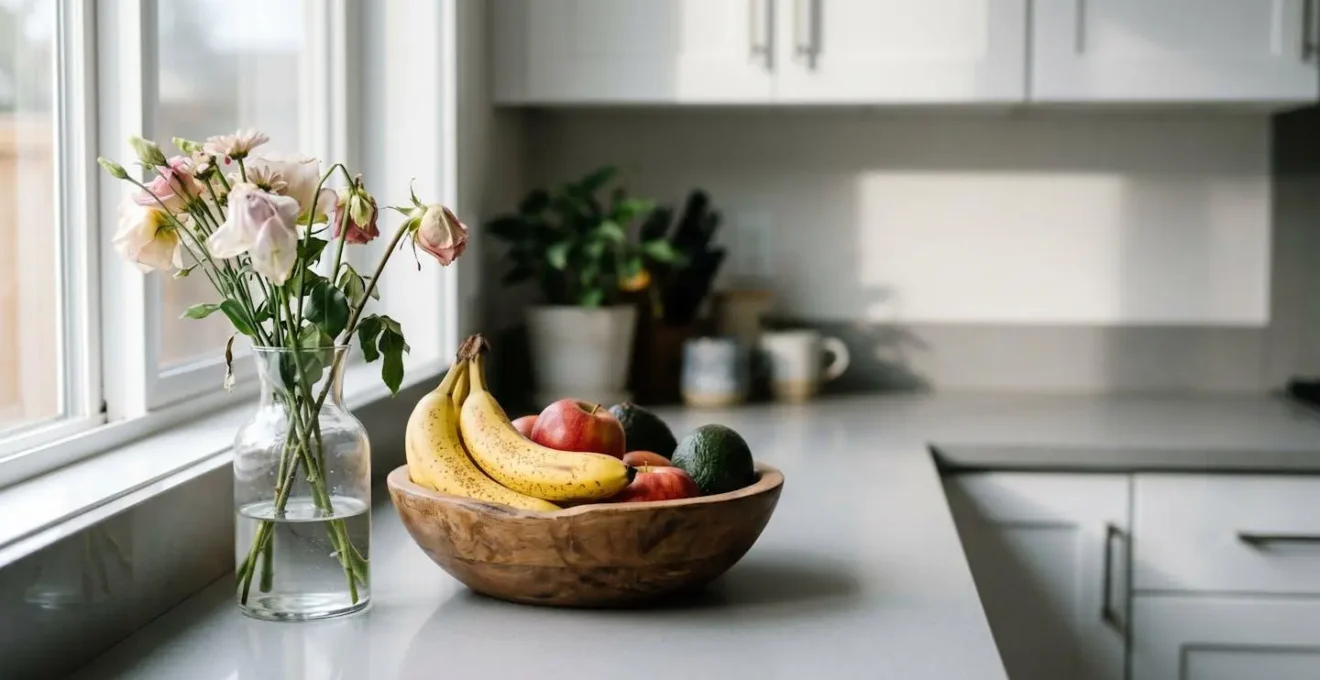
The tragic wilting of your flowers is not simple decay; it’s a hijacking. Ethylene gas from fruit is a potent plant hormone that triggers a self-destruct sequence in your bouquet.
- Ethylene sources are everywhere, not just the fruit bowl. Gas hobs, ripe tomatoes, and even other wilting plants emit this invisible signal.
- Flower sensitivity varies dramatically. A carnation has built-in resistance (often chemically enhanced), while a delphinium is genetically programmed to collapse upon exposure.
Recommendation: Move beyond simply separating fruit and flowers. Learn to identify the hidden sources, recognise the specific symptoms of ethylene damage, and choose your arrangements with biochemical wisdom to truly master their longevity.
It’s a familiar and frustrating scenario for any UK homeowner who loves fresh flowers. A beautiful, expensive bouquet, vibrant and full of promise, is placed in the kitchen. Within two days, it’s a shadow of its former self: petals are dropping, colours are fading, and stems are bowed in defeat. Meanwhile, an identical arrangement in the living room remains pristine. You’ve heard the common wisdom, of course—”keep flowers away from the fruit bowl”—but this advice feels incomplete. It doesn’t explain the sheer speed of the decline or why some flowers, like tulips, seem to collapse overnight while carnations soldier on.
The truth is far more fascinating and complex than a simple “gas leak.” The culprit, ethylene, is not a poison. It is a powerful, naturally occurring plant hormone, an invisible chemical messenger that orchestrates the entire life cycle of a plant, from sprouting to ripening and, ultimately, to senescence—the programmed process of aging and death. When your flowers encounter ethylene from an external source, they aren’t being poisoned; they are receiving a premature, hormonal command to die. Their internal biological clocks are hijacked, accelerating a process that should take weeks into a matter of days, or even hours.
This guide will move beyond the platitudes and delve into the biochemistry of this phenomenon. We will decode the language of ethylene, exploring its hidden sources, understanding the vast spectrum of sensitivity among different flower species, and revealing the commercial treatments that create the confusing longevity differences you see. By understanding the science, you can move from being a victim of circumstance to a strategic curator of your home’s floral beauty.
This article provides a complete overview of the subject, breaking down the science behind this invisible interaction. Below, the table of contents will guide you through each critical aspect, from identifying the sources of ethylene to diagnosing its specific damage and understanding why some flowers are simply more vulnerable than others.
Contents: The Complete Guide to Ethylene and Flower Longevity
- Fruit Bowls, Gas Hobs, and Ripe Tomatoes: The Hidden Ethylene Sources Killing Your Flowers?
- Why Carnations Resist Ethylene but Delphiniums Collapse: The Sensitivity Spectrum?
- Can You Buy the Anti-Ethylene Treatments Florists Use for Home Arrangements?
- How Far Away Should Fruit Be From Flowers: The 2-Metre Rule?
- The Yellowing Leaves and Petal Drop That Signal Ethylene Exposure?
- The Fruit Bowl Mistake That Wilts Your Tulips in 48 Hours
- Why Carnations Last 3 Weeks While Delphiniums Collapse in Days?
- Why Do Tulips Last 10 Days While Sweet Peas Fade in 4?
Fruit Bowls, Gas Hobs, and Ripe Tomatoes: The Hidden Ethylene Sources Killing Your Flowers?
The first step in managing ethylene is recognising that the fruit bowl is just the most obvious culprit in a network of household sources. Ethylene is a gas, and its effect is a function of concentration and exposure time. Even minuscule amounts can be damaging; research demonstrates that ethylene concentrations as low as 0.1-10 parts per million (ppm) can initiate the senescence process in sensitive flowers. This is an incredibly small amount, equivalent to one drop of water in a large swimming pool.
The most notorious producers are climacteric fruits, which undergo a dramatic increase in respiration and ethylene production as they ripen. This category includes apples, bananas, avocados, cantaloupes, and ripe tomatoes. A single ripe banana can emit enough ethylene to significantly shorten the vase life of a nearby bouquet in a poorly ventilated room. However, the list of sources extends far beyond fresh produce.
Incomplete combustion is another significant source of ethylene. This means that gas hobs, gas fireplaces, and even cigarette smoke release the hormone into your home’s atmosphere. A kitchen with a gas stove is a fundamentally more hostile environment for sensitive flowers than one with an electric or induction hob. Furthermore, be mindful of hidden sources like indoor compost caddies, where decomposing organic matter produces ethylene, or exhaust fumes from an attached garage seeping into the house. Finally, the process is self-perpetuating. A wilting flower or a piece of rotting fruit in a bouquet will start producing its own ethylene, triggering a chain reaction that dooms its neighbours. Identifying and isolating these sources is the foundational strategy for protecting your arrangements.
Why Carnations Resist Ethylene but Delphiniums Collapse: The Sensitivity Spectrum?
The dramatic difference in how flowers react to ethylene is not random; it’s a matter of genetics and cellular biology. Flowers possess specific protein structures on their cells called ethylene receptors. When an ethylene molecule docks with one of these receptors, it triggers a cascade of internal signals that leads to senescence. The key variables are the number of receptors a flower has and how its internal chemistry responds to the signal. This creates a vast “sensitivity spectrum.”
At one end of the spectrum are highly sensitive flowers like Delphiniums, Sweet Peas, and many orchids. These species are genetically programmed with a high density of ethylene receptors. Upon exposure, they experience a catastrophic failure. In Delphiniums, this manifests as “petal shatter,” where the cells holding the petals to the stem rapidly break down, causing the blooms to drop en masse, often while still looking fresh. It’s an all-or-nothing response.
This is a visual representation of the cellular breakdown that occurs. The delicate structure is unable to withstand the hormonal signal.
At the other end are flowers like carnations and chrysanthemums, which are naturally less sensitive. Their resilience is often enhanced by commercial breeding and post-harvest treatments. However, even within a single species, sensitivity can vary. For example, a 2024 study analysing 14 carnation varieties found a wide range of responses, with the ‘Master’ cultivar showing significant sensitivity while ‘Snow White’ was almost completely resistant. This demonstrates that ethylene sensitivity is a finely-tuned trait, not a simple on/off switch, explaining the often confusing and inconsistent longevity you observe at home.
Can You Buy the Anti-Ethylene Treatments Florists Use for Home Arrangements?
For decades, the floral industry has relied on chemical interventions to combat the effects of ethylene and extend the vase life of cut flowers. The historical gold standard was Silver Thiosulfate (STS). STS works by introducing silver ions that effectively block the ethylene receptor sites on the flower’s cells, rendering it “blind” to the ethylene hormone. While incredibly effective, STS is classified as a heavy metal pollutant and its use is now heavily restricted and unavailable to consumers due to its toxicity.
The modern, safer, and consumer-accessible alternative is a compound called 1-Methylcyclopropene, or 1-MCP. This is a gas that has a similar molecular shape to ethylene. It works by competitively binding to the same receptor sites on the flower. However, unlike ethylene, 1-MCP does not trigger the aging signal. It simply occupies the parking spot, preventing the ethylene molecule from docking and initiating senescence. The effect can be dramatic; studies demonstrate that 1-MCP-treated flowers can achieve up to four times longer vase life compared to their untreated counterparts when exposed to ethylene.
While large-scale commercial treatments are complex, consumer versions of 1-MCP are available. They typically come in the form of small sachets or “flowers” that you place in the water or near the arrangement. These products slowly release the 1-MCP gas, providing a protective shield for your bouquet. It’s important to distinguish these from standard “flower food,” which primarily provides sugars for energy and biocides to prevent bacterial growth in the water. An anti-ethylene sachet is a specific hormonal treatment, not a nutritional supplement.
Case Study: The Shift from Toxic STS to Consumer-Safe 1-MCP
Research on cut carnations exposed to ethylene showed that a 6-hour pretreatment with low concentrations of 1-MCP was as effective as the toxic commercial standard, Silver Thiosulfate (STS). This breakthrough paved the way for consumer-grade products like EthylBloc sachets, which use 1-150 nanoliters per liter of 1-MCP gas over 6-20 hours to provide the same protective benefit without the environmental and health risks of STS, making professional-grade ethylene protection available for home use.
How Far Away Should Fruit Be From Flowers: The 2-Metre Rule?
Knowing that ethylene is the culprit naturally leads to the question: how far is far enough? While a simple “2-metre rule” is often quoted, the reality is more nuanced and depends on three key factors: the emission rate of the source, the sensitivity of the flower, and the ventilation of the room.
Ethylene gas diffuses through the air, and its concentration decreases with distance from the source. In a small, enclosed space with poor air circulation, like a pantry or a small kitchen, the gas can accumulate to damaging levels. Conversely, in a large, airy living room with open windows or a fan, the gas is dispersed much more effectively. The danger is not just proximity but a combination of proximity and confinement. The power of this effect is well-documented; research shows that exposing ethylene-sensitive vegetables to producers causes a 50 percent reduction in their shelf life, a principle that applies directly to flowers.
Therefore, a rigid rule is less useful than a dynamic assessment of risk. A single apple (a high emitter) next to a bouquet of delphiniums (highly sensitive) in a sealed-up room is a recipe for disaster. That same apple in a large, well-ventilated hall might have a negligible effect. The key is to think in terms of airflow. To provide a more practical guideline, we can assess the safe distance based on the type of ethylene source and the quality of room ventilation.
The following table provides a practical matrix for determining a safe distance, moving beyond a one-size-fits-all rule to a more strategic placement based on your specific environment. It underscores the critical role of ventilation in mitigating risk.
| Ethylene Source | Poor Ventilation (closed room) | Average Ventilation (normal airflow) | Excellent Ventilation (fan/open window) |
|---|---|---|---|
| Low Emitters (citrus, berries, grapes) | 1.5 meters minimum | 1 meter minimum | 0.5 meters acceptable |
| Moderate Emitters (peaches, tomatoes) | 3+ meters recommended | 2 meters minimum | 1 meter minimum |
| High Emitters (apples, bananas, avocados, cantaloupes) | Separate room strongly advised | 3+ meters minimum | 2 meters minimum |
The Yellowing Leaves and Petal Drop That Signal Ethylene Exposure?
One of the most useful skills you can develop is the ability to diagnose ethylene damage, as its symptoms are distinct from other common problems like dehydration or disease. Being able to read these signals allows you to intervene early or, in a post-mortem, understand what went wrong to prevent it from happening again. The symptoms vary depending on the flower species, but some general patterns are clear indicators of a hormonal issue.
Unlike dehydration, which causes a general wilting or drooping of the entire flower and foliage, ethylene damage is often more specific and sequential. Key signs include:
- Premature Petal Drop (Shattering): As seen in delphiniums and snapdragons, the petals fall off while still looking turgid and colourful.
- Unopened Bud Drop (Abscission): On spray flowers like freesia or alstroemeria, the small, unopened buds will yellow and fall off before they have a chance to bloom.
- “Sleepiness” in Carnations and Roses: The petals curl inwards, and the flower fails to open properly, appearing to go “to sleep” permanently.
- Yellowing of Foliage: Often, the leaves will turn yellow and drop before the petals show significant damage. This is a classic sign in carnations and alstroemeria.
- Loss of Fragrance: One of the earliest, though less visible, signs is a rapid decline in the flower’s scent.
This damage is most pronounced in certain species. According to industry research, highly sensitive species include alstroemeria, baby’s-breath, carnations, delphinium, freesia, lilacs, most orchids, and snapdragons.
This image provides a direct comparison between the distinct yellowing caused by ethylene and the general wilting from lack of water.
Learning to spot these early warnings can make a significant difference in managing your arrangements and understanding your home’s environment.
Your Action Plan: 5-Point Ethylene Damage Diagnostic Check
- Check Fragrance Intensity: Notice a slight loss of fragrance? This is an early sign as flowers reduce volatile compound production under ethylene stress.
- Inspect Petal Edges: Look for a watery, transparent appearance developing at the very edge of the petals. This indicates cellular breakdown is beginning.
- Monitor for Bud Drop: Examine spray flowers. Are buds that should be opening instead falling off while still closed? This is premature abscission.
- Observe Opening Speed: Are your roses or tulips opening much faster than you’d expect, going from bud to fully blown in a day? This is accelerated development.
- Scrutinise the Foliage: Check the leaves at the base of the stems. Is there any yellowing, particularly if the petals still look healthy? This is often the first visible symptom.
The Fruit Bowl Mistake That Wilts Your Tulips in 48 Hours
The tulip is a perfect case study in ethylene sensitivity. A bouquet of fresh, tightly closed tulips can go from vibrant to vanquished in less than 48 hours in the wrong environment, a phenomenon many have witnessed with dismay. While tulips have a moderate natural vase life of around 7-10 days, their susceptibility to ethylene can slash this dramatically. Unlike carnations, tulips are not typically pre-treated with anti-ethylene compounds by growers, leaving them completely vulnerable when they enter your home.
The mechanism of damage in tulips is rapid, accelerated opening and elongation. Ethylene exposure signals the petals to open wide, much faster than their natural developmental timeline. Simultaneously, it can cause the stems to continue to grow, stretch, and contort in the vase, often leading them to bend and droop under the weight of the fast-opening bloom. The flower essentially exhausts its finite energy reserves in a single, final flourish. Placing a bouquet of tulips next to a bowl of ripening apples or bananas is the horticultural equivalent of putting a lit match to a powder keg.
This extreme sensitivity is why separating tulips from all known ethylene sources is not just a recommendation; it is an absolute necessity for achieving a reasonable vase life. As the experts at The Tulip Workshop, a specialist flower farm, point out, this is a fundamental aspect of the flower’s biology.
Some flowers (like tulips) are especially sensitive to ethylene gas.
– The Tulip Workshop, Ethylene Gas: What is it and why do we care – flower farmer guide
The tulip’s plight serves as a potent reminder that for some species, there is very little margin for error. The “fruit bowl mistake” is no exaggeration; it is a guaranteed method for wilting your tulips in record time.
Why Carnations Last 3 Weeks While Delphiniums Collapse in Days?
We’ve established that carnations are less sensitive to ethylene than delphiniums, but the full story is a fascinating mix of natural resilience and industrial chemistry. The remarkable longevity of a commercial carnation—often lasting up to three weeks—is largely an artificial construct created by post-harvest treatment. The carnation’s natural defence is that its ethylene receptors are less numerous or responsive. However, the floral industry leaves nothing to chance.
The key is a process called autocatalytic ethylene synthesis. For many flowers, a small initial exposure to external ethylene triggers the flower to begin producing its *own* ethylene internally, in a runaway chain reaction that seals its fate. The industry’s goal is to prevent this self-destruction from ever starting. By pre-treating carnations with 1-MCP or STS, growers create an “artificial immunity.” The receptors are blocked, so the flower never gets the initial signal and never begins its own internal ethylene production. This effectively pauses the aging program, allowing them to last for an unnaturally long time. Indeed, properly pre-treated carnations can last for up to 25 days.
Delphiniums, on the other hand, are typically sold untreated. They enter your home with their high density of ethylene receptors fully active and their genetic program ready to initiate autocatalytic synthesis at the slightest provocation. They represent the “natural state,” while the carnation represents a state of suspended animation. The difference in their vase life is therefore not just a story about nature, but a story about human intervention.
Case Study: The Genetic Switch in Carnation Senescence
A deep-dive into gene expression during carnation aging reveals the biochemical mechanism behind their engineered longevity. Analysis shows that industry-standard 1-MCP treatment creates an artificial ethylene immunity lasting 12-25 days. Exposure to ethylene for less than 10 hours only causes temporary changes in key receptor genes (DcETR1, DcERS1), allowing the flower to recover. However, exposure beyond 12 hours triggers irreversible autocatalytic ethylene production. In contrast, untreated delphiniums lack this buffer, collapsing within 3-5 days. This highlights the dramatic difference between chemically-induced resilience and natural vulnerability.
Key takeaways
- Ethylene is an active aging hormone, not a passive poison. It signals flowers to initiate a programmed self-destruct sequence.
- A flower’s reaction depends on its “sensitivity spectrum,” a genetic trait determining its density of ethylene receptors. This is why some flowers collapse while others resist.
- Longevity is often artificial. The long life of flowers like carnations is due to commercial anti-ethylene treatments that block their receptors, an intervention most other flowers don’t receive.
Why Do Tulips Last 10 Days While Sweet Peas Fade in 4?
The final piece of the puzzle lies in understanding the inherent, genetically determined vase life of a flower, independent of ethylene exposure. Even in a perfectly ethylene-free environment, a sweet pea will never last as long as a tulip. This is because each flower has a finite amount of stored energy (carbohydrates) and a genetically programmed rate of metabolism.
Sweet peas are the sprinters of the flower world. They are programmed for a short, glorious burst of life. Their petals are delicate and paper-thin, their metabolism is high, and their primary biological purpose is to attract pollinators quickly. They simply do not have the cellular structure or energy reserves for a long marathon in a vase. Their ephemeral nature is part of their charm. Ethylene is a major factor, as multiple studies confirm. As noted by researchers, “Ethylene regulates flower senescence in many plants, including carnation, Delphinium, and sweet pea,” which confirms their high sensitivity. This extreme sensitivity, combined with their naturally short lifespan, means they fade in just a few days.
Tulips, while still sensitive to ethylene, are built more like middle-distance runners. They have more substantial petals and a larger store of energy in their stems and bulbs. Their natural aging process is simply slower. In ideal, ethylene-free conditions, they can easily last 7-10 days, continuing to grow and evolve in the vase. This fundamental difference in biological clocks is crucial. You can protect a sweet pea from ethylene, and you might gain an extra day of beauty, but you cannot change its fundamental nature. You can expose a tulip to ethylene and lose a week of its life. True mastery of floral longevity comes from understanding both the external threats, like ethylene, and the innate characteristics of each flower you bring into your home.
Armed with this biochemical understanding, your next step is to perform an ‘ethylene audit’ of your own home. Identify the high-risk zones, assess your ventilation, and begin selecting and placing your flowers with strategic wisdom. This knowledge transforms the care of cut flowers from a game of chance into a practice of applied science.