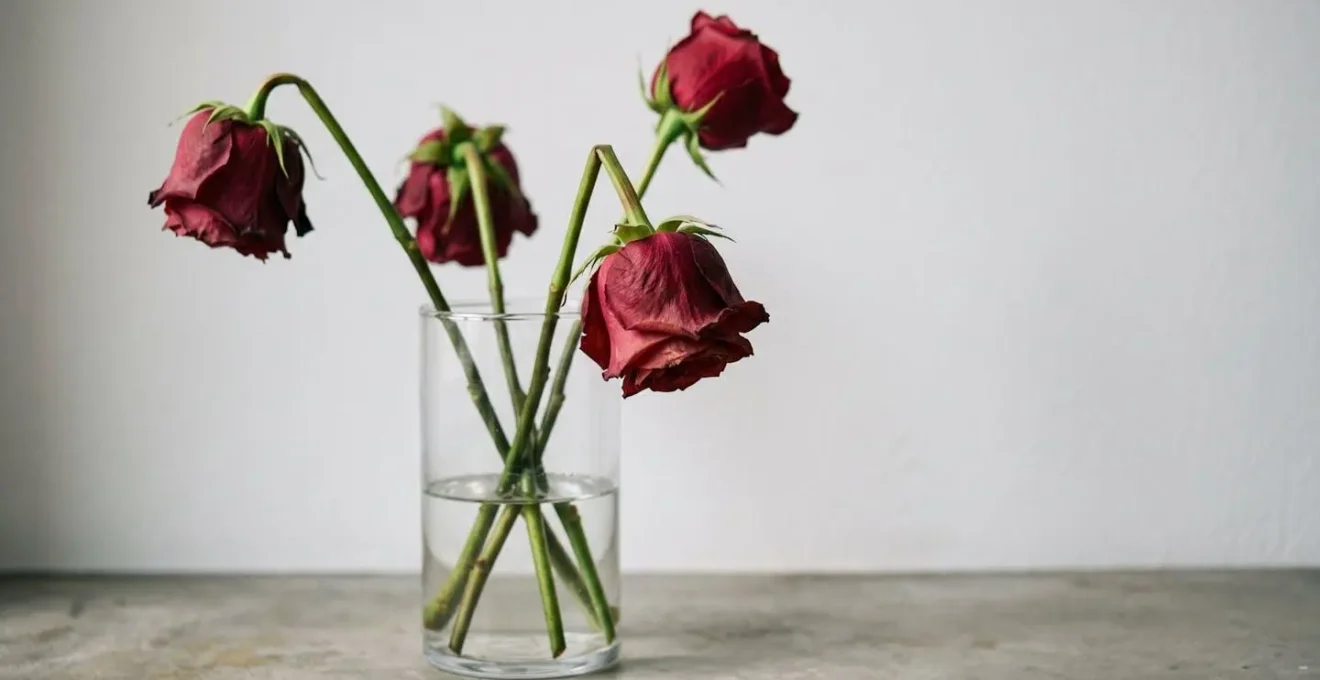
The shocking collapse of your new roses is not bad luck; it’s a specific physiological failure, most often an air bubble blocking the stem’s ability to drink.
- A wilted flower is like a person choking: the stem’s vascular system (the xylem) is blocked, cutting off water supply to the head.
- Heat exposure, even for a few hours on a doorstep, can cause irreversible cellular damage that no amount of water can fix.
Recommendation: Before panicking, perform a diagnostic “pinch test” on the flower’s base and attempt the hot water emergency procedure to dislodge the blockage.
There are few floral disappointments as acute as the one you’re experiencing. You invested in beautiful, expensive roses that looked perfect upon arrival. You placed them in a vase, admiring their vibrant colour and tightly furled buds. Yet, a mere 12 hours later, you’re faced with a tragic scene: gracefully arched necks have become defeated, drooping heads, the petals looking sad and soft. It feels like a betrayal.
The standard advice immediately comes to mind: “Did you cut the stems? Did you use the flower food?” While these steps are important, they represent basic care, not emergency diagnostics. When a flower collapses this quickly, it’s not a sign of slow neglect; it’s evidence of a specific, acute trauma that likely occurred before the roses ever graced your vase. The problem isn’t that they are dying of old age; it’s that they are suffocating.
But what if we treated this not as a simple case of wilting, but as a physiological crime scene? To save your roses, we must shift from a gardener’s mindset to that of a wilting diagnostician. The true key lies in understanding the plant’s vascular system, identifying the exact culprit—be it an air embolism, a structural failure, or thermal shock—and deploying a precise rescue operation. This is not about general care; it’s about floral forensics.
This guide will walk you through the diagnostic process step-by-step. We will investigate the clues your flowers are giving you, understand the science behind their sudden collapse, and explore the professional techniques used to perform a floral resurrection. Prepare to move beyond simple tips and into the world of applied plant physiology.
Summary: A Diagnostic Guide to Understanding and Reversing Sudden Rose Collapse
- Dehydration vs Death: How to Tell if Your Wilted Flowers Can Be Saved?
- The 2-Hour Hot Water Bath That Brings Wilted Roses Back to Life?
- Why Flowers Left on a Hot Doorstep for 4 Hours May Never Recover?
- Why Rose Heads Flop Despite Stiff Stems: The Bent-Neck Diagnosis?
- Why Conditioning Flowers for 2 Hours Before Arranging Prevents Collapse?
- Why Cutting Stems Out of Water Creates Fatal Air Bubbles in the Vascular System?
- The Yellowing Leaves and Petal Drop That Signal Ethylene Exposure?
- Why Does Cutting Stems at the Wrong Angle Block Water Uptake Completely?
Dehydration vs Death: How to Tell if Your Wilted Flowers Can Be Saved?
The first step in any rescue mission is triage: assessing whether the victim is merely injured or beyond saving. For a rose, the primary distinction is between simple dehydration and cellular death. A dehydrated flower still has its core cellular structure intact; it’s just lacking the water needed to maintain rigidity. A dead flower has suffered irreversible cell wall collapse. Fortunately, a few simple physical tests can reveal the truth.
The most telling sign is the state of the petals and calyx (the green, leafy part at the base of the bloom). If the cells still have integrity, they will retain some elasticity. This is the core principle behind the ‘Pinch & Reflex’ diagnostic test, a quick procedure to gauge a flower’s potential for revival.
Here is how to perform this crucial initial assessment:
- Pinch the calyx firmly: If the base feels firm while the flower head droops, the main structure is sound. This is a positive sign for recovery.
- Gently bend a petal backward: If it springs back, the cells retain turgor pressure, the internal hydraulic force that keeps them firm. Revival is highly likely.
- Check for translucent or bruised patches: These spots indicate collapsed cell walls. This is irreversible damage.
- Distinguish the wilt type: Is the entire flower, stem and all, limp (systemic dehydration)? Or is the stem stiff with only the head flopped over (a localized blockage)?
- Perform the crease test: If petals feel papery and stay creased when you bend them, the flower has passed the point of no return.
As florists at The Smell of Roses note, it’s vital to have realistic expectations. In their guide on reviving wilted roses, they offer a crucial piece of advice:
It’s important to note that not all wilted roses can be saved. If the flower heads have been drooping for more than a day, or if young buds have wilted at the neck (just below the flower), revival may not be possible.
– The Smell of Roses, The Art of Resurrection: Reviving Wilted Cut Roses Like a Pro
If your flowers pass these initial tests, it’s time to move immediately to emergency intervention. The prognosis is good, but the window for action is small.
The 2-Hour Hot Water Bath That Brings Wilted Roses Back to Life?
If your diagnosis points to a simple blockage—a common culprit known as an air embolism—then you need a method to forcefully clear the obstruction. This is where the hot water technique, a kind of floral angioplasty, comes into play. It sounds counterintuitive and even dangerous, but the physics behind it is sound. Hot water has a lower viscosity and surface tension than cold water, allowing it to travel up the stem’s xylem (the plant’s water-carrying tubes) more quickly. More importantly, the heat causes the trapped air bubble to expand and be forced out, clearing the path for rehydration.
As you can see in the anatomy of a stem cut, the vascular system is a network of tiny tubes. Keeping these channels clear is paramount. The hot water method is an aggressive but effective way to do this. However, it must be performed with precision to avoid cooking the delicate bloom.
Follow these critical do’s and don’ts for the hot water revival method:
- Heat water to approximately 110°F (43°C). This is typical hot tap water, not boiling. Boiling water will cook the stem and destroy the flower.
- Protect the flower heads from steam. You can do this by wrapping the blooms in a paper cone or simply ensuring they remain outside the hot water container.
- Submerge only the bottom 2-3 inches of the stems in the hot water for a maximum of 2-3 minutes.
- After the hot water treatment, immediately transfer the stems to a vase filled with room temperature water for at least two hours to fully rehydrate.
- CRITICAL WARNING: This technique is only for woody-stemmed flowers like roses and hydrangeas. Applying it to soft-stemmed flowers such as tulips or anemones will destroy them.
This method directly tackles the most common cause of sudden wilting in newly arrived roses. By clearing the air embolism, you reopen the highway for water to reach the drooping head, often resulting in a dramatic recovery within a couple of hours.
Why Flowers Left on a Hot Doorstep for 4 Hours May Never Recover?
You followed the delivery tracking, but arrived home a few hours late to find the box of roses sitting on your sun-drenched doorstep. They looked fine when you unboxed them, but now they’re wilting. The culprit here isn’t an air bubble, but a catastrophic failure in the “cold chain.” This is a logistics term for the consistent refrigeration required to transport perishable goods, and for cut flowers, it is not optional; it is essential.
Professional florists operate within a strict temperature range to preserve flower life. According to wholesale florist cold chain standards, roses must be kept between 34–38°F (1–3°C) from the moment they are harvested until they reach the flower shop. This slows down their metabolic processes, including respiration and water loss, effectively putting them in a state of suspended animation. Leaving a box on a warm doorstep shatters this process. Even if the temperature is a mild 70°F (21°C), it’s a massive thermal shock to a flower accustomed to near-freezing temperatures.
Case Study: The Exponential Cost of a Broken Cold Chain
A controlled study on temperature’s impact on vase life provides a stark illustration. Research demonstrated that a rose held consistently at 35°F might last 7–10 days longer than an identical rose exposed to temperature fluctuations during transport. The study emphasized a critical rule of plant physiology: for every 10°C (18°F) increase in temperature, a flower’s respiration rate—its rate of aging—doubles. This means a flower left on a warm doorstep is not just getting warm; it’s aging at a hyper-accelerated rate, consuming its stored energy and water far faster than its stem can possibly absorb it. This creates a water deficit that leads to wilting, and once the cells have used up their reserves and collapsed, the damage is often irreversible.
So, those four hours on the doorstep didn’t just warm up your roses; they potentially subjected them to days’ or even a week’s worth of aging. When they collapse from this kind of stress, it’s not dehydration you can fix—it’s exhaustion at a cellular level, and unfortunately, there is no coming back from it.
Why Rose Heads Flop Despite Stiff Stems: The Bent-Neck Diagnosis?
Perhaps the most baffling scenario is the one where the stem is perfectly rigid and healthy, yet the flower head has completely flopped over at a 90-degree angle, as if its neck has snapped. This isn’t a sign of dehydration in the traditional sense; it’s a specific structural failure known as “bent-neck.” This condition occurs at the peduncle, the delicate section of stem directly beneath the heavy bloom.
The underlying cause is often a combination of factors, but a primary culprit is premature harvesting. As the experts at Chrysal International, a leader in post-harvest flower care, explain, the issue is mechanical:
Premature harvesting is the core problem of bent-neck in roses. The stem right under the bud is not strong enough to carry the weight of the growing bud/flower. When the stem bends in this way, the vascular bundles are pinched shut and the flower’s water supply is cut off.
– Chrysal International, What is bent-neck in roses and how can you avoid it?
Essentially, the neck of the rose wasn’t mature and lignified (woody) enough to support the bloom as it opened and became heavier with water. When it kinks, it’s like pinching a drinking straw. Even if the rest of the stem is perfectly capable of drawing water, the supply is severed at that bottleneck. This is not something the consumer does; it is a quality issue originating at the grower level. While not rampant, it is a documented issue; for example, research published in Horticulturae found that bent-neck affected 4.7% of ‘Orange Crush’ roses in one study. For the recipient, it means that despite a stiff stem, the flower head is effectively dying of thirst.
Unfortunately, once a severe kink has formed, the prognosis is poor. The only slim chance of recovery is to try the hot water method to see if the vascular tissue can be un-pinched, but in most cases of true bent-neck, the damage to the vascular bundles is permanent.
Why Conditioning Flowers for 2 Hours Before Arranging Prevents Collapse?
After their long journey through the cold chain, your roses are stressed, thirsty, and in a state of shock. Tearing them out of the box and immediately arranging them in a vase is like asking a marathon runner to sprint the final 100 meters without a water break. This crucial transitional period is what florists call “conditioning,” and skipping it is a primary cause of premature collapse.
Conditioning is the process of allowing flowers to acclimate to their new environment—your home’s temperature and humidity—while having unrestricted access to water. This allows them to fully rehydrate and stabilize before undergoing the additional stress of being handled, cut, and arranged. A minimum of two hours is recommended for this “hydration therapy.”
Case Study: The Power of ‘Hydration Therapy’
Professional florists use an intensive conditioning technique for severely wilted roses. They fully submerge the entire rose—stem, leaves, and bloom—in a sink or large bowl of lukewarm water for 30-60 minutes. This extreme measure allows the flower to absorb water rapidly through its petals and leaves, not just the stem. This dramatically re-establishes the cellular turgor pressure that keeps the plant rigid. For a standard consumer, a less extreme but equally important version is simply letting the roses sit in a bucket of fresh, clean water for a couple of hours in a cool, dim location before you begin arranging. This period acts as a buffer, ensuring the flower’s internal systems are stable before you demand it perform aesthetically in a vase.
Think of it as re-acclimatizing a traveler. The two-hour conditioning window gives the rose time to “unpack,” drink deeply, and adjust to its new surroundings. By taking this time, you ensure the flower is at maximum strength and hydration *before* you place it in its final arrangement, drastically reducing the risk of a sudden, post-arrangement collapse.
Why Cutting Stems Out of Water Creates Fatal Air Bubbles in the Vascular System?
You’ve been told to cut flower stems, but has anyone ever explained the life-or-death importance of *how* and *where* you make that cut? The moment a stem is cut in the open air, a process called transpiration (water loss from leaves) continues to pull on the water column inside the stem’s xylem. Since there’s no water at the cut end, the stem sucks in a tiny bubble of air instead. This creates an air embolism—a fatal blockage that prevents any future water uptake, no matter how much water is in the vase.
It is the single most common, and most preventable, cause of sudden wilting in cut flowers. The flower is literally choking on an air bubble just an inch up its stem. As high-level research confirms, this is not a fringe theory. A study on “Peduncle Necking” from the National Center for Biotechnology Information highlights the cause:
Necking is thought to be caused by either an air embolism or accumulation of microorganisms at or within the stem end, blocking the xylem vessels and preventing water uptake.
– National Center for Biotechnology Information, Peduncle Necking in Rosa hybrida Induces Stress-Related Transcription Factors
While an air embolism is an immediate physical blockage, the accumulation of microorganisms is a slower, biological one. Bacteria from the vase water, leaves, and the stem itself can clog the xylem. This is why using flower food (which often contains a biocide) and clean vases is so critical. In fact, a foundational 1970 study found that cut roses placed in a bacteriostatic solution showed a 2x longer vase life than those in plain water, proving that preventing these blockages is key.
The solution to the air embolism problem is simple but non-negotiable: make your cuts underwater. By cutting the stem while it’s submerged in a bowl of water, you ensure that the stem draws in water, not air, at the moment of the cut. This guarantees a clear and open pathway for hydration once the flower is placed in its vase.
The Yellowing Leaves and Petal Drop That Signal Ethylene Exposure?
If your roses didn’t wilt dramatically but are instead showing signs of rapid aging—yellowing leaves, petals dropping prematurely, or blooms that fail to open—the likely culprit is an invisible one: ethylene gas. Ethylene is a naturally occurring plant hormone that governs the ripening and aging process. For cut flowers, it is a potent poison that significantly shortens their life, even in minuscule concentrations.
Roses are extremely sensitive to ethylene. While you might not smell or see it, its effects are undeniable. In fact, studies have shown that ethylene levels as low as 0.1 ppm (parts per million) can cause significant damage to sensitive flowers. The problem is that many common household items are major ethylene producers. Your beautiful roses might be placed next to a silent killer.
The first step in preventing ethylene damage is to conduct an audit of your flowers’ environment. Use this checklist to identify and eliminate hidden ethylene sources in your home.
Your Ethylene Audit Checklist: Finding the Hidden Sources
- Proximity to Ripening Fruit: The fruit bowl is the number one enemy. Bananas, apples, and avocados are “super-producers” of ethylene and must be kept far away from your floral arrangements.
- Gas Appliances: Check the location relative to gas stoves or faulty heating systems, which can release ethylene during combustion.
- Vehicle Exhaust: This is a huge factor during delivery. Even brief exposure in a garage or loading area from a running vehicle can start the aging cascade.
- Cigarette Smoke: Tobacco smoke contains ethylene and is a direct cause of premature petal drop and discoloration.
- Decaying Plant Material: Are there old flowers or fallen leaves in the vase water? Decaying organic matter produces its own ethylene, creating a vicious cycle that ages nearby healthy flowers.
By being mindful of these sources, you can protect your investment from this invisible threat and ensure your roses age gracefully, rather than being prematurely forced into senescence.
Key Takeaways
- Sudden wilting is usually a sign of a water blockage (an ‘air embolism’) in the stem, not old age, and is often reversible.
- The “cold chain” is critical; a box of roses left on a warm doorstep can suffer irreversible cellular damage in just a few hours.
- Cutting stems under water at a 45-degree angle is the single most important action to prevent fatal air bubbles from blocking hydration.
Why Does Cutting Stems at the Wrong Angle Block Water Uptake Completely?
We’ve established that cutting stems is vital to prevent air embolisms. Now, let’s focus on the final, crucial details of that cut: the tool and the angle. Using the wrong tool or the wrong angle can be just as damaging as not cutting at all, effectively sealing the stem off from its water source.
First, the tool. Always use very sharp floral shears or a knife. Never use dull household scissors. Scissors, especially dull ones, crush the delicate xylem vessels at the cut site. A crushed straw cannot draw liquid, and a crushed stem cannot draw water. You may have made a fresh cut, but you’ve also destroyed the very cellular structures needed for hydration. Secondly, the angle. A 45-degree angle is the professional standard for a reason. It dramatically increases the surface area of exposed xylem available to absorb water compared to a flat, 90-degree cut. More importantly, it prevents the stem from sitting flush against the bottom of the vase, which would create a perfect seal and block all water entry.
Here is the definitive protocol for processing stems to ensure maximum hydration:
- Use sharp floral shears or a knife, never dull scissors, to avoid crushing vascular tissues.
- Make the cut at a 45-degree angle to maximize the surface area for water uptake.
- Perform the cut underwater or immediately plunge the cut stem into water to prevent an air embolism.
- Strip any leaves that will fall below the waterline in the vase. Leaves rotting in water breed bacteria that clog stems.
- Recut the stems every 2-3 days, removing about a half-inch each time, to ensure the vascular system remains open and efficient.
Combining this perfect cut with proper nutrition is the final piece of the puzzle. The flower food packet isn’t a gimmick; it contains sugar for energy, an acidifier to help water travel up the stem, and a biocide to keep bacteria at bay. The impact is significant; research by FloraLife in 2023 demonstrated a 90% increase in rose vase life when flower food was used correctly compared to plain tap water.
Armed with this diagnostic knowledge, you are now equipped to investigate any case of sudden wilting, deploy the correct emergency procedure, and provide the optimal environment for your flowers. The next time you bring a bouquet home, you won’t just be arranging flowers; you’ll be applying a precise protocol to ensure their health and longevity. Start by applying this essential cutting technique to every bouquet you receive.