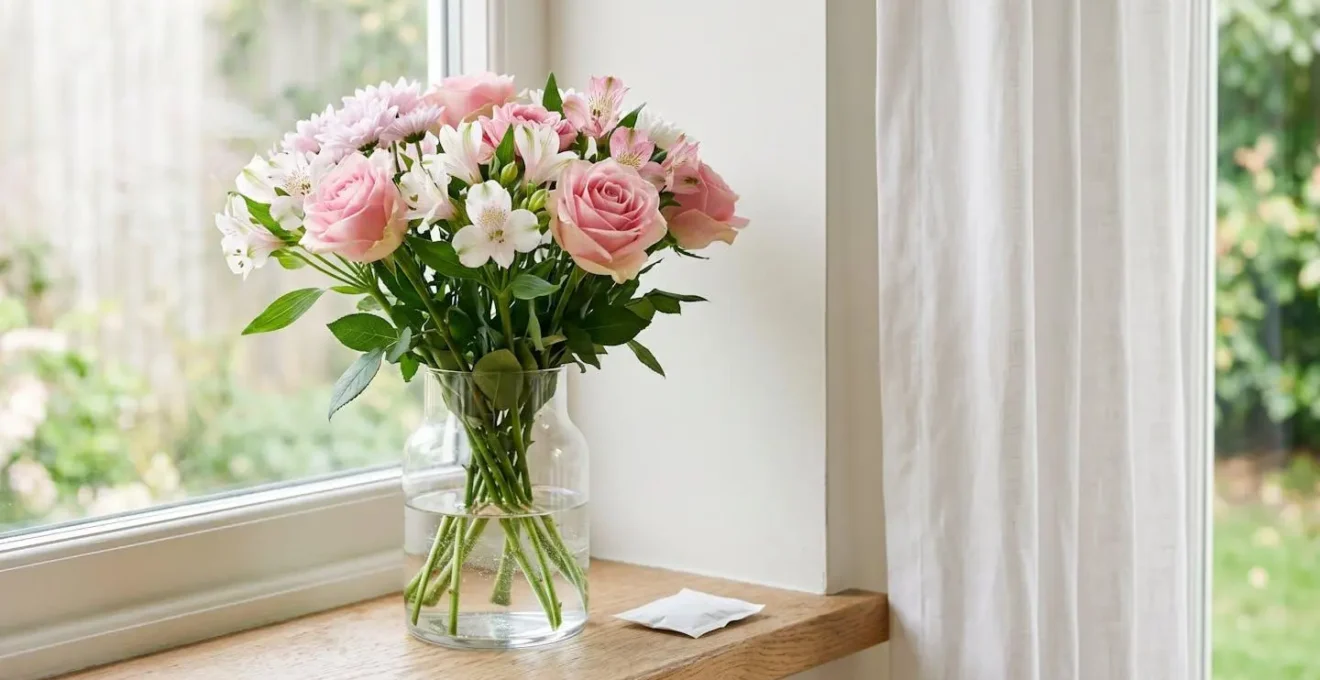
Contrary to the belief that it’s an unnecessary additive, that small flower food sachet is a precisely engineered life-support system. It’s not just “food”; it’s a chemical trinity of sugar for energy, acidifiers for water uptake, and biocides for microbial warfare. Tossing it aside in favour of plain water or ineffective home remedies is the single biggest reason a bouquet wilts prematurely, discarding days of potential beauty that science has carefully formulated to preserve.
It’s a familiar ritual for many in the UK: a beautiful bouquet arrives, and with it, a small, often overlooked sachet. For many, this packet is immediately discarded, seen as an unnecessary chemical addition to an otherwise natural product. The belief that fresh water is all that’s needed, perhaps with a trim of the stems, is pervasive. After all, flowers grow in nature with just water, don’t they? This thinking, however, ignores a critical distinction: a cut flower is no longer a living plant. It is an organism in its final, glorious phase, and its needs have fundamentally changed. The longevity of cut flowers can be incredibly variable, with some lasting just a single day and others for nearly three weeks with proper care.
The common advice to use homemade solutions—a dash of Sprite, a drop of bleach, or even a copper penny—is often born from a desire for a more “natural” approach. Yet, these methods are the chemical equivalent of guesswork. They fail to address the three simultaneous challenges a cut flower faces: energy depletion, dehydration due to air bubbles and pH imbalance, and a relentless bacterial assault on its vascular system. This is where the science of floral preservation offers a far more effective path.
What if that little sachet wasn’t just “food,” but a sophisticated, multi-part prescription designed to combat these three threats at once? This article will deconstruct the chemical engineering behind that packet. We will move beyond the myths and reveal the precise role of each ingredient. We will explore why dosage is non-negotiable, why some flowers are notable exceptions, and why the professional-grade solutions used by florists operate on the same principles, only at a different scale. It’s time to see that sachet not as a piece of waste, but as the key to unlocking days of extra life from your flowers.
This guide delves into the chemistry of floral preservation, explaining the specific function of each component and debunking common myths. You’ll understand the science that makes your bouquets last longer, turning a fleeting pleasure into a lasting display.
Summary: The Chemistry of a Longer-Lasting Bouquet
- Sugar, Acid, and Biocide: What Each Ingredient in Flower Food Actually Does?
- Sprite, Bleach, and Vinegar Mixes: Do Homemade Flower Foods Actually Work?
- Why Using Half a Sachet in a Large Vase Delivers Half the Results?
- Why Daffodils, Hyacinths, and Bulb Flowers Should Skip the Flower Food?
- Do Flower Food Sachets Expire: The Shelf Life You Should Know?
- Are Professional Chrysal or Floralife Products Worth Buying for Home Use?
- Does a Penny in the Vase Actually Prevent Bacterial Growth?
- Why Do Florists Add Bleach to Bucket Water but Tell You Not to at Home?
Sugar, Acid, and Biocide: What Each Ingredient in Flower Food Actually Does?
To understand the power of a flower food sachet is to understand its core chemical trinity: sugar, an acidifier, and a biocide. Each component serves a distinct, non-negotiable purpose in fighting the inevitable process of decay. It is not “food” in the way a plant in soil eats, but rather a life-support solution for a severed biological system. A cut flower has been disconnected from its energy source (photosynthesis) and root system (water uptake), and the sachet is engineered to replicate these functions in a vase.
First, sugar (typically sucrose or dextrose) serves as a direct source of carbohydrates. A flower, once cut, cannot produce its own energy. The sugar in the solution provides the fuel necessary to maintain metabolic processes, helping buds to open fully, colors to remain vibrant, and petals to stay turgid. It is the raw energy that powers the flower’s final performance.
Second, an acidifier (commonly citric acid) is crucial for water uptake. It works by lowering the pH of the vase water. Tap water is often slightly alkaline, which is not ideal for the flower’s vascular system, or xylem. The acidic environment helps keep the xylem “open” and efficient, preventing blockages and promoting better hydration. It essentially makes the water “wetter” and easier for the stem to absorb, a process known as improving osmotic balance.
Finally, the biocide is the agent of microbial warfare. This is perhaps the most critical component. The nutrient-rich, sugary water is a perfect breeding ground for bacteria, yeasts, and fungi. These microorganisms multiply rapidly, clogging the stem’s vascular tissue and preventing water from reaching the flower head, which is a primary cause of wilting. The biocide, a type of disinfectant, keeps the water clean and the stems clear, ensuring the hydration and energy pathways remain functional. As Dr. Susan S. Han of the University of Massachusetts Amherst confirms, these solutions contain the major active ingredients necessary for a good preservative solution: sugar, citric acid, and a biocide.
Without this three-pronged approach, any single intervention is largely ineffective. Plain water allows for rapid bacterial growth and offers no energy, while a simple sugar solution would create a bacterial explosion. The sachet’s formula is a precise, synergistic balance.
Sprite, Bleach, and Vinegar Mixes: Do Homemade Flower Foods Actually Work?
The allure of a homemade flower food recipe is understandable. It feels resourceful and avoids the “unknown chemicals” in the commercial sachet. Popular concoctions often involve a mix of a sugary soda like Sprite, a drop of bleach, and a splash of vinegar. Theoretically, these ingredients mimic the commercial formula: Sprite for sugar, vinegar for acid, and bleach for a biocide. However, the critical difference lies in one key factor: precision and stability. Do they work? Marginally better than plain water, perhaps, but significantly worse than a formulated product.
The problem with kitchen-cupboard chemistry is the lack of correct concentration and buffering. The amount of sugar in Sprite is not optimized for cut flowers, and its other ingredients can complicate the solution. The acidity of household vinegar varies, and getting the pH to the optimal range of 3.5 to 5.0 is pure guesswork. Most critically, the concentration of bleach (sodium hypochlorite) required to be effective without being phytotoxic (harmful to the flower) is a tiny, precise amount that is nearly impossible to measure accurately at home. Too little, and bacteria thrive; too much, and you chemically burn the stem.
Scientific testing consistently demonstrates the performance gap. For example, a 2026 FloraLife laboratory study found that formulated flower food extended vase life by as much as 8 days longer for roses and 7 days longer for chrysanthemums compared to the best-performing homemade recipes. The formulated products contain specific types of sugars, buffered acids that maintain a stable pH over time, and biocides that are effective at low, flower-safe concentrations.
In short, while a DIY mix might feel like a good idea, it’s an imprecise attempt to replicate a scientifically balanced formula. The sachet isn’t just a convenience; it’s a guarantee of the correct, stable, and effective dosage that home chemistry simply cannot match.
Why Using Half a Sachet in a Large Vase Delivers Half the Results?
The instructions on a flower food sachet are clear: “Mix one sachet with 0.5 litres (or 1 pint) of water.” Yet, it’s common to see people use a single sachet to top up a large, two-litre vase, assuming “some is better than none.” From a chemist’s perspective, this is fundamentally flawed. It’s like taking a quarter of a prescribed antibiotic tablet and expecting it to cure an infection. The effectiveness of a floral preservative is entirely dependent on achieving the correct concentration of its active ingredients.
When you under-dose the solution by using half the recommended amount of powder for the volume of water, you compromise every part of the chemical trinity. The sugar concentration becomes too dilute to provide adequate energy for the flowers’ metabolic needs. The pH of the water may not be lowered sufficiently to the optimal acidic range, hindering water uptake. Most dangerously, the biocide concentration will fall below the Minimum Inhibitory Concentration (MIC)—the lowest level at which it can effectively prevent microbial growth. A weakly dosed biocide doesn’t just work less well; it may not work at all, allowing bacteria to flourish in the now-sugared water.
Think of it as a recipe. If a cake recipe calls for 200g of flour and you only use 100g but keep all other liquid ingredients the same, you don’t get a “half-good” cake; you get an inedible slurry. The chemical ratios are precise. Using half a sachet in a large vase, or one full sachet in a two-litre vase, creates a solution that is neither plain water nor an effective preservative. It becomes a weak, sugary broth that can actually accelerate bacterial growth, leading to slimy water and clogged stems faster than plain tap water might have.
Your Flower Care Routine Audit: Key Points to Check
- Vase Selection: Is the vase clean and of an appropriate size for the bouquet?
- Water Volume: Do you measure the water to ensure you match the sachet’s required volume (e.g., 0.5L or 1L)?
- Sachet Dosage: Do you use the entire sachet for the correct volume, or do you estimate?
- Stem Preparation: Are you re-cutting the stems at an angle before placing them in the solution?
- Environment: Is the vase placed away from direct sunlight, heat sources, and ripening fruit (which releases ethylene gas)?
Therefore, always follow the instructions. If your vase is larger than the volume specified for one sachet, use two sachets or find a more appropriately sized vase. Dosage isn’t a suggestion; it’s the core of the science.
Why Daffodils, Hyacinths, and Bulb Flowers Should Skip the Flower Food?
While flower food is a near-universal benefit for most cut flowers, there are notable exceptions, primarily among early spring bulb flowers like daffodils (Narcissus) and hyacinths. For these varieties, adding them to a vase with a standard flower food solution—especially in a mixed bouquet—can be a mistake. This isn’t because they don’t need the benefits of hydration and microbial control, but because of a unique form of biological antagonism.
Daffodils, in particular, exude a slimy, toxic sap from their stems when cut. This mucilage is harmful to other flowers, essentially poisoning the water and causing them to wilt prematurely. Tulips, roses, and freesias are especially sensitive to this daffodil sap. For this reason, florists have a specific conditioning process for them.
Case Study: The Daffodil Isolation Technique
Professional florists often follow a strict protocol when preparing daffodils for mixed arrangements. They first place the freshly cut daffodils in a bucket of plain water by themselves for at least 12 to 24 hours. During this “quarantine” period, the stems release the majority of their toxic sap into the water. After this conditioning, the stems are rinsed, and can then be added to a mixed arrangement with a standard flower food solution without risk, as the sap production has significantly decreased. Attempting to add them directly to a mixed vase, even with flower food, can doom the other flowers.
Other flowers present different challenges. Some, like poppies and euphorbia, release a milky latex sap. This sap is designed to seal a wound on the living plant, but in a vase, it can clog the flower’s own stem, preventing water uptake. This is why sources on floral care sometimes mention special treatments for these types. As one guide notes, for flowers with milky sap, this substance “prevents the absorption of water.” While commercial hydrating solutions exist to counter this, for the home user, it’s a sign that these flowers have needs beyond a simple sachet.
So, if you have a bouquet of only daffodils, plain water is often the best and simplest choice. If you intend to mix them, be sure to condition them separately first. Their unique biology makes them an important exception that proves the rule: you must first understand the flower to know how to care for it.
Do Flower Food Sachets Expire: The Shelf Life You Should Know?
A common sight in many kitchen drawers is a small collection of flower food sachets, saved from bouquets over months or even years. This raises a practical question: does this powder lose its potency? The answer is yes, but it depends entirely on storage conditions. Flower food is a mixture of dry, crystalline solids which, when kept dry, are incredibly stable. In a sealed, moisture-proof sachet, the shelf life is effectively indefinite.
The primary enemy of flower food powder is moisture. The components, particularly the sugar and citric acid, are hygroscopic, meaning they actively attract and absorb water molecules from the air. If a sachet is opened, damaged, or stored in a damp environment like a cellar or under a kitchen sink, its lifespan shortens dramatically. As the powder absorbs moisture, it will begin to clump and harden. This is the first visual cue that its efficacy is compromised.
When the powder becomes hard, it’s not just a physical inconvenience. The clumping indicates that a slow chemical reaction may have begun, and more importantly, the powder will not dissolve properly in water. An even, quick dissolution is critical to creating a homogenous solution at the correct concentration. Clumped powder can sink to the bottom of the vase, failing to deliver the biocide and acidifier evenly throughout the water column. You will end up with pockets of high concentration and large volumes of ineffective, sugary water—a perfect recipe for bacterial growth.
So, if you find an old sachet and the powder inside is still loose, white, and free-flowing, it is almost certainly as effective as the day it was made. If it has turned into a solid, hard rock, it’s best to discard it. Its ability to properly perform its chemical duties has been critically compromised by moisture.
Are Professional Chrysal or Floralife Products Worth Buying for Home Use?
Walking into a floral wholesaler reveals a world of preservation products far beyond the simple consumer sachet. Brands like Chrysal and Floralife offer a dizzying array of liquids, powders, and sprays. For the avid flower enthusiast, the question arises: is it worth investing in these professional-grade products for home use? The answer depends on your commitment, but the science shows a clear benefit. These products are more specialised and potent versions of the consumer sachet, designed for specific stages of the flower’s journey from farm to vase.
Professional solutions are not a single product, but a system. The floral supply chain is a “cold chain” for flowers, and specific formulations are used at each step. A hydration solution is used at the farm immediately after cutting, a transport solution is used by wholesalers to keep buds tight, and a final “feed” or display solution is used by retail florists and, ultimately, the consumer. This final stage formula, rich in sugar, is what most closely resembles the sachet that comes with your bouquet.
As this table from a professional supplier illustrates, the sugar content and purpose of the solution change dramatically depending on its role in the supply chain.
| Product Category | Sugar Content | Primary Use | User Channel |
|---|---|---|---|
| Hydration Solutions | No sugar | Fast water uptake after harvest | Growers/Farms (within 4 hours of cutting) |
| Store & Transport | Low sugar | Hold flowers at tight bud stage | Wholesalers, supermarkets, dot-com retailers |
| Feed (Display/Vase) | High sugar | Promote full opening and color development | Retail florists, event planners, end consumers |
So, is it worth buying a large tub of Chrysal or Floralife powder? If you frequently buy large amounts of flowers, especially directly from markets, the answer is likely yes. Buying the “Vase” or “Feed” formulation in bulk can be more economical and ensures you always have the correct solution on hand for any size vase. The consistency offered by these professional products is undeniable, with brands stating they can increase vase life by a significant margin. For the average person who receives one or two bouquets a month, the included sachets are perfectly sufficient and scientifically formulated for this exact final stage of use.
Ultimately, using a professional product at home is about embracing the same science the industry relies on. It’s a step up in commitment, but one that delivers measurable results in the beauty and longevity of your flowers.
Does a Penny in the Vase Actually Prevent Bacterial Growth?
One of the most persistent floral old wives’ tales is to drop a copper penny into the vase water to keep it fresh. The theory is that copper is a fungicide and bactericide, and it will leach into the water to prevent microbial growth. While the premise contains a grain of scientific truth—copper is indeed an effective biocide—the practice is utterly ineffective in reality. It’s a classic case of a correct principle applied at a completely meaningless scale.
The primary flaw in this logic is the composition of modern coinage. A modern UK penny is not made of copper; it is copper-plated steel. The amount of copper present is minuscule. Furthermore, the rate at which copper ions would leach from this plating into a neutral or slightly alkaline pH vase of water is incredibly slow and results in a concentration far too low to have any meaningful antimicrobial effect. As the editorial team at Gardener’s Path succinctly puts it, ” Copper is indeed a biocide, but a modern penny contains very little copper, and the amount that can leach into the water is too minuscule to have a meaningful antimicrobial effect.”
This myth sits alongside others, such as adding aspirin, vodka, or other household items to vase water. Experiments consistently show these methods to be ineffective or even detrimental.
The FTD Additive Experiment
In a widely cited experiment, florists from FTD tested several common home remedies over seven days. They set up identical arrangements with different additives: vodka, Sprite, apple cider vinegar with sugar, and aspirin. The results were clear. The Sprite arrangement became slimy by day 5. The vodka arrangement was droopy with greyish stems by day 4. Aspirin, another common myth, was found to have no preserving effects whatsoever. Only the arrangement with the commercial flower food packet remained consistently fresh and healthy throughout the test period, demonstrating the failure of single-ingredient or improperly balanced solutions.
There is no shortcut. The most effective way to combat bacterial growth in a vase is not with spare change, but with a properly dosed biocide, which is a core component of every commercial flower food sachet for this exact reason.
Key Takeaways
- The sachet’s power lies in its precise ‘chemical trinity’: sugar for energy, acid for hydration, and a biocide for cleanliness.
- Dosage is critical. Using half a sachet or diluting it too much renders it ineffective and can be worse than using plain water.
- Scientifically formulated products consistently outperform homemade mixes like Sprite or vinegar, which lack precise concentrations and stability.
Why Do Florists Add Bleach to Bucket Water but Tell You Not to at Home?
A customer might notice a faint scent of chlorine at their local florist and wonder why, if bleach is a good biocide, they are told not to use it at home but it seems to be used professionally. The answer lies in one word: scale. A florist’s bucket is a high-density, high-risk environment for bacterial contamination, worlds away from the controlled setting of a single bouquet in a vase at home. Florists are managing a massive bio-load.
A typical florist’s bucket might contain 20, 30, or even 40 stems. These stems shed leaves, pollen, and other organic debris into the water. This creates an incredibly rich nutrient soup for bacteria to multiply in. To combat this, florists must use a powerful biocide strategy. Sometimes this involves a small, carefully measured amount of bleach, but more often it means using professional-grade products designed specifically for this high-stress environment.
These professional solutions are formulated for what’s known as “dirty water” conditions. As noted in a test by the British Florist Association involving Chrysal products, the high density of stems means water quality can deteriorate very quickly. Professional solutions contain special ingredients that keep the water fresher for much longer, reducing the need for daily water changes even with dozens of stems. This is a level of biocidal power far beyond what is needed—or safe to handle without training—in a home environment.
In contrast, a home vase with a handful of stems has a very low bio-load. The small, precisely measured dose of biocide in the consumer sachet is perfectly calibrated for this low-risk setting. It’s strong enough to keep the water clear for several days but not so harsh as to damage the delicate stems. Advising a customer to add bleach at home is a recipe for disaster, as the risk of over-dosing and causing chemical burns to the stems is extremely high. While these solutions are formulated for flowers, it’s always prudent to keep them away from pets and children.
The florist’s use of strong biocides isn’t a contradiction; it’s a confirmation of the same scientific principle—microbial control is paramount. They are simply operating at the industrial end of the spectrum, while your sachet provides the perfect, safe, and effective dose for the home finale.