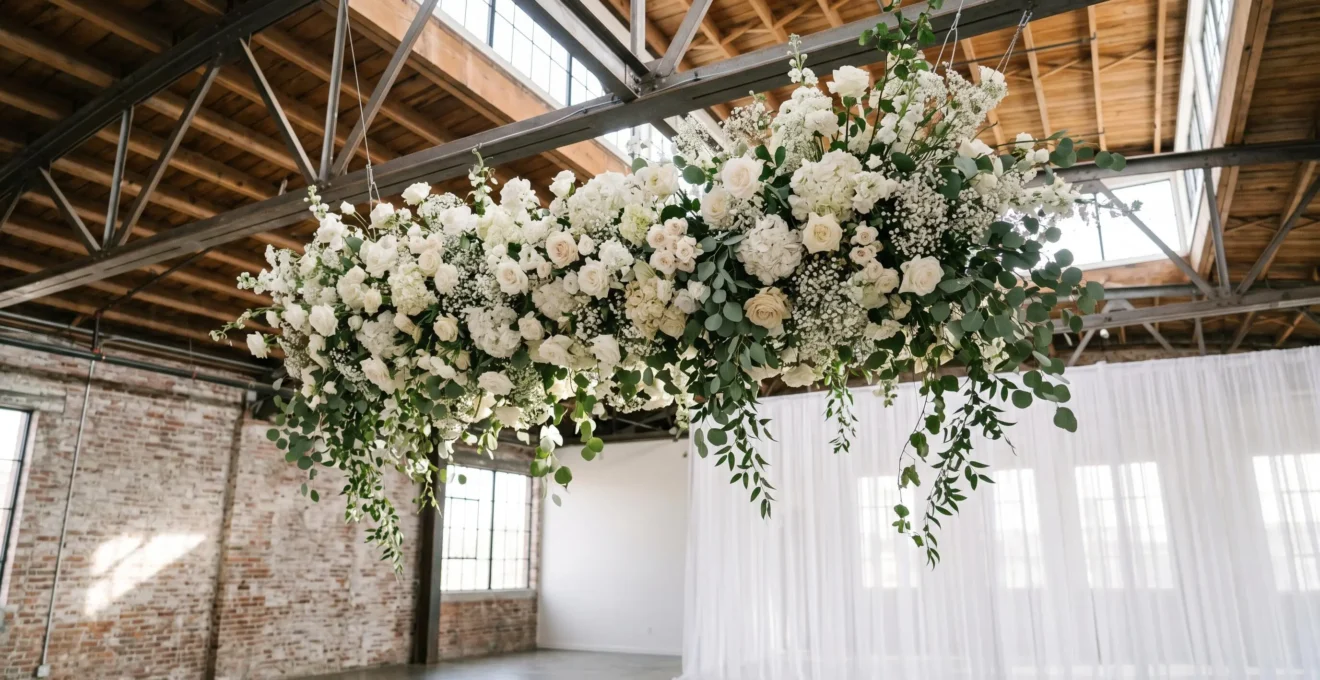
The safety of a suspended floral installation depends on structural engineering principles, not just aesthetic choices.
- A fully saturated 2-metre floral cloud can weigh over 50kg, making water weight the single biggest risk factor.
- In listed or heritage venues, non-invasive rigging like freestanding frames or certified I-beam clamps are the only viable options; drilling is never acceptable.
Recommendation: Always commission a static load test on any potential hanging point before finalizing your design, and get written sign-off from the venue manager.
As an event planner, your client’s vision for a breathtaking, suspended floral cloud is exhilarating. The dream is a lush, dramatic canopy of flowers floating effortlessly above the guests. The reality, especially in the UK’s historic and listed venues, is a complex challenge of physics, liability, and structural integrity. The fear of an installation dripping on a VIP’s head—or worse, crashing down entirely—is a legitimate professional concern that keeps the best planners awake at night.
Many guides focus on the creative aspect: using chicken wire, choosing pretty flowers, or finding a “strong-looking” beam. This approach is dangerously incomplete for a professional setting. It ignores the core principles of load management, the hidden weight of water, and the stringent rules of heritage buildings. We often hear about creating floral meadows or statement urns as safer alternatives, but these can fail to deliver the same immersive impact your client desires.
But what if the solution wasn’t to scale back the vision, but to elevate the methodology? The key to a spectacular and safe overhead installation is to stop thinking like a decorator and start thinking like an engineer. This guide moves beyond simple tips to provide a technical, safety-aware framework. It’s about understanding the forces at play before a single stem is purchased.
We will deconstruct the process, starting with the crucial calculation of weight, selecting materials for their structural properties, navigating the complex world of venue rigging, and finally, designing for longevity and safety. By mastering these engineering principles, you can confidently execute ambitious floral designs that are not only beautiful but fundamentally sound.
This article provides a complete roadmap for event planners to tackle suspended floral installations with an engineer’s precision. Explore each section to master the technical details that ensure a flawless and safe execution.
Contents: How to Engineer a Safe and Stunning Floral Cloud
- Why a 2m Floral Cloud Weighs 50kg: The Hidden Water Weight Factor?
- Which Flowers Create Drama Overhead Without Adding Dangerous Weight?
- Rigging Points, Cable Drops, or Freestanding Frames: Which Suits Listed Venue Ceilings?
- Why Overhead Installations Drip on Guests: The Waterless Floral Cloud Solution?
- How to Keep a Suspended Installation Fresh for 3 Days Without Ladder Access?
- The Ceiling Hook Load Test That Prevents a £3,000 Installation From Crashing
- Suspended Cloud, Meadow Floor, or Statement Urn: Which Installation Suits a Barn Venue?
- How to Transform a Blank Marquee Into an Immersive Floral Experience Under £3,000?
Why a 2m Floral Cloud Weighs 50kg: The Hidden Water Weight Factor?
The single greatest point of failure in any suspended floral installation is a catastrophic underestimation of its final weight. An airy, delicate-looking floral cloud is deceptive. The true mass comes not from the flowers themselves, but from the water required to keep them fresh. This hidden weight is the critical factor that transforms a decorative element into a significant structural load.
Consider the core mechanics. Traditional methods often rely on floral foam or a similar water-retentive medium. A dry block of foam is negligible in weight, but once fully saturated, its weight can increase by a factor of 30 or more. The principle is similar to that seen in horticulture, where wet potting soil can weigh up to double its dry weight. For a large installation, this translates to tens of kilograms of water hanging directly over people’s heads.
A typical 2-metre by 1-metre floral cloud using a saturated medium can easily exceed 50kg (110 lbs). This calculation must include not only the flowers and foliage but also the base structure (chicken wire, frame) and the water itself. Ignoring the water weight is the most common and dangerous mistake. It leads to selecting inadequate rigging, overloading ceiling anchor points, and creating a massive liability risk. Therefore, the first step in any overhead design is not creative, but mathematical: calculating the Total Saturated Weight.
This engineering-first approach requires you to assume the maximum possible weight as your baseline. From there, every design decision should aim to reduce this number, primarily by exploring waterless or minimal-water mechanics. Understanding this weight dynamic is the foundation of safe and responsible overhead floral design.
Which Flowers Create Drama Overhead Without Adding Dangerous Weight?
Once you’ve accepted that water is the primary source of dangerous weight, the next logical step is to design for minimal or zero hydration. This means selecting botanicals not just for their beauty, but for their structural integrity and ability to perform without a water source for the duration of an event. The goal is to achieve high visual volume with minimal mass.
Expert florists who specialize in large-scale, foam-free work focus on two key attributes: stem rigidity and longevity. Materials that wilt or droop within hours are unsuitable for overhead designs where access for maintenance is impossible. The most reliable choices are flowers and foliage that either hold their shape naturally or dry gracefully, retaining their structure and much of their colour. This approach significantly reduces the overall weight and completely eliminates the risk of dripping.
As the close-up image reveals, materials like Eucalyptus and Gypsophila (Baby’s Breath) create an airy, voluminous effect. Their complex structures fill space and catch light, creating a sense of fullness without the dense mass of water-heavy blooms. Here are some of the most reliable lightweight champions for overhead installations:
- Baby’s Breath (Gypsophila): The ultimate high-volume, low-weight filler. It dries perfectly in place, maintaining its cloud-like appearance.
- Statice and Limonium: These flowers have a papery texture and hold their colour and form exceptionally well when drying. They require no water source for a single-day event.
- Carnations: When properly conditioned beforehand, these hardy flowers can last for over 48 hours without water, offering pops of colour with strong, reliable stems.
- Eucalyptus and Asparagus Fern: These foliage types provide excellent structure and high visual impact per gram. They maintain their rigidity and contribute significantly to the shape of the installation.
- Craspedia (Billy Buttons): Naturally dry and extremely lightweight, they add a modern, textural element with zero water requirements.
By building the bulk of your installation with these tried-and-tested materials, you engineer a design that is inherently lighter, safer, and more resilient. Any delicate, ‘hero’ flowers that require hydration can then be added sparingly using targeted, sealed water sources.
Rigging Points, Cable Drops, or Freestanding Frames: Which Suits Listed Venue Ceilings?
In a modern hotel ballroom with a steel grid ceiling, rigging is straightforward. In a Grade II listed Georgian manor or a rustic tithe barn, it’s a minefield of restrictions. For a UK event planner, understanding what is permissible is paramount, as unauthorised drilling or fixing can lead to severe financial penalties and reputational damage. The choice of rigging method is dictated entirely by the venue’s structural characteristics and rules.
First, you must differentiate between the main options. Certified rigging points are anchor points (like eye bolts in a steel I-beam) that have been installed and load-tested by a structural engineer, with a clearly stated Safe Working Load (SWL). These are the gold standard but are rare in historic venues. Cable drops from existing structural members, like exposed wooden beams, are a common request. However, you cannot assume a beam is load-bearing without professional assessment. Finally, freestanding frames are ground-supported structures (like goalpost trusses) from which the installation is hung. This method is often the only approved option in protected buildings as it makes no contact with the historic fabric of the ceiling or walls.
Never take a venue coordinator’s verbal “it should be fine” as approval. Your due diligence requires a formal technical assessment. Before even sketching a design, you must work through a rigorous checklist to determine what is physically and legally possible. This audit protects you, your client, and the venue.
Your Venue & Design Audit Plan: 5 Key Verification Steps
- Points of Contact: Identify all stakeholders. Who is the venue’s technical manager? Who holds the structural reports? Is there a designated approved contractor list for rigging?
- Collect Existing Data: Formally request all available documentation. This includes structural engineer reports, building plans showing ceiling load capacity, and the venue’s official policy on suspended decor.
- Assess for Coherence: Compare your design’s calculated weight against the certified Safe Working Load (SWL) of any existing rigging points. If no SWL is documented, the point is unusable until tested.
- Evaluate Emotional Impact vs. Feasibility: Does the venue’s structure support the desired dramatic overhead effect? Or would a floor-based installation (like a meadow) achieve a similar immersive feel without the structural risk and cost?
- Create an Integration Plan: Based on the audit, define the only acceptable rigging method (e.g., “freestanding truss only,” “clamp to certified I-beam”). This becomes a non-negotiable part of your event plan shared with all vendors.
This systematic process removes guesswork and demonstrates a high level of professionalism to the venue management, building the trust necessary to execute ambitious designs.
Why Overhead Installations Drip on Guests: The Waterless Floral Cloud Solution?
The dreaded drip is the most immediate and embarrassing sign of a poorly engineered floral installation. It’s caused by one of two things: over-saturated floral foam leaking under gravity, or condensation. Both are direct consequences of relying on large, open water sources in an overhead design. For a high-end event, this is not just an inconvenience; it’s a critical failure that can ruin a guest’s experience and damage your professional reputation. The solution lies in adopting a philosophy of “short-term performance” and employing waterless mechanics.
As a professional, you must accept that a suspended installation is a temporary piece of art, not a long-lasting arrangement. Its only job is to look perfect for the 6-8 hours of the event itself. This shift in mindset liberates you from the need for bulky, dripping water sources. As leading florist Susan McLeary notes, it’s about creating a piece designed for its specific, limited lifespan.
Most of these pieces only need to ‘perform’ for the length of a single event… I set them up to look fresh for the 6-8 hours they’ll be viewed for and compost them after the event.
– Susan McLeary, Passionflower Sue blog
This approach relies on using the hardy, lightweight flowers discussed earlier for the main structure. But what about those ‘hero’ blooms, like delicate garden roses or hydrangeas, that the client loves but which will not survive without water? For these, the answer is hybrid mechanics using targeted, sealed hydration. This avoids open-source water entirely, eliminating drips while still allowing for design flexibility.
Case Study: Hybrid Mechanics with Sealed Water Pouches
A pragmatic solution is demonstrated by systems like the OshunPouch. These are small, sealed pouches made from a plant-based membrane filled with coconut coir. A delicate focal flower, like a rose, can be inserted into the pouch, providing it with a personal, sealed water source for the event’s duration. The bulk of the installation remains waterless, built from hardy foliage. This hybrid method is the perfect compromise: it keeps ‘hero’ blooms fresh, is fully home-compostable, and—most importantly—completely eliminates the risk of dripping on guests.
By combining a waterless base structure with targeted, sealed hydration for select blooms, you achieve the best of both worlds: a lush, premium look that is also lightweight, safe, and entirely drip-free.
How to Keep a Suspended Installation Fresh for 3 Days Without Ladder Access?
The challenge of freshness is magnified for multi-day events like conferences, exhibitions, or weekend-long weddings. Once an installation is suspended 20 feet in the air, access for maintenance is often impossible without disrupting the event space with ladders or lifts. Relying solely on fresh, water-sourced flowers is a recipe for a wilting, decaying disaster by day three. The engineering solution is to design for graceful aging and structural longevity from the outset.
The most effective strategy is a hybrid approach that combines a permanent, non-perishable base with selective fresh elements. This creates a robust structure that looks perfect throughout the event, while the fresh flowers are designed to either last the duration or age beautifully without compromising the overall aesthetic.
Designing for Longevity: The Artificial Base Technique
Professional florists often build the core structure of a multi-day ceiling installation using high-quality artificial greens. This reusable base, which can be installed well in advance, provides the permanent shape and volume of the design. Once this skeleton is in place, fresh, hardy foliage and flowers can be added on-site, just before the event begins. This method is not only efficient but also ensures the installation’s core structure remains immaculate for the entire event duration, while the fresh accents provide the authentic touch of nature.
For the fresh components you do use, pre-conditioning is everything. Flowers must be fully hydrated for at least 24 hours in a professional-grade flower food solution before being added to the installation. This maximizes their turgidity and cellular water content, allowing them to perform for far longer without an external water source. Research consistently shows the effectiveness of these treatments; for instance, a floral research experiment measuring water uptake and fresh weight confirmed that commercial solutions significantly extend vase life over plain water.
By combining a durable artificial base with meticulously conditioned fresh flowers, and selecting varieties known for their graceful aging (like Gypsophila or Statice), you can create a suspended installation that looks just as stunning on day three as it did on day one, with no need for risky, disruptive maintenance.
The Ceiling Hook Load Test That Prevents a £3,000 Installation From Crashing
This is the single most important safety procedure in suspended floral design. No matter how sturdy a ceiling hook, beam, or anchor point appears, you cannot trust it until you have tested it. The cost of a £3,000 installation is nothing compared to the cost of property damage, personal injury, and the legal liability that follows a structural failure. A static load test is a non-negotiable insurance policy against disaster.
A proper load test is not simply giving a hook a good tug. It is a methodical, documented process that simulates the forces the anchor will be subjected to. The industry standard is to test the point with 150% of the calculated final weight of your installation. So, for a 50kg floral cloud, you must apply a 75kg test weight. This safety factor accounts for dynamic loads (e.g., slight movement from air conditioning) and provides a crucial margin of error. You must also only ever use professionally rated rigging hardware with a clearly stamped Safe Working Load (SWL).
The attachment point itself is only half the story. As rigging experts constantly warn, the substrate it’s fixed into is what truly matters. An industrial-rated hook is useless if it’s screwed into weak plasterboard.
Attach safety cables only to structural members such as steel trusses, I-beams, or concrete, using rated eye bolts, through-bolts, or welded anchors, and never to ceiling tiles, conduit, sheet metal, or plastic anchors, which offer negligible pull-out strength.
– UKING Industrial Rigging Guidelines, Stage Lighting and Truss Rigging Safety Guide
The professional protocol for conducting a static load test is rigorous and must be followed to the letter. This is not an area for shortcuts. According to professional event rigging standards, a documented test provides the verifiable proof of due diligence that your insurance and the venue require.
- Calculate Total Weight: Sum the weight of all flowers, water, mechanics, and hardware. Multiply this total by a 1.5x safety factor to get your test weight.
- Apply Test Load: Securely hang the test weight (using sandbags or water containers) from the anchor point.
- Document the Test: Video the entire process, showing the scales used to measure the weight and the attachment point under load. The test load must be left in place for a minimum of 12 hours.
- Inspect the Substrate: After the test, inspect not just the hook, but the ceiling material around it for any signs of stress, cracking, or deflection.
- Get Written Sign-Off: Present your video and photographic documentation to the venue manager and obtain a written, signed approval confirming the successful load test. If any movement or damage occurs during the test, stop immediately and insist that a certified structural engineer assesses the site.
Suspended Cloud, Meadow Floor, or Statement Urn: Which Installation Suits a Barn Venue?
Barn venues, with their high vaulted ceilings and rustic charm, seem like the perfect canvas for a dramatic suspended floral cloud. However, their very nature—often being listed or having aged timber frames of unknown structural integrity—makes them a complex environment. Choosing the right type of large-scale installation is a strategic decision that balances aesthetic impact with logistical reality and structural safety.
A suspended cloud offers the ultimate “wow” factor, drawing the eye upwards and making the most of the barn’s vertical space. But it is also the most demanding option, requiring robust, exposed beams or pre-certified rigging points that can safely bear a significant load. A meadow floor installation, which creates a lush, growing garden along an aisle or at the base of a wall, offers a similarly immersive experience at ground level. It has a minimal structural footprint but must be planned around the floor surface, as it can be unsuitable for delicate historic flagstones. Finally, large statement urn arrangements are the most flexible and least demanding. They are self-supporting and can be placed anywhere but may require multiple units to achieve the same visual scale as a single large cloud.
The decision depends on a careful evaluation of the specific barn’s features against the client’s vision and budget. A direct comparison highlights the trade-offs involved in each choice.
The following table, based on insights from an analysis of large flower installations, breaks down the key considerations for a typical barn setting.
| Installation Type | Structural Requirements | Logistical Footprint | Cost Efficiency | Best Use Case |
|---|---|---|---|---|
| Suspended Cloud | Requires exposed ceiling beams or certified rigging points; not suitable for decorative/weak ceilings | High: Needs early venue access, clear room for scaffolding/lifts, impacts other vendor setup | High cost but maximum ‘wow per pound’ for large venues | Barn with exposed timber beams, high ceilings, desire for dramatic overhead focal point |
| Meadow Floor Installation | Depends on floor surface: unsuitable for delicate historic flagstones; ideal for stable concrete/wood | Low: Minimal setup time, no ceiling access needed | Medium cost, easy to scale up/down based on budget | Ceremony aisle, photo backdrop, venues with floor restrictions but beautiful existing architecture |
| Statement Urn Arrangements | No structural requirements; self-supporting | Minimal: Quick setup, no special equipment, portable | Lower cost per piece but requires multiple units for impact | Entrance statement, flanking doorways, smaller barn spaces, historic venues with restrictions |
Ultimately, for a barn with beautiful, accessible, and certifiably strong timber beams, a suspended cloud is an unparalleled choice. However, if the ceiling structure is questionable or protected, a stunning floor meadow can create an equally magical atmosphere without the associated risks and engineering complexities.
Key Takeaways
- The final weight of a hydrated floral installation is the single biggest risk; always calculate the Total Saturated Weight.
- In historic or listed venues, freestanding frames are often the only permissible rigging method. Never drill without explicit, documented permission.
- A documented static load test (at 150% of calculated weight) is a non-negotiable safety procedure for any suspended element.
How to Transform a Blank Marquee Into an Immersive Floral Experience Under £3,000?
A blank marquee is both a challenge and an opportunity. While it lacks the architectural character of a historic venue, it offers a structurally predictable and uniform canvas, perfect for a complete floral transformation. The aluminium frame of a marquee provides ample, regularly spaced, and load-rated rigging points. The primary challenge here is not safety, but budget: how to create a high-impact, immersive experience that feels lush and expansive without costs spiralling out of control.
The key to a budget-friendly transformation is to focus on volume and texture over expensive blooms. Greenery is your most powerful tool. Hardy, trailing foliage like smilax and eucalyptus can cover large areas of the ceiling, creating a ‘green ceiling’ effect that instantly makes the space feel more intimate and magical. This foliage-first approach provides the bulk of the visual impact for a fraction of the cost of premium flowers.
Budget-Friendly Technique: The Foliage-First Ceiling Illusion
Guides for DIY weddings often showcase this professional technique effectively. The method involves creating a full, lush greenery base on a chicken wire or custom frame 1-2 days before the event. This structure is then hoisted into the marquee ceiling. On the day of the event, fresh ‘pops’ of flowers are added into the greenery at key visual points. This maximises the perceived value and volume while carefully controlling the spend on the most expensive floral elements.
Presenting the budget to a client in a tiered framework can also be highly effective. It empowers them to make choices based on their priorities and demonstrates how their investment translates directly into visual impact. A proposal could be structured as follows:
- Good (£1,500): A 3-metre foliage-only cloud using cost-effective materials like eucalyptus, ruscus, and smilax. This creates the shape and atmosphere.
- Better (£2,200): The same foliage base, but with generous pops of seasonal, hardy flowers like carnations, statice, and baby’s breath to add colour and texture.
- Best (£3,000): A fuller design that incorporates the flower pops plus elegant hanging floral garlands and a higher density of statement hero blooms (like roses) in the most visible, sight-line areas.
This approach, combined with the subtle integration of elements like fairy lights or Edison bulbs within the foliage, can turn a sterile white tent into an unforgettable, immersive floral world, all while staying within a defined and manageable budget.
By applying these engineering principles and safety protocols, you can move from hoping an installation is safe to knowing it is. This elevates your service, protects your business, and gives you the confidence to execute truly breathtaking overhead floral designs for your clients.