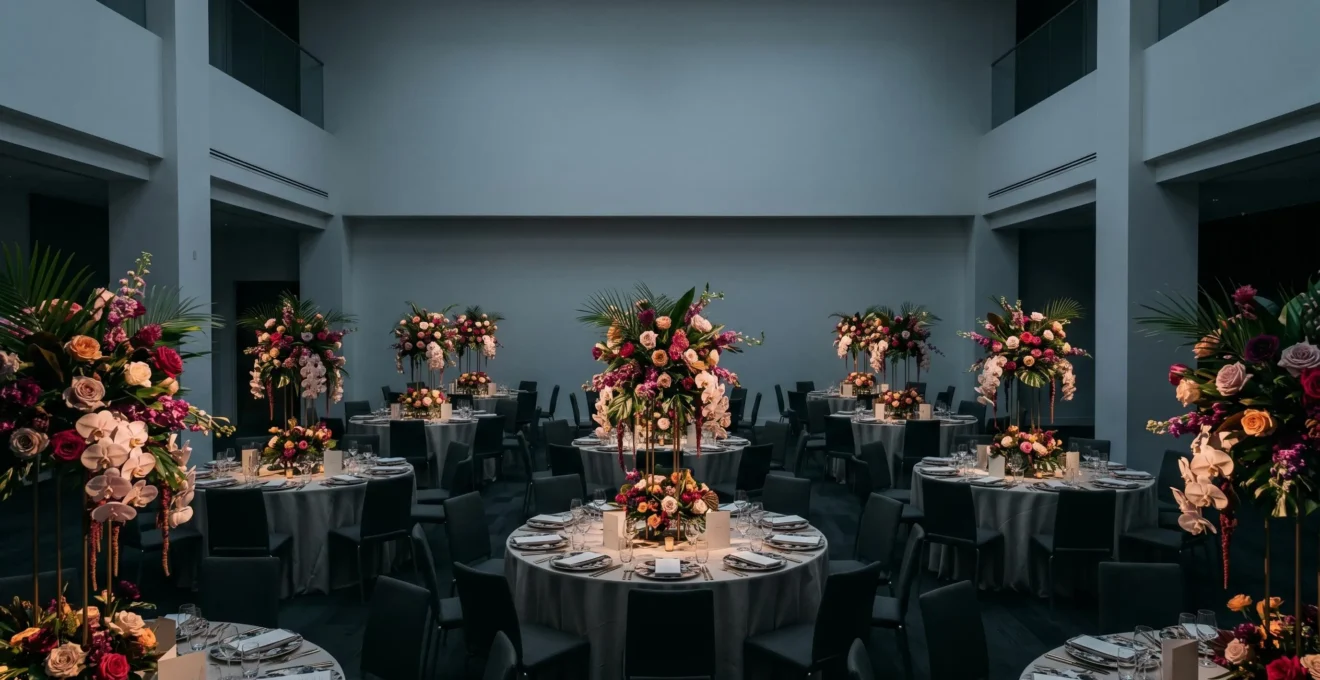
You’ve invested in stunning, expensive floral centrepieces, yet your reception lacks the ‘wow’ factor and guest feedback is lukewarm. The problem isn’t the quality of your flowers; it’s the strategy. This guide reveals that memorable events are built on a ‘floral journey’—a series of choreographed moments that engage guests from entry to exit. Instead of focusing budget on static tables, you’ll learn to map the guest experience and place high-impact arrangements at key touchpoints, creating a dynamic and unforgettable atmosphere.
You’ve felt it before: the slight deflation when you walk into a reception you’ve poured your heart and budget into, only to sense that the atmosphere is… fine. Not magical, just fine. You opted for lavish, expensive floral centrepieces, believing they were the cornerstone of an elegant affair. Yet, the energy feels static, the compliments are polite but not effusive, and the space somehow feels less than the sum of its parts. This is a common frustration for hosts who rightly believe that beautiful flowers should create a beautiful experience.
The conventional wisdom tells us to focus on the dinner tables. After all, that’s where guests will spend a significant amount of time. But this approach overlooks a fundamental truth about human perception and how we experience a space. An event is not a static portrait; it’s a narrative, a journey your guests take from the moment they arrive. What if the key to unlocking that ‘wow’ factor wasn’t found in the centre of the table, but in the flow of the entire room? What if the secret lies not in the arrangements themselves, but in the experience *between* them?
This guide reframes the entire concept of event floristry. We will move away from the outdated focus on table decor and instead embrace the art of ‘experience choreography’. You will learn to think like a guest-experience designer, mapping out the natural pathways and psychological high points of your event. By understanding where and why certain moments matter more than others, you can create a cohesive floral journey that builds emotion, encourages interaction, and leaves a lasting impression far more powerful than any single, isolated centrepiece ever could.
In this article, we’ll deconstruct the elements of an effective floral strategy. From the psychology of first impressions to the practical risks of the wrong bloom, you’ll gain the insights needed to create a reception that feels as incredible as it looks.
Summary: Creating a Memorable Floral Experience for Your Guests
- Where to Place Florals for Maximum Impact: Entry, Bar, or Dinner Tables?
- Why Your Stunning Centrepiece Looks Lost in a Double-Height Venue?
- Which Reception Flowers Add Ambient Fragrance Without Overwhelming Dining Tables?
- The Lily Pollen Disaster That Stained 30 Wedding Guest Outfits
- How to Move Your Ceremony Arch to the Reception for Double Impact?
- Which Flowers to Avoid at a Conference: The Allergy and Scent Risks?
- Why Your Entrance Arch Generates More Social Media Than Your Centrepieces?
- How to Brief Your Florist for a 200-Guest Corporate Gala Without Overspending?
Where to Place Florals for Maximum Impact: Entry, Bar, or Dinner Tables?
The single biggest mistake in event floral design is assuming all locations are created equal. The belief that the dinner table is the prime real estate for your floral budget is precisely why many receptions feel underwhelming. The guest experience isn’t static; it’s a story with a beginning, middle, and end. To understand where to invest, we must look at the psychology of memory. It’s a concept that modern event planners are embracing, with a recent study showing that 75% of couples now prioritize the guest experience above all else.
The key lies in the “Peak-End Rule,” a psychological heuristic that explains how we remember an experience. As pioneering researchers Daniel Kahneman and Barbara Fredrickson established, our memory of an event is not an average of every moment. Instead, we disproportionately weight two things: the most emotionally intense point (the “peak”) and the very end. As they state in their foundational research:
people judge experiences based on two key moments: the peak (the most intense point) and the end
– Daniel Kahneman and Barbara Fredrickson, Peak-End Rule psychological research
In a reception context, this translates to three critical zones: the entrance (the beginning), the bar (a guaranteed “peak” moment of social gathering and reward), and the exit (the end). A breathtaking entrance arrangement makes an immediate, powerful first impression. A stunning installation over the bar creates a memorable social hub. The dinner table, by contrast, is the “middle.” It’s important, but it’s not where lasting memories are forged. By reallocating a portion of the centrepiece budget to these peak-end zones, you are designing for memory, not just for aesthetics.
Why Your Stunning Centrepiece Looks Lost in a Double-Height Venue?
Another common reason for a “flat” reception is a failure to engage in a dialogue with the venue’s architecture. You can have the most beautiful, lush centrepiece, but if it’s sitting on a table in a room with a 30-foot ceiling, it becomes a whisper in a cathedral. It gets visually lost, its impact completely swallowed by the sheer volume of negative space above it. This is a problem of scale and proportion. The human eye perceives things in relation to their surroundings. A low arrangement in a grand hall makes the room feel even bigger and emptier, rather than creating the intimate, luxurious atmosphere you intended.
The solution is not to make the centrepiece bigger, but to think vertically. You must “activate” the unused vertical volume of the room. This is where suspended floral installations, or “floral chandeliers,” become one of the most powerful tools in an event designer’s arsenal. By drawing the eye upward, you do several things at once: you make the large space feel more intimate and cohesive, you create a dramatic focal point that feels grand and intentional, and you free up valuable table space for conversation and dining. Strategic uplighting or pin-spotting on these overhead arrangements can further enhance the effect, making them appear to float in the space.
While seemingly extravagant, a single, spectacular suspended piece can often have more impact than dozens of smaller table arrangements for a similar budget. It’s a statement of confidence that works *with* the architecture, not against it. As one real-world case study shows, a suspended installation is not just about flowers; it’s an engineering and lighting project. The budget for a Maui wedding’s 10-foot installation revealed that rigging, labour, and breakdown were significant costs, proving that this is a strategic choice for maximum impact, not a simple floral order.
Which Reception Flowers Add Ambient Fragrance Without Overwhelming Dining Tables?
A truly immersive experience engages more than just the eyes. Scent is one of the most powerful and primitive senses, directly linked to memory and emotion. A strategically chosen fragrance can elevate a reception from simply beautiful to utterly unforgettable. However, this is a double-edged sword. The goal is ambient fragrance, not an olfactory assault. The most common mistake is placing highly fragrant flowers, like lilies or hyacinths, on dining tables.
When a floral scent has to compete with the aroma of food and wine, it creates a confusing and often unpleasant sensory clash. A guest trying to appreciate the delicate notes of a pinot noir or the herbs in their main course doesn’t want to be overwhelmed by the heavy perfume of a Stargazer lily. As research into sensory marketing confirms, scent must be congruent with the environment to be perceived positively. An academic study on the topic notes that even a pleasant scent can be negative if it feels out of place, citing the example of “floral scents in a bicycle shop.” The same logic applies to a dining table.
So, how do you create a beautiful scent-scape?
- Zone Your Scents: Place more heavily scented flowers like gardenias, freesias, or tuberoses at the entrance, in lounge areas, or near restrooms—spaces where they can be appreciated without competing with food.
- Choose Wisely for Tables: For centrepieces, opt for flowers with a light, clean, or “green” fragrance. Think of delicate sweet peas, ranunculus, or certain varieties of roses. Peonies offer a lovely scent that is generally considered complementary to dining.
- Consider Scented Greenery: Don’t forget foliage! Eucalyptus, mint, or rosemary can add a wonderfully fresh and subtle aromatic layer that enhances, rather than overpowers, the dining experience.
The key is subtlety and context. The right scent in the right place creates an invisible layer of luxury. The wrong scent creates a memorable experience for all the wrong reasons.
The Lily Pollen Disaster That Stained 30 Wedding Guest Outfits
Beyond fragrance, flowers carry physical risks that can turn a dream reception into a dry-cleaning nightmare. The most notorious culprit is the beautiful but treacherous lily. Its anthers are loaded with a fine, rust-coloured pollen that is notoriously difficult to remove from fabric. The pollen contains an oily substance called pollenkitt, which is designed to stick to pollinators—and, unfortunately, to the silks, satins, and wools of your guests’ expensive outfits. A single brush against a lily-heavy arrangement at the bar or in a narrow hallway can result in a permanent stain, creating a negative “peak” moment that will overshadow all other positive memories.
This isn’t just a theoretical risk. Event planners have horror stories of bride’s maids with yellow streaks down their dresses and dozens of guests leaving with tell-tale smudges. The solution is not to ban lilies entirely, but to insist on meticulous preparation. A professional florist should manually remove the anthers from every single lily bloom before it’s used in an arrangement, a process known as ‘de-pollening’. This should be a non-negotiable point in your floral brief. This simple act of care mitigates a massive risk to your guests’ experience and attire.
Pollen is just one of many potential hazards. Dripping sap from foraged branches, shedding debris from sunflowers, or even thorns left on rose stems in a crowded area can all create problems. A proactive approach to floral risk management demonstrates a high level of care for your guests, a subtle but powerful element of a luxury experience. It’s about anticipating problems so your guests don’t have to.
Your Floral Risk Mitigation Checklist
- Lily Anther Removal: Confirm with your florist that all lily anthers will be removed before the flowers open. The oily pollenkitt bonds instantly to fabric fibers.
- Pollen Stain Protocol: Know the counter-intuitive first aid: Never use water on pollen stains. Water emulsifies the oils and sets the stain permanently. Instead, use sticky tape to lift the dry pollen off the fabric.
- Sap & Debris Containment: Ensure foraged branches are properly sleeved at the base to contain sap. Request that high-shed flowers like sunflowers are shaken and blown out before assembly to remove loose debris.
- Installation Dripping: Ask your florist a direct question: “How do you guarantee that hanging installations or arrangements in floral foam will not drip water onto my guests or the dance floor?”
- Thorn and Hazard Check: Specify that any arrangements placed in high-traffic, narrow, or crowded areas (like bar tops or entryways) must be completely free of thorns or sharp branches.
How to Move Your Ceremony Arch to the Reception for Double Impact?
In a world of rising event costs, the idea of “repurposing” your ceremony flowers for the reception is incredibly appealing. The most common target for this strategy is the ceremony arch or chuppah—a large, impactful piece that seems a waste to use for only 30 minutes. Moving it behind the top table or as a photo booth backdrop sounds like a brilliant, budget-saving move. However, the reality is far more complex than simply picking it up and carrying it over.
A large-scale floral installation is not a vase of flowers; it’s a piece of temporary architecture. It is often constructed on-site from heavy bases, intricate mechanics like chicken wire, and water-soaked floral foam. Moving it without it falling apart requires a dedicated team, specific equipment, and, most importantly, time. This “room flip” time often happens while your guests are enjoying a cocktail hour, a period when your floral team’s labour is at a premium. As a result, the cost to have a team stay on-site, carefully deconstruct, move, and reinstall the piece can sometimes approach the cost of a separate, simpler arrangement for the reception.
Expert floral designers who specialize in these structures confirm this. Winnipeg-based Stone House Creative explains that structures designed for repurposing are built differently from the start, using modular mechanics like wood lattice and airline cables. Their case study on the topic reveals that the logistics are significant, often requiring scissor lift licenses and coordination with lighting companies for support rigging. This isn’t a job for a couple of helpful groomsmen. Another expert source bluntly states you should budget an extra couple thousand dollars for any suspended installation, a cost that applies equally to moving one. Before you commit to the “repurpose” plan, ask your florist for a detailed logistical quote. You may find that two separate, strategically designed pieces offer better value and less risk than one high-maintenance, mobile one.
Which Flowers to Avoid at a Conference: The Allergy and Scent Risks?
The principles of a thoughtful floral journey extend beyond weddings to the corporate world, where the stakes of guest comfort are just as high. While you might not be worried about staining a wedding dress, you should be deeply concerned with allergies and sensory overload in an enclosed, air-conditioned conference room. A beautiful arrangement that triggers a keynote speaker’s allergies or gives attendees headaches is a failure, no matter how good it looks.
The primary culprits are flowers with high pollen counts and extremely strong fragrances. In a professional setting, an overpowering scent can be distracting and even mimic the symptoms of “Sick Building Syndrome,” leading to complaints of headaches and nausea. This directly impacts attendees’ ability to focus and network. The hospitality industry has long understood the power of scent, with research revealing that 91% of hotel guests said a pleasant smell had a positive impact on their experience. The key is that the smell must be *pleasant and subtle*, not overwhelming. For corporate events, the safest path is to assume a “hypoallergenic” approach.
Your florist should be able to guide you toward low-risk options. This means prioritizing flowers with little to no scent and low pollen, such as orchids, anemones, and calla lilies. Flowers like hydrangeas and chrysanthemums fall into a medium-risk category, often cited as allergens. High-risk flowers like Stargazer lilies, freesias, and hyacinths should be avoided entirely in enclosed meeting spaces. Briefing your florist on a “low-scent, low-pollen” mandate is a sign of a sophisticated planner who prioritizes attendee well-being.
The following table, adapted from event design best practices, offers a clear framework for making safe and smart choices for a corporate setting.
| Risk Level | Flower Types | Primary Concerns | Recommended Use |
|---|---|---|---|
| Low-Risk | Orchids, Roses (de-pollened), Anemones | Minimal scent, low pollen, non-toxic | Safe for all corporate settings including dining areas |
| Medium-Risk | Hydrangeas, Baby’s Breath, Chrysanthemums | Often cited as allergens, moderate scent | Use in well-ventilated entrance areas, avoid breakout rooms |
| High-Risk | Lilies, Freesias, Hyacinths, Stargazer Lilies | Strong fragrance mimics Sick Building Syndrome, high pollen | Avoid in enclosed air-conditioned conference rooms entirely |
Why Your Entrance Arch Generates More Social Media Than Your Centrepieces?
If you’ve ever noticed that the entrance arch gets far more attention on Instagram than your carefully curated tablescapes, you’ve witnessed a key principle of guest psychology in action. This isn’t an accident; it’s a predictable outcome based on the science of how people use space. The entrance is what sociologists call a “social choke point.” It’s a natural gathering spot where guests arrive, greet one another, wait for others, and orient themselves. This moment is charged with anticipation and social energy.
This phenomenon is explained by the study of Proxemics, a term coined by anthropologist Edward T. Hall to describe how humans use physical space. As one expert on wedding psychology notes, this science is critical to understanding guest behaviour. The entrance is a “natural gathering and waiting spot,” making it a prime location for interaction—and for taking photos. Guests are fresh, excited, and looking for the first “wow” moment to capture and share. A stunning floral installation at the entrance provides the perfect backdrop, signaling the quality and style of the event to come. In fact, The Knot’s 2023 Real Weddings Study found that 62% of Gen-Z couples are opting for grand entrances/exits, a 14-point increase that shows a clear trend toward valuing these “journey” moments.
By the time guests are seated for dinner, this initial energy has dissipated. They are focused on conversation, food, and drink. The centrepiece becomes part of the background ambiance, but it’s no longer the main event. It’s not a primary moment for social media sharing. Therefore, from a purely strategic standpoint, investing in a highly “shareable” entrance moment provides a far greater return in terms of guest excitement and online buzz than investing the same amount spread across 20 tables.
Proxemics—the study of how humans use physical space in social interactions—plays a crucial role in wedding seating chart development. The entrance is a social choke point, a natural gathering and waiting spot
– Bridesmaid For Hire (referencing Edward T. Hall), Psychology of Wedding Seating Charts
This isn’t to say centrepieces aren’t important. They are. But understanding the psychology of guest flow allows you to allocate your budget more intelligently, ensuring you create those high-impact, memorable—and shareable—moments that define a truly great event.
Key Takeaways
- Guest experience is a journey; focus on ‘peak’ moments like the entrance and bar, not just the dinner table ‘middle’.
- Work with your venue’s architecture by using vertical space with suspended florals to make large rooms feel intimate and impactful.
- Use scent strategically—place fragrant flowers in entryways and choose low-scent options for dining tables to avoid sensory clashes.
How to Brief Your Florist for a 200-Guest Corporate Gala Without Overspending?
You have now grasped the core principles of experience choreography: designing for the guest journey, respecting the venue’s architecture, and managing sensory inputs like scent and risk. The final step is translating this knowledge into a clear, effective, and budget-conscious brief for your florist. The traditional method of sending a simple list—”20 centrepieces, 1 bar arrangement, 2 entrance pieces”—is the root cause of so many underwhelming outcomes. It encourages a “paint-by-numbers” approach rather than a creative, strategic partnership.
To get the most value from your budget, you must shift the conversation from a list of items to a statement of objectives. Your brief should start with the goal: “Our objective is to create an atmosphere of sophisticated luxury for 200 guests. Our key guest journey moments are the main entrance and the central circular bar. Our budget is X. How can we best achieve our objective with this budget?” This reframes the florist from a simple vendor to a creative consultant. It invites them to propose solutions you may not have considered, like one spectacular bar installation instead of 20 forgettable table arrangements.
Embrace the “Impact vs. Quantity” principle. Three massive, show-stopping arrangements in high-traffic, high-impact zones will generate far more conversation and memory than 25 small, polite centrepieces for the same cost. To facilitate this, ask for quotes in ‘Good, Better, Best’ tiers for your main statement pieces. This allows you to see where your money has the most effect and which elements can be scaled back without compromising the overall vision. Finally, always include a visual mood board with your brief. Words like ‘lush’ or ‘modern’ are subjective. Pictures of your venue, approved colour palettes, and examples of floral textures will ensure you and your florist share the exact same vision. This strategic briefing process is the single most effective tool for ensuring your floral investment pays off in guest experience.
By shifting your focus from static objects to a dynamic journey, you can choreograph a floral experience that resonates with guests long after the last petal has fallen. Begin planning your event’s floral narrative today to ensure your investment creates not just a beautiful room, but a lasting memory.