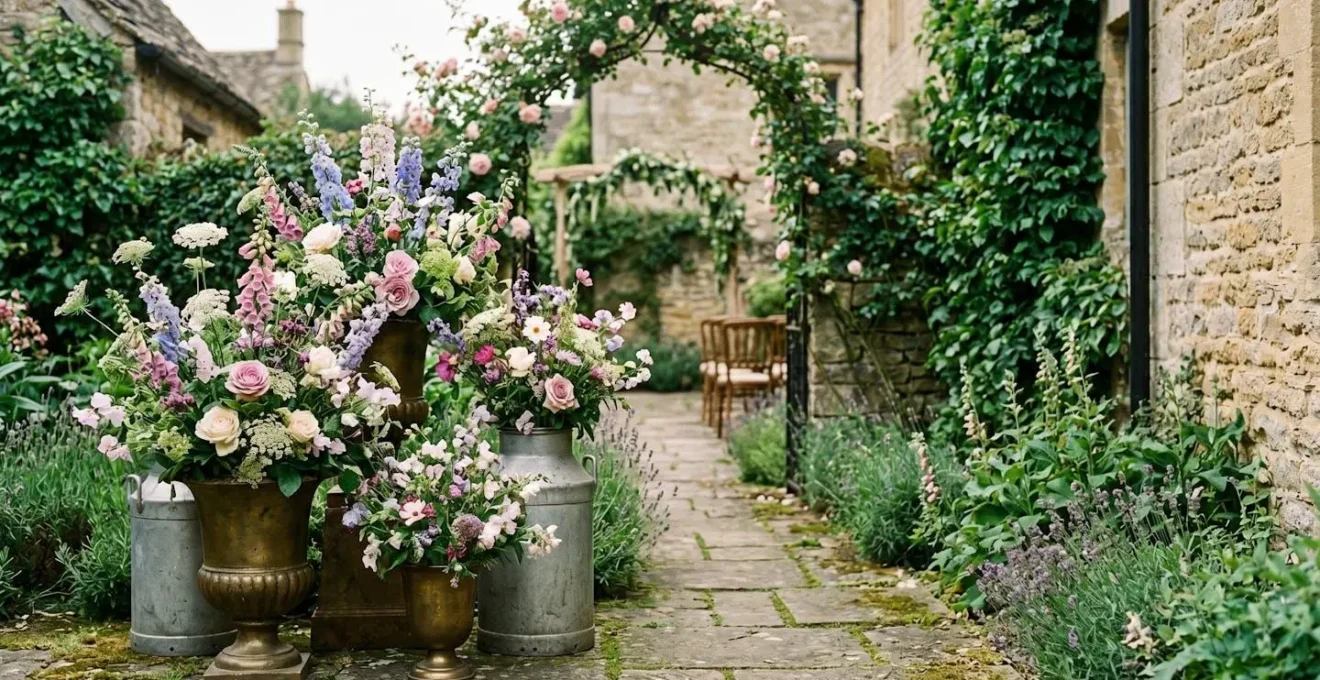
Achieving a luxurious English cottage garden wedding look is not about a massive budget, but about mastering specific design principles and resourceful sourcing.
- The authentic feel comes from “curated imperfection” and varying bloom sizes, not expensive flowers alone.
- Sustainable, foam-free mechanics like chicken wire are key to a natural, “just-picked” aesthetic.
Recommendation: Focus your spending on one or two “hero” blooms and use budget-friendly, period-appropriate fillers to create an opulent look for less.
That vision of a romantic English cottage garden wedding—abundant, soft, and spilling over with nostalgic blooms—is a beautiful dream. You can almost smell the sweet peas and see the peonies nodding in the breeze. But then, reality hits. You see jaw-dropping floral installations on Pinterest, followed by quotes that feel more like a down payment on a house than a wedding decor budget. The common advice is to “use seasonal flowers” or “DIY it,” but that often leads to arrangements that look less like a heritage-inspired dream and more like a well-meaning but amateur attempt.
But what if the secret wasn’t about simply finding cheaper flowers, but about understanding the very soul of the cottage garden itself? The key isn’t a limitless budget; it’s a shift in philosophy. It’s about embracing what I call “curated imperfection” and learning the resourceful techniques that make inexpensive flowers look utterly luxurious. This isn’t about cutting corners; it’s about being clever, strategic, and channelling the spirit of a 1920s gardener who created beauty from what was on hand.
This guide will walk you through the very principles a vintage wedding specialist uses. We’ll explore which flowers instantly evoke that old-fashioned charm, where to source authentic vessels without breaking the bank, and the design secrets that create breathtaking visual movement. We’ll uncover the one mistake that makes vintage florals look jarringly modern and teach you how to create an atmosphere that feels rich and layered, proving that an unforgettable look is born from artistry and knowledge, not just expenditure.
This article provides a complete roadmap to achieving your floral dreams. The following summary outlines the key strategies we will explore, from choosing the right blooms to creating a truly atmospheric reception.
Summary: Your Guide to a Budget-Wise Cottage Garden Wedding
- Which 5 Old-Fashioned Flowers Instantly Create a 1920s English Garden Feeling?
- Where to Find Vintage Brass Urns and Milk Churns for Wedding Florals in the UK?
- Why Varying Bloom Sizes From Spray Roses to Delphiniums Creates Visual Movement?
- The Overworked Arrangement Mistake That Makes Vintage Florals Look Modern?
- How to Schedule Bloom Purchases for DIY Dried Petal Confetti 3 Weeks Ahead?
- Why David Austin Roses Take 15 Years to Breed and Cost Accordingly?
- Why Does Your Reception Feel Flat Despite Expensive Centrepieces?
- What Flowers Symbolise 25 Years of Marriage Beyond the Obvious Silver Theme?
Which 5 Old-Fashioned Flowers Instantly Create a 1920s English Garden Feeling?
To capture that authentic 1920s English garden atmosphere, you must think like a gardener of the era. The look is not just about colour, but about scent, texture, and form. It’s about choosing flowers that feel like they were just gathered from a rambling, well-loved garden. Forget fleeting trends; these five floral archetypes are the cornerstones of a timeless, nostalgic aesthetic. They represent a “working garden” beauty, where every plant had a purpose, from fragrance to structure.
Building your floral palette around these categories ensures a result that feels layered, authentic, and effortlessly romantic. This isn’t just a list of flowers; it’s a recipe for atmosphere:
- The Scent Base: Start with intensely fragrant flowers. Sweet peas are the absolute mainstay of a cottage garden, their perfume instantly transporting you. Pair them with Stocks for a rich, authentic scent profile that fills the air.
- The Architectural Hero: Every garden needs height and drama. Use tall, stately blooms like delphiniums or hollyhocks. Their vertical spires can reach impressive heights, providing a grand but natural structure that modern, rounded bouquets often lack.
- The Romantic Heart: This is your sumptuous, show-stopping bloom. Think old-fashioned cabbage roses or peonies. Their dense, layered petals provide a luxurious focal point and a soft, romantic texture that feels truly vintage.
- The Ethereal Whisper: To prevent arrangements from looking too heavy, you need delicate, airy elements. Flowers like cosmos, scabiosa, or love-in-a-mist on their slender, nodding stems add a touch of wildness and light.
- The Authentic Foliage: Don’t just use standard greenery. Incorporate foliage that feels historic and functional. Chamomile, fragrant lavender, or even raspberry leaves add a unique texture and scent that grounds your arrangements in an authentic working-garden aesthetic.
Real Wedding Inspiration: A 1920s Larmer Tree Gardens Wedding
To see this in practice, look at a real wedding held at the historic Larmer Tree Gardens in Wiltshire. The bride specifically requested ‘English country garden’ flowers to complement the venue’s 19th-century architecture and peacock-filled meadows. The arrangements featured a beautiful mix of peonies, roses, fragrant freesias, and delicate astrantia. This demonstrates how selecting period-appropriate blooms creates an authentic heritage atmosphere without needing an enormous budget, simply through strategic and thoughtful variety selection.
Where to Find Vintage Brass Urns and Milk Churns for Wedding Florals in the UK?
The secret to a high-end vintage look often lies in the vessels. The right container can elevate even the simplest bunch of flowers into a work of art. Gleaming brass urns, rustic milk churns, and weathered terracotta pots are the soul of the cottage garden style. But acquiring a collection for your wedding day can be expensive and a logistical headache. The savvy bride doesn’t buy; she sources strategically. This is where your resourcefulness truly shines, giving you a designer look for a fraction of the cost.
Before you start endlessly scrolling through online marketplaces, consider a multi-pronged approach to find the perfect vessels for your UK wedding. Here are four paths to explore, plus a clever DIY alternative:
- Hire from Specialists: The most stress-free option. UK-based wedding prop hire companies are a goldmine. For example, some companies allow you to hire classic urn pairs, and their service often includes delivery on the morning of the wedding and collection the next day, completely eliminating transport and storage hassles. Specialist vintage dealers like Dress It Yourself also offer specific items like rusty metal urns, perfect for a boho-vintage theme.
- Explore Vintage Marketplaces: Websites like Etsy UK and Chairish are excellent for finding unique, curated vintage brass urns. Look for sellers with strong reviews to ensure authenticity and quality. This path is great if you want to own a few special pieces as a memento after the wedding.
- Think Outside the Box: Theatre Props: This is a brilliant and often overlooked resource. Local drama departments and professional theatre companies have extensive prop stores. They frequently rent out authentic, heavy-duty urns and other period vessels for a fraction of what they would cost to buy or even hire from a wedding supplier.
- The Savvy DIY Alternative: If your budget is tight, don’t despair. You can achieve a convincing weathered-brass or aged-stone effect on a budget. Purchase inexpensive terracotta or even plastic urns and transform them. Use metallic finishes like Rub ‘n’ Buff or experiment with chalk paints and dark waxes to create a beautifully aged patina.
Why Varying Bloom Sizes From Spray Roses to Delphiniums Creates Visual Movement?
Have you ever seen a floral arrangement that, despite being full of beautiful flowers, felt a bit… flat? The reason is often a lack of variation. The modern tendency is to create tight, dome-shaped bouquets where every flower is the same size and at the same level. An authentic cottage garden look, however, is all about creating visual movement. It’s the art of making a static arrangement feel alive, as if it’s still growing and dancing in a gentle breeze.
This is achieved by applying a classic design principle, borrowed from container gardening, known as “Thrillers, Fillers, and Spillers.” It’s a simple but transformative concept that creates a natural hierarchy and three-dimensional depth, tricking the eye into seeing a much more opulent and mature arrangement than the sum of its parts.
As the illustration demonstrates, this technique is about assigning a role to each flower based on its shape and size. As Fine Gardening’s design principle explains, the roles are clear:
- Thrillers: These are your tall, dramatic, eye-catching elements. In a cottage garden arrangement, this would be your soaring delphiniums, foxgloves, or larkspur. They provide the vertical height and the main focal point that draws the eye upwards.
- Fillers: These are the rounded, voluminous blooms that create fullness and support the thriller. They surround the main event. Think of your cabbage roses, peonies, or clusters of spray roses. They are the heart of the arrangement.
- Spillers: These are the trailing elements that soften the edges of the container and link the arrangement to its setting. Cascading jasmine, trailing ivy, or evenclematis vines break up the hard lines of the vase and create a graceful, romantic overflow.
By consciously combining these three types of blooms, you create an arrangement with layers, depth, and a dynamic flow. This visual movement is the absolute key to preventing a flat, modern look and instead achieving that coveted, naturally abundant cottage garden style.
The Overworked Arrangement Mistake That Makes Vintage Florals Look Modern?
The single biggest mistake that can sabotage a vintage floral aesthetic is overworking the arrangement. The culprit is almost always the same: a reliance on floral foam. This green block, a florist staple for decades, encourages a very specific style of arranging: stems are cut short, inserted rigidly, and packed tightly together. The result is a dense, static, and often perfectly symmetrical dome—the exact opposite of the loose, airy, and natural feel of a cottage garden.
To achieve an authentic “just-picked” look, you must abandon this rigid structure and embrace techniques that allow flowers to have their own space and natural grace. This is the heart of “curated imperfection.” The goal is to make the arrangement look as if you barely touched it, even though the technique is deliberate and skilled. It means seeking out crooked stems and nodding flower heads, not discarding them as flaws. Fortunately, there are several sustainable, foam-free alternatives that are not only better for the environment but are also the secret to a truly vintage flow.
- Chicken Wire (Wire Mesh): This is the vintage florist’s best friend. Create a loose ball of chicken wire and place it inside your vessel. This forms a grid-like structure that you can insert stems into. It allows for a much more natural, organic placement, as the stems have room to move and fall as they would in a garden.
- Pin Frogs (Kenzan): These are heavy metal discs with sharp pins that sit at the bottom of a shallow vase. They are perfect for more minimalist, Japanese-inspired arrangements (ikebana), but can be wonderfully effective for securing a few key stems in a cottage garden design, encouraging looser, more organic placement.
- Plant-Based Foam Alternatives: The industry is evolving. For instance, according to the British Florist Association, new options are emerging, such as a plant-based foam launched in early 2025 that provides a similar feel to traditional foam without the petroleum base.
- The ‘One-Touch’ Method: This is more of a philosophy than a tool. Start by creating a framework with your foliage. Then, as you add your flowers, turn the vase, and try to place each stem only once. Constantly re-working and moving stems leads to a bruised, tired-looking arrangement. Trust your initial instincts to maintain an effortless look.
Your Checklist for an Authentic Vintage Look
- Points of contact: Check for varied heights. Does your arrangement clearly feature thriller, filler, and spiller elements to guide the eye?
- Collecte: Inventory your stems. Are there any “too perfect” stems? Actively seek out and use some naturally crooked or bent stems to create organic lines.
- Cohérence: Does the arrangement feel loose and airy, or is it a tight, compacted dome? Step back and check for “breathing room” or negative space between blooms.
- Mémorabilité/émotion: Identify your most beautiful “hero” bloom. Is it given space to be the star, or is it crowded by other flowers?
- Plan d’intégration: Turn the arrangement 360 degrees. Does it look beautiful and intentional from all angles, or is it a purely front-facing design? Gently adjust stems to ensure beauty all around.
How to Schedule Bloom Purchases for DIY Dried Petal Confetti 3 Weeks Ahead?
There’s nothing more charming than being showered with real, fragrant flower petals as you walk back down the aisle. But pre-made petal confetti can be surprisingly expensive. Creating your own is a wonderfully personal and budget-savvy project, but it requires a little forward planning. You can’t simply buy flowers the week before and expect them to be ready. A strategic timeline, starting about three weeks out, will ensure you have beautiful, colourful confetti without the last-minute stress or a hefty bill.
This is a perfect project for maximising value and embracing a no-waste philosophy. By planning ahead, you can source flowers at their cheapest or even for free, and give them a second life as a beautiful wedding detail. Here is a sample timeline strategy for your DIY confetti preparation:
- Week 1 (3 Weeks Before): The Savvy Scavenge. This is your most important week for budget sourcing. Contact local florists and even the floral departments at supermarkets. Ask if they have any “blown” (fully open and therefore unsellable) or day-old flowers that they would be willing to give you for free or at a very deep discount. These are perfect for immediate drying.
- Week 2 (2 Weeks Before): The Double-Duty Strategy. If you’re having a bridal shower or any other pre-wedding event, purchase flowers in bud for the occasion. Enjoy them at the event, and then as they begin to fade, harvest the petals for drying. This approach gets double the value from a single purchase.
- Weeks 2-3: The Drying Process. Your drying method will depend on the flower. For vibrant colours, especially with rose petals, the microwave method using silica gel is fantastic for preserving hues. For hardier flowers like larkspur or statice, simple air-drying in a warm, dark place works beautifully and ensures your confetti is colourful, not brown.
- Week 3 (1 Week Before): The Colour-Retention Boost. To ensure your confetti mix is vibrant, supplement it with flowers known for holding their colour when dried. Statice (symbolising remembrance), strawflower (everlasting love), and fragrant lavender are all excellent choices. You can also add dried wheat for a rustic texture.
- Final Days: Proper Storage. Once all your petals are crisp and dry, the final step is crucial. Store them in a cool, dry place inside breathable fabric or paper bags. Avoid plastic, as it can trap residual moisture and cause the petals to spoil before the big day.
Why David Austin Roses Take 15 Years to Breed and Cost Accordingly?
When planning a budget-friendly wedding, it can be tempting to dismiss premium blooms like David Austin roses as an unnecessary extravagance. It’s true they come with a higher price tag, but understanding *why* is key to using them strategically. These aren’t just any roses. A David Austin rose is the result of a painstaking breeding process that can take up to 15 years per variety. This involves hundreds of thousands of cross-pollinations to achieve their signature cupped shape, complex fragrance, and nostalgic, multi-petalled appearance—the very essence of a bygone era.
This long-term investment in artistry and horticulture is reflected in their cost. But for the vintage bride, they are an icon. The good news is, you don’t need a bouquet overflowing with them to capture their magic. This is where the “Hero Bloom Strategy” comes into play—a clever way to get the luxury look without the luxury price tag.
a single, perfect David Austin rose placed in the bride’s bouquet instantly elevates the entire arrangement, making all the surrounding, less expensive flowers look more luxurious by association
– Hidden Botanics Weddings, Vintage Wedding Flowers and Bouquets Design Guide
This quote perfectly encapsulates the strategy. Instead of forgoing your dream rose, you simply use it with intention. Here’s how to make a single splurge work for you:
- The Single Splurge: The most effective strategy is to purchase just one or a few perfect David Austin stems for the most important arrangement: your bouquet. This “hero” bloom becomes the star, and you can then fill 80% of the arrangement with more affordable filler flowers and foliage that complement it.
- Know Your Dupes: If even one stem is out of reach, learn to spot a good “dupe.” Look for fully-bloomed spray rose clusters or standard garden roses that have a similar cupped shape and antique colour palette. When nestled amongst other flowers, they can give a very similar impression for a fraction of the cost.
- The Living Memento: This is a wonderfully romantic and sustainable approach. Purchase a single David Austin rose bush from a garden centre. Use a few of its precious blooms for your wedding day, and then plant the bush in your garden (or a pot) as a living symbol of your marriage, providing you with anniversary flowers for years to come.
Why Does Your Reception Feel Flat Despite Expensive Centrepieces?
It’s a common wedding planning trap: you allocate a significant portion of your floral budget to beautiful, expensive centrepieces for each table, yet on the day, the room still feels… lacking. It feels flat, missing that magical, immersive atmosphere you were dreaming of. The reason is that a great atmosphere is rarely created by a single element, no matter how lovely. A truly romantic and memorable reception space is built on layers of sensory details.
Instead of focusing all your attention and budget on one style of centrepiece, think in terms of the “Atmospheric Trinity.” This is my term for the three interwoven elements that create depth, warmth, and intimacy: varied floral heights, layered candlelight, and scattered sensory details. This approach creates multiple points of interest for the eye, making the entire room feel fuller and more thoughtfully designed.
Here’s how to build your atmosphere using this layered approach:
- Varied Floral Heights: Don’t put the same arrangement on every surface. Instead, create a mix. Have a few larger, taller “moment” pieces—perhaps in milk churns at the entrance or a large urn on the cake table. Then, on the guest tables, combine a modest central arrangement with a collection of tiny bud vases, each holding a single perfect bloom or a sprig of herbs. This creates high and low points, making the tablescape far more dynamic.
- Layered Candlelight: Candlelight is pure magic and the fastest way to create intimacy and a romantic glow. But don’t just use one type. Mix tall, elegant taper candles with chunky pillar candles of varying heights and scatter dozens of tea lights. The flickering light at multiple levels will create a beautiful, dappled effect that makes everything and everyone look wonderful.
- Scattered Sensory Details: The final layer is about the small things that delight the senses. Instead of just flowers, consider scattering sprigs of fragrant rosemary or lavender across the linen tablecloths. Small bowls of fresh berries or herbs not only add colour but a beautiful scent. These small, unexpected details are what guests remember and what makes a space feel truly personal and alive.
Key takeaways
- An authentic cottage garden look relies on “curated imperfection,” embracing natural, asymmetric forms over rigid perfection.
- Achieve a high-end feel on a budget by using the “Hero Bloom Strategy”—splurging on a few premium flowers and surrounding them with affordable, textural fillers.
- Create a dynamic, layered reception atmosphere by combining varied floral heights, multiple sources of candlelight, and scattered sensory details like herbs and foliage.
What Flowers Symbolise 25 Years of Marriage Beyond the Obvious Silver Theme?
While you are joyfully planning the very beginning of your marriage journey, it’s a romantic thought to consider the floral legacy you are creating. The flowers you choose for your wedding day can be the start of a beautiful tradition, a story that can be retold and reimagined for anniversaries to come. Looking ahead, for example, to a 25th “silver” anniversary, the traditional flower is the Iris. But a cottage garden approach allows for a much more creative and personal interpretation, one that connects directly back to the style of your wedding day.
Thinking about this now can infuse your wedding choices with even more meaning. You’re not just picking pretty flowers; you’re choosing the first chapter of your shared floral story. Instead of a generic “silver” themed bouquet in 25 years, imagine an arrangement that whispers of your wedding day. This can be done by focusing on symbolic longevity and foliage that nods to the theme, rather than being limited by it.
- An Everlasting Arrangement: Create a design using flowers celebrated for their longevity, both fresh and dried. Statice, which symbolises remembrance, and Strawflower, representing everlasting love, are perfect. They can be woven with silvery foliage like Eucalyptus or Dusty Miller to give a nod to the silver theme in a subtle, elegant way.
- Nostalgia Reimagined: The most powerful approach is to recreate a version of your original wedding bouquet. Imagine having a loose, cottage-garden arrangement made with the same types of roses, delphiniums, and sweet peas you carried down the aisle. It’s a potent and beautiful way to connect the past and the present.
- A Living Anniversary Gift: Instead of a fleeting bouquet, consider a living planter. A beautiful pot filled with plants featuring silver foliage, such as the soft, fuzzy leaves of Lamb’s Ear or Artemisia, mixed with the traditional 25th-anniversary Iris. This is a gift that continues to grow, just like a marriage.
- Symbolic Layers: Incorporate other meaningful blooms. The ethereal quality of Gypsophila (baby’s breath) represents everlasting love, while grand hydrangeas in muted, dusky tones echo the grand displays of the Victorian era, adding a layer of heritage and history.
By choosing flowers with a rich history and personal meaning for your wedding, you are planting a seed for future celebrations. You are creating a personal floral language that can be spoken for many happy years.
Now that you are armed with the philosophy and practical strategies of a vintage floral designer, you can approach your wedding flowers with confidence and creativity. You have the keys to create a look that is not only beautiful and romantic but also deeply personal and intelligently budgeted. Start by gathering inspiration, visiting local gardens, and talking to florists about your vision—not just what you want, but the feeling you want to create.