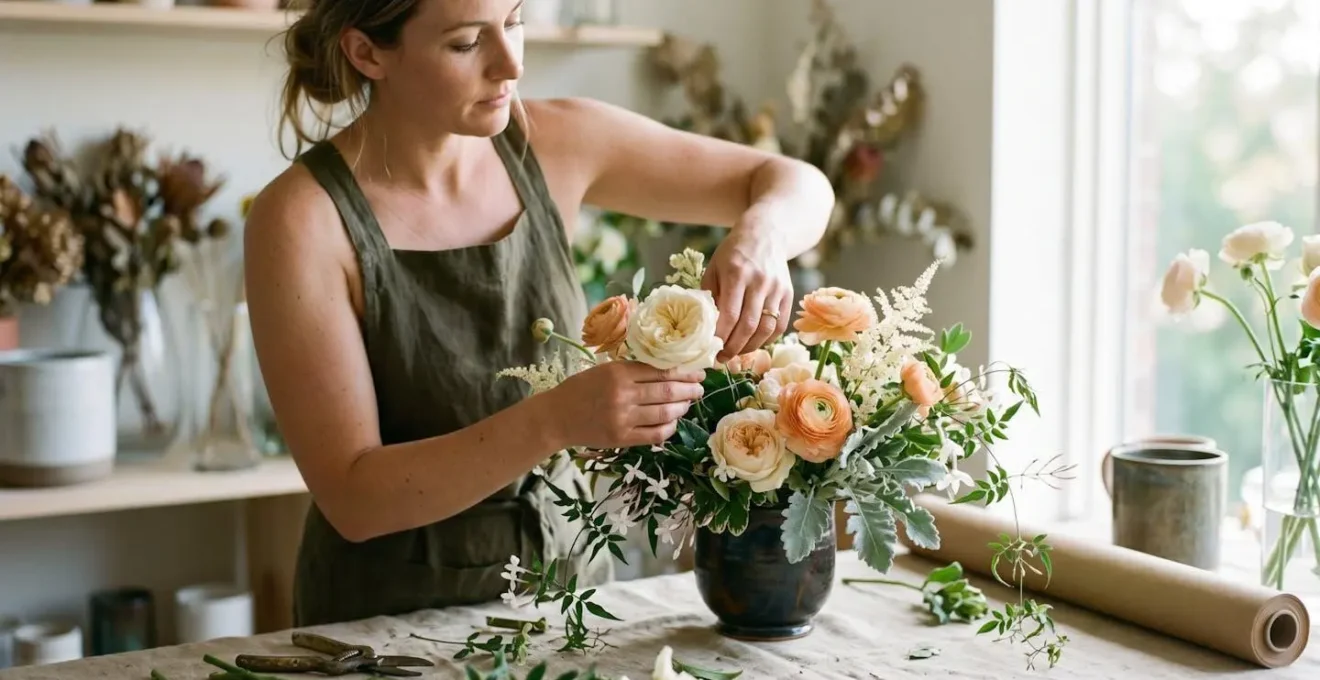
That five-figure floral quote isn’t a markup on “just flowers”; it’s the all-inclusive price for a flawlessly executed, ephemeral work of art.
- The majority of the cost covers the ‘invisible hours’ of specialised labour, complex logistics, and the high price of botanically superior, out-of-season blooms.
- Large-scale installations like floral arches require significant engineering, manpower, and on-site time, driving the budget far more than table centrepieces.
Recommendation: Approach your floral budget not as an expense, but as an investment in the expertise, peace of mind, and breathtaking photographic moments that define a luxury wedding experience.
When a quote for £15,000 lands in your inbox, the number can be staggering. You’ve scrolled through Pinterest, you’ve seen the beautiful images, but the reality of the price tag feels disconnected from the product. You find yourself asking a perfectly reasonable question: how can “just flowers” possibly cost this much? It’s a query I’ve addressed with many of my clients, from high-profile couples to families wanting an unforgettable celebration. The common assumption is that the cost is simply the price of the flowers themselves, marked up. This is the single biggest misconception in luxury floristry.
The truth is, the flowers are often just one component of a much larger, more complex equation. What you’re truly investing in is not just the blooms, but the logistical choreography, the artistic expertise, and the sheer manpower required to transform a space into a botanical masterpiece for a single, perfect day. My role isn’t just to arrange flowers; it’s to be a designer, an engineer, a project manager, and a crisis coordinator. We battle weather, fragile supply chains, and impossibly tight timelines. Your quote reflects the cost of mitigating every conceivable risk to deliver perfection.
This article will pull back the curtain on the world of high-end wedding floristry. We’re moving beyond the simple “cost per stem” and diving deep into the hidden mechanics of a luxury floral quote. This isn’t an apology for the price; it’s a transparent explanation of the value, skill, and immense effort it represents. By the end, you won’t just understand the cost—you’ll appreciate the art and science behind it, empowering you to have a far more insightful conversation with your floral designer.
To help you navigate this detailed breakdown, we will explore the specific elements that constitute a luxury floral budget, from the hidden labour costs to the strategic impact of large-scale installations.
Summary: Deconstructing the Cost of Luxury Wedding Florals
- Labour, Logistics, and Losses: The 3 Costs That Triple Luxury Wedding Flower Quotes?
- Why Ranunculus, Sweet Peas, and Café au Lait Dahlias Command £10+ per Stem?
- How Many Florists Does It Take to Install a £20,000 Wedding in 4 Hours?
- Why Pinterest Peonies Look Different From Your Wedding Day Flowers?
- How to Preserve Your £500 Bridal Bouquet for Lifelong Display?
- Where to Find Vintage Brass Urns and Milk Churns for Wedding Florals in the UK?
- Why Your Entrance Arch Generates More Social Media Than Your Centrepieces?
- How to Create an English Cottage Garden Wedding Look Without a £10,000 Budget?
Labour, Logistics, and Losses: The 3 Costs That Triple Luxury Wedding Flower Quotes?
The most significant part of your floral quote is what I call the ‘invisible hours’. This is the extensive work that happens long before your wedding day. It starts with our initial consultations, mood board creation, and detailed proposal writing, often involving multiple revisions. It then moves to sourcing—contacting growers across the world to secure the perfect shade of rose or a specific variety of eucalyptus. Then comes the complex logistics of ordering, shipping, and receiving hundreds, sometimes thousands, of delicate, perishable stems. Upon arrival, every single flower and piece of foliage must be carefully inspected, unboxed, and conditioned—a process of trimming, hydrating, and storing them in precise temperature-controlled environments to ensure they peak at the exact right moment.
This labour is not a small line item; it is the financial engine of the entire operation. In fact, industry data reveals that 25-30% of total revenue from a wedding goes directly to covering these comprehensive labour costs. It’s far more than just “arranging flowers.” A former accountant and floral industry finance expert, Paul Goodman, developed a formula to properly account for this. He explains that standard design-time calculations are insufficient for weddings. A luxury florist must charge for every phase: from the initial client meeting to the final, post-event teardown and cleanup.
His recommended hourly rate calculation demonstrates this complexity. For a designer paid £19/hour, the billable rate to the client needs to be around £44/hour. This multiplier isn’t profit; it covers taxes, insurance, studio overhead, vehicle costs, and the time spent on non-billable administrative tasks that are essential to the project’s success. This is the true cost of a seamless, stress-free service. When you see a high labour cost, you are seeing the price of guaranteed expertise and execution.
Why Ranunculus, Sweet Peas, and Café au Lait Dahlias Command £10+ per Stem?
Not all flowers are created equal. While a carnation or a standard rose might be relatively inexpensive, the blooms that define a luxury aesthetic—ethereal ranunculus with their paper-thin layers, fragrant sweet peas, or the coveted ‘Café au Lait’ dahlia—are in another league entirely. Their high price is a direct reflection of their difficulty to grow, fragility to ship, and short-lived seasonality. These are not mass-market commodities; they are horticultural specialities. A ‘Café au Lait’ dahlia, for instance, is prized for its dinner-plate size and unique, creamy-blush tones. Its delicate petals can bruise with the slightest mishandling, and its season is fleeting.
This botanical scarcity has a direct impact on cost. According to floral industry pricing data, a single stem of a dinner-plate dahlia can cost $4-$8 (£3-£6) at wholesale—and that’s before it even reaches the florist’s studio. By the time it’s sourced, shipped internationally, conditioned, and artistically placed in your arrangement, its value has compounded significantly. A single bridal bouquet might contain 15-20 of these premium stems, in addition to other costly flowers and foliage. The £500 price tag on that bouquet suddenly becomes a clear reflection of the quality of its ingredients.
Furthermore, achieving that perfect “blush” or “champagne” palette often means sourcing flowers out of their natural UK season, requiring refrigerated transport from Holland, Italy, or even South America. This global sourcing strategy ensures we can deliver on your vision, but it adds layers of cost for transport, import duties, and a higher percentage of potential loss or damage during transit, which must be factored into the overall budget.
As you can see from the intricate, layered structure of a premium bloom, its beauty is complex. This is the tangible quality you are investing in—a level of botanical alchemy that elevates an arrangement from simply “pretty” to a true work of art.
How Many Florists Does It Take to Install a £20,000 Wedding in 4 Hours?
A £20,000 wedding isn’t just about more flowers; it’s about executing large-scale, complex designs within an incredibly compressed timeframe. Venues often give suppliers a window of just a few hours for setup. In that time, a small army of skilled florists must unload vans, build massive structures, and place every arrangement perfectly. Imagine a team of 8-10 experienced designers working non-stop for four hours to construct a breathtaking floral arch, hang a 20-foot floral ceiling installation, and arrange 20 elaborate table centrepieces. This is not a task for one or two people.
The cost of this team—their wages, insurance, travel, and meals—is a significant part of the budget. Beyond the on-site team, there’s the design lead who has orchestrated the entire project. This leads to the concept of the ‘design fee’. Professional florists often add a design and administration fee of 30-50% on top of the product costs (flowers and materials) to cover their creative expertise, project management, and the financial risk involved. For a £20,000 project, this fee alone could be £5,000-£7,000, and it rightfully compensates the lead designer for the hundreds of hours of planning and the responsibility of managing a five-figure budget.
Furthermore, the pricing model in luxury floristry reflects these overheads. As the business platform Curate explains, it’s not as simple as doubling the wholesale price. Their expert advice highlights the necessary calculation:
Florists in higher cost-of-living markets or those positioned in the luxury segment often price at 4x to 5x wholesale cost. The key discipline here is pricing every stem, not rounding down.
– Curate (Wedding Florist Business Platform), Wedding Florist Pricing: The Math Behind Profitable Proposals
This 4-5x multiplier isn’t pure profit. It covers the wholesale cost of the flower, the labour to process and arrange it, its share of the studio overheads, the design fee, and a small profit margin. It’s a comprehensive formula that ensures the business is sustainable and the event is executed flawlessly. This is the logistical choreography in action, and it requires a significant, highly-skilled team.
Why Pinterest Peonies Look Different From Your Wedding Day Flowers?
Pinterest is a wonderful tool for inspiration, but it has also created a significant gap between expectation and reality. The images you see are often from styled photoshoots, not real weddings. They are shot by professional photographers using perfect lighting, and the images are then edited and colour-graded to enhance their beauty. That ‘dusty rose’ you fell in love with might not exist in nature; it’s the product of a specific photo filter. This digital perfection sets an impossibly high bar that drives up desire and, consequently, budgets. In fact, recent industry analysis shows that couples are paying up to 10 times the average amount for florals, largely influenced by the grand-scale installations they see on social media.
A key part of my job is to translate your Pinterest board into a tangible reality. This often means managing expectations about specific flowers. For example, peonies have an extremely short season in the UK (typically May-June). If your wedding is in September, sourcing them becomes incredibly difficult and expensive, and the quality may be inferior to in-season blooms. A good florist will suggest an alternative, like a garden rose, that provides a similar lush, romantic feel but is at its peak during your wedding month. This is where expertise and botanical knowledge are invaluable.
Moreover, the scale you see online can be misleading. A seemingly simple “wildflower” bouquet might look effortless, but to achieve that textured, multi-layered look, it could require 20-30 different types of flowers and foliage, each with its own price point. The ‘just-picked’ look is often more complex and costly to design than a traditional, structured arrangement. You are paying for the designer’s skill to make something highly technical look completely natural.
How to Preserve Your £500 Bridal Bouquet for Lifelong Display?
After investing so much thought, emotion, and budget into your wedding flowers, especially your bridal bouquet, it’s only natural to want to preserve them. A £500 bouquet is a work of art, and modern preservation techniques can transform it into a lasting keepsake. This is no longer about simply air-drying flowers upside down; it’s a sophisticated service that maintains the colour and shape of the original blooms. However, this process is an art and science in itself, and it comes with its own associated costs.
In the UK, you should expect to invest a significant amount to have this done professionally. According to UK-based specialists, professional preservation services in the UK typically charge between £300 to £650 for the preservation of a full bouquet, depending on the size and framing options. This price reflects a meticulous, multi-week process. It’s a delicate operation that must begin within 48 hours of the wedding to have any chance of success.
Case Study: The True Cost of Bouquet Preservation in the UK
A leading UK specialist, Precious Petals, provides a transparent breakdown of their service. The average cost for preserving and framing a hand-tied bouquet is around £468. This fee covers an intricate process: first, an assessment of the flowers, with any damaged blooms replaced at wholesale cost. Then, the flowers undergo a careful conditioning and preservation treatment. Finally, they are artistically rearranged and mounted in a custom frame with UV-protective conservation glass to prevent fading. Optional extras like engraved nameplates can add to the final cost. This detailed service transforms your bouquet from a temporary joy into a permanent piece of personal art.
To ensure the best results, it’s crucial to plan for preservation in advance. Designate someone—a bridesmaid or family member—to be responsible for getting the bouquet to the preservation company immediately after the wedding. The sooner they receive it, the better the final outcome will be.
Action Plan: Ensuring Your Bouquet is Ready for Preservation
- Research & Book Early: Select and book your preservation specialist at least 3-6 months before your wedding, as popular companies have limited capacity.
- Designate a Helper: Assign a trusted person (e.g., bridesmaid, wedding planner) the specific task of handling the bouquet post-reception. Provide them with the preservation company’s name, address, and packaging instructions.
- Keep it Hydrated: On the wedding day, whenever the bouquet is not being held, place it back in a vase with fresh water. Avoid leaving it out in direct sun or a hot car.
- Package Correctly: Follow the specialist’s instructions for packaging. This usually involves leaving the stems in a small amount of water or wrapping them in damp paper towels for transit. Do not freeze the bouquet.
- Ship Immediately: The bouquet must be sent via next-day courier, typically on the first working day after your wedding. Time is absolutely critical for successful preservation.
Where to Find Vintage Brass Urns and Milk Churns for Wedding Florals in the UK?
The vessels that hold your flowers are just as important as the blooms themselves. For a luxury or English cottage garden look, generic glass vases simply won’t do. The demand is for characterful pieces: weathered terracotta pots, elegant vintage brass urns, or rustic galvanised milk churns. These items provide the structural and aesthetic foundation for the arrangements, but sourcing and owning a vast inventory of them is a significant expense for a florist.
This is why most high-end florists operate a hire-based model for their vessel collection. It’s not financially viable to sell a £1,000 antique urn to a client for one-day use. Instead, we invest in a curated library of props that can be hired out. This gives you access to an incredible range of high-value items without bearing the full cost of purchase. A common industry rule of thumb is that the hire fee for a prop is around 10-15% of its retail value. This fee covers the item’s wear and tear, storage, cleaning, and transport.
Finding these unique pieces is a constant treasure hunt for florists. We spend our off-season scouring antique fairs at places like Ardingly or Newark, building relationships with salvage yards, and trawling online marketplaces. This is another part of the ‘invisible hours’—the time spent curating a collection that sets our work apart. When you hire a set of brass urns from us, you’re not just renting an object; you’re accessing the fruits of that extensive sourcing and our curatorial expertise.
Why Your Entrance Arch Generates More Social Media Than Your Centrepieces?
In the age of Instagram, some floral elements offer a far greater ‘return on investment’ in terms of visual impact and shareability. While your table centrepieces are beautiful and create an intimate atmosphere for guests, it is the large-scale statement pieces that become the photographic icons of the day. Chief among these is the floral entrance arch. It’s the first thing your guests see, it frames your arrival, and it serves as the most popular backdrop for photos throughout the event. Every guest photo taken in front of that arch becomes a testament to the beauty of your wedding, amplified across social media.
This immense visual impact comes at a price. A floral arch is a feat of engineering. It requires a sturdy metal or wooden frame, extensive use of water-retaining floral foam (or more sustainable mechanics), and hundreds, if not thousands, of stems. The installation is labour-intensive and often requires ladders, scaffolding, and a team of florists working for hours. As a result, UK wedding florists report that floral arches can cost from £600 to £3,000 or more, depending on size and density. This price reflects not only the materials but the significant on-site labour and structural integrity required.
However, as UK wedding specialists Chirpee Flowers note, this is often an investment worth making. They provide a clear perspective on the value of such a statement piece:
Floral arches and large structures could be a significant part of your budget. Despite the cost, these structures are worth the investment. They provide a stunning focal point for your wedding, making it a truly memorable event.
– Chirpee Flowers (UK Wedding Specialist), How much are Wedding Flowers?
When you allocate a significant portion of your budget to a statement piece like an arch, you are prioritising the overall guest experience and the creation of iconic, lasting images. You are investing in the ‘wow’ factor that will be remembered and shared long after the day is over.
Key Takeaways
- A luxury floral quote is primarily driven by expert labour and logistics (‘the invisible hours’), not just the cost of flowers.
- Premium, delicate, or out-of-season blooms like dahlias and peonies have a high wholesale cost that is compounded by sourcing and conditioning.
- Large-scale installations (e.g., arches) are priced to include engineering, a large on-site team, and compressed setup times, justifying their significant budget share.
How to Create an English Cottage Garden Wedding Look Without a £10,000 Budget?
Achieving that coveted, ‘just-picked’ English cottage garden look is a popular dream for many UK couples. The style evokes a sense of romance, wildness, and effortless elegance. However, there’s a common misconception that “wild” and “natural” means “cheaper.” As we’ve discussed, the opposite is often true. The expertise required to make a design look artfully undone is significant. As florist Sophie O’Keeffe rightly points out, “The ‘wild, just-picked’ cottage garden style often requires more design expertise and a wider variety of less-common stems than a traditional, more structured look.” The value is in the skill to make it look effortless.
So, how can you achieve this aesthetic without the £10,000+ budget often associated with luxury weddings? The key is strategic allocation. According to 2024 UK wedding industry data, an average floral spend is between £500 and £2,500, with luxury budgets starting from there. The secret to maximising a more moderate budget is to be smart about where you make an impact.
First, trust your florist with flower selection. Be open to using locally grown, seasonal flowers. A British-grown scabiosa or cosmos in August will give you that cottage feel far more cost-effectively than trying to import peonies in September. Second, focus your budget on one or two ‘wow’ moments. Instead of trying to have elaborate flowers everywhere, invest in a spectacular entrance arch and a breathtaking bridal bouquet. For the tables, consider smaller bud vases with single, beautiful stems or foliage-heavy runners, which can be more budget-friendly than large centrepieces. This strategy ensures you get those high-impact photos and a luxurious feel where it matters most, while being resourceful elsewhere.
Armed with this insight into the mechanics of floral pricing, your next conversation with a floral designer can be one of partnership and creativity. It becomes a dialogue about maximising beauty and impact, rather than just a negotiation on cost. This knowledge empowers you to invest confidently, knowing that you are commissioning not just flowers, but a seamless, unforgettable, and masterfully executed experience.