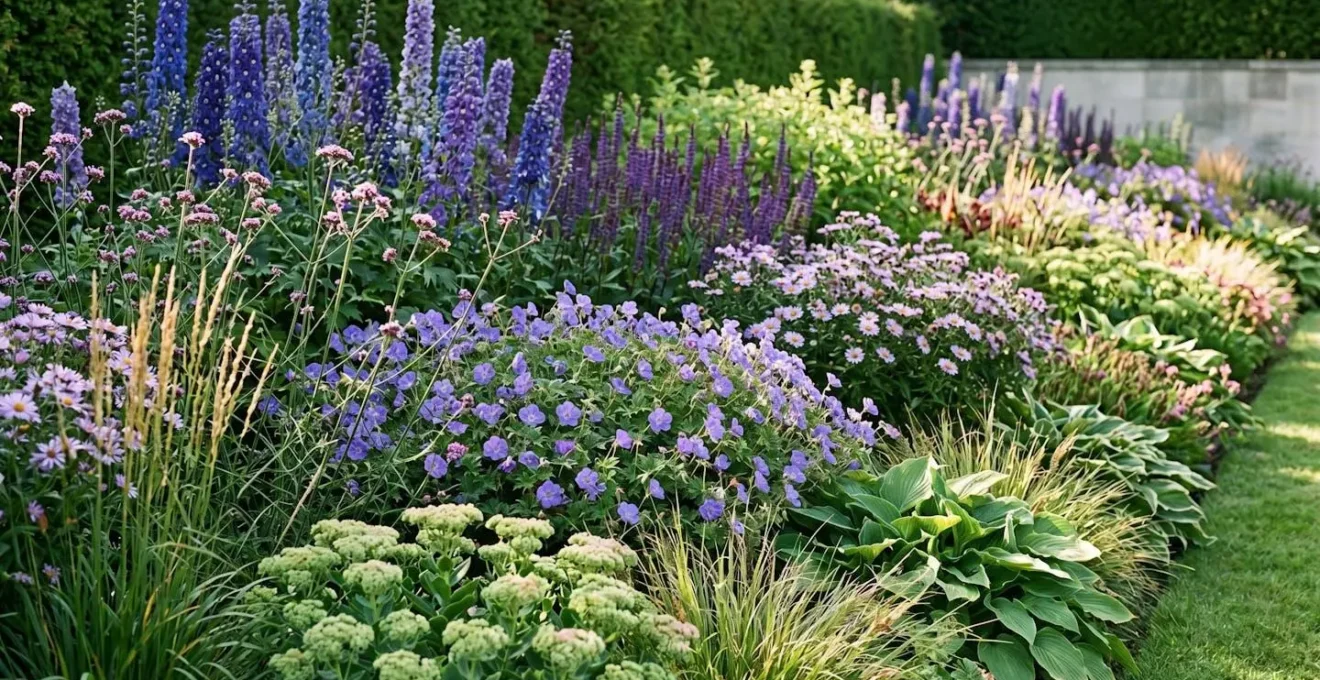
The secret to a long-flowering border isn’t a list of ‘star’ plants; it’s a design philosophy that treats your garden as a 12-month performance.
- Prioritise permanent evergreen structure (the ‘bones’) before choosing a single flower (the ‘actors’).
- Use rhythmic repetition of reliable ‘workhorse’ plants to create cohesion, avoiding the ‘one of everything’ look.
Recommendation: Shift your thinking from collecting plants to choreographing a successional display where different elements take the stage from spring through autumn.
For many UK gardeners, the story is painfully familiar. A glorious explosion of colour in late May and June, full of hope and peony blooms, gives way to a long, dull stretch from July onwards. The border that promised so much becomes a green, gappy, and disappointing space for the rest of the season. The common advice—to deadhead relentlessly or simply buy more “long-flowering” perennials—often feels like a plaster on a deeper wound. It treats the symptoms, not the cause.
The frustration stems from a fundamental misunderstanding. We treat gardening like shopping, accumulating a collection of individual plants we love. But a border that performs from April to October is not a collection; it’s a composition. It’s a piece of living theatre, choreographed in four dimensions. The true secret isn’t in finding a single magical plant that blooms for seven months. The secret lies in designing a permanent stage and writing a script that allows a cast of different plants to have their moment in the spotlight, one after another, in a seamless, overlapping performance.
This guide will shift your perspective. We will move beyond a simple list of plants and instead deconstruct the design philosophy that professionals use. We’ll establish the architectural ‘bones’ of your border, explore how to cast the right plant ‘actors’ for every scene—even in challenging shade—and master the art of the ‘seasonal handoff’ to ensure there’s never an empty stage. Prepare to stop being a plant collector and become a garden director.
To navigate this design journey effectively, this article breaks down the core principles into distinct, manageable stages. The following summary provides a roadmap, linking you directly to the key concepts that will transform your border from a fleeting show into a season-long spectacle.
Summary: How to Create a Perennial Border That Flowers From April to October?
- Why Your Border Looks Flat: The Front-Middle-Back Height Rule?
- Which Flowering Perennials Thrive in Shade: 5 Reliable Performers for North Walls?
- Salvia, Geranium, or Astrantia: Which Perennial Flowers Longest in British Gardens?
- Why Oriental Poppies Leave a Gap for 10 Months After Their 2-Week Show?
- When to Divide Hostas, Daylilies, and Sedums to Double Your Border for Free?
- How to Stagger Sowings to Cut Fresh Flowers From May Through October?
- Why Evergreen Structure Matters More Than Your Flower Choices?
- Why Does Your Garden Look Like a Plant Collection Rather Than a Designed Space?
Why Your Border Looks Flat: The Front-Middle-Back Height Rule?
The most common piece of advice given for border design is the “front-middle-back” rule, suggesting a tiered arrangement like stadium seating. While it’s a valid starting point to ensure smaller plants aren’t hidden, applying it too rigidly is why so many borders look flat and artificial. A truly dynamic border doesn’t feel like a static line-up; it has rhythm and movement, with height variations that draw the eye through the space, not just across it.
The professional approach evolves this rule into a more sophisticated layering of heights. It’s less about three distinct rows and more about creating a visual journey. This involves using transparent ‘weaving’ plants, like ornamental grasses or Verbena bonariensis, which can be planted further forward than their height would suggest because their airy structure allows you to see through them. Furthermore, planting in elongated ‘drifts’ rather than round ‘blobs’ creates flowing lines of colour and texture that guide the eye on a journey from front to back and side to side.
The key is to think in four dimensions. A tall delphinium that provides a stunning backdrop in June can be cut back to allow a mid-height aster to take the stage in the same spot in September. The flat, static border is a result of thinking in two dimensions. The dynamic, immersive border is born from choreographing height over both space and time.
Your action plan: 5 steps to create dynamic height layers
- Apply the Rule of Thirds: Place plants next to ones that are around one-third taller or shorter, moving layers up in thirds or 50% at most to create visual flow.
- Identify Transparent ‘Weaving Plants’: Select airy perennials like ornamental grasses that can break rigid height layers due to their light, see-through structure.
- Plant in ‘Drifts’ Not ‘Blobs’: Arrange plants in elongated, intermingling drifts (groups of 3, 5, or 7) that draw the eye through the border rather than static clumps.
- Plan for the Fourth Dimension (Time): Map when each plant reaches its peak height and flowering period, allowing tall spring plants to be succeeded by different heights in the same spot.
- Break Your Own Rules Strategically: Once you understand the classic front-to-back graduation, intentionally place a tall, airy plant mid-border to create naturalistic interest.
Which Flowering Perennials Thrive in Shade: 5 Reliable Performers for North Walls?
A north-facing wall or a spot under a mature tree is often seen as a problem area, a ‘dead zone’ where nothing will flower. This perception, however, comes from planting the wrong plants in the wrong kind of shade. The first step to success is to diagnose your shade correctly. Is it ‘damp shade’, typical of a north-facing border with moisture-retentive soil, or is it the far more challenging ‘dry shade’ found under the canopy of large trees where roots compete for every drop of moisture?
Many classic “shade plants” like Hostas and Astrantias will thrive in the consistently moist conditions of damp shade but will wither and fail in dry shade. For those tough, parched spots, you need specialists like Epimedium or the bigroot geranium (Geranium macrorrhizum). The solution for dry shade is often soil preparation: amending the area with copious amounts of garden compost and mulching annually creates a reservoir of moisture that helps plants establish. For any UK gardener, understanding this distinction is the single most important factor for creating a lush, thriving shade border.
Once you’ve identified your conditions, you can select from a cast of reliable performers that bring light and interest to the darkest corners. These plants are chosen not just for their flowers, but for their season-long foliar texture and form, providing interest long after the blooms have faded.
5 reliable shade perennials for north-facing walls
- Hosta: Bold clumps of decorative leaves in green, blue, gold, and variegated patterns; flowers appear on tall stems in summer though most value is in foliage; tolerates damp shade.
- Brunnera macrophylla: Heart-shaped leaves (some with silver variegation), forget-me-not-like flowers; thrives in both damp and dry shade once established.
- Pulmonaria (Lungwort): Silver-spotted foliage and early spring flowers; particularly loves dry shade once established, making it ideal for north walls with rain shadow.
- Astrantia: Intricate, papery flowers in white, pink, and burgundy from May to August; thrives in moist, humus-rich soil that north-facing borders naturally provide.
- Hardy Ferns (Dryopteris, Asplenium): Excellent for adding texture and structure without bright sunlight; particularly reliable in UK climate for year-round interest.
Salvia, Geranium, or Astrantia: Which Perennial Flowers Longest in British Gardens?
The quest for the longest-flowering perennial is a common obsession for gardeners seeking non-stop colour. While plants like Salvia ‘Caradonna’, Astrantia, and certain Geraniums are rightly praised for their endurance, the answer to the question isn’t just a plant name; it’s a biological principle. The undisputed champion, Geranium ‘Rozanne’, holds a crucial secret: it’s a sterile hybrid. Unable to set seed and complete its reproductive cycle, it pours all its energy into producing more and more flowers, often from May right through to the first frosts.
This principle—that preventing seed production prolongs flowering—is the key to extending your border’s performance. It’s not just about choosing the right plant, but about managing that plant to maximise its floral display. This is where the gardener’s intervention becomes critical. The simple act of deadheading is, in effect, tricking the plant into thinking it hasn’t yet succeeded in its mission to reproduce, forcing it to try again by producing more blooms. However, this is only one part of the equation.
A plant’s ability to flower continuously also depends on the resources it has available. Consistent moisture and the right kind of food are essential to fuel the production of new buds. This is why a simple framework of cultural practices can turn a good perennial into a great one, significantly extending its season of interest and ensuring your border has vibrant colour for months, not weeks.
The triangle of endurance: 3 cultural practices for longest blooms
- Correct Watering: According to experts at Gardeners’ World, long-flowering perennials need consistent moisture during active growth; a weekly application of a high-potash feed like tomato fertiliser can also promote new flowers.
- Strategic Feeding: Use low-nitrogen fertilizers to promote buds over leafy growth; high nitrogen creates lush foliage but can reduce flower production in many perennials.
- The Art of Deadheading: Remove flowers before they set seed to trick the plant into producing more blooms; this prevents the plant’s energy being diverted to seed production and can extend the flowering period by weeks or even months.
Why Oriental Poppies Leave a Gap for 10 Months After Their 2-Week Show?
Oriental poppies are the epitome of a ‘show pony’ plant. They deliver a breathtaking, dramatic performance of colour and form in late May and early June that is second to none. But after their show, which according to specialist perennial growers lasts just 10-14 days, they take a dramatic bow and disappear, going dormant and leaving a conspicuous brown, gappy mess right in the middle of the border. For the unprepared gardener, this creates a significant design problem for the rest of the season.
The solution is not to avoid these spectacular but fleeting performers, but to plan for their ‘intermission’. This requires clever successional planting, using what can be called ‘Houdini plants’. These are later-emerging companions planted nearby that grow up and expand to magically fill the space just as the poppies recede. This isn’t just about covering a bare patch; it’s a choreographed handoff between different actors on the garden stage.
Plants like Russian Sage (Perovskia) or ornamental grasses emerge late and stay compact while the poppies are in flower, then rapidly expand to occupy the space with their own display of texture and colour from mid-summer onwards. The key is to see the border as a dynamic, shifting mosaic, where the retreat of one plant is the cue for another to make its entrance. This turns the ‘poppy problem’ into a design opportunity, ensuring continuous interest and a seamless transition from one act of the garden play to the next.
Succession planting plan: ‘Houdini’ plants for poppy gaps
- Houdini Plant 1: Russian Sage (Perovskia) — Emerges late, staying small while poppies bloom, then expands to fill space with airy silver foliage and purple flowers from July onward.
- Houdini Plant 2: Ornamental Grasses (Calamagrostis, Panicum) — Provide contrasting texture, grow up through dying poppy foliage, and fill space when poppies go dormant in summer.
- Houdini Plant 3: Black-eyed Susans (Rudbeckia) — Late bloomers that peak exactly when poppies vanish, maintaining continuous color from midsummer into autumn.
- Camouflage Technique: Baby’s Breath (Gypsophila) — Expands rapidly into a cloud of tiny white flowers occupying airspace above dormant poppy crowns, preventing bare spots.
- Three-Act Strategy: Interplant poppies on 18-inch centres with late-emerging companions in the middle, ensuring the succession happens naturally as poppies recede.
When to Divide Hostas, Daylilies, and Sedums to Double Your Border for Free?
Dividing perennials is often seen as a way to get free plants, and it’s certainly an incredibly economical way to populate a garden. However, its most important function is not propagation, but rejuvenation. Over time, many clump-forming perennials like Hostas and Daylilies become overcrowded. They develop a woody, non-productive ‘dead heart’ at their centre, which results in diminished flowering, smaller leaves, and increased susceptibility to pests and diseases. Division is a vital health check, a way to reset the clock and restore a plant’s vigour.
The process involves lifting the entire clump, removing the old, tired central portion, and replanting the vigorous, younger sections from the outer edge. This not only invigorates the plant for better performance but also provides an opportunity to improve the soil with fresh compost where it’s needed most. The timing of this operation is crucial for success and follows a simple, logical rule: divide plants in the season opposite to their main flowering period. This gives them a full six months to recover and establish their roots before they are called upon to perform.
By investing in a few reliable ‘workhorse’ perennials and multiplying them yourself every few years, you create a sustainable and cost-effective system. The money saved can then be invested in a few special, slow-growing ‘show pony’ plants, creating a balanced and beautiful border without breaking the bank.
Strategic division calendar: timing by flowering season
- Spring Division (March-April): The Royal Horticultural Society advises this is best for autumn-flowering perennials like Sedums (Hylotelephium), Asters, and ornamental grasses. Dividing in spring gives them a full growing season to re-establish.
- Autumn Division (September-October): Best for spring- and early summer-flowering perennials like Hostas, Daylilies, Irises, and Peonies. Autumn division allows root establishment during cooler, moister months.
- The Logic: Divide plants in the season opposite to their flowering period, giving them maximum recovery time before they need to produce blooms. Never divide during active flowering.
- Method: Lift the clump, shake off excess soil, and use two garden forks back-to-back to lever the clump apart, or cut with a sharp spade. Replant immediately with improved soil and water thoroughly.
- Economic Strategy: Invest in a few ‘workhorses’ (Hostas, Daylilies, Sedums, Hardy Geraniums), multiply them over 2-3 years, and use saved money to purchase expensive specimen plants.
How to Stagger Sowings to Cut Fresh Flowers From May Through October?
While perennials form the backbone of a border, annuals and biennials are the ‘guest stars’ that can provide incredible flushes of colour and valuable cutting material. A savvy designer uses these shorter-lived plants to bridge gaps in the perennial display. However, the most effective strategy isn’t just about a single spring sowing. It’s about orchestrating a succession of sowings and embracing the power of self-seeders to create a low-effort, high-impact display that evolves through the seasons.
One of the most powerful techniques is autumn-sowing hardy annuals like Ammi majus (Bishop’s Flower) and Nigella (Love-in-a-Mist). Sown in September or October, these plants develop deep, robust root systems over winter. This head start means they surge into growth in spring, flowering earlier, for longer, and on stronger stems than their spring-sown counterparts. They act as a perfect temporary filler, weaving through emerging perennials before finishing their cycle as the summer performers take over.
An even lower-effort approach is to curate a cast of reliable self-seeders. By introducing plants like Foxgloves, Aquilegias, or Verbena bonariensis and allowing some to set seed, you empower the garden to start designing itself. Your role shifts from planter to editor: thinning seedlings where they are too dense, removing them where they are not wanted, and allowing them to pop up in unexpected and often delightful combinations. This creates a naturalistic, dynamic border that offers up free plants and cutting material year after year.
Curating self-seeders: a low-effort succession strategy
- Select Reliable Self-Seeders: Choose plants that naturally sow themselves year after year—Foxgloves (Digitalis purpurea), Aquilegia, Verbena bonariensis, Nigella, and Ammi majus.
- First-Year Investment: Sow or plant your chosen self-seeders, allowing them to flower and set seed. Shake mature seedheads across desired areas to distribute seed.
- Second-Year Editing: In spring, identify emerging seedlings and ‘edit’ the border—thin out seedlings where they’re too dense, transplant to fill gaps, or remove where they conflict with perennials.
- Maintain the Cycle: Allow some plants to flower and set seed each year while deadheading others for continuous bloom. This creates a naturalistic, evolving border that fills its own gaps for free.
- Integration Method: Use self-seeders as the ‘jewels’ that provide seasonal sparkle around the permanent perennial structure of your border.
Why Evergreen Structure Matters More Than Your Flower Choices?
This is the most crucial, and often most overlooked, principle of four-season border design: flowers are fleeting, but structure is permanent. A border that relies solely on perennial flowers will, by definition, look bare and desolate for up to six months of the year. The true mark of a well-designed garden is that it has a strong ‘winter skeleton’—an architectural framework of evergreen plants and persistent seedheads that provides form, texture, and interest all year round.
This evergreen structure forms the ‘bones’ of the border. It consists of shrubs with interesting shapes (globes of boxwood, cones of yew), plants with compelling foliage texture (the glossy leaves of Sarcococca, the fine blades of evergreen grasses), and groundcovers that create carpets of colour. These elements are the permanent stage set. The flowering perennials are the actors who come and go, but the stage itself must always be interesting to look at. This structure provides a living backdrop that makes flower colours pop in summer, and it catches frost and snow to create magical vignettes in winter.
A common guideline for a mixed border is to dedicate 20-30% of the space to evergreen structure. These plants are positioned first in any new design, acting as punctuation marks that anchor the entire composition. The flowering perennials are then woven around them. Without this foundational framework, you don’t have a 12-month garden; you have a 4-month floral display followed by a long expanse of bare earth.
Key takeaways
- Design with Structure First: A successful border is built on a permanent framework of evergreen ‘bones’ that provides year-round interest, not just a collection of summer flowers.
- Embrace Rhythm and Repetition: Create visual cohesion by repeating a limited palette of reliable ‘workhorse’ plants in drifts, rather than a chaotic ‘one of everything’ approach.
- Choreograph in Time: Think of your border as a stage for a seasonal play, using successional planting with ‘Houdini plants’ and self-seeders to ensure there’s always something happening.
Why Does Your Garden Look Like a Plant Collection Rather Than a Designed Space?
If you’ve followed all the advice, bought the ‘right’ plants, and your garden still feels like a jumble of individuals rather than a cohesive whole, you’re experiencing the classic ‘plant collection’ syndrome. It’s the result of focusing on individual plants in isolation. A designed space, by contrast, is created using the powerful principles of repetition and rhythm. It’s about how the plants relate to each other.
Professional designers achieve this by selecting a limited palette of 5-7 key ‘workhorse’ plants and repeating them in drifts of odd numbers (3, 5, or 7) at intervals along the border. This repetition creates a visual echo that draws the eye through the landscape, providing a sense of unity and deliberate design. The repeated plant acts as a thematic anchor, a recurring motif that ties the whole composition together. Without this rhythm, the eye has nowhere to rest and jumps from one plant to the next, resulting in visual chaos.
A practical way to implement this is the ‘Workhorse and Show Pony’ strategy. Dedicate 70% of your border to reliable, long-season workhorses—plants like hardy geraniums, salvias, and ornamental grasses. These are the plants you will repeat to create your rhythm. The remaining 30% is for the dramatic, but often fleeting, show ponies like oriental poppies, delphiniums, and alliums. The workhorses carry the design and provide continuity; the show ponies provide the ‘wow’ moments and exclamation marks. This balance is the key to transforming a collection into a composition.
The following table, based on common design principles, highlights the fundamental shift in thinking required. As this comparative analysis from garden design experts shows, moving from a collector’s mindset to a designer’s mindset changes every decision you make.
| Characteristic | Plant Collection Approach | Designed Border Approach |
|---|---|---|
| Plant Selection | One of every species; maximum diversity | 5-7 key species repeated in drifts of 3-5-7 |
| Visual Effect | Chaotic; eye jumps randomly; no focal flow | Rhythmic; eye follows repeated forms; intentional journey |
| Color Scheme | All colors present; no unifying palette | Dominant color per 10-foot section with 1-3 accent colors |
| Plant Proportion | Equal importance given to all plants | 70% reliable workhorses; 30% dramatic show ponies |
| Texture Strategy | Random mix of forms and textures | Echoing forms (spires with spires, mounds with mounds) |
| Seasonal Planning | Focus on individual peak bloom moments | Continuous interest through succession and foliage |
By embracing these principles—prioritising structure, creating rhythm through repetition, and choreographing a successional performance—you can finally create the garden you’ve always dreamed of. Now, stop collecting plants and start conducting your own beautiful, season-long garden symphony.