The secret to a thriving, stylish plant-filled home isn’t just choosing ‘low-light’ plants; it’s adopting a designer’s mindset of “botanical architecture.”
- Layering plant heights is a core technique to create the illusion of space and depth in compact rooms.
- Evergreen structure provides year-round visual interest, which is more critical than fleeting flowers in the UK’s changing seasons.
- Most plant death comes from a misunderstanding of light and water, not a lack of care.
Recommendation: Stop thinking of plants as disposable accessories and start treating them as long-term, living structural elements that shape your space.
It’s a familiar story for many UK homeowners, especially those living in charming but light-challenged Victorian terraces. You invest in a beautiful houseplant, a lush Fiddle Leaf Fig or a delicate Calathea, placing it in the perfect spot to complete your living room vision. You water it, you talk to it, but within months, it’s a sad, yellowing ghost of its former glory. You’re left with a sense of guilt and another empty pot, wondering why you can’t keep anything green alive.
The common advice is often a simple list of “indestructible” plants or a vague warning to “not overwater.” While well-intentioned, this advice misses the fundamental point. It treats the symptom, not the cause. The challenge of a north-facing British room isn’t just a lack of light; it’s a complex interplay of light *intensity*, fluctuating temperatures from central heating, and dramatic seasonal shifts that generic advice fails to address.
But what if the solution wasn’t about finding a magic, unkillable plant, but about changing your entire approach? What if you started to think like an interior plant stylist? This guide moves beyond the basics. We will explore the concept of botanical architecture: treating plants not as mere decoration, but as dynamic, structural elements that shape the feeling and flow of your home. It’s about understanding the science of light in our homes, mastering the art of composition, and embracing a strategy that works *with* the British seasons, not against them.
This article provides a complete framework for transforming your space. From the common pitfalls that lead to plant failure to the high-level design principles used by professionals, you’ll find everything you need to create a botanical display that not only survives, but truly thrives.
Summary: A Stylist’s Guide to Thriving Botanical Interiors
- Why Do 70% of Houseplants Die Within 6 Months in UK Homes?
- How to Layer 3 Plant Heights to Make a Small Room Feel Twice as Large?
- Real Plants or Premium Faux: Which Works Better in a Windowless UK Bathroom?
- The Watering Mistake That Rots Root Systems in Centrally Heated Homes
- When to Swap Your Botanical Displays: The 4 Seasonal Shifts British Homes Need
- How to Add Drama to a Bouquet Using Foliage and Seedpods Instead of More Flowers?
- Why Evergreen Structure Matters More Than Your Flower Choices?
- Why Are Minimalist Arrangements With 3 Stems Priced Higher Than Overflowing Bouquets?
Why Do 70% of Houseplants Die Within 6 Months in UK Homes?
The surprisingly high mortality rate for houseplants isn’t usually due to neglect, but rather a fundamental misunderstanding of a plant’s most basic need: light. We see a room as “bright,” but our eyes are far more adaptable than a plant’s leaves. This is the ‘Lumen Illusion’: a space that feels airy and well-lit to us can be a dark cave from a botanical perspective. Experts confirm that light intensity drops exponentially the further you move from a window. A plant placed just two metres away from a north-facing window might receive only 5% of the light energy it would get right on the sill.
In the UK, this problem is magnified by our geography. Our winters are long, and the sun sits low in the sky, meaning even south-facing rooms struggle for months. For a north-facing room, which only ever receives indirect light, this creates a chronic energy deficit for any plant not specifically adapted to deep shade. The plant slowly starves, its leaves yellow, and it becomes susceptible to pests and diseases.
The other major culprit is, paradoxically, our love. A comprehensive UK houseplant survey found that over 50% of owners have killed an average of 5 plants, with overwatering being the single biggest killer. We see a struggling plant and our first instinct is to give it a drink, assuming it’s thirsty. More often than not, it’s starving for light, and the excess water simply suffocates its already stressed root system. Understanding this interplay between light and water is the first step to breaking the cycle.
How to Layer 3 Plant Heights to Make a Small Room Feel Twice as Large?
In interior design, the eye moves where you direct it. In a small room, flat, one-dimensional styling can make the space feel even more cramped. The secret to creating an illusion of space and grandeur, even in a compact living room, is to introduce vertical layers. By using plants of different heights, you encourage the eye to travel up and around the room, perceiving more depth and volume than actually exists. This isn’t just about placing plants; it’s about choreographing a visual journey.
This technique, known as the ‘Designer’s Triangle’, uses three distinct layers to build a cohesive and spatially-enhancing composition. Think of it as painting with plants: you need a background, a middle ground, and a foreground to create a complete picture. Each layer has a specific role in creating the overall effect of a lush, dynamic, and larger-feeling space. It is a foundational principle of botanical architecture.
By thoughtfully combining these three tiers, you create a vignette that has structure, fullness, and movement. The composition feels intentional and complete, transforming a simple collection of plants into a powerful design feature that actively works to enhance your perception of the room.
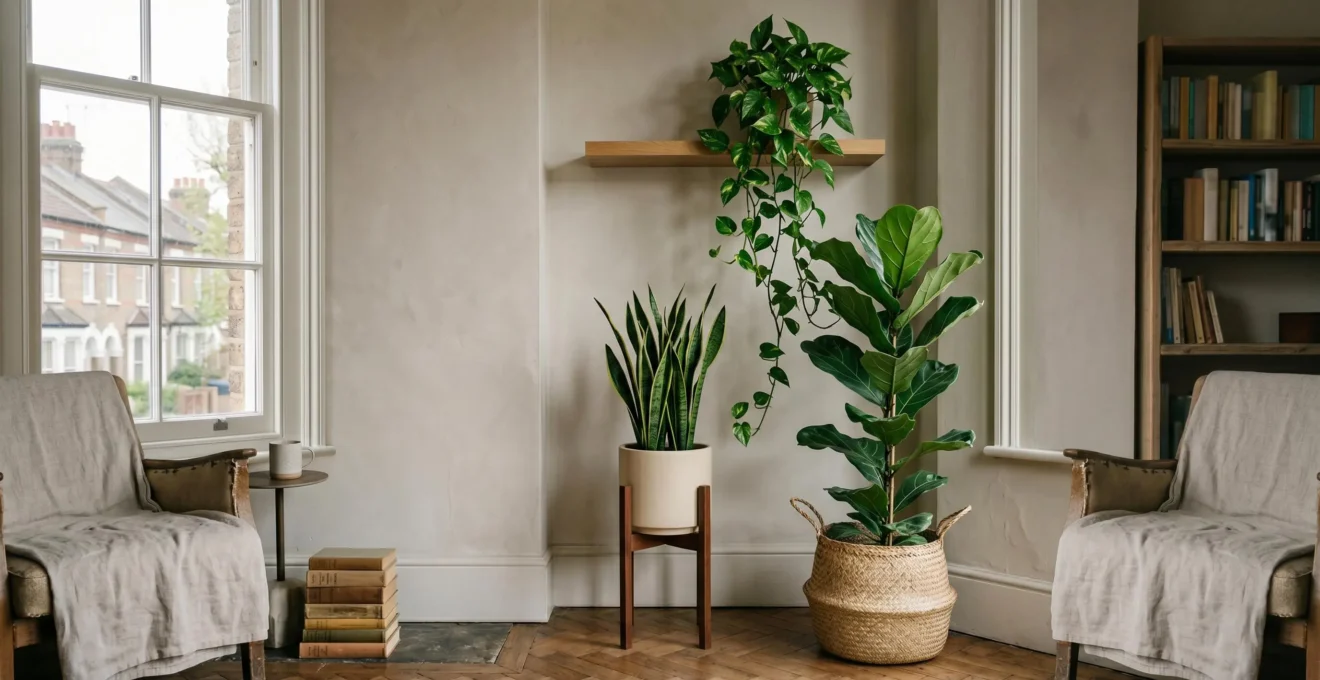
As you can see, the tallest plant acts as an anchor, drawing the eye upward. The mid-level plant adds body and connects the vertical and horizontal planes, while the trailing plant softens the edges and leads the eye back down, completing the visual loop. This creates a dynamic sense of movement and depth that a single plant, or a group of same-sized plants, could never achieve.
- Tall Layer (Thriller): Position a tall floor plant like a Kentia Palm or a slender Ficus in a corner or behind furniture. This creates a strong vertical line, the ‘thriller’ that provides the initial height and draws the eye upward, making ceilings feel higher.
- Mid-Level Layer (Filler): Use bushy plants like a Peace Lily or a Pothos on surfaces like sideboards, shelves, or dedicated plant stands. This ‘filler’ layer adds volume and texture to the middle visual field, connecting the tall floor plant to the lower elements.
- Low/Trailing Layer (Spiller): Complete the look with ‘spiller’ plants that cascade gracefully over the edges of pots or shelves. A String of Hearts or English Ivy softens hard lines, adds a sense of lushness, and leads the eye downwards, grounding the arrangement.
Real Plants or Premium Faux: Which Works Better in a Windowless UK Bathroom?
The dream of a lush, spa-like bathroom filled with greenery often clashes with the reality of many UK homes: a small, windowless space with only artificial light. While the humidity is a bonus for many tropical species, the complete lack of natural light is a deal-breaker for photosynthesis. As plant design expert Tara Heibel, founder of Sprout Home, points out, you have two choices for real plants: “You will either need to invest in a grow light for the space to provide a full light spectrum for the plants, or you will need to do some creative moving around.”
You will either need to invest in a grow light for the space to provide a full light spectrum for the plants, or you will need to do some creative moving around.
– Tara Heibel, Founder of Sprout Home, plant design and garden center
This “creative moving around” means rotating plants weekly, treating your bathroom as a temporary holiday destination rather than a permanent home. This is a high-maintenance strategy that requires a collection of plants and dedication. For many, the more practical and ultimately cost-effective solution is to invest in premium faux plants. The market has evolved far beyond the dusty plastic ivy of the past. Today’s high-end fakes are made with PE plastic, offering remarkable realism in texture and colour, often fooling even a discerning eye.
The decision comes down to a trade-off between authenticity and practicality. A two-year cost analysis shows that while the initial outlay for a premium faux plant is high, it often breaks even with the cost of repeatedly replacing dying real plants within 18-24 months. For a truly zero-maintenance, consistently beautiful green accent in a challenging space, a high-quality faux plant is often the superior design choice.
This table breaks down the long-term commitment of each option, based on data and analysis from interior design resources like a recent Apartment Therapy report.
| Factor | Real Plants (with rotation) | Premium Faux Plants |
|---|---|---|
| Initial Cost | £20 per plant | £150 one-time |
| Replacement Frequency | Every 3-4 months | None (10+ years) |
| 2-Year Total Cost | £120-160 (6-8 replacements) | £150 (no replacements) |
| Maintenance Time | Weekly rotation + watering | Occasional dusting |
| Light Requirements | Grow light or rotation essential | None |
| Realism Level | 100% authentic | 95% with quality PE plastic |
| Break-Even Point | N/A | 18-24 months |
The Watering Mistake That Rots Root Systems in Centrally Heated Homes
It is the number one killer of houseplants across the UK. It’s not pests, nor is it disease. It’s overwatering. In fact, research shows that a staggering 54% of UK plant owners admitted overwatering is the main reason their plants die. This mistake is often born from good intentions, but it’s compounded by a common design choice: the decorative cachepot. We place our nursery pot inside a beautiful ceramic or metal pot with no drainage holes, creating what experts call an ‘invisible swamp’ at the bottom.
Here’s the fatal mechanism: plant roots need oxygen to breathe just as much as they need water. When you water the plant, excess liquid collects at the bottom of the cachepot, submerging the lower roots in a stagnant, anaerobic environment. Even if the topsoil feels dry to the touch, the roots are effectively suffocating and beginning to rot. This root rot is a silent killer, as the plant’s leaves may only show signs of distress—yellowing, wilting—when the damage is extensive and often irreversible.
This issue is particularly prevalent in centrally heated British homes. The dry air from radiators causes the top layer of soil to dry out quickly, tricking us into thinking the whole pot is dry. We water again, adding to the hidden reservoir at the bottom and accelerating the rot. The solution is simple but crucial: always take the plant out of its decorative pot to water it in a sink, let it drain completely for 10-15 minutes, and only then return it to the cachepot. This one change in habit can save more plants than any other advice.
The visual difference is stark. Healthy roots are white and firm, growing in well-aerated soil. Oxygen-deprived roots become brown, mushy, and give off a faint, unpleasant smell as they decay. By preventing the ‘invisible swamp’, you ensure your plant’s foundation remains healthy and capable of supporting lush growth.
When to Swap Your Botanical Displays: The 4 Seasonal Shifts British Homes Need
In the world of professional interior styling, a plant display is never static. It’s a living, breathing element that should evolve with the changing seasons, especially in the UK where the difference in light and mood between June and January is profound. A “set-and-forget” approach is destined for failure. Instead, embracing a dynamic, four-season rotation strategy allows you to keep your home looking fresh and ensures your plants get the conditions they need throughout the year. This isn’t about buying new plants constantly; it’s about smart management and creative adaptation.
This approach treats your home as a collection of microclimates. The bright spot by the window in summer might become a dim corner in winter. A plant that thrives in a north-facing room during the long days of July might need to be moved to a brighter south-facing window for a “rehab” period in the darker months. This rotation is the key to long-term success and is a core part of creating sustainable botanical architecture in your home.
By planning your displays around the calendar, you can celebrate each season. This might mean highlighting architectural forms in winter, introducing fresh growth in spring, incorporating foraged elements in summer, and shifting to rich foliage colours in autumn. It transforms plant care from a chore into a creative, seasonal ritual.
Your Four-Season Botanical Plan
- Winter (November-February): The ‘Good Bones’ Season. Light is at a premium. Focus on plants with strong, architectural forms that look beautiful even without new growth, like ZZ plants or Sansevieria. Appreciate their structure and accept slower growth. This is the skeleton of your year-round display.
- Spring (March-May): The ‘Rehab & Rotate’ Season. As light levels increase, it’s time for a reshuffle. Move any plants that struggled through winter to a brighter spot for a 4-6 week recovery period. Introduce fresh, fast-growing plants to celebrate the new energy of the season.
- Summer (June-August): The ‘Foraging’ Season. Your indoor plants are at their peak. Complement them by creating temporary, high-impact displays with responsibly foraged grasses, branches, and wildflowers. This brings the wild, meadow-like feeling of a British summer indoors.
- Autumn (September-October): The ‘Foliage & Texture’ Season. As the light fades, shift focus to rich colours and textures. Introduce plants with red, orange, or deep purple foliage. Integrate dried elements like seedpods, bracken, and hydrangeas to echo the colours outside and prepare for the winter structure.
How to Add Drama to a Bouquet Using Foliage and Seedpods Instead of More Flowers?
A truly dramatic floral arrangement often has very little to do with the number of flowers it contains. Professional florists understand that the secret to high-impact design lies in structure, texture, and movement—qualities most often provided by foliage, not petals. The “more is more” approach of a dense, overflowing bouquet can feel generic. A curated, foliage-forward arrangement, however, tells a story. It feels deliberate, artistic, and architectural.
The first step is to unlearn the idea that foliage is just ‘filler’. In the hands of a stylist, a single, dramatic branch of Contorted Hazel or a sweep of Eucalyptus becomes the entire skeleton of the piece. This ‘Line of Movement’ is established first, dictating the shape, height, and flow before a single flower is even considered. Every other element is then placed in service to this initial gesture, creating a cohesive and dynamic composition.
Next is the principle of ‘Texture as the Silent Color’. You can create immense visual interest and drama using a very limited colour palette—or even a single colour—by contrasting different textures. Imagine the waxy sheen of a Magnolia leaf next to the soft, velvety texture of Lamb’s Ear, punctuated by the sharp, spiky form of an Eryngium seedpod and the airy lightness of a grass plume. This textural conversation creates a depth and sophistication that a cacophony of colours can’t achieve. It’s a quiet, confident form of drama that draws the viewer in for a closer look.
Finally, a professional technique to elevate any arrangement is the ‘Foliage Collar’. By creating a base of large, dark leaves (like Aspidistra or Monstera) around the vase opening, you achieve two things. Firstly, you hide any mechanics like floral foam or a flower frog. Secondly, you create a rich, dark backdrop that makes the few flowers you do use appear infinitely more precious and vibrant by contrast. It’s a classic trick that makes colour pop and turns a simple stem into a jewel.
Key takeaways
- The ‘Lumen Illusion’: A room that feels bright to you can be a dark cave for a plant; light intensity drops dramatically with distance from a window.
- Structure Over Flowers: In the UK’s variable climate, relying on plants with strong, evergreen architectural forms provides more consistent, year-round visual interest than relying on ephemeral blooms.
- Embrace the Seasons: A static display is doomed to fail. A dynamic, four-season rotation strategy is essential for plant health and keeping your home’s decor feeling fresh.
Why Evergreen Structure Matters More Than Your Flower Choices?
In the pursuit of a beautiful, green interior, it’s easy to be seduced by the fleeting beauty of a flower. An orchid in full bloom or a vibrant Begonia offers an instant hit of colour and life. However, a stylist’s approach to botanical architecture prioritizes a more enduring quality: structure. In the context of a British home, where light levels fluctuate dramatically and winter can feel long and grey, the permanent form of an evergreen plant provides the essential ‘good bones’ of your interior landscape. Flowers are a temporary celebration; structure is a year-round statement.
As leading landscape designers Thomas Rainer and Claudia West state, “Structural plants provide the dominant presence and aesthetics for most of the growing season… [their] stems and branches that last throughout the seasons and give winter interest to the design.” This principle is just as true indoors. A well-chosen Ficus with an elegant trunk, a Sansevieria with its sharp, vertical lines, or a trailing Philodendron that defines the edge of a shelf—these are the elements that hold the design together when the flowers have faded. They provide the constant green backdrop that makes the occasional pop of colour feel all the more special.
Investing in good structure is also a sound financial decision. Research into UK houseplant spending reveals that the average Brit spends over £300 per year on houseplants. By focusing a portion of that budget on larger, more established structural evergreens, you are making a long-term investment in your home’s aesthetic. These plants become part of the furniture, fixtures of the room that you can then accent with smaller, seasonal, and less expensive flowering plants. This strategy provides maximum visual impact for your investment, ensuring your home feels lush and intentionally designed, no matter the season.
Why Are Minimalist Arrangements With 3 Stems Priced Higher Than Overflowing Bouquets?
It’s a paradox that often confuses consumers: how can a sparse arrangement of three elegant stems command a higher price than a large, bountiful bouquet packed with dozens of flowers? The answer lies in the distinction between quantity and curation, and the hidden economics of ‘specimen grade’ floral design. In a dense, mixed bouquet, a florist can cleverly hide imperfections—a slightly bruised petal, a bent stem, a leaf with a small tear. The sheer volume of material provides cover.
In a minimalist arrangement, there is nowhere to hide. Each element is exposed and must be flawless. Professional designers explain that this requires the use of ‘specimen’ or ‘A1’ grade stems. Every part of these stems—from the curve of the stalk to the health of the leaf to the perfect unfurling of the petal—is judged. To find three perfect stems, a florist might have to sort through hundreds, rejecting any that are merely ‘good’. This premium-grade material commands a significantly higher wholesale price.
Beyond the cost of materials, the price reflects the designer’s most valuable skill: editing. Knowing what to leave out is a far more advanced and difficult skill than knowing what to put in. The selection of the three stems, the precise angle of their placement, the balance of form and negative space—this is where the artistry lies. You are not paying for the flowers themselves; you are paying for the confidence, experience, and expert eye of the person who chose them and arranged them with such impactful simplicity.
This philosophy is the ultimate expression of botanical architecture, where plants and stems are treated as sculptural objects. It is a quiet luxury, a statement of confidence that values precision over proliferation. The high price reflects the reality that in design, true value is often found in what is skillfully and intentionally left out.
Now, look at your space not as a challenge, but as a canvas. You don’t need a huge budget or a perfect green thumb. Start with one corner of your north-facing room, apply one of these principles—whether it’s layering, focusing on texture, or simply ensuring your pot has drainage—and begin crafting your own small piece of living, breathing architecture.