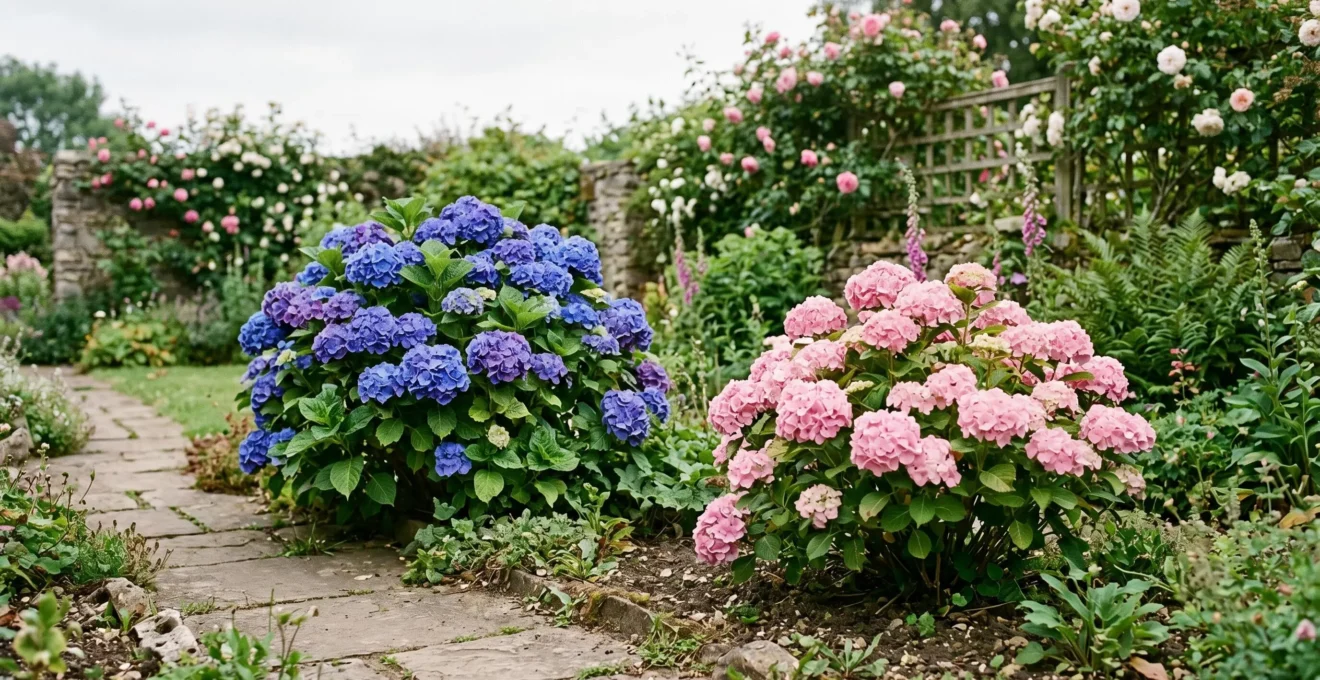
The colour of your hydrangeas isn’t just about adding a product; it’s a direct expression of your garden’s unique geological signature and the specific micro-environments within it.
- Soil pH is the trigger, but it’s the underlying geology (like chalk in Kent vs. granite in Cornwall) that dictates the starting point.
- Small “micro-pH zones” exist all over your garden—near walls, under trees—creating different conditions just metres apart.
Recommendation: Stop fighting your soil. Become a “soil detective” to understand its natural tendencies and choose plants that will thrive, or create targeted acidic pockets for specific acid-loving plants like blueberries.
It’s a classic British garden mystery. You and your neighbour both plant the same ‘Endless Summer’ hydrangea. A year later, theirs is a brilliant, vivid blue, while yours stubbornly blooms a soft, gentle pink. You’ve both watered, you’ve both pruned, yet the results are starkly different. The common advice is to blame soil pH, and while that’s true, it’s only the beginning of the story. The real reason lies deeper, written in the very bedrock beneath your feet and in the subtle chemistry of your garden’s unique landscape.
Most guides will tell you to add aluminum sulfate for blue flowers or lime for pink ones. But this approach treats the garden like a chemistry set, often leading to temporary fixes and frustrated gardeners. It ignores the fundamental truth: your garden has a “soil terroir,” a unique character shaped by millennia of geology, rainfall, and even the history of your property. Understanding this story is far more powerful than any single product you can buy.
This isn’t about fighting your soil into submission. It’s about learning to read its signals. The key to unlocking vibrant, healthy plants—from the deepest blue hydrangeas to thriving rhododendrons—is to understand the hidden geological signature of your garden and work *with* it. This article will empower you to move beyond simple fixes and become a true soil strategist, capable of interpreting your garden’s unique chemistry to create the beautiful, thriving spaces you envision.
Summary: Unlocking Your Garden’s True Colours by Understanding Soil Chemistry
- How to Test Your Soil pH for £5 Using a Simple Kit From the Garden Centre?
- Acid-Lovers or Lime-Tolerant: How to Choose Plants That Won’t Struggle in Your Soil?
- How to Lower Soil pH for Blueberries Without Harming Nearby Plants?
- Why Adding Vinegar to Soil Doesn’t Actually Help Your Acid-Loving Plants?
- Why Gardens in Kent Have Chalk Soil While Cornwall Has Acid Clay?
- Which Cut Flowers Tolerate Heavy Clay Soil Without Constant Amending?
- Why Your Blue Hydrangeas Dried Grey: The Soil pH Connection?
- How to Design a Cutting Garden in a 6m x 4m British Back Garden?
How to Test Your Soil pH for £5 Using a Simple Kit From the Garden Centre?
Before you can work with your soil, you must first understand it. The single most important measurement is its pH level, which indicates its acidity or alkalinity on a scale of 0 to 14. For gardeners, this isn’t an abstract number; it’s the master key that unlocks nutrient availability for your plants. Fortunately, you don’t need a complex laboratory to get a reliable reading. A simple, affordable pH testing kit from any garden centre is your first and most essential tool.
These kits typically use a colour-chart system. You mix a small soil sample with water and the provided chemical, and the resulting colour of the water corresponds to a pH value on the chart. While a professional lab test, which can cost between $20 and $25 according to University of Maryland extension experts, provides more detail, a basic home kit gives you the crucial information you need to start making informed decisions. The goal isn’t just to get one number, but to map your garden’s “micro-pH zones.”
Your garden’s pH isn’t uniform. The soil near a concrete path or house foundation is often more alkaline due to lime leaching from the building materials. The area under a pine tree might be more acidic from years of needle drop. By taking multiple samples from different areas, you create a pH map of your garden. This reveals why a hydrangea by the wall is pink (alkaline) while one in the middle of the lawn might be leaning towards blue (more acidic). It transforms you from a guessing gardener to an informed strategist.
To get a comprehensive picture, follow a methodical approach. Test different zones to understand the variations across your property. This simple diagnostic step is the foundation of effective gardening, allowing you to either amend specific areas or, even better, choose plants perfectly suited to the conditions you already have. It’s the first step in reading your garden’s hidden story.
Acid-Lovers or Lime-Tolerant: How to Choose Plants That Won’t Struggle in Your Soil?
Once you’ve mapped your garden’s pH, you hold the power to avoid one of the most common gardening frustrations: watching a plant struggle, turn yellow, and fail to thrive. This is often caused by a mismatch between the plant’s needs and the soil’s chemistry. Forcing an acid-loving plant like a rhododendron into alkaline soil is a recipe for disappointment. The plant isn’t being difficult; it’s starving. In high-pH soils, essential micronutrients like iron and manganese become chemically locked away and unavailable to the plant’s roots, leading to a condition called iron chlorosis, visible as yellowing leaves with green veins.
The solution is not to constantly battle your soil’s nature, but to embrace it. By choosing plants that are naturally suited to your soil’s pH, you set them up for success from day one. If your test reveals alkaline (or “sweet”) soil with a pH above 7.0, embrace plants that thrive in chalky conditions. Think of a Mediterranean palette: fragrant lavender, silvery-leaved Cistus (Rock Rose), and culinary herbs like rosemary and thyme. These plants are adapted to excel in lime-rich environments.
Conversely, if your soil is acidic (pH below 6.5), you have the perfect conditions for a vibrant woodland-style garden. This is the ideal home for spectacular rhododendrons, camellias, pieris, and, of course, blue hydrangeas. For these plants, an acidic environment is crucial, as research shows iron is most easily available in a pH range of 5.5-6.0, allowing them to absorb the nutrients they need for lush, green growth. Working with your soil’s natural inclination saves you time, money, and heartache, leading to a healthier, more resilient garden.
This table illustrates two distinct design approaches, each tailored to a specific soil chemistry. It highlights how choosing the right plants for your pH creates a cohesive, low-struggle garden ecosystem.
| Design Element | Acid-Loving Guild (pH 4.5-5.5) | Chalk Garden Masterpiece (pH 7.0-8.0) |
|---|---|---|
| Signature Shrubs | Rhododendrons, Camellias, Pieris | Lavender, Cistus, Rosemary |
| Herbaceous Layer | Hostas, Ferns, Trillium | Dianthus, Euphorbia, Achillea |
| Groundcover | Vinca minor, Pachysandra | Thyme, Sedum, Armeria |
| Nutrient Focus | Iron, Manganese (highly available) | Calcium, Magnesium (highly available) |
| Maintenance Strategy | Sulfur or organic acid mulches to maintain pH | Lime topdressing or crushed shells |
How to Lower Soil pH for Blueberries Without Harming Nearby Plants?
Sometimes, your heart is set on a plant that simply won’t tolerate your garden’s native soil. Blueberries, for instance, are notoriously demanding, requiring a highly acidic environment (pH 4.5-5.5) to fruit successfully. If you have neutral or alkaline soil, does this mean you must give up on them? Not at all. The key is to stop thinking about changing the pH of your entire garden and instead focus on creating a targeted, localized “acidic pocket.”
This technique involves amending a specific area, either a designated planting hole or a raised bed, to create a micro-environment perfectly tailored to the acid-loving plant. This allows you to grow blueberries without negatively impacting nearby lime-tolerant plants like lavender or clematis, which would be harmed by broad-scale acidification. The most effective and safest way to do this is by using elemental sulfur. This natural mineral is slowly converted into sulfuric acid by soil bacteria, gradually and safely lowering the pH over several months.
To create an acidic pocket, excavate a planting hole at least twice the width of the plant’s root ball and incorporate a mix of ericaceous (acidic) compost and elemental sulfur into the backfill soil. This creates a contained zone where your blueberry can thrive. It is a precise, surgical approach rather than a broad, disruptive one. This method respects the integrity of the surrounding garden while still allowing you to cultivate those special, demanding plants.
Case Study: The Best Method for Blueberry Acidification
When it comes to lowering soil pH for blueberries, not all methods are equal. Michigan State University research demonstrates that elemental sulfur provides the most cost-effective pH reduction through a biological conversion process that takes place over 3-6 months. The study highlights that other common acidifiers are less efficient or even risky. Ferrous sulfate, for example, requires eight times more material to achieve the same effect. Meanwhile, aluminum sulfate, though faster-acting, has been reported as potentially toxic to blueberry plants at high application rates, making elemental sulfur the safer, more sustainable choice for the home gardener.
Why Adding Vinegar to Soil Doesn’t Actually Help Your Acid-Loving Plants?
In the search for a quick fix, many gardeners turn to household products, and a common myth is that adding diluted vinegar (acetic acid) to the soil is an easy way to help acid-loving plants. While pouring vinegar on your soil will indeed cause a temporary drop in pH, it’s a harmful and ineffective long-term strategy. This approach fundamentally misunderstands the nature of soil, treating it as an inert chemical medium rather than a living, breathing ecosystem.
The problem is twofold. First, the effect of acetic acid is fleeting. It neutralizes quickly in the soil and is rapidly washed away, meaning the soil’s pH will rebound to its natural baseline, often within days. It does nothing to alter the underlying soil chemistry. Second, and more importantly, this sudden, harsh chemical shock can be devastating to the soil’s microbiome. The complex community of beneficial bacteria and fungi that are essential for nutrient cycling and disease suppression can be severely damaged.
As one group of researchers noted in a landmark study on soil health:
Soil acidification impacts bacterial communities and reduces the capacity of soils to combat fungal pathogens.
– Li, Chen, Carrión et al., Nature Communications
This is why methods that work *with* the soil’s biology are far superior. Using coffee grounds, for instance, is a gentler approach; as they decompose, they provide a very mild, slow-release acidifying effect while also adding organic matter. For a more significant change, elemental sulfur remains the gold standard. It acts as a food source for specific soil bacteria, which in turn produce acid. This biological process is gradual, stable, and works in harmony with the soil ecosystem. Indeed, research indicates elemental sulfur reacts slowly, lowering pH over 3 to 6 months, creating a lasting change without the damaging shock of a chemical like vinegar.
Why Gardens in Kent Have Chalk Soil While Cornwall Has Acid Clay?
The reason your hydrangea is pink while a friend’s in another part of the country is blue often comes down to one word: geology. The UK has an incredibly diverse geological map, and the type of rock your home is built on is the single biggest determinant of your native soil’s pH. This is your garden’s “geological signature,” and it explains the vast differences seen across regions.
In areas like Kent and the South Downs, the ground is predominantly chalk, a form of soft limestone. Over millennia, this chalk has weathered to create a soil that is naturally alkaline (high pH) and rich in calcium carbonate. This is “chalk soil,” and it’s why plants like lavender, clematis, and pink-flowering hydrangeas thrive there. Trying to grow a blueberry in this soil without significant amendment is futile, as the immense buffering capacity of the chalk will always push the pH back up.
Contrast this with Cornwall or parts of Scotland, where the underlying bedrock is often granite. Granite is an igneous rock, hard and acidic. As it weathers, it creates a soil that is naturally acidic (low pH) and often heavy with clay. This environment is a paradise for acid-loving plants. Rhododendrons, heathers, and camellias flourish, and hydrangeas will naturally turn a brilliant blue due to the low pH and the high availability of aluminum released from the clay. Your garden’s soil isn’t a blank slate; it’s the end product of a geological story millions of years in the making.
Even your tap water tells this story. Water that has filtered through chalk bedrock will be “hard”—high in dissolved calcium carbonate. Watering your ericaceous plants with hard water is like giving them a small dose of lime every day, actively raising the soil pH. This is why becoming a “soil detective” and investigating your local geology is such an empowering step for any gardener.
Your Plan for Becoming a Soil Detective: A 5-Step Investigation
- Access free British Geological Survey (BGS) Geology Viewer online to identify the bedrock type beneath your property.
- Cross-reference your postcode with regional rainfall data—high rainfall areas typically show more acidic soils due to mineral leaching.
- Identify whether your home was built on fill soil or glacial till by checking construction records or observing neighbouring undisturbed land.
- Test your tap water hardness using aquarium test strips—hard water (high calcium carbonate) indicates underlying chalk geology.
- Look for native indicator plants in nearby wild areas: sorrel and heather suggest acid soil, while wild clematis and spindle indicate alkaline conditions.
Which Cut Flowers Tolerate Heavy Clay Soil Without Constant Amending?
Heavy clay soil can feel like a curse. It’s dense, drains poorly, and can bake solid in summer. However, it’s also incredibly rich in nutrients. The challenge is not the fertility but the structure. Rather than engaging in an endless, back-breaking battle of adding sand and compost, a more effective strategy is to enlist the help of plants that are natural “clay-breakers.” These are species with strong, deep root systems that do the hard work of aeration and improving drainage for you, all while providing beautiful blooms for cutting.
The ideal cut flowers for clay are perennials with robust taproots or fibrous root systems. These roots penetrate and fracture the dense soil structure, creating channels for air and water. As they die back, they add valuable organic matter deep into the soil profile. This is a long-term, sustainable solution that improves your soil year after year. The goal is to establish a community of plants that don’t just tolerate your clay, but actively improve it.
Even in clay, pH remains a critical factor. While clay can be acidic, neutral, or alkaline depending on the parent rock, it’s a general rule that most plant nutrients are readily available in a pH 5-7 range. Testing your clay’s pH will help you select the most suitable clay-busting heroes for your specific conditions. Here are some top performers for a cutting garden in heavy soil:
- Baptisia (False Indigo): Its 3-foot taproot naturally aerates clay while producing beautiful spikes of blue or white blooms perfect for cutting.
- Echinacea (Coneflower): A tough perennial with a deep taproot that improves drainage and provides a continuous supply of summer flowers.
- Rudbeckia (Black-Eyed Susan): An aggressive root system colonizes heavy soil, and its cheerful yellow flowers have an excellent vase life.
- Silphium (Cup Plant): With a deep, fibrous root system, this tall plant helps break compaction and yields striking yellow flowers from July to September.
The best time to plant these is in the autumn when the clay is more workable. This gives their roots a chance to establish over the moist winter, preparing them to thrive before the soil hardens in the summer heat.
Key Takeaways
- Your garden’s soil colour for hydrangeas is dictated by your region’s geology (e.g., chalk vs. granite) more than by any single product.
- Quick fixes like vinegar are ineffective and harm the living soil microbiome; slow, biological methods like elemental sulfur are superior.
- Instead of fighting your soil’s natural pH, the most successful strategy is to choose plants that are adapted to it or to create small, targeted “acidic pockets” for special plants.
Why Your Blue Hydrangeas Dried Grey: The Soil pH Connection?
One of the most enchanting qualities of hydrangeas is their ability to be preserved as dried flowers, bringing their summer beauty indoors through the winter. It’s also one of the most disappointing moments when your vibrant blue blooms fade to a dull, washed-out grey during the drying process. This colour change isn’t your fault; it’s a matter of plant biology, and it’s directly linked to the same soil chemistry that created the blue in the first place.
The blue colour in a hydrangea is not a simple pigment. It is the result of a chemical complex formed between a plant pigment (anthocyanin) and aluminum ions that the plant has absorbed from the soil. This absorption, as we’ve seen, is only possible in acidic soils with a low pH. This delicate anthocyanin-aluminum complex exists only within the living, water-filled cells of the flower’s petals (sepals).
When you cut the flower and begin to dry it, the water evaporates from the plant cells. As the water leaves, the fragile chemical structure that holds the aluminum and pigment together breaks down. Without this complex, the underlying base pigments of the flower are revealed, which are typically muted shades of mauve, dusty pink, or greyish-tan. The brilliant blue was a temporary, living illusion created by soil chemistry.
The Science of Fading: Anthocyanin-Aluminum Complex Breakdown
The secret to a hydrangea’s colour is elegantly explained by plant science. Garden Design research clarifies that the blue hue is determined by the amount of aluminum a plant can access, which is governed by soil pH. This aluminum forms a complex with anthocyanin pigments within the living cell sap. However, once the flower is cut and dries, the water that stabilizes this complex is removed. The structure collapses, and the vibrant blue disappears, revealing the flower’s default, often greyish, underlying pigments. This explains why even the most intensely blue flower will not retain its colour when simply air-dried.
While you can’t stop this process with simple air-drying, starting with a stronger blue can result in a more interesting dried colour. A flower grown in optimal low-pH soil will have a more stable complex to begin with. For true colour preservation, more advanced methods like using silica gel or glycerine are required, as they work by either rapidly removing moisture or replacing it with a preservative, helping to maintain the flower’s cellular structure and the delicate colour complex within.
How to Design a Cutting Garden in a 6m x 4m British Back Garden?
You don’t need a sprawling country estate to enjoy a steady supply of fresh, homegrown flowers. Even a modest 6m x 4m plot—a standard size in many British back gardens—can be transformed into a highly productive cutting garden with smart design. The key is to think in three dimensions and plan for succession, ensuring you have something to cut from early spring through to the first frosts.
The traditional approach of planting in long rows is inefficient in a small space. A more effective method is intensive “succession planting” in one-square-metre blocks. This involves layering plants with different bloom times and growth habits within the same small area. For example, spring bulbs are planted deep in autumn, and as they fade in late spring, their declining foliage is hidden by emerging summer annuals like snapdragons or cosmos, which are then joined by late-season perennials.
The most transformative technique for a small garden is to go vertical. Dedicating the corners of your plot to climbing plants on tripods or obelisks can triple your growing space without increasing the garden’s footprint. Sweet peas are a classic choice, providing an abundance of scented blooms for months on end. Finally, a professional-looking bouquet is about more than just flowers. You must dedicate at least 30% of your space to “structural foliage“—plants like Eucalyptus, Pittosporum, or ornamental grasses that provide the framework and filler for your arrangements.
This layered, multi-season approach ensures your small plot is always working for you. It transforms a simple patch of lawn into a dynamic, ever-changing source of beauty for your home. By combining smart planting, vertical structures, and a focus on foliage, a small British garden can easily yield beautiful bouquets from spring until autumn.
By understanding the deep story of your soil, you can move from being a reactive gardener to a proactive one, creating a garden that is not only beautiful but also resilient and deeply connected to its unique place in the world. Start by testing your soil and discovering the geological secrets it holds.
Frequently Asked Questions About Hydrangea Colour and Soil
What is the best stage to harvest hydrangeas for drying to retain color?
Harvest when blooms feel papery to the touch and have naturally started to ‘antique’ on the plant—not when they are at fresh, peak color. This typically occurs 6-12 months after initial pH adjustments.
Does a lower soil pH create more stable blue pigments for drying?
Yes. Soil with optimal low pH (5.0-5.5) and available aluminum creates a stronger, more stable blue anthocyanin-aluminum complex initially, which provides a better starting point for color retention during drying, though it does not guarantee blue dried flowers.
Are silica gel and glycerine better than air-drying for preserving hydrangea color?
Yes. Both methods are specifically designed to preserve color far more effectively than simple air-drying by either rapidly removing moisture (silica gel) or replacing water content with preservative solution (glycerine), maintaining cellular structure better.