In summary:
- Pampas grass sheds due to its natural seed-dispersal lifecycle, which is worsened by post-harvest processing like bleaching and compression during shipping.
- A simple, 10-minute sealing process using a clear matte spray (not hairspray) can stop over 90% of the shedding by reinforcing the delicate fibres.
- The origin and colour of your pampas matter; locally-grown, natural beige varieties have better structural integrity and shed less than imported, bleached white plumes.
- Elegant styling focuses on using fewer, high-quality stems in a sculptural way rather than large, dated bunches, minimising both the mess and visual clutter.
- All dried grasses are highly flammable and must be kept far away from open flames, including candles and fireplaces, to prevent a serious fire risk.
You saw it on Instagram, perfectly poised in a minimalist vase, adding a touch of soft, bohemian elegance to a pristine living room. You bought the pampas grass, brought it home, and now you’re living in a constant snowstorm of beige fluff. That picture-perfect dream has become a daily battle with the dustpan and a source of quiet regret. This frustrating gap between inspiration and reality is a near-universal experience for pampas grass owners.
The common advice is often a quick, temporary fix like a spritz of hairspray. But this rarely solves the problem for long and can leave plumes feeling sticky and unnatural. The shedding seems relentless, a fundamental flaw in an otherwise beautiful natural product. Many simply give up, banishing the pampas to the garage or the bin.
But what if the shedding isn’t a flaw, but a feature we just don’t understand? The key to solving the fluff problem permanently isn’t found in a better cleaning routine, but in a deeper appreciation of the plant itself. The relentless shedding is a direct symptom of its botanical lifecycle, its post-harvest journey, and its interaction with your home environment. Understanding why it sheds—from damaged cellular structure to its natural impulse to disperse seeds—is the only way to implement a lasting solution.
This guide will walk you through the science and style of pampas grass. We’ll move beyond temporary hacks to professional preservation techniques, explore how choices in colour and origin impact shedding, and master the art of styling it to look elegant, not overwhelming. It’s time to turn your pampas frustration into a lasting statement piece.
This article provides a complete roadmap, from immediate practical fixes to long-term care and styling philosophy. Explore the sections below to master every aspect of living beautifully with dried botanicals.
Summary: The Complete Guide to Taming Pampas Grass
- How to Spray-Seal Pampas Grass in 10 Minutes to Stop 90% of Shedding?
- Natural Beige or Bleached White Pampas: Which Suits a Minimalist Interior?
- British-Grown or Imported Pampas: Why Does Origin Affect Fluffiness?
- The Pampas Fire Risk: Why You Should Never Place Dried Grass Near Candles?
- How to Use Pampas Grass Sparingly to Look Elegant Rather Than Dated?
- Why Preserved Flower Walls Fade in 6 Months Near Windows: The UV Protection Guide
- Why the Empty Space in Your Ikebana-Style Arrangement Is Not a Mistake?
- Why Do DIY-Dried Flowers Turn Brown While Shop-Bought Preserved Blooms Stay Vibrant?
How to Spray-Seal Pampas Grass in 10 Minutes to Stop 90% of Shedding?
The single most effective way to combat pampas shedding is to seal the plumes. While many reach for hairspray, this is a suboptimal fix. Hairspray is designed to be flexible but eventually breaks down, becoming sticky and attracting dust, which dulls the plumes’ natural lustre. A far superior solution is a clear matte spray sealer, the kind used by florists and crafters. This creates a stronger, non-sticky bond that locks the delicate fibres in place without compromising their soft appearance.
The goal of sealing is to reinforce the thousands of tiny, feathery strands that make up the plume. Each one is a potential shedder, especially after the stress of transport. A light, even mist creates a micro-scaffolding around these fibres, holding them together while remaining invisible. This process is most effective after you’ve first “pre-shed” the grass, removing all the loose particles that were dislodged in transit.
As this detailed image shows, the structure is incredibly intricate. Sealing effectively “glues” these individual fibres to the central stem, preventing them from detaching with vibrations or air currents in your home. The key is a light touch; oversaturation can cause the plumes to clump and lose their signature airy volume.
Your Action Plan: Professional Sealing Steps for Pampas Grass
- Initial Shedding: Take the pampas grass outside and shake each stem vigorously. This is a crucial first step to remove any fibres that are already loose from packaging and transport.
- Fluffing: Use a hairdryer on a cool, low setting to gently fluff the plumes. This opens up any compressed areas and dislodges the next layer of weak fibres.
- Sealing: Holding a can of clear matte spray sealer (like Krylon Matte Finish or a floral-specific brand) about 12 inches away, apply a light, even mist over the entire plume. Focus particularly on the base and tips.
- Drying: Allow the stems to air dry completely outside or in a well-ventilated area for at least 30 minutes before bringing them indoors. This prevents fumes from entering your home.
- Maintenance: Plan to reapply a light coat of sealer every 6-12 months, or if you notice shedding has started to resume, to maintain the protective barrier.
Natural Beige or Bleached White Pampas: Which Suits a Minimalist Interior?
The choice between natural beige and bleached white pampas grass extends far beyond simple colour preference. It directly impacts the plume’s longevity, texture, and propensity to shed. The difference lies in the cellular integrity of the plant fibres. Natural pampas is simply dried, retaining its original strength. Bleached pampas, however, undergoes a chemical process that strips its colour but also weakens its structure, making the stems more brittle and the plumes more prone to breakage and shedding.
For a minimalist interior, the decision should align with your specific aesthetic. A warm, earthy, or Japandi-style minimalism, which favours natural materials and textures, is perfectly complemented by the soft, warm tones of natural beige pampas. It absorbs light, adding a gentle, grounding texture to a space. Conversely, a cool, high-contrast, or Scandinavian-style minimalism often benefits from the stark, graphic quality of bleached white pampas. It reflects light, creating an airy, expansive feeling that can make smaller rooms feel larger. However, this aesthetic benefit comes at the cost of durability.
This comparative table breaks down the key differences to help you make an informed choice based not just on looks, but on long-term performance, as detailed in an analysis of pampas grass care.
| Characteristic | Natural Beige Pampas | Bleached White Pampas |
|---|---|---|
| Structural Integrity | Maintains natural cellular strength | Chemical bleaching compromises fiber structure, making stems more brittle and prone to breakage |
| Minimalist Style Match | Warm/Japandi minimalism (earthy undertones, natural fibers, wood accents) | Cool/Scandinavian minimalism (high contrast, monochrome palette, graphic simplicity) |
| Light Interaction | Absorbs light, creates softer textured feel, grounds large open spaces | Reflects light, creates airy expansive feeling, ideal for smaller rooms |
| Longevity | More durable, less shedding over time | May shed more due to weakened cellular structure from processing |
| Maintenance | Lower, less prone to yellowing | Keep away from direct sunlight to prevent yellowing and increased brittleness |
British-Grown or Imported Pampas: Why Does Origin Affect Fluffiness?
Not all pampas grass is created equal, and its origin story is a primary determinant of its quality and fluffiness. The difference between lush, full plumes and thin, shedding ones often comes down to the supply chain journey. Imported pampas, which dominates the mass market, is typically harvested in vast quantities, rapidly dried, and then tightly compressed into shipping containers for weeks or even months. This process of prolonged compression causes irreversible damage to the delicate plume structures, crushing the fibres and ensuring they will never achieve their full, natural volume.
In contrast, locally-grown pampas, such as that sourced from specialist farms in the UK, benefits from a much shorter and more careful supply chain. Growers can prioritise quality over quantity. A critical factor is the harvest timing. Pampas is at its best when harvested just as it reaches maturity but before it enters its natural seed-dispersal phase. Reputable local growers have precise control over this timing, whereas mass-market importers often harvest indiscriminately to maximise volume, leading to a higher likelihood of shedding. In fact, research shows that pampas grass takes 2-4 years to reach full maturity, a window that small-scale growers can monitor closely.
Case Study: The Impact of Supply Chain on Plume Quality
Professional flower growers have documented a stark quality difference between locally-grown and imported pampas grass. The study noted that imported plumes are often harvested prematurely to fit shipping schedules, then flash-dried and compressed. This combination of an immature harvest and physical damage from supply chain compression results in plumes that are not only less fluffy but also significantly more prone to shedding. Locally-grown pampas, harvested at the optimal moment and transported with care, consistently maintains superior natural fluffiness and structural integrity, validating the “farm-to-vase” approach for delicate botanicals.
The Pampas Fire Risk: Why You Should Never Place Dried Grass Near Candles?
Beyond the frustration of shedding, there is a far more serious issue that every owner of pampas grass or any dried botanical must be aware of: the extreme fire risk. Dried grass is, by its nature, highly flammable. The fine, airy plumes can ignite instantly from a single spark or brief contact with a naked flame. Placing a vase of pampas grass near candles, fireplaces, open-flame heaters, or even kitchen hobs is an exceptionally dangerous fire hazard.
The fluff that sheds from the plumes only exacerbates this risk, creating a trail of fine, combustible tinder around the arrangement. A small ember from a fireplace or a draft blowing a plume into a candle flame can lead to a rapidly spreading fire. The danger is not theoretical; it is a tangible and significant threat. According to U.S. Consumer Product Safety Commission data, candle fires cause approximately 7,610 residential fires, 81 deaths, and 677 injuries annually, often due to flammable materials being placed too close to them.
The National Candle Association has conducted controlled safety tests on this very issue, highlighting the specific dangers of botanicals. Their findings are a stark warning for anyone mixing dried decor with open flames:
Dried flowers, leaves, herbs, and wood create higher flames, uneven burning, and in some cases, open combustion and flame leap.
– National Candle Association, NCA Report on Botanical Candles – Controlled Safety Testing
As a responsible owner, your primary duty is to ensure safety. Always maintain a minimum of one meter (three feet) between your dried arrangements and any source of flame or intense heat. For ambient lighting, opt for flameless LED candles, which provide the same warm glow without any of the associated risk.
How to Use Pampas Grass Sparingly to Look Elegant Rather Than Dated?
The “more is more” approach that defined the initial boho pampas trend can quickly look dated and cluttered. The secret to a modern, elegant pampas display lies in restraint and intentionality. Instead of overwhelming a space with huge, fluffy bunches, the contemporary approach treats each stem as a sculptural object. This not only looks more sophisticated but also has the practical benefit of minimising potential shedding.
The most important principle is the “Three-Stem Rule.” By starting with just three high-quality stems of varying heights, you create a dynamic, asymmetrical arrangement that feels deliberate and artistic. This minimalist approach draws the eye to the form and texture of the individual plumes, allowing them to be appreciated as natural art. It’s about creating visual interest through structure, not volume.
Another key is to create textural contrast. Pair the soft, feathery pampas with a sleek metallic or glass vase for a modern look, or a rough, earthy ceramic pot for a more organic feel. Mixing pampas with other dried elements like palm spears, eucalyptus pods, or curly willow can also add depth and prevent the arrangement from looking monotonous. This deconstructed approach, focusing on form and texture, ensures your pampas grass remains a timeless accent rather than a fleeting trend.
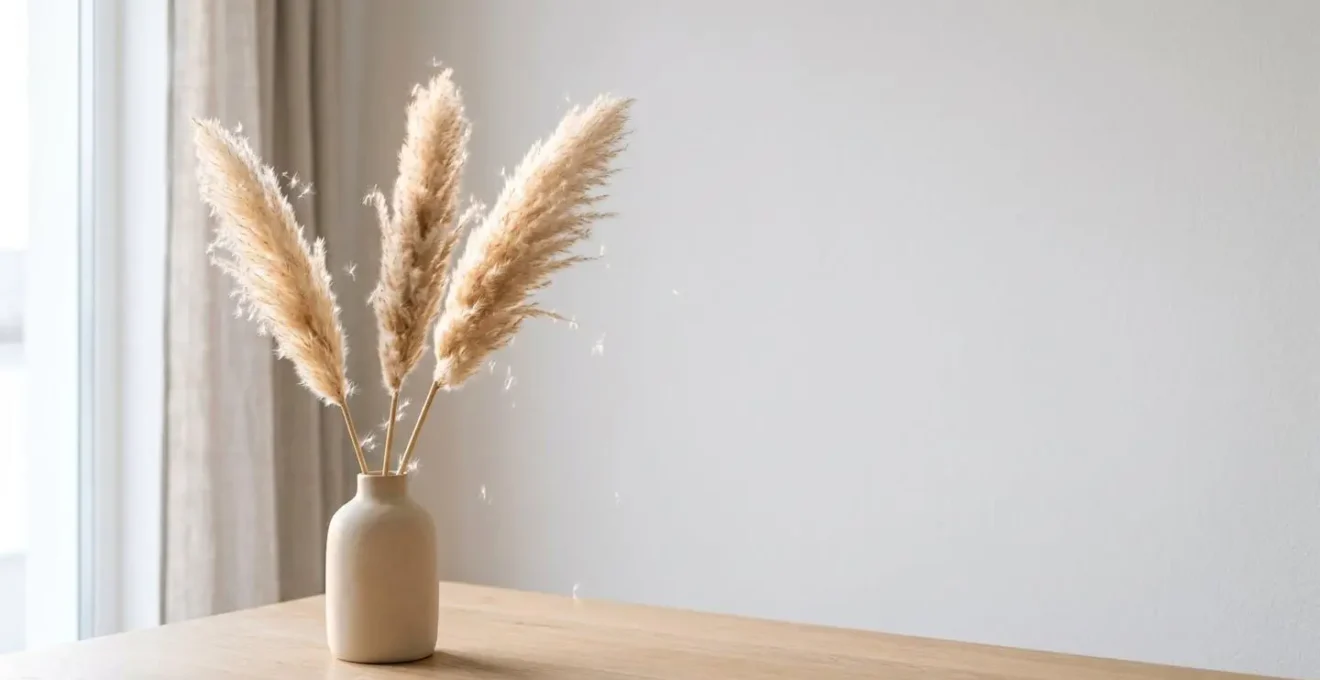
This arrangement perfectly illustrates the power of restraint. By using just three stems and a simple vase against a clean backdrop, the focus shifts to the beautiful, natural form of the pampas itself, creating a sense of calm and sophistication.
Why Preserved Flower Walls Fade in 6 Months Near Windows: The UV Protection Guide
The beauty of preserved botanicals, whether a single pampas stem or an entire flower wall, is their supposed permanence. Yet, homeowners are often dismayed to see their vibrant arrangements fade to a dull brown within months, especially when placed near a window. The culprit is an invisible force: ultraviolet (UV) radiation. Just as it damages our skin, UV light relentlessly breaks down the pigments in preserved flowers, a process known as photodegradation.
This fading is not uniform across all colours. The vibrant pinks and blues in many preserved arrangements are often created with acid dyes that are highly susceptible to UV damage. Similarly, the natural chlorophyll that gives foliage its green colour is notoriously unstable and fades quickly. This explains why earthy, natural tones tend to last longer than brightly coloured or artificially dyed botanicals. The location within your home is also a critical factor; south-facing windows in the UK receive the most intense, prolonged UV exposure and will cause the fastest fading, whereas north-facing windows are the safest placement.
Furthermore, the environment near a window presents a dual threat. High humidity, often caused by condensation, can accelerate the breakdown of the glycerin used in the preservation process. This moisture works in tandem with UV light to degrade the dyes and cellular structure even faster. Protecting your investment requires a proactive approach. The most effective solution is applying a UV-filtering film to your windows. These modern films are virtually invisible and can block up to 99% of harmful UV rays without significantly reducing visible light, dramatically extending the life and vibrancy of your preserved flowers.
Why the Empty Space in Your Ikebana-Style Arrangement Is Not a Mistake?
In our quest to fill our homes with beautiful objects, we often overlook the power of what isn’t there. When styling pampas grass or any floral arrangement, our instinct is to fill the vase. If there’s a gap, we add another stem. However, in the Japanese art of flower arranging, Ikebana, the empty space is not a void to be filled but a deliberate and essential component of the design. This concept is known as Ma.
Ma (間) is the intentional, meaningful interval or pause between elements. It’s the silence between musical notes that gives the melody its rhythm, or the unpainted part of a canvas that draws focus to the subject. In floral design, this empty space gives the arrangement room to breathe. It directs the viewer’s eye, creates a sense of balance and harmony, and allows the unique shape of each individual stem, leaf, and flower to be fully appreciated. An arrangement crowded with material can feel chaotic; an arrangement that embraces Ma feels calm and contemplative.
This philosophy directly connects to the modern, elegant way of styling pampas grass. The “Three-Stem Rule” is an intuitive application of Ma. By using fewer stems, you are creating these intentional spaces that elevate the composition from a simple bunch of grass to a piece of living sculpture. As explained by the leading authority on the art form:
In Ikebana, the space is an active component of the design, shaping the composition and directing the viewer’s eye through the concept of Ma—the intentional, meaningful interval between elements.
– Ikebana International, The Philosophy of Japanese Floral Art
So, the next time you arrange your pampas grass, resist the urge to fill every gap. Step back and consider the spaces between the plumes. That emptiness is not a mistake; it is an active, powerful element of your design that brings a sense of peace and sophistication to your home.
Key takeaways
- Shedding is a solvable problem caused by the plant’s natural lifecycle and post-harvest processing. A proper sealing technique is the most effective solution.
- The quality, colour (natural vs. bleached), and origin of pampas grass directly impact its durability and shedding.
- Styling with restraint—using fewer, high-quality stems—and understanding principles like negative space (Ma) leads to a more elegant and timeless look while minimizing mess.
Why Do DIY-Dried Flowers Turn Brown While Shop-Bought Preserved Blooms Stay Vibrant?
Anyone who has tried to air-dry flowers at home has likely experienced the same disappointing result: once-vibrant petals turn a dull, lifeless brown. Yet, professionally preserved blooms can maintain their colour for years. The difference is not magic, but chemistry. The two methods, desiccation (drying) and preservation, are fundamentally different processes with vastly different outcomes.
DIY air-drying is a process of desiccation, which simply removes water from the plant cells. As the cells lose water and die, they begin to oxidise—the same process that turns a cut apple brown. This oxidation and cellular breakdown are inevitable, leading to the characteristic brittle texture and faded, brownish colour of traditionally dried flowers. It’s a process of managed decay.
Professional preservation, on the other hand, is a process of replacement. It “tricks” the flower into halting the decay cycle. The water within the plant’s cellular structure is replaced with a substance, typically glycerin, that maintains the cell walls. This keeps the flower supple and prevents the oxidation that causes browning. This sophisticated process is often enhanced with colour stabilisers and pH-controlled environments to lock in vibrancy. This explains why preserved blooms feel soft and look lifelike, while dried flowers are stiff and fragile.
The Science of Preservation: Drying vs. Glycerin
The core difference between DIY-dried flowers and shop-bought preserved blooms is the method used to halt decay. Air-drying (desiccation) removes water, causing cellular collapse and oxidation, which results in browning and brittleness. Professional preservation replaces the plant’s water with glycerin, a humectant that keeps the cellular structure intact, supple, and vibrant. This process effectively ‘freezes’ the flower in time, preventing the natural decay and browning associated with simple drying. For those attempting home preservation, experts suggest an optimal glycerin-to-water ratio of 1:2, using warm water to facilitate absorption through freshly cut stems.
By understanding this, you can appreciate that a well-cared-for preserved botanical is an incredible piece of natural engineering. With the right care, including sealing and protection from UV light, its beauty is not fleeting. In fact, reports show that properly maintained dried pampas grass can last up to 3 years under proper care, offering a truly long-term decorative investment.
By applying these specialist insights, you can finally transform your pampas grass from a source of frustration into the effortless, elegant statement piece you always envisioned. Begin by assessing your current arrangement and decide on your first step: sealing, restyling, or repositioning.