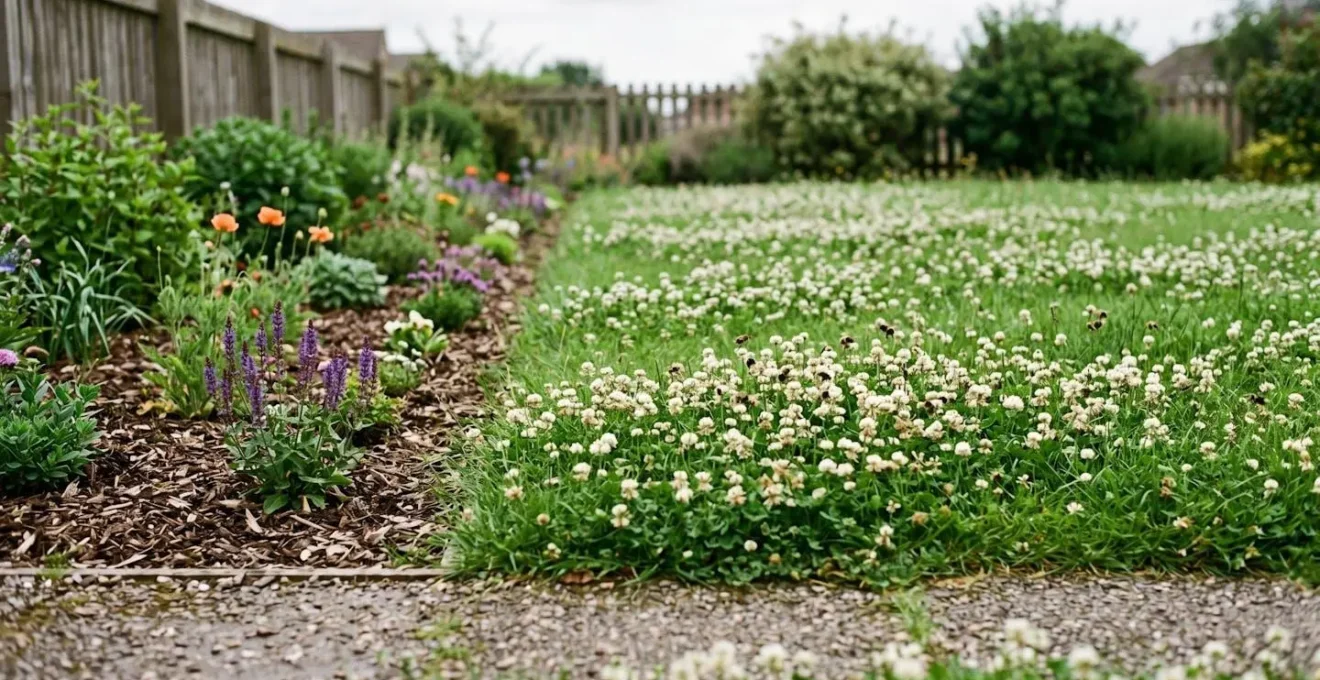
The frustrating truth is that a garden full of “pollinator-friendly” plants can fail if it ignores the single most important factor: foraging efficiency.
- Bees are not browsers; they are efficient foragers who need large, obvious patches of a single food source to load up on nectar and pollen.
- A scattered collection of 50 different plant species is often less effective than large, repeating drifts of 7 well-chosen ones.
Recommendation: Stop collecting individual plants and start designing a cohesive, large-scale feeding system that works for pollinators, not just for you.
You’ve done everything by the book. You diligently selected plants labelled “bee-friendly,” spent a small fortune on diverse wildflower mixes, and proudly avoided pesticides. Yet, the result is a disquieting silence. Your garden is a beautiful collection of botanical specimens, but it lacks the vibrant hum of life you envisioned. Meanwhile, your neighbour’s admittedly boring lawn, dotted with clover, seems to be a non-stop party for every bee in the vicinity. This paradox isn’t your failure as a gardener; it’s a failure of the common advice we’re all given.
The conventional wisdom encourages us to think of a wildlife garden as a shopping list: get one of these, a few of those, and a packet of that. We are told to plant flowers, provide water, and let things get a little “messy.” But what if this approach is fundamentally flawed? What if the key isn’t just about *what* we plant, but a complete shift in *how* we see and design our outdoor spaces? The solution isn’t to buy more plants, but to understand the ecological principles that make a habitat truly functional.
This article will deconstruct the common myths and investigate the scientific reasons your wildlife garden might be underperforming. We will explore the critical difference between a plant’s appearance and its function, the importance of habitat structure beyond just flowers, and the design strategies that transform a quiet plant collection into a thriving, buzzing ecosystem. It’s time to think less like a collector and more like an ecological architect.
To guide you through this paradigm shift, we’ll examine the crucial elements of a genuinely successful wildlife garden. This guide provides a structured path to understanding and implementing the principles that will finally bring the buzz back to your borders.
Contents: Why Your Garden Needs a Systems-Thinking Overhaul
- Why Wild Geraniums Support 10x More Insects Than Double-Flowered Cultivars?
- Why Ground Beetles Need Leaf Litter More Than Your Perfect Borders?
- How to Ensure Your Garden Has Flowers for Bees From March Through November?
- Why Spraying Aphids Kills the Ladybirds That Would Control Them Naturally?
- How to Count Bee Species in Your Garden: The 15-Minute Survey Method?
- How to Design a Beautiful Border That Also Supports Bees and Butterflies?
- When to Sow, Plant Out, and Cut: The Month-by-Month British Cutting Garden Schedule?
- Why Does Your Garden Look Like a Plant Collection Rather Than a Designed Space?
Why Wild Geraniums Support 10x More Insects Than Double-Flowered Cultivars?
The first clue to solving our garden’s silent spring lies in a simple, yet profound, observation: not all flowers are created equal. In the world of garden retail, “more is more” often dictates design, leading to lush, double-petaled cultivars that promise a bigger floral display. However, from a bee’s perspective, these complex flowers are often ecological traps. They are the equivalent of a beautifully decorated restaurant with a locked pantry. The very traits that make them visually spectacular to us—densely packed petals—render their nectar and pollen inaccessible to foraging insects.
This isn’t just theory; it’s backed by scientific observation. Research consistently shows that pollinators have a strong preference for simpler, native forms. For instance, an Oregon State University study found that pollinators favored wild native plants 37% of the time compared to a mere 8% for their cultivated counterparts. The reason is a matter of simple mechanics and evolutionary biology. Wildflowers, like the single-petaled wild geranium, have co-evolved with local pollinators, resulting in an open, honest structure where the pollen and nectar are clearly advertised and easily accessible.
To a bee, a double-flowered rose or geranium is a frustrating maze of sterile petals. They may expend precious energy trying to navigate the structure only to find no reward. Choosing native species or simple, open-flowered “heirloom” varieties over their complex cousins is the first and most critical step in providing a genuine food source. It’s about prioritizing ecological function over purely human-centric aesthetics.
As this image clearly demonstrates, the structural difference is everything. The open architecture of the wild-type flower offers a clear landing pad and direct access to the nutrient-rich stamens. The double-flowered cultivar, for all its beauty, presents a physical barrier. By consciously selecting for this accessibility, you are making a fundamental shift towards a garden that truly feeds wildlife, rather than just decorating a space.
Why Ground Beetles Need Leaf Litter More Than Your Perfect Borders?
A successful wildlife garden is more than a collection of flowers; it’s a complete habitat. While we focus on the airborne ballet of bees and butterflies, we often overlook the crucial world at our feet. The obsession with perfectly clean, tidy borders—raked, dug, and mulched into submission—destroys a vital layer of the garden ecosystem: the leaf litter. This “mess” is, in fact, a bustling metropolis for some of your garden’s most valuable allies, particularly the ground beetle.
Ground beetles are voracious, nocturnal predators. They are the unpaid security team of your garden, tirelessly hunting slugs, snails, and other pests that threaten your plants. The benefits they provide are staggering; research from South Dakota State University shows that ground beetle larvae and adults can consume up to their body weight in prey each day. However, these beneficial insects have specific needs. They require the cool, damp, and dark environment provided by a layer of leaves and other organic debris for shelter, hunting, and overwintering. Your pristine border is a desert to them.
Embracing a “managed mess” is key. This doesn’t mean letting your entire garden run wild. It means strategically creating and preserving areas of structural diversity. Leave the leaves under your hedges and at the back of your borders. Allow a small pile of logs or woody debris to rot down in a shady corner. This simple act provides the essential habitat that supports a healthy population of predators, creating a natural and self-regulating system of pest control. By tidying less, you are in fact gardening more effectively.
Your 5-Step Plan for a “Managed Mess” Habitat Audit
- Identify Points of Contact: List all areas where life happens in your garden. Include not just flower heads, but tree trunks, hedge bottoms, bare patches of soil, and your compost heap. These are all potential habitats.
- Inventory Your Resources: Walk your garden and inventory the existing structural elements. Do you have any leaf litter? Log piles? Areas of long grass? Be honest about how much “tidiness” has erased these features.
- Assess for Coherence: Compare your inventory to the needs of beneficial insects. You have flowers for bees, but where do the ground beetles live? Where do ladybirds overwinter? Identify the gaps between the food (pests) and the shelter for their predators.
- Evaluate Habitat Efficiency: Look at your leaf litter not as mess, but as a resource. Is it a thin, useless scattering or a deep, moisture-retaining layer that can shelter an entire food web? The quality and depth of the habitat matter.
- Create an Integration Plan: Instead of binning or burning leaves this autumn, create a dedicated “leaf mould” bay. Intentionally move leaves from your lawn to the back of your borders. The goal is to manage this resource, not eliminate it.
How to Ensure Your Garden Has Flowers for Bees From March Through November?
A garden that is only beautiful in June is a failure for pollinators. The annual life cycle of many bee species, particularly bumblebees, depends on a continuous and reliable supply of nectar and pollen from early spring to late autumn. A huge glut of flowers for a few weeks, followed by a “nectar desert,” is highly inefficient. The goal is to create a sequential bloom, a floral calendar that provides sustenance for the entire nine-month pollinator season in the UK.
This starts in late winter when queen bumblebees emerge from hibernation, weak and desperate for energy to start their colonies. Early-flowering bulbs like crocuses and snowdrops, and catkins on pussy willow, are their lifeline. It ends in the cool days of autumn, when ivy flowers and late-blooming asters provide a final, crucial meal for new queens fattening up for winter. Your garden design must bridge this entire gap. A common mistake is focusing solely on the classic summer perennials, leaving a devastating food gap in the “shoulder seasons” of spring and autumn.
Bees like to load up on one type of pollen or nectar per foraging outing. That means if you have similar plants clumped together it makes foraging more efficient for the bees. The clumps need to be about three-feet wide.
– Backyard Beekeeping Expert, Backyard Beekeeping – Succession Planting Guide
Thinking like a caterer for bees means planning your menu across the seasons. The following table provides a basic framework for a UK pollinator garden, ensuring there’s always something on offer for every stage of a bee colony’s life.
| Season | Key Flowering Period | Recommended Plants | Target Pollinator Life Stage |
|---|---|---|---|
| Early Spring | March-April | Crocuses, snowdrops, primroses, pussy willow | Emerging queen bumblebees establishing colonies |
| Late Spring | May | Fruit tree blossoms, wild geranium, dandelion | Colony expansion, first worker bees |
| Summer | June-August | Lavender, salvias, poppies, sunflowers, cosmos, catmint | Peak colony size, maximum foraging activity |
| Autumn | September-November | Ivy, sedum, asters, hyssop, verbena bonariensis | Winter preparation, new queen feeding |
Why Spraying Aphids Kills the Ladybirds That Would Control Them Naturally?
The sight of aphids clustering on a favourite rose can trigger a gardener’s instinct to reach for a spray bottle. It feels proactive, a decisive strike against a visible enemy. However, this action is often a catastrophic mistake that reveals a deep misunderstanding of a garden’s ecosystem. The problem isn’t just that pesticides kill aphids; it’s that they kill indiscriminately, wiping out the very predators that would have solved the problem for you, for free. This creates a dangerous “predator vacuum.”
When you spray a broad-spectrum insecticide, you eliminate not only the pest but also the ladybirds, lacewings, hoverflies, and tiny parasitic wasps that were just beginning to build their populations in response to the aphid feast. Pest species, like aphids, reproduce incredibly quickly. Predator species reproduce much more slowly. The result is that after the chemical wears off, the aphids return and, with no natural enemies left, their population explodes to levels far worse than before. You have not solved the problem; you have made your garden dependent on chemical intervention.
This counter-intuitive outcome—where applying insecticide leads to more pests—is a well-documented phenomenon. It highlights the importance of tolerating a small amount of “damage” to allow the natural system of checks and balances to kick in. A few aphids on a plant are not a crisis; they are a dinner bell for beneficial insects. By intervening, you are silencing that bell and starving your allies.
Case Study: The Insecticide That Boosted Pest Numbers
A revealing three-year research project in Lombardy, Italy, provides a stark warning. Scientists studied maize fields and found that chemical insecticide application significantly increased aphid abundance in fields where no crop rotation was used. The sprays decimated the populations of beneficial insects like ladybirds, hoverflies, and lacewings. This created a predator vacuum, allowing the surviving aphid populations to surge without any natural controls, ultimately making the pest problem far worse than in the unsprayed fields.
How to Count Bee Species in Your Garden: The 15-Minute Survey Method?
How do you know if your garden is truly successful? The number of flowers is not the metric. The true measure of a wildlife garden’s success is its biodiversity. But how can you, a home gardener, possibly measure that? The answer is simpler than you think. By becoming a “citizen scientist” in your own backyard, you can gather valuable data that not only tracks your progress but also deepens your understanding of the life your garden supports.
The 15-minute bee survey is a simple, powerful diagnostic tool. It’s not about identifying every single species down to its Latin name. It’s about learning to spot the main groups—the big, fuzzy bumblebees; the more slender honeybees; and the myriad of smaller, often overlooked solitary bees (like mason or leafcutter bees). This simple act of observation and counting can reveal huge amounts about your garden’s health.
Are you only seeing the generalist honeybees and common bumblebees? This might suggest your garden lacks the specific flower shapes needed by specialist solitary bees. Are all the bees congregating on one type of plant while ignoring others? This indicates a lack of diversity in flower shapes or a gap in your sequential bloom. This data-driven approach transforms you from a passive gardener into an active habitat manager. You can test changes—adding a new plant, letting a patch of ground go bare for ground-nesting bees—and use the survey to scientifically measure the impact. It’s the ultimate feedback loop for ecological gardening.
Your Garden’s Biodiversity Audit: The 15-Minute Bee Survey
- Establish Observation Points: Choose a warm, sunny day (above 13°C) between 10am and 4pm. Select 2-3 different patches of flowering plants in your garden that you can observe easily.
- Collect Data: Spend 5 minutes observing each patch (for a total of 15 minutes). Tally every bee visit and, crucially, try to categorize the bee: is it a large, fuzzy bumblebee, a slender honeybee, or a small solitary bee?
- Analyse for Coherence: Review your notes. Did you see only one type of bee? This is a key diagnostic. ‘Only honeybees?’ suggests a lack of diverse flower shapes for specialists. ‘All bees on one plant type?’ points to a need for more variety across the season.
- Measure True Biodiversity: Don’t just count the total number of bees. The most important metric is the number of *different types* you observed. Ten bees of one species is good; ten bees across three different groups is fantastic. This is the difference between abundance and biodiversity.
- Implement and Re-test: Record your results in a journal. Now, make a change—plant a new block of catmint, or create a small patch of bare earth. In a few weeks, repeat the survey under similar conditions. Have your numbers changed? You now have scientific proof of your impact.
How to Design a Beautiful Border That Also Supports Bees and Butterflies?
An ecologically functional garden does not have to be a chaotic mess. The principles of good design and the principles of good habitat can, and should, go hand-in-hand. The key is to move away from the “one of everything” approach—the hallmark of the plant collector—and embrace a more intentional, impactful design philosophy: planting in drifts and matrices.
Imagine seeing your garden from a bee’s-eye view, flying high above. A single plant is a tiny, insignificant dot. A scattered collection of different dots is a confusing, inefficient pattern. But a large, bold block of a single colour—a ‘drift’ of five, seven, or more of the same plant—is a powerful, unmissable signal. It’s a billboard that screams “All-You-Can-Eat Buffet Here!” This is the principle of massing. As a simple rule, borders and clusters of flowers attract more pollinators than solitary flowers dispersed throughout the garden.
This approach has a name in garden design: matrix planting. It involves using a limited palette of high-performing plants and repeating them in large, interlocking groups. A “matrix” of a base plant, often an ornamental grass, creates a soft, cohesive background. Then, “drifts” of flowering perennials are woven through it in bold strokes. This creates a garden that is both visually stunning—with rhythm, repetition, and a painterly quality—and incredibly effective for pollinators who can forage efficiently on the large, reliable patches of food.
This style of planting achieves the holy grail for the modern gardener: it is beautiful, low-maintenance (once established), and a haven for wildlife. It proves that you can have a garden that looks like it belongs in a magazine while functioning as a high-performance ecosystem. It’s about designing with intention and repetition, not just accumulating plants.
When to Sow, Plant Out, and Cut: The Month-by-Month British Cutting Garden Schedule?
The desire for a cutting garden, a space to grow flowers for the house, can seem at odds with the goals of a wildlife garden. Every flower you cut is one less for a bee, right? Not necessarily. With careful plant selection and management, your cutting garden can become a dual-purpose powerhouse, providing beauty for your home and a prolonged feast for pollinators. The secret lies in a simple mantra: “the more you cut, the more they flower.”
Many of the best cut flowers are “cut-and-come-again” annuals and perennials. Plants like Cosmos, Zinnias, and many Salvias respond to harvesting by producing even more blooms. This regular cutting extends their flowering season far beyond what it would be if left alone, which is a huge win for pollinators, especially in late summer. As experts note, if you cut back the flowers after their first bloom, it stimulates more flower production throughout the season for both annuals and perennials. The key is to choose plants that excel both in a vase and as a nectar source.
A smart cutting garden integrates plants that offer different forms, textures, and bloom times, while always keeping the pollinator in mind. This means including plants with long stems, good vase life, and, critically, simple, open-flower structures rich in nectar. Below are some top performers for a dual-purpose British cutting and pollinator garden:
- Echinacea purpurea (Purple Coneflower): A robust, long-stemmed cut flower that blooms from July to October and provides a large, sturdy landing pad for various bee species.
- Rudbeckia (Black-eyed Susan): With its striking dark centre and golden petals, it’s a visual star in a vase and a magnet for pollinators in the garden.
- Verbena bonariensis: Its tall, wiry stems and clusters of purple flowers are perfect for adding height to arrangements and offer a nectar-rich feast for butterflies and bees.
- Salvia (multiple varieties): Many salvias, like ‘Caradonna’, produce long-lasting spikes of flowers that are beloved by bees and look stunning in bouquets.
- Cosmos: The ultimate cut-and-come-again flower. Regular cutting ensures a continuous supply for your vases and an extended blooming period for pollinators right into the autumn.
Key Takeaways
- Structure over Species: A simple, open-flowered native plant is almost always better for pollinators than a complex, multi-petaled modern cultivar whose nectar and pollen are inaccessible.
- Scale and Repetition Matter: Bees are efficient foragers. Plant in large, single-species drifts (at least 3ft wide) to create a strong, attractive signal, rather than a confusing scattering of individual plants.
- Think in 4D (3 Dimensions + Time): A truly successful wildlife garden provides structural diversity (like leaf litter) and a continuous, sequential bloom of flowers from early spring through to late autumn.
Why Does Your Garden Look Like a Plant Collection Rather Than a Designed Space?
We arrive at the heart of the matter, the core reason your well-intentioned wildlife garden may be failing. It is the fundamental difference between being a plant collector and a habitat designer. A collector acquires individual, interesting specimens. A designer curates a functional, cohesive system. Your garden likely looks like a collection because that is how you’ve been taught to approach it: one of this, one of that, creating a botanical postage stamp collection. But pollinators don’t want a collection; they want a supermarket.
A bee’s brain is wired to find large, obvious patches of colour. Bees have some of the best eyesight in the animal kingdom. They prefer large, reliable patches of a single food source over a scattered collection of many different single plants.
– Backyard Beekeeping, Succession Planting With the Best Plants for Bees
This single insight is transformative. It explains why a field of lavender, a swathe of poppies, or even a humble lawn full of clover is so much more attractive to bees than a garden with 50 different species planted as singletons. It’s all about foraging efficiency. A bee needs to gather a huge amount of nectar or pollen to make a foraging trip worthwhile. Landing on a large patch of a single flower type allows it to work quickly and efficiently, moving from flower to flower without having to re-orientate or search for the next meal. A mixed-up border is a slow, frustrating, and energy-wasting experience for them.
The Surprising Success of the Clover Lawn
The mystery of the neighbour’s buzzing lawn is solved by this principle. A lawn dotted with clover, while seemingly simple, is seen by a bee as a massive, uniform ‘drift’ of a single, reliable nectar source. Its success comes from its huge scale and uniformity. As confirmed by organisations like Friends of the Earth, who advocate for continuous food sources, this massing creates a powerful, efficient signal for pollinators. The lesson is not to plant more lawn, but to apply the same principle to your borders. Instead of planting 50 different species as individuals, choose 7 high-performing species and plant them in 5-7 large, repeating groups. This achieves both a greater visual impact and a vastly superior ecological function.
The journey from a silent garden to a vibrant habitat is not about spending more money or buying more exotic plants. It is about a fundamental shift in perspective. It requires you to see your garden through the eyes of the creatures you wish to attract. By prioritising function, structure, and system-level design over the simple accumulation of ‘things’, you can create a space that is not only more beautiful but infinitely more alive. The next logical step is to walk through your own garden, not as a collector admiring specimens, but as a designer evaluating a system, and ask: “How can I make this space work more efficiently for wildlife?”