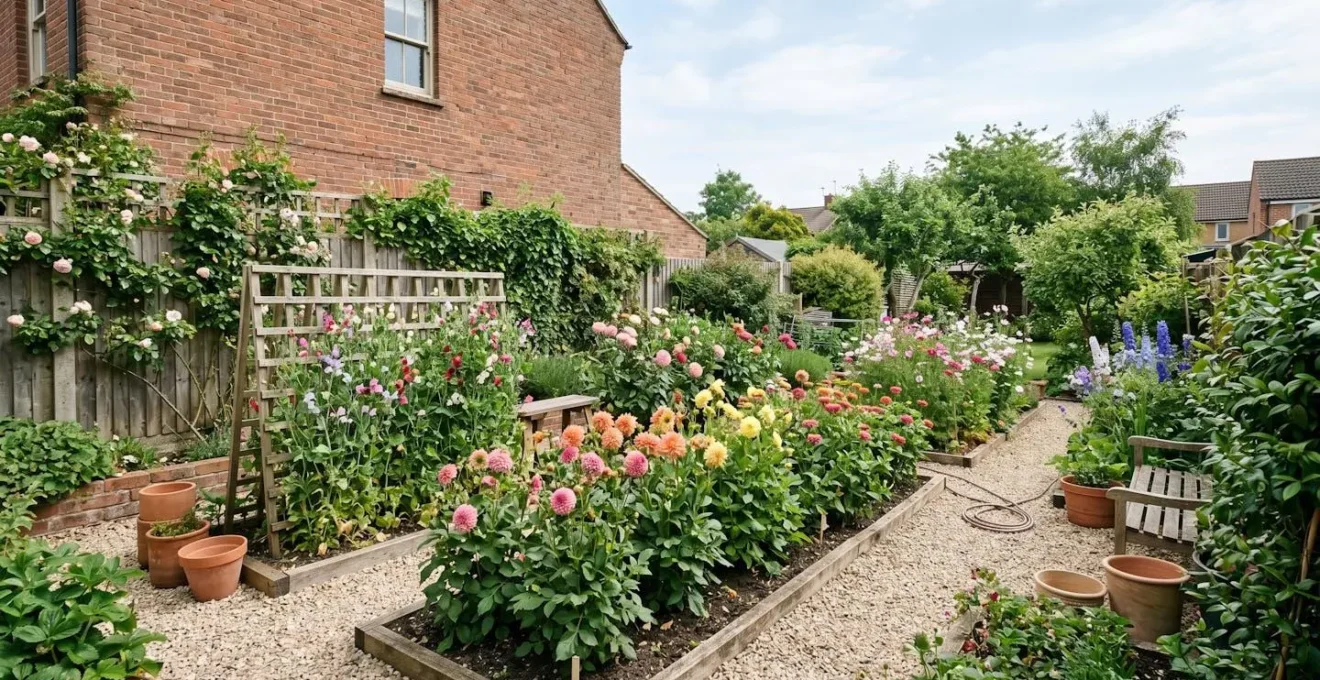
Transforming a small 6x4m British garden into a productive cutting patch isn’t about finding more space; it’s about strategic engineering and ruthless efficiency.
- Success depends on choosing plants that tolerate your specific soil, not just ones you love the look of.
- Continuous blooms from May to October are achieved through a disciplined ‘three-wave’ succession sowing plan, not random planting.
- Counter-intuitively, wider spacing and ‘pinching’ techniques produce a far greater harvest of high-quality stems than cramming plants together.
Recommendation: Start by testing your soil pH. This single piece of information will guide every plant choice you make and is the true foundation of a successful, low-struggle cutting garden.
The vision is captivating: stepping out into your own British back garden, secateurs in hand, and cutting a beautiful, fresh bouquet for the kitchen table. But for most of us, the reality is not a sprawling country estate, but a modest 6m x 4m plot, often with challenging heavy clay soil. The common advice to “grow what you love” or “just scatter some seeds” often leads to disappointment, with a short burst of flowers followed by a barren patch for the rest of the season. Many aspiring flower growers believe they simply don’t have the right space or the right soil to succeed.
But what if the secret to a prolific small cutting garden wasn’t about more space, but about better strategy? What if, instead of fighting your garden’s limitations, you could engineer a system that thrives within them? The key is to shift your mindset from that of a traditional gardener to that of a small-scale flower farmer. This means focusing on production, efficiency, and understanding the core principles that deliver the maximum number of high-quality stems from every square foot of your precious soil.
This guide will walk you through that strategic process. We will move beyond generic plant lists to explore the non-negotiable foundations: selecting flowers that actively enjoy your soil, mastering the art of succession sowing for a non-stop harvest, and understanding the critical (and often counter-intuitive) rules of spacing. By the end, you’ll have a practical blueprint for creating a tiny but mighty cutting garden that provides beautiful, homegrown flowers from late spring right through to the first autumn frosts.
This article provides a complete roadmap, from the soil up. To help you navigate, the following summary outlines the key strategic pillars for designing your productive small-space cutting garden.
Summary: The Complete Blueprint for Your 6x4m UK Cutting Garden
- Which Cut Flowers Tolerate Heavy Clay Soil Without Constant Amending?
- How to Stagger Sowings to Cut Fresh Flowers From May Through October?
- Dahlias or Sweet Peas: Which Delivers More Stems Per Square Foot in Year One?
- Why Planting Zinnias 15cm Apart Instead of 30cm Halves Your Harvest?
- When to Sow, Plant Out, and Cut: The Month-by-Month British Cutting Garden Schedule?
- What Flowers Can You Actually Grow in Britain Each Month of the Year?
- Acid-Lovers or Lime-Tolerant: How to Choose Plants That Won’t Struggle in Your Soil?
- How to Create a Perennial Border That Flowers From April to October?
Which Cut Flowers Tolerate Heavy Clay Soil Without Constant Amending?
Heavy clay is the defining feature for a vast number of UK gardeners. It’s dense, slow to drain in winter, and can bake solid in summer. Instead of fighting a losing battle by trying to amend it into perfect loam, the strategic move is to choose plants that either tolerate or actively thrive in it. A surprising number of a florist’s favourites fall into this category. In fact, it’s a useful filter; if a plant can’t handle your clay, it doesn’t earn a spot in your high-production plot. With around 40% of UK gardens sitting on clay soil, especially in the Midlands and South East, you are in good company.
Think of clay-tolerant plants in two groups. First are the ‘Clay Busters’. These plants, like Eryngium (sea holly) and Echinops (globe thistle), have deep tap roots that physically drive down through the dense soil, breaking it up and improving its structure over time. They are your long-term allies. The second group are the ‘Surface Skimmers’. Plants like Astrantia, Geum, and Helenium have fibrous root systems that are happy in the top few inches of soil. They don’t need deep, fluffy earth to perform, thriving with just a simple top-dressing of compost each year.
Don’t forget shrubs and grasses for structure and foliage, which are essential for creating professional-looking arrangements. Cornus (dogwood) provides incredible coloured stems for winter bouquets, while grasses like Calamagrostis add year-round vertical interest and movement. By choosing from this palette of tough, proven performers, you set your cutting garden up for success from the ground up, saving you time, money, and backache.
- Deep tap-root ‘Clay Busters’: Eryngium (sea holly), Echinops (globe thistle) – these naturally break up heavy soil structure.
- Fibrous-root ‘Surface Skimmers’: Astrantia (masterwort), Geum, Helenium – thrive with a simple compost top-dressing.
- Clay-loving shrubs for structure: Cornus (dogwood) for winter stems, Physocarpus ‘Diabolo’ for dark foliage.
- Ornamental grasses: Calamagrostis (feather reed grass) provides year-round vertical interest.
- Proven perennials for clay: Rudbeckia (black-eyed Susan), Hardy Geraniums, and many Roses (especially Rosa rugosa).
How to Stagger Sowings to Cut Fresh Flowers From May Through October?
A cutting garden that blooms all at once in July and is finished by August is a common beginner’s mistake. The key to a continuous supply of flowers is succession sowing. This isn’t a vague concept; it’s a disciplined, three-wave strategy that ensures you always have something coming into bloom, something at its peak, and something finishing. This is the engine room of your 6x4m flower farm, turning your small space into a constantly productive zone.
The first wave begins in autumn. Sowing hardy annuals like sweet peas and larkspur in September or October allows them to establish strong root systems over winter, ready to burst into flower in late May and June, well ahead of anything sown in spring. The second wave involves half-hardy annuals like cosmos and zinnias. These are started indoors from mid-April, with new trays sown every two to three weeks. This small gap between sowings translates to a much longer flowering period in the garden. The third wave is your high-summer-to-autumn powerhouse: tender perennials like Dahlias, planted out as tubers in late May, which will take over as the earlier annuals start to fade, carrying your harvest through to the first frosts in October.
An advanced technique is ‘Harvest-Triggered Sowing’. Every time you clear a patch of spent flowers, you immediately sow a new batch of fast-growing fillers like Phacelia or Dill. This dynamic approach ensures no space is left empty and maximises your ‘stem-per-square-foot’ output. It transforms your garden from a static display into a living, flowing system of production.
This continuous cycle of sowing, growing, and cutting is the heart of small-space flower farming. It requires planning, but the reward is a garden that gives and gives, providing you with beautiful, fresh material for arrangements for a full six months of the year. It’s the difference between a garden that is merely pretty and one that is truly productive.
Dahlias or Sweet Peas: Which Delivers More Stems Per Square Foot in Year One?
When space is at a premium, every plant must justify its footprint. This brings us to a classic cutting garden dilemma: Dahlias versus Sweet Peas. Both are incredibly productive, but they offer very different returns on your investment of space and time. The choice between them isn’t about which is ‘better’, but which better serves your design goals and production schedule. Looking at the data helps make the decision a strategic one, not just an aesthetic one.
Sweet peas are the undisputed champions of early-season volume. From a single packet of seeds, you can grow dozens of plants along a trellis. With regular cutting, each plant can produce a hundred or more stems. They are the definition of ‘cut-and-come-again’. However, their productive season is relatively short, typically lasting 6-10 weeks from June to early August before they succumb to heat or mildew. They deliver an intense, massive burst of scented, delicate stems perfect for romantic bouquets.
Dahlias are a longer-term investment. They start later, hitting their stride in August just as sweet peas are finishing, and continue producing until the first frosts, often well into October. While a single tuber is more expensive than a packet of seeds, one plant can yield 20-50 high-impact focal flowers. Their ‘stem-per-plant’ count is lower than sweet peas, but the value and impact of each stem is much higher. As flower farmer Erin Benzakein notes of Dahlias in her article for Growing for Market, they are a true garden workhorse.
With an extremely long harvest window of up to 3 months, these brilliant gems have become the workhorse of our summer garden.
– Erin Benzakein, Growing for Market – Dahlias article
So, which delivers more? For sheer stem count in year one, sweet peas win. You can pack more plants into a square foot and the stems per plant are higher. But for season-long production and high-value focal blooms, dahlias are essential. The strategic answer for a 6x4m garden is not to choose one, but to use both in sequence: sweet peas for the early summer sprint, and dahlias for the late summer marathon.
This comparative table breaks down the key performance metrics for a first-year cutting garden.
| Factor | Dahlias | Sweet Peas (Spencer type) |
|---|---|---|
| Productive Season | August-October (up to 3 months) | June-August (6-10 weeks) |
| Initial Investment | £3-8 per tuber | £2-4 per seed packet (20+ seeds) |
| Stems per Plant | 20-50+ stems (cut-and-come-again) | 40-100+ stems (with regular cutting) |
| Space Required | 18″ spacing (3 plants per m²) | 2″ spacing on trellis (20+ plants per m²) |
| First Year Performance | Full production from tubers | Full production from seed |
| Artistic Use | Bold focal flowers, high-impact arrangements | Delicate, scented, romantic bouquets |
Why Planting Zinnias 15cm Apart Instead of 30cm Halves Your Harvest?
It feels logical: to get more flowers, plant more plants. In a small garden, the temptation to cram seedlings together is immense. However, with many cut flower varieties, particularly Zinnias, this approach is deeply counter-productive. Planting Zinnias at a tight 15cm spacing, rather than the recommended 23-30cm (9-12 inches), might give you more individual plants, but it will dramatically reduce your overall harvest of usable, high-quality stems. This is a core principle of ‘flower farming’ over ‘gardening’: prioritise stem quality and overall yield over initial plant count.
The primary reason is airflow. In the typically damp and humid British climate, tightly packed plants create a stagnant environment where moisture lingers on leaves after rain or morning dew. This is a perfect breeding ground for fungal diseases, especially powdery mildew, which can decimate a Zinnia patch in weeks. As Master Gardener Stacy Ling notes, this is a universal issue. Wider spacing allows air to circulate freely, letting foliage dry quickly and keeping plants healthier for longer.
In hot, humid climates like mine in New Jersey, tighter spacing almost always leads to earlier powdery mildew because moisture lingers on foliage and airflow becomes restricted.
– Stacy Ling, Master Gardener, Bricks ‘n Blooms – Zinnia Spacing Guide
Secondly, generous spacing unlocks the power of ‘the pinching multiplier’. When a Zinnia plant has enough space, you can ‘pinch’ or snip out the central growing tip when it’s about 30cm tall. This signals the plant to stop growing upwards and instead send out multiple side shoots from the base. A single, properly spaced and pinched plant will produce 5-10 long, strong, high-quality stems. A crowded plant, in contrast, will put all its energy into a single, often weak and spindly, main stem in a desperate race for light. You get one poor-quality stem instead of many excellent ones. By giving each plant the room it needs, you are investing in a multiplication of your final harvest.
- Cut flower production: Spacing of 23-30cm for tall varieties like ‘Benary’s Giant’ promotes strong central stems.
- The pinching multiplier: Wider spacing enables the crucial ‘pinch back’ technique, resulting in 5-10 robust side shoots.
- Airflow prevents disease: A minimum of 23cm allows leaves to dry faster, delaying powdery mildew in the humid British climate.
- Stem quality over quantity: 30cm spacing produces thick, robust stems with numerous long side-shoots, versus one weak, spindly stem at 15cm.
- British climate rule: Never plant large varieties closer than 23cm (9″); increase to 30cm (12″) in shadier or damper spots.
When to Sow, Plant Out, and Cut: The Month-by-Month British Cutting Garden Schedule?
Successful flower farming in a small space is all about timing and rhythm. Knowing what to do each month removes the guesswork and ensures your 6x4m plot is working at maximum capacity throughout the season. A clear schedule, tailored to the British climate, allows you to anticipate tasks, prepare materials, and stay one step ahead, transforming a potentially chaotic hobby into a smooth, productive operation. This calendar is your strategic plan for the entire year, from the first sowings to the final cuts.
The year begins in earnest in March, starting half-hardy annuals like zinnias and cosmos indoors on a bright windowsill to get a head start. As April arrives, you’ll be hardening off these seedlings and continuing with succession sowings. The major transition happens in May, after the risk of the last frost has passed (this varies across the UK, so check your local forecast!). This is the time to plant out all your tender seedlings and get dahlia tubers in the ground. June and July are about maintenance and harvesting, including the crucial ‘Chelsea Chop’ or ‘pinching’ of plants like zinnias to encourage bushier growth and more flowers.
By August, the garden is in full production. This is peak dahlia season, but it’s also, critically, the time to sow your hardy annuals for next year. As you’re harvesting bucketfuls of flowers, you are also laying the groundwork for the following spring. September and October are about enjoying the late-season bloomers like dahlias and asters, while also starting to tidy up, protect tender plants from the first frosts, and plan your layout for the next year. Following a clear month-by-month schedule ensures no opportunity is missed and the cycle of abundance continues.
Here is a practical, month-by-month schedule to guide you through the British cutting garden year.
| Month | Sow & Grow | Plant & Protect | Cut & Condition |
|---|---|---|---|
| March | Start half-hardies indoors (zinnias, cosmos) | Direct sow hardy annuals outdoors (sweet peas, larkspur) | Cut early spring bulbs (daffodils, tulips) |
| April | Continue succession sowing half-hardies | Harden off indoor seedlings | Cut spring perennials (hellebores, pulmonaria) |
| May | Direct sow fast growers (cosmos, sunflowers) | Plant out half-hardies after last frost; plant dahlia tubers | Peak sweet pea harvest begins |
| June-July | Final succession sowings (zinnias, cosmos) | Pinch back zinnias at 12″ height | Cut annuals, early roses, hardy geraniums |
| August | Sow autumn hardy annuals for next year | Remove spent sweet peas to make room | Peak dahlia season; cut zinnias, cosmos, rudbeckia |
| September-October | Plan next year’s garden | Protect tender perennials from frost | Late dahlias, seed heads (eryngium), autumn foliage |
What Flowers Can You Actually Grow in Britain Each Month of the Year?
The goal of a year-round cutting garden is to have something beautiful to bring indoors every single month, even in the depths of winter. This requires expanding your definition of a ‘cut flower’ beyond just summer annuals. It means embracing coloured stems, interesting seed heads, fragrant shrubs, and the quiet beauty of early spring bulbs. By creating simple ‘bouquet recipes’ for each month, you can plan a garden that offers a continuous, changing display of texture, colour, and scent.
In the bleakest months of January and February, the focus is on structure and scent. You can force branches of Forsythia or flowering quince into bloom indoors. A simple bouquet might consist of fragrant Sarcococca (winter box), a few precious Hellebore flowers, and the striking coloured winter stems of Cornus. As spring arrives, the palette explodes. May is for the first flush of sweet peas, combined with airy Aquilegia and the zingy lime-green of Euphorbia. Summer is a riot of colour; an August bouquet is a celebration of abundance, with big focal dahlias supported by zinnias, cosmos, and frothy Alchemilla mollis foliage.
Even as autumn deepens, the garden still provides. A November arrangement can be one of the most beautiful, combining the last of the hardy chrysanthemums with evergreen foliage from Viburnum tinus, structural Eryngium seed heads, and a final flourish of Cornus stems, bringing the cycle full circle. Planning for these monthly combinations ensures your small plot works for you twelve months of the year.
Case Study: RHS Award-Winning Plants for Year-Round Cutting on Clay Soil
The Royal Horticultural Society provides an excellent shortcut for gardeners. Their Award of Garden Merit (AGM) highlights plants that perform reliably in UK conditions. For clay soil, they’ve identified specific award-winners that provide a continuous harvest. For spring, Ajuga reptans ‘Catlin’s Giant’ offers spikes of blue flowers. For the late summer and autumn gap, Anemone × hybrida ‘Honorine Jobert’ produces masses of pure white flowers on long, wiry stems. And for the peak of summer, Helenium ‘Moerheim Beauty’ provides a fiery display of red and yellow blooms. Choosing these proven AGM plants is a low-risk, high-reward strategy for a productive clay soil cutting garden.
Acid-Lovers or Lime-Tolerant: How to Choose Plants That Won’t Struggle in Your Soil?
Beyond soil structure, the single most important factor for a thriving, low-maintenance cutting garden is soil pH. This simple measure of acidity or alkalinity dictates which nutrients are available to your plants. Forcing a plant to grow in the wrong pH is like asking it to live on a diet it can’t digest. It will lead to weak growth, yellowing leaves (chlorosis), and a constant struggle. A simple, inexpensive soil test kit from any garden centre is the most valuable investment you can make. Once you know your pH, you can work *with* it, selecting a palette of plants that will naturally flourish.
If your test reveals acidic soil (pH below 7.0), you have a wonderful palette to work with. You can grow stunning acid-lovers like Camellias, some Hydrangeas (which will turn blue), and heathers. These provide fantastic spring blooms and valuable evergreen foliage for winter arrangements. You are essentially unlocked to create an ‘acidic florist’s palette’.
Conversely, if you have alkaline or chalky soil (pH above 7.0), you have a different but equally beautiful set of options. This is the perfect environment for a ‘Mediterranean’ style palette, including Lavender, Gypsophila, Scabious, and Eryngium (sea holly). Roses and Clematis also generally prefer slightly alkaline conditions. As the RHS wisely points out, if your soil has a pH of 7.5, you should forget Rhododendrons and embrace Scabious. Trying to grow a Rhododendron in chalky soil will only result in a sad, yellowing plant that never thrives. Most of the popular and easy-to-grow annuals like Dahlias, Zinnias, and Cosmos are adaptable and will perform well in a neutral pH range (6.5-7.5). Knowing your soil’s preference is not a limitation; it is a powerful design tool.
This table outlines the distinct floral palettes you can create based on your soil’s natural chemistry.
| Soil Type | pH Range | Cut Flowers & Foliage | Structural Plants |
|---|---|---|---|
| Acidic Palette | pH 5.0-6.5 | Camellia (spring blooms & foliage), Pieris (foliage), Heathers, Hydrangea (blue forms) | Rhododendron, Blueberry (autumn foliage & berries) |
| Alkaline/Chalky Palette | pH 7.0-8.0 | Lavender, Gypsophila, Scabious, Eryngium (sea holly), Crambe cordifolia | Roses, Clematis, Dianthus (pinks) |
| Neutral/Adaptable | pH 6.5-7.5 | Dahlias, Zinnias, Cosmos, Sweet Peas, Alchemilla mollis | Most annuals, Cornus, Viburnum |
Key Takeaways
- Work with your soil, not against it. Choose plants that naturally tolerate heavy clay for a low-struggle garden.
- Continuous blooms are not luck; they are the result of a disciplined succession sowing plan.
- More stems come from better spacing, not more plants. Give them room to breathe and branch out.
How to Create a Perennial Border That Flowers From April to October?
While annuals provide the explosive summer colour, perennials are the backbone of a truly sustainable cutting garden. They are the ‘buy once, cut for years’ investment. Creating a dedicated ‘perennial production patch’ provides a reliable source of flowers and foliage from early spring to late autumn, forming a permanent framework that you can inter-plant with annuals. This approach, focusing on a grid layout for easy harvesting rather than a traditional decorative border, is pure flower-farmer efficiency.
The foundation of this patch is the ‘Perennial Scaffolding’. This consists of high-value foliage and filler plants that form the structure of your bouquets. Think Alchemilla mollis for its frothy lime-green flowers, Stachys byzantina for its tactile silver foliage, and various Euphorbias for colour and texture. These are the workhorses that tie everything together. Once this scaffolding is in place, you layer in the flowering stars according to their bloom time.
For early spring (April-May), clay-tolerant choices like Aquilegia, hardy Geraniums, and Astrantia provide the first precious cuts. The summer workhorses (June-August) include the incredible Helenium ‘Moerheim Beauty’ and the virtually indestructible Rudbeckia. A quote from a Garden Ninja designer on the BBC’s Garden Rescue highlights its value perfectly.
Hardy and adaptable, the Black-Eyed Susan is my number-one clay-soil perennial. Rudbeckia is virtually slug-proof, which matters enormously in the wetter conditions that clay gardens often produce.
– Garden designer (BBC Garden Rescue), Garden Ninja UK – Plants That Love Clay Soil
A key technique for perennials is the ‘Chelsea Chop’. By cutting plants like Nepeta or Salvia back hard in late May/early June, you not only get a harvest of stems for the vase but also stimulate a much stronger second flush of flowers for late summer. Finally, as the season wanes (September-October), late-flowering heroes like Japanese Anemones take centre stage. This layered, strategic approach ensures your perennial patch is a gift that keeps on giving.
Your Action Plan: Building the Perennial Production Patch
- Establish ‘Perennial Scaffolding’: Plant your permanent framework of high-value foliage like Alchemilla mollis, Stachys byzantina, and Euphorbia.
- Layer in Bloomers by Season: Add your spring (Aquilegia, Geranium), summer (Helenium, Rudbeckia), and autumn (Anemone) producers in designated blocks.
- Embrace the ‘Chelsea Chop’: Identify plants like Nepeta and Salvia and schedule their ‘chop’ for late May to stimulate a second, later harvest.
- Plan for Gaps: Unlike a decorative border, embrace the gaps left by heavy harvesting. This is a sign of a productive patch, ready for inter-planting with annuals.
- Prioritise Stem Length: When choosing varieties, always select those bred for cutting with long, strong stems over dwarf bedding types.
Now that you have the strategic blueprint, from soil preparation to perennial structure, the next step is to draw up your own plan. Take these principles, apply them to your 6x4m patch, and begin the rewarding journey of turning that small space into a source of constant beauty and creativity.