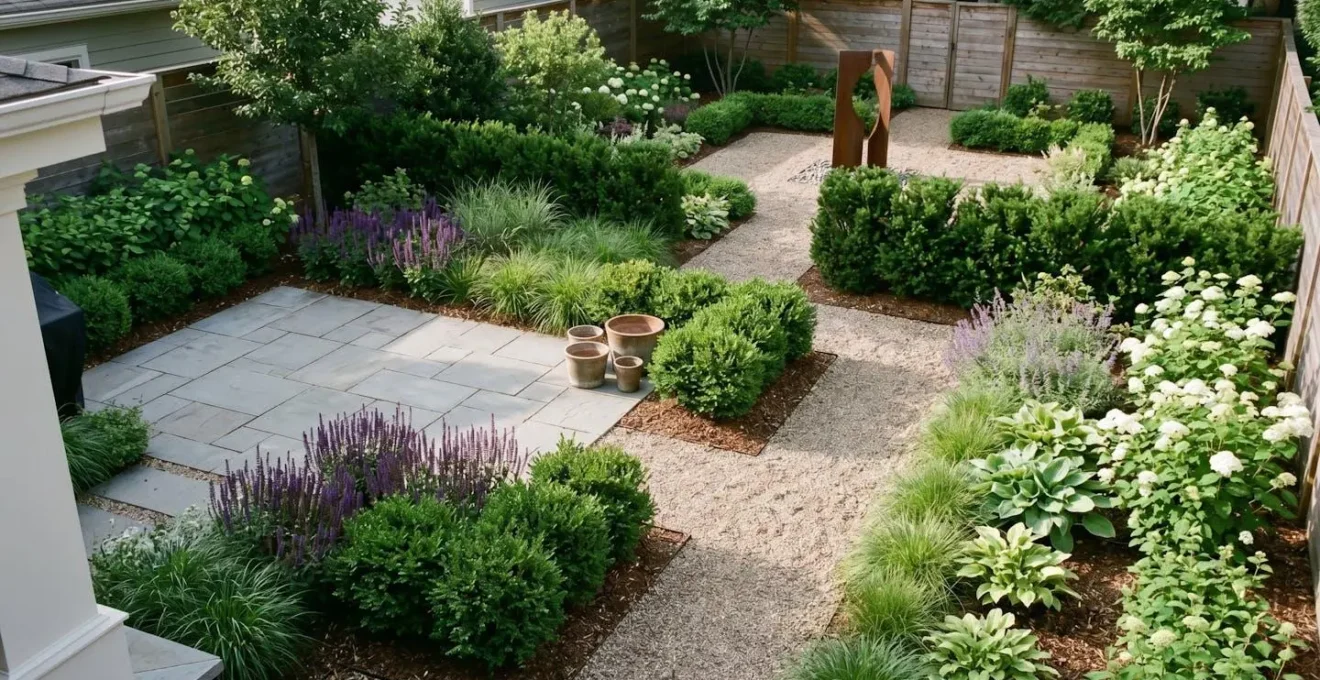
The key to transforming a random collection of plants into a cohesive garden is to shift focus from flowers to a permanent architectural framework.
- Cohesion comes from a strong evergreen structure and well-defined hardscaping that provides year-round form.
- A limited colour palette and strategic plant layering create visual harmony and depth, making the space feel intentionally designed.
Recommendation: Prioritise establishing at least 50% evergreen structure and a clear hardscape layout before focusing on seasonal flowering perennials.
For many passionate UK gardeners, the cycle is familiar. A visit to the garden centre results in another beautiful plant, then another. Soon, the borders are full, yet the overall effect is chaotic—a collection of individual specimens rather than a unified, restful space. You have an abundance of life and colour, but it lacks the deliberate harmony of a professionally designed garden. The common advice to repeat plants or create focal points often feels insufficient, a temporary patch on a deeper structural problem. You’ve accumulated assets, but you haven’t built an ecosystem.
The conventional approach of focusing on flower colour and bloom time is precisely what leads to this feeling of fragmentation. It treats the garden as a two-dimensional canvas that needs to be constantly repainted. This overlooks the fundamental truth of great garden design: a garden is a three-dimensional, living architecture. The sense of peace and cohesion you admire in designed spaces doesn’t come from the fleeting beauty of the flowers; it comes from the permanent skeleton beneath them.
But what if the solution wasn’t about finding more plants, but about establishing a stronger framework? What if the secret to a beautiful garden lay not in what you add, but in the permanent structure you build first? This guide will shift your perspective from that of a plant collector to that of a garden architect. We will deconstruct the principles that create visual coherence, focusing on the unshakeable foundations of evergreen structure, hard landscaping, and ecological function.
By understanding this architectural framework, you will learn how to make your plant collection work for you, transforming it from a beautiful mess into a breathtakingly cohesive and resilient garden that has presence in every season.
Summary: From Plant Collection to Designed Garden
- Why Evergreen Structure Matters More Than Your Flower Choices?
- How to Choose a Garden Colour Palette That Doesn’t Clash When Everything Blooms?
- Why 40% Hard Landscaping Makes Your Garden Easier to Maintain?
- Why Your Sun-Lovers Are Sulking in Shade: The Site Assessment You Skipped?
- How to Design a Beautiful Border That Also Supports Bees and Butterflies?
- Why Your Border Looks Flat: The Front-Middle-Back Height Rule?
- Why Ground Beetles Need Leaf Litter More Than Your Perfect Borders?
- Why Does Your “Wildlife Garden” Attract Fewer Bees Than Your Neighbour’s Lawn?
Why Evergreen Structure Matters More Than Your Flower Choices?
The single greatest difference between a plant collection and a designed garden is its appearance in the depths of winter. A garden that relies on herbaceous perennials for its appeal dissolves into a flat, muddy canvas from November to March. A designed garden, however, retains its form, its “good bones,” through the bleakest months. This resilience is achieved through an architectural framework of evergreen plants. These shrubs, trees, and groundcovers are not mere background fillers; they are the walls, pillars, and foundations of your garden space.
Thinking of evergreens as structure, rather than just “winter interest,” is a transformative mindset. They define the shape of borders, create pathways, screen unsightly views, and provide the permanent mass against which the ephemeral beauty of flowers can truly shine. Without this solid, year-round framework, your seasonal blooms have no context. They are performers on an empty stage. As award-winning garden designer Kate Gould emphasises, this isn’t a minor detail. In her professional opinion, when designing any garden, you want a high percentage of evergreen plants that hold their structure. She suggests that ideally, 50-70 per cent of the planting would be evergreen.
This evergreen structure provides more than just winter form. It creates a sense of enclosure and permanence that is deeply calming to the human eye. It offers vital shelter for birds and insects during harsh weather. By prioritising the placement of yew hedges, box balls, sarcococca, hellebores, and evergreen grasses, you are not sacrificing space for flowers. Instead, you are building the very architecture that will elevate them from a chaotic jumble into a curated display. The flowers become the art on the walls, but the evergreens are the walls themselves.
How to Choose a Garden Colour Palette That Doesn’t Clash When Everything Blooms?
Once your garden’s evergreen framework is in place, the next layer of design is colour. However, for the plant collector, this is often where chaos ensues. A love for all plants can lead to a riot of competing colours that creates a restless, jarring effect. The secret to a sophisticated, harmonious garden is not to use more colours, but to use fewer, more thoughtfully. Professional landscape designers often advise you to choose no more than 2-3 main colours for your scheme, which forces discipline and creates instant cohesion.
To implement this, designers often use the classic 60-30-10 rule, adapted for the garden. Your evergreen structure provides a baseline of green, but for your flowering plants, the rule provides a clear hierarchy:
- 60% Dominant Color: This is your primary hue. It should be repeated in large drifts and serves as the visual anchor for your design. This could be a single flower colour, like the purple of ‘Caradonna’ salvia, used throughout the space.
- 30% Secondary Color: This colour supports the dominant one. It could be an analogous colour (next to it on the colour wheel, like blue) or a complementary one (opposite, like yellow) for more drama. It appears in smaller, but still significant, groups.
- 10% Accent Color: This is your “pop” of colour. A contrasting or unexpected hue used very sparingly to create focal points and prevent the scheme from becoming predictable. A single splash of orange in a purple-and-blue scheme, for instance.
A more advanced technique is the use of “colour echo.” This involves creating harmony by linking plants through shared undertones in their foliage, stems, or flowers. A deep red rose, for instance, can be perfectly paired with a purple-leafed Heuchera because the foliage echoes the deep, wine-coloured undertones of the rose petals. This creates a subtle, sophisticated link that feels intentional and deeply satisfying to the eye.
By restraining your palette and looking for these subtle echoes, you move from simply placing colours next to each other to truly weaving them together. This disciplined approach ensures that even when your garden is at its peak bloom, it feels like a unified composition, not a random collision of colours.
Why 40% Hard Landscaping Makes Your Garden Easier to Maintain?
A plant-obsessed gardener often sees every square foot of ground as a potential planting opportunity. However, a truly designed space understands the critical role of negative space, which in a garden is often defined by hard landscaping. Patios, paths, gravelled areas, and low walls are not just functional necessities; they are a core part of the garden’s architectural framework. They provide definition, create clean lines, and, crucially, offer a visual rest from the beautiful complexity of the planting.
Embracing a significant proportion of hardscaping can feel counterintuitive to someone who loves plants, but it is one of the most effective ways to create a sense of design and dramatically reduce maintenance. A lawn, for example, is a high-maintenance “soft” surface requiring weekly mowing, feeding, and watering. Replacing a portion of it with a well-laid stone patio or a gravel garden instantly reclaims hours of work while adding year-round structure and usability to the space.
The idea of a garden being approximately 40% hardscape and 60% softscape (planting) is a well-established design guideline that creates balance and practicality. This isn’t just about aesthetics; it’s a strategic choice for a more sustainable and manageable garden.
Case Study: The Mediterranean Water-Wise Garden
Mediterranean-style gardens are a masterclass in using hardscaping for both beauty and function. These designs often feature a hardscape ratio of 40% or more, combining drought-tolerant plants with substantial elements like stone pathways, gravel mulch, and walled courtyards. This approach drastically reduces maintenance needs by replacing water-thirsty lawns. The stone and gravel require only occasional sweeping instead of constant care, while simultaneously providing year-round structure and creating shaded retreat areas that make the outdoor space more usable in hot weather. The hardscape becomes as much a feature as the plants themselves.
By thinking of paths as lines that guide the eye, patios as outdoor rooms, and gravel as a textured canvas, hard landscaping becomes a powerful design tool. It provides the crisp edges and solid forms that make the softness of the planting look intentional and curated, rather than overgrown and chaotic. It is the essential counterpart to the living elements of your garden.
Why Your Sun-Lovers Are Sulking in Shade: The Site Assessment You Skipped?
One of the most common frustrations for any gardener is a plant that fails to thrive. Often, we blame the plant, the soil, or our own lack of skill. Yet, in most cases, the failure is rooted in a fundamental mismatch between the plant’s needs and its location. A lavandula that flourishes in a neighbour’s front garden may sulk and rot in your back border. This isn’t bad luck; it’s a failure to conduct a proper site assessment and understand the unique microclimates of your garden.
A garden is not a uniform environment. It is a mosaic of different conditions. A south-facing brick wall can create a pocket of intense heat, mimicking a Mediterranean climate, while the north-facing side of the house may remain in cool, damp shade all day. The base of a hedge can be a rain shadow, creating a zone of surprising dryness. These variations in light, temperature, and moisture are your garden’s microclimates, and understanding them is non-negotiable for successful planting.
Skipping this assessment is the classic mistake of the impulsive plant collector. We buy a plant because we love it, then try to find a spot for it. The designer’s approach is the opposite: first, understand the spot, then select a plant that will thrive there naturally. This “right plant, right place” philosophy is the bedrock of a low-maintenance, resilient garden. It means your sun-loving salvia won’t be struggling in the shadow of a fence, and your shade-loving hostas won’t be scorching in the midday sun.
A thorough site assessment prevents costly mistakes and ensures your plants don’t just survive, but flourish. It is the diagnostic work that must happen before any design prescription can be written.
Action Plan: The Four-Season Sun Mapping Method
- Winter Solstice Observation: On or around December 21st, take photos or sketch your garden every few hours. Note which areas receive the low-angle winter sun—these are precious spots for winter-flowering shrubs and early bulbs.
- Spring Equinox Assessment: Repeat the process around March 21st. The sun is higher, and you’ll see how light patterns change. Crucially, note where deciduous trees (yours or your neighbours’) will soon cast shade.
- Summer Solstice Tracking: On June 21st, map the sun’s highest and strongest path. Identify the hot spots, the all-day sun traps, and the areas that have now shifted into deep summer shade from full spring sun.
- Autumn Equinox Verification: Do one final check around September 21st. This confirms the summer patterns and helps you anticipate how autumn leaf drop will reintroduce light for the coming dormant season.
How to Design a Beautiful Border That Also Supports Bees and Butterflies?
A beautiful garden and a wildlife-friendly garden are not mutually exclusive goals; in fact, the best designs seamlessly integrate both. The key is to move beyond the simplistic idea of just “planting flowers for bees” and start thinking about the border as a complete habitat, or an ecological scaffold. This means providing not just food (nectar and pollen), but also shelter, water, and breeding grounds within a designed, aesthetically pleasing structure.
A common mistake in “wildlife gardening” is to scatter plants in a loose, meadow-style arrangement. While this can look naturalistic, research shows it’s often inefficient for pollinators. Bees and butterflies expend significant energy flying between flowers, so they prefer to forage in dense, adjacent clusters of their preferred plants. Designing your pollinator border with large drifts of a single species (e.g., a 1-metre-wide block of Echinacea) rather than dotting individual plants around is more visually impactful and creates a more efficient “fuelling station” for insects.
Furthermore, a truly supportive garden provides for the entire lifecycle of an insect. This means including host plants for butterfly larvae, such as fennel for swallowtails or nettles (in a discreet corner) for red admirals. It also means incorporating a variety of flower shapes to cater to different pollinators: open-faced daisies for hoverflies, deep trumpets for long-tongued bees, and flat-topped umbels like achillea that act as landing pads for beetles and flies.
Case Study: The Fine Gardening Pollinator Garden
A research-based pollinator garden created by Fine Gardening demonstrated these principles perfectly. Initially, the garden showed little insect activity in its first spring. However, by late summer, as the planting matured into a continuous bloom, pollinator numbers surged. The design’s success was attributed to two key factors. First, plants were grouped in large, adjacent clusters, a strategy based on research showing pollinators prefer not to search widely for nectar. Second, the design integrated both nectar sources and larval host plants within a clever scaffolding structure. Taller, wispy species were planted through and supported by lower, bulkier plants, creating a resilient, interconnected network that looked like a lush herbaceous garden, not a wild meadow.
By designing with these ecological principles in mind—clustering plants, providing for full lifecycles, and offering diverse flower shapes—you create a border that is not only visually stunning but also humming with life. This is the ultimate expression of a garden that is both beautiful and functional.
Why Your Border Looks Flat: The Front-Middle-Back Height Rule?
One of the most common reasons a garden border can feel amateurish and uninspired is a lack of depth. This often stems from a rigid adherence to the most basic planting rule: short plants at the front, medium in the middle, and tall at the back. While logical, this tiered, “stadium seating” approach can create a very static, predictable, and two-dimensional effect. It presents the plants for inspection rather than inviting the viewer into a dynamic, three-dimensional scene.
Professional designers create depth and rhythm by strategically breaking this rule. They understand that a border is a composition of forms, not just heights. They create intrigue by using “see-through” plants—tall, airy species with slender stems and delicate flowers, like Verbena bonariensis or Thalictrum. By placing these tall-but-transparent plants near the front or middle of the border, they create a veil through which the rest of the planting can be glimpsed. This simple trick instantly adds layers and a sense of mystery, drawing the eye deeper into the composition.
Beyond this trick, creating depth is about creating a dynamic interplay of different plant shapes. A successful border composition balances several key forms:
- Mounding Forms: Rounded, hummock-forming plants like hardy geraniums or Alchemilla mollis provide the foundation. They act as the visual “glue,” filling gaps and providing a soft, solid mass from which other shapes can emerge.
- Vertical Spires: Upright flower spikes from plants like salvia, delphinium, and foxglove provide drama and rhythm. They act as exclamation points, drawing the eye upward and preventing the composition from feeling squat.
- Cloud-like Fillers: Airy, multi-branched plants like Gypsophila or fennel create soft, hazy transitions between bolder forms, preventing the composition from feeling too blocky or rigid.
- Architectural Foliage: Bold-leaved plants such as Rodgersia or Acanthus, placed in the middle layer, provide substance and structural contrast to finer textures, ensuring the border has presence even when out of flower.
By thinking in terms of these contrasting forms and daring to place a tall, airy plant at the front, you transform your border from a flat lineup into an immersive, living tapestry with real depth and movement.
Why Ground Beetles Need Leaf Litter More Than Your Perfect Borders?
The desire for a tidy garden is deeply ingrained in many UK gardeners. We rake leaves, cut back every stem, and hoe the soil to a fine, bare tilth. While this may satisfy a need for order, a perfectly pristine border is often an ecological desert. One of the most beneficial things a gardener can do for their local ecosystem is to embrace a degree of “managed messiness”, particularly by preserving a layer of leaf litter and organic matter on the soil surface.
This layer, known as the “duff layer,” is a critical habitat for a vast array of beneficial creatures, most notably ground beetles. These unglamorous, often nocturnal insects are voracious predators of common garden pests, including slugs, snails, and vine weevil larvae. By clearing away every fallen leaf and scrap of dead wood, we are effectively evicting our own best security team. A bare, tidy border is an open invitation for pests, whereas a border with a healthy duff layer is a self-regulating system.
The Royal Horticultural Society (RHS), a leading authority for UK gardeners, has conducted extensive research on this topic. Their work provides compelling evidence for leaving organic matter in place.
RHS Research: The Power of the Duff Layer
The RHS’s sustainable planting trials demonstrate that designs incorporating a ground-level layer of organic matter significantly boost garden biodiversity. Their findings show that leaving mulch and ground cover in place not only provides essential habitat for beneficial ground beetles but also has profound horticultural benefits. This layer helps reduce soil surface moisture evaporation by approximately 70%, suppresses weed growth, and prevents soil erosion. The ground beetles that emerge from these preserved habitats act as a natural pest management system, reducing the need for chemical interventions and contributing to a healthier, more resilient garden.
Managed messiness doesn’t mean letting your whole garden run wild. It’s a strategic approach:
- Designate Wildlife Zones: Concentrate leaf litter and small log piles in the back third of deep borders, or behind larger shrubs, where they are less visible but still highly effective.
- Shred Your Leaves: If whole leaves look too untidy, run them over with a lawnmower. The resulting shredded material makes an excellent, fine-textured mulch that looks more intentional while still supporting the ecosystem.
- Leave Stems Standing: Don’t cut back all your perennial stems in autumn. Hollow stems of plants like Echinacea and grasses provide crucial overwintering sites for solitary bees.
By reframing “messy” as “habitat,” you can create a garden that is not only beautiful and designed but also a thriving, balanced ecosystem that largely takes care of itself.
Key Takeaways
- A cohesive garden is built on a permanent architectural framework of evergreen structure and hardscaping, not a collection of flowers.
- Discipline is key: use a limited colour palette (the 60-30-10 rule) and always match plants to your specific site conditions (microclimates).
- True wildlife gardening is a system: it requires continuous bloom for food, host plants for larvae, and “managed messiness” like leaf litter for shelter.
Why Does Your “Wildlife Garden” Attract Fewer Bees Than Your Neighbour’s Lawn?
It’s a perplexing scenario for the well-intentioned gardener. You’ve dutifully planted bee-friendly flowers, installed a bug hotel, and avoided pesticides, yet your garden seems quiet. Meanwhile, your neighbour’s simple lawn, dotted with clover and dandelions, is buzzing with activity. The reason often lies in a crucial misunderstanding of what pollinators truly need: not just a random selection of “good” flowers, but a continuous and reliable food source from the first mild days of spring to the last warm days of autumn.
Many “pollinator gardens” have a spectacular bloom in July but offer very little in the crucial shoulder seasons of March, April, September, and October. This “boom and bust” cycle is a famine for emerging queen bumblebees in early spring and for insects preparing for winter. A lawn with clover, on the other hand, offers a consistent, if modest, supply of nectar for a very long period. Consistency trumps spectacle. Your goal should be to create a “continuous snack bar,” ensuring something is in flower for pollinators every single week of the growing season.
Furthermore, it’s vital to cater to the right audience. Much of the focus is on honeybees, but in reality, they are just one type of visitor. In fact, UK gardens are heavily serviced by a diverse range of solitary bees, bumblebees, and hoverflies. Research on pollinator gardens found that solitary native bees accounted for 61% of all pollinator visits, making them your most important client. These native bees are often more efficient pollinators and have specific needs that can be met by planning a varied, continuous bloom calendar.
A truly effective wildlife garden is a system designed over time, not a one-off planting. It requires a strategic selection of plants that bridge the gaps between seasons:
- Early Spring (March-April): This is the most critical period. Early bulbs like crocus and winter aconite, along with perennials like hellebores and pulmonaria, provide the first vital nectar for emerging queen bees.
- Late Spring (May-June): Bridge the gap between bulbs and summer’s peak with alliums, catmint (nepeta), and hardy geraniums.
- Summer (July-August): This is the easy part. Maintain abundant blooms with long-flowering perennials like Echinacea, Rudbeckia, lavender, and Monarda.
- Autumn (September-October): As summer flowers fade, late-season bloomers like asters (Symphyotrichum), sedum (Hylotelephium), and Japanese anemones provide the final crucial fuel before winter.
By planning your planting with this calendar in mind, you transform your garden from a beautiful but unreliable restaurant into the most popular, consistently stocked diner in the neighbourhood.
Shifting your perspective from collecting plants to designing a structural and ecological system is the definitive path to a cohesive garden. Begin today by assessing your garden’s evergreen framework and identifying the gaps in your year-round bloom calendar.