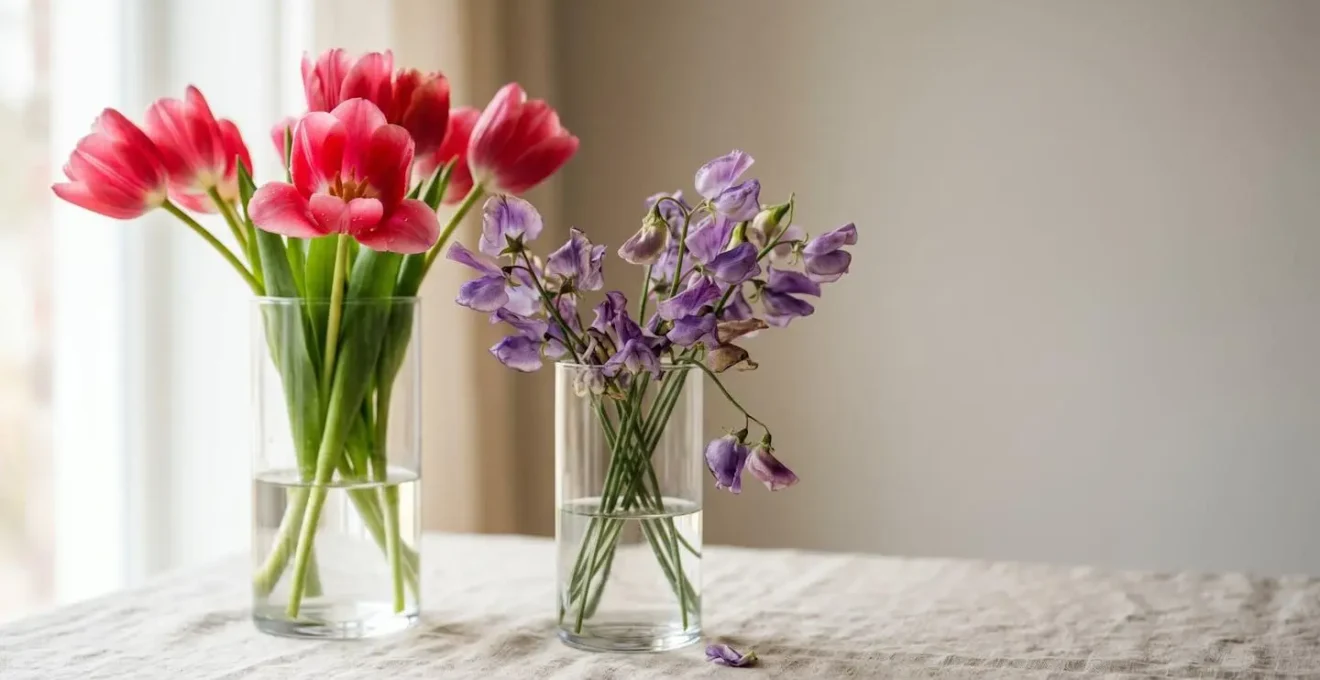
You might think making flowers last is all about fresh water and flower food packets. The reality is far more fascinating. A flower’s lifespan is predetermined by its genetics, stem structure, and sensitivity to aging hormones. Understanding this hidden biology is the real key to moving beyond frustration and selecting bouquets that offer predictable beauty and maximum value for your money.
For any UK flower buyer, the frustration is familiar. You bring home a stunning bouquet, a vibrant mix of colours and forms, only to watch in dismay as the delicate delphiniums collapse in three days while the sturdy carnations look pristine for three weeks. You follow all the conventional wisdom: you dutifully trim the stems, change the water, and use the little sachet of flower food. Yet, the inconsistency persists, turning what should be a simple joy into a game of floral roulette.
The common advice isn’t wrong, but it’s incomplete. It addresses the symptoms of decay but ignores the root causes. The truth is, not all flowers are created equal. Each variety is born with an internal “senescence clock” and a unique structural blueprint that dictates its potential vase life. The real secret to a long-lasting display isn’t just about care; it’s about understanding the inherent nature of the flowers you choose.
This guide moves beyond the platitudes. Instead of repeating generic tips, we will delve into the plant science that governs why some blooms are marathon runners and others are sprinters. We will explore the vascular architecture of stems, the invisible warfare of aging hormones like ethylene, and the genetic programming that makes a carnation an endurance athlete and a sweet pea a fleeting pleasure. By understanding the “why,” you can finally make informed choices, predict performance, and maximise the days-per-pound value of every bouquet you buy.
This article dissects the science behind floral longevity to empower you with expert knowledge. Explore the sections below to master the art and science of a longer-lasting bouquet.
Summary: A Scientific Guide to a Longer-Lasting Bouquet
- How Long Should Each Flower Type Actually Last: The Realistic Expectation List?
- Why Carnations Last 3 Weeks While Delphiniums Collapse in Days?
- Which 10 Flowers Deliver the Best Days-Per-Pound Value in the UK?
- When to Pull Dying Flowers: The Removal Strategy That Saves the Rest?
- How to Use Your Fridge to Add 3 Days to Your Bouquet’s Display Life?
- Why Rose Heads Flop Despite Stiff Stems: The Bent-Neck Diagnosis?
- Why Carnations Resist Ethylene but Delphiniums Collapse: The Sensitivity Spectrum?
- Why Does Placing Flowers Near a Fruit Bowl Kill Them in Half the Time?
How Long Should Each Flower Type Actually Last: The Realistic Expectation List?
The first step in overcoming floral frustration is to set realistic expectations. Not every flower is designed to last for weeks. Each species has an innate genetic timer, or senescence clock, that dictates its potential vase life. While proper care can help a flower reach its maximum potential, it cannot fundamentally change its nature. A poppy will always be a fleeting beauty, while a chrysanthemum is built for endurance.
As a general rule, most common cut flowers should last between 5 and 14 days with proper care. As one gardening expert notes, “Roses, chrysanthemums, and alstroemerias tend to be the long-haulers. Delicate things like sweet peas or poppies are more fleeting, regardless of what you do.” The key is to know which category your flowers fall into. For example, spray roses can have a dramatically different lifespan depending on care; a 2024 FloraLife study showed they last an average of 11 days with flower food versus 7.7 days with water alone. This highlights that while genetics sets the upper limit, proper care is crucial for reaching it.
- Short-Lived (3-5 days): Sweet Pea, Poppy, Dahlia, Cosmos
- Medium-Lived (5-7 days): Tulip, Iris, Delphinium, Rose (some varieties), Lily
- Long-Lived (10-14+ days): Carnation, Chrysanthemum, Alstroemeria, Statice, Orchid
Understanding this basic categorisation transforms you from a hopeful observer to an informed curator. You can build bouquets with a mix of lifespans, enjoying the sequential blooming and fading as part of the experience, rather than feeling disappointed by a perceived failure.
Why Carnations Last 3 Weeks While Delphiniums Collapse in Days?
The vast difference in vase life between a carnation and a delphinium is not accidental; it’s a tale of two completely different biological strategies. The secret lies in their internal architecture and genetic programming. A carnation’s longevity is a masterclass in structural and metabolic efficiency, while a delphinium prioritises a dramatic but brief display.
The primary factor is vascular integrity. A carnation stem is solid, waxy, and dense. Its xylem—the microscopic tubes that transport water—are well-supported and less prone to blockages or collapse. In contrast, a delphinium stem is hollow and delicate. This structure is inherently weaker and more susceptible to air bubbles (embolisms) or bacterial blockages that quickly halt water uptake, causing the flower to wilt rapidly, even in a vase full of water. Plant breeders have capitalised on the carnation’s robust nature; a research program demonstrated that targeted breeding could extend vase life to an incredible 27.8 to 32.7 days, showcasing the power of genetics in defining the senescence clock.
This structural difference is fundamental. The carnation is built like a marathon runner, conserving resources and maintaining hydration with a highly efficient system. The delphinium is a sprinter, putting all its energy into a magnificent but unsustainable burst of glory. No amount of fresh water can overcome a complete failure in the flower’s internal plumbing.
Which 10 Flowers Deliver the Best Days-Per-Pound Value in the UK?
For the savvy UK buyer, thinking in terms of “days-per-pound” is the ultimate strategy for maximising value. This metric moves beyond the initial purchase price and focuses on the total enjoyment delivered over time. It’s about investing in blooms that provide a lasting return. The champions in this category are flowers that combine a reasonable price point with a genetically programmed longevity and a robust structure.
These are the flowers that consistently perform, resisting wilting and providing a long-lasting display. They are often the workhorses of the floral industry for a reason: they are reliable. Alstroemeria, also known as the Peruvian Lily, is a prime example of a high-value flower. It’s affordable, comes in a huge range of colours, and boasts a natural vase life of up to two weeks. Furthermore, it responds exceptionally well to post-harvest treatments, with research showing its life can be extended from 12-13 days to 20-21 days with specific preservatives, highlighting its incredible potential.
Here are 10 of the best flowers for days-per-pound value available in the UK market:
- Alstroemeria: The undisputed champion of longevity and value.
- Carnations: Inexpensive, available in every colour, and can last up to three weeks.
- Chrysanthemums: ‘Mums’ are exceptionally hardy, with some varieties lasting a month.
- Statice: Often used as a filler, it’s a long-laster that also dries beautifully.
- Gladiolus: A great value buy as the florets open sequentially up the tall spike over a week or more.
- Sunflowers: For their size and impact, they offer great value, typically lasting 7-10 days.
- Freesias: While more delicate, their staggered blooming and powerful scent provide extended enjoyment.
- Stock: Known for its spicy, clove-like fragrance and a respectable vase life of 5-7 days.
- Orchids (Cymbidium/Dendrobium): While a single stem is more expensive, its vase life of 2-4 weeks provides exceptional long-term value.
- Anthurium: The glossy, heart-shaped ‘flower’ is actually a spathe (a modified leaf) and can last for several weeks with minimal care.
Focusing your purchases on these varieties ensures your floral investment pays dividends in long-lasting beauty, taking the guesswork out of building a resilient bouquet.
When to Pull Dying Flowers: The Removal Strategy That Saves the Rest?
Removing a fading flower from a bouquet isn’t just about aesthetics; it’s a critical act of triage that can save the rest of the arrangement. A single dying bloom initiates a process of “ethylene warfare” that can trigger a chain reaction of premature aging in its neighbours. Understanding when and why to intervene is essential for extending the life of the whole bouquet.
Dying and decaying plant matter releases ethylene gas, a natural plant hormone that acts as a powerful aging signal. As a scientific publication from ResearchGate explains, “Ethylene causes petal wilting and abscission, leaf yellowing and abrupt or premature death of flowers.” A wilting flower is actively broadcasting a message to all the healthy flowers around it: “It’s time to age and die.” By removing the source of this signal, you protect the rest of the bouquet from this hormonal assault.
The key is to act at the first sign of irreversible decline. Don’t wait for a flower to be completely brown and shrivelled. Look for these early warning signs:
- Loss of Turgidity: The petals or stem feel soft and are no longer crisp, and the flower head begins to droop.
- Petal Discoloration: The edges of the petals start to turn brown, transparent, or develop dark spots.
- Petal Drop (Abscission): The flower starts to shed its petals with the slightest touch.
When you spot a flower exhibiting these symptoms, remove it immediately. This simple act of ‘weeding’ your vase is one of the most effective ways to prolong the collective beauty of the arrangement.
How to Use Your Fridge to Add 3 Days to Your Bouquet’s Display Life?
One of the most effective but often overlooked techniques for extending a bouquet’s life is borrowed directly from the professional floral industry: refrigeration. Florists use cold storage, or a “cold chain,” to press pause on a flower’s life cycle. By lowering the temperature, you dramatically slow down the flower’s metabolism, including its rate of respiration, water loss, and production of aging hormones like ethylene. For the home user, a domestic fridge can serve as a powerful tool to add several days to your bouquet’s display window.
However, simply shoving your vase into the fridge is not the answer and can cause more harm than good. You must replicate the professional process on a smaller scale to avoid temperature shock and freezing damage. This involves proper conditioning and a gradual re-acclimatisation. The key is to slow the flower’s ‘senescence clock’ without stopping it so abruptly that the mechanism breaks. It’s particularly useful for preserving a bouquet overnight for an event the next day, ensuring it’s at its absolute peak.
Never store flowers next to fruit in the fridge, especially apples and avocados. These release high levels of ethylene gas, which will have the opposite of the desired effect and rapidly accelerate the flowers’ demise. By following a structured cold treatment protocol, you can reliably gain an extra 2-3 days of peak freshness.
Your Action Plan: The Home Cold-Chain Protocol
- Condition First: Before refrigeration, allow freshly cut flowers to hydrate in a bucket of water in a cool room (e.g., a garage or cellar) for at least 4-6 hours. This prevents shocking a dehydrated flower with cold.
- Refrigerate Correctly: Place the conditioned flowers (ideally in a vase or bucket of water) in the main part of the fridge, not the crisper drawer unless its humidity is adjustable. The ideal temperature is between 3-5°C. Ensure they are not touching the back wall, where ice can form.
- Isolate from Fruit: Critically, ensure there is no ripening fruit anywhere in the fridge. Ethylene gas from a single apple can ruin the entire process.
- Harden Off: After removing from the fridge (e.g., the next morning), do not place the bouquet directly into a warm, bright room. Allow it to sit in a cool room for about an hour to ‘harden off’ and adjust to the temperature change gradually.
- Refresh and Recut: After the hardening-off period, give the stems a fresh cut and place them in a clean vase with fresh water and flower food before moving to their final display location.
Why Rose Heads Flop Despite Stiff Stems: The Bent-Neck Diagnosis?
It’s one of the most common and frustrating failures in floristry: a beautiful rose with a firm, strong stem suddenly develops a limp neck, and the head flops over as if guillotined. This phenomenon, known as “bent-neck syndrome,” is not a sign of a weak stem but rather a catastrophic failure in the flower’s water supply system. The stem below the bend is perfectly hydrated, but an invisible blockage is preventing water from reaching the heavy head.
This is a classic issue of failed vascular integrity. The blockage acts like a dam in the xylem, the plant’s water-conducting tissues. According to a research team at Frontiers in Plant Science, “Necking is thought to be caused by either an air embolism or accumulation of microorganisms at or within the stem end, blocking the xylem vessels and preventing water uptake.” An air embolism occurs when the stem is cut out of water, allowing a tiny air bubble to be sucked into the xylem, which is fatal for water flow. A bacterial blockage is the result of dirty water or vases, where microbes multiply and physically clog the plumbing.
This issue is a significant problem in the commercial supply chain. A 2023 study on commercial shipments found that 4.7% of commercial ‘Orange Crush’ roses showed bent neck symptoms upon arrival after just a six-day transport, demonstrating how quickly these blockages can form. For the home user, the fix is to address the blockage. Recutting the stem (under water, to prevent another embolism) by several inches can sometimes remove the blocked section and restore water flow. However, prevention is far better: always use a clean vase and cut stems under water.
Key Takeaways
- Every flower has a pre-programmed genetic lifespan—the “senescence clock”—which determines its maximum potential vase life.
- A flower’s internal plumbing, or “vascular integrity,” is critical. Solid stems (like carnations) hydrate more reliably than hollow ones (like delphiniums).
- Ethylene gas is the primary aging hormone. Managing exposure to both internal (from dying flowers) and external (from ripening fruit) sources is essential for longevity.
Why Carnations Resist Ethylene but Delphiniums Collapse: The Sensitivity Spectrum?
The story of ethylene sensitivity is one of the most fascinating and misunderstood aspects of flower longevity. While we know ethylene is the “aging hormone,” not all flowers react to it in the same way. There is a vast spectrum of sensitivity, and a flower’s position on this spectrum is a primary determinant of its vase life. This explains why a delphinium can collapse overnight next to a fruit bowl, while a nearby orchid remains unaffected.
Here lies a fascinating paradox with carnations. The title of this section suggests they resist ethylene, and in the consumer’s home, they do. However, the botanical reality is the opposite. According to a post-harvest care presentation, “Most carnation cultivars are extremely sensitive to ethylene at concentrations below 1 ppm, and affected flowers wilt very rapidly.” So how can they be both extremely sensitive and famously long-lasting? The answer is technology. The floral industry knows carnations are sensitive, so virtually all commercially grown carnations are treated post-harvest with an ethylene inhibitor, such as Silver Thiosulfate (STS) or 1-MCP. This treatment effectively blocks their ethylene receptors, making them “blind” to the aging gas. You are buying a flower that has been immunised against its greatest weakness.
This proactive treatment is now being applied to other sensitive flowers, like roses. A 2024 Flowerwatch study demonstrated that 100% of roses treated with a new ethylene-blocking technology remained in excellent condition after 7 days, compared to only 62.5% of the untreated group. The delphinium, on the other hand, is also highly sensitive to ethylene but is not always treated as standard. This leaves it vulnerable to both its own internally produced ethylene and any external sources, explaining its rapid collapse.
Why Does Placing Flowers Near a Fruit Bowl Kill Them in Half the Time?
It’s a piece of advice passed down so often it has become folklore: keep your flowers away from the fruit bowl. This isn’t an old wives’ tale; it’s a stark demonstration of plant biochemistry in action. The fruit bowl is the most common domestic source of ethylene gas, the invisible enemy of a fresh bouquet. This is the clearest example of external factors dramatically shortening a flower’s pre-programmed lifespan.
As the Proflowers blog simply puts it, “Ripening fruits release tiny amounts of ethylene gas which can reduce the longevity of your fresh arrangement.” Fruits like apples, bananas, avocados, and tomatoes are particularly high emitters as they ripen. Placing a vase of ethylene-sensitive flowers—such as roses, lilies, or delphiniums—next to these fruits is like putting them in a gas chamber. The ethylene floods their receptors and triggers the senescence process, accelerating everything from petal wilting and discoloration to the eventual dropping of flowers (abscission).
Case Study: Ethylene as the Universal “Flower Drop” Trigger
The universal power of ethylene was demonstrated in a comprehensive study investigating its effects on flower abscission. Researchers examined approximately 300 different species from 50 plant families and found a consistent pattern. The study, published in PMC, concluded that in all species studied (except for the Cymbidium orchid), flower fall was highly sensitive to ethylene. It acts as the primary trigger for accelerated aging, whether the flower is on the plant or in a vase. This confirms that the fruit bowl effect is not a fluke but a clear example of a fundamental biological mechanism.
By understanding that this gas is the culprit, the solution becomes obvious. Keep your bouquets well away from ripening fruit. This single, simple action can often double the vase life of sensitive flowers, protecting your investment and allowing them to live out their full genetic potential. You are not just moving your vase; you are protecting it from a direct chemical assault.
By moving beyond generic tips and understanding the core principles of floral senescence—genetics, vascular structure, and ethylene management—you are no longer just a buyer, but an informed curator. You now have the knowledge to select the right flowers for your needs, provide precisely the right care, and truly maximise the joy and value of every bouquet.