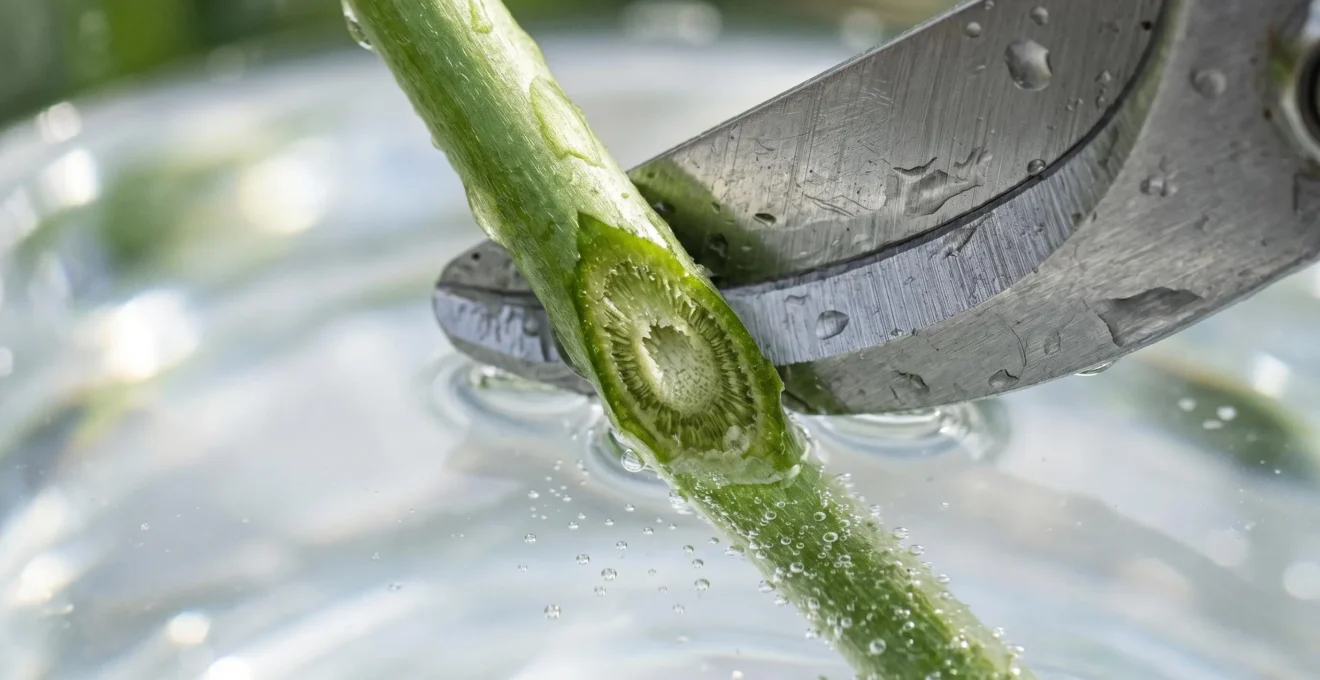
The common advice to ‘trim your stems’ is dangerously incomplete; using the wrong tool or angle actively creates microscopic blockages that starve your flowers, regardless of fresh water or flower food.
- A blunt cut crushes the stem’s vascular tissue (the xylem), while a cut in open air allows a fatal air bubble (an embolism) to form, both of which stop water flow.
- Mastering a 45-degree cut with a sharp tool, performed underwater, is the foundational skill for maximising the hydraulic efficiency of the stem.
Recommendation: Stop using kitchen scissors. Switch to bypass secateurs or a floral knife and always re-cut stems submerged in water to prevent the air blockages that cause premature wilting.
You’ve followed the instructions diligently. The moment your beautiful bouquet arrives, you find your sharpest kitchen scissors, trim the stems, and place them in a vase of fresh water, perhaps with the little food sachet. Yet, within a day or two, the heads begin to droop, the petals look tired, and you’re left wondering what you did wrong. This frustrating experience is incredibly common, and it stems from a misunderstanding of what a flower stem truly is: not just a stalk, but a sophisticated piece of hydraulic engineering.
The conventional wisdom focuses on simple actions but rarely explains the critical science behind them. The truth is, the method of cutting is far more important than the act of cutting itself. An incorrect cut doesn’t just fail to help; it actively harms the flower by creating blockages within its delicate vascular system. This system is a network of microscopic tubes, known as the xylem, designed to pull water from the vase all the way up to the petals. When this system is compromised at the base, the flower is effectively sentenced to death by dehydration, even while sitting in water.
This is where professional floral care diverges from household habit. The key isn’t just about providing water, but ensuring the flower can actually drink it. The problem isn’t your water or your vase; it’s a fatal blockage at the point of entry. If the microscopic ‘straws’ of the xylem are crushed, clogged with debris, or sealed by an air bubble, the pathway is broken. This guide moves beyond the superficial advice to give you the technical understanding of a professional florist.
We will deconstruct the science of the cut, explore the mechanics of water uptake, and reveal why the tools you use and the environment you cut in are non-negotiable factors for success. By understanding the ‘why’ behind the technique, you’ll learn how to prevent these fatal blockages and ensure every bouquet you receive can achieve its maximum potential lifespan, transforming your floral experience from one of fleeting beauty to one of lasting enjoyment.
This article will guide you through the essential techniques and scientific principles that govern a flower’s ability to stay hydrated. Below is a summary of the key areas we will cover to turn you into an expert in floral care.
Summary: The Professional’s Guide to Stem Hydraulics and Flower Longevity
- How a 45-Degree Cut Creates 40% More Surface Area for Water Absorption?
- Kitchen Scissors or Proper Secateurs: Which Tool Prevents Stem Crushing?
- How Often Should You Re-Cut Stems: The 48-Hour Refresh Rule?
- Why Cutting Stems Out of Water Creates Fatal Air Bubbles in the Vascular System?
- Why Tulips Need Different Prep Than Roses: The Soft-Stem Exception Guide?
- How a 45-Degree Cut Adds 3 Extra Days to Your Bouquet’s Lifespan?
- When to Hammer or Split Woody Stems: The Technique for Lilacs and Hydrangeas?
- Why Do Chrysanthemums Drink Twice as Much Water as Roses?
How a 45-Degree Cut Creates 40% More Surface Area for Water Absorption?
The 45-degree angle is the most cited rule in flower care, but its purpose is twofold and rooted in simple physics. Firstly, a diagonal cut exponentially increases the surface area of the xylem exposed to water. Instead of a small, flat circle of tissue, you create a wide, elliptical opening. This is a simple geometric advantage: more open channels mean a higher potential rate of water uptake. Think of it as opening one small window versus opening a large patio door; the potential for flow is dramatically different. This increased access is vital, as research demonstrates that more than 50% blockage of the stem’s vascular tissue significantly shortens a flower’s life.
Secondly, the angled cut serves a crucial mechanical function. A stem cut flat at 90 degrees can sit flush against the bottom of the vase. When this happens, it’s like putting your thumb over the end of a straw. Water flow is almost completely obstructed, regardless of how much surface area was initially exposed. The pointed tip created by a 45-degree cut ensures that the stem always rests on a point, guaranteeing that the cut surface remains surrounded by water and free to draw it up into the petals. This maintains the hydraulic pressure needed for the flower to remain turgid and vibrant.
This principle is fundamental to professional floristry. As the experts at the Brooklyn Botanic Garden explain, the technique is about maximising opportunity for the plant:
Cutting at an angle provides a larger exposed area for the uptake of water. It also enables the stem to stand on a point, allowing water to be in contact with the cut surface.
– Brooklyn Botanic Garden, Cut-Flower Care Guide
Therefore, the angled cut is not just a ‘nice-to-have’ tip; it is a foundational technique that addresses both the biological need for surface area and the mechanical reality of how a stem sits in a vase. It is the first and most important step in ensuring your flowers have the unimpeded access to water they need to thrive. Without this, all other efforts are compromised from the start.
Kitchen Scissors or Proper Secateurs: Which Tool Prevents Stem Crushing?
The single biggest mistake in home flower care is the choice of cutting tool. While reaching for standard kitchen or craft scissors seems convenient, it is the primary cause of stem failure. Most scissors are designed with a crushing action. They have two blades that press against the stem from opposite sides before shearing through it. For a flower stem, this is a catastrophic event. This pressure squeezes and flattens the delicate, straw-like xylem vessels, effectively pinching them shut. Even if you make a perfect 45-degree angle cut, the crushed vessels at the opening cannot draw up water. This is why you can follow the ‘rules’ and still see your flowers wilt; you’ve inadvertently destroyed the very plumbing you were trying to open.
A professional florist’s toolkit is built around preventing this damage. The ideal tools are those that use a slicing or bypassing action. A sharp floral knife offers the ultimate surgical precision, slicing cleanly through the tissue without any compression. The next best option, and the most practical for home use, is a pair of bypass secateurs. Unlike anvil secateurs (which have one blade that closes onto a flat surface, causing crushing), bypass secateurs work like scissors, but the blades slide past each other to make a clean slice. This action preserves the structural integrity of the xylem.
The visual evidence at a microscopic level is stark. A stem cut with a sharp knife or bypass secateurs shows clean, open circular vessels ready for hydration. A stem cut with household scissors reveals a mangled, compressed mess of collapsed cell walls. To ensure your flowers have a fighting chance, a hierarchy of tools should be followed:
- Best: A dedicated, sharp floral knife for surgical-level precision that leaves vascular tissue completely intact.
- Better: Sharp bypass secateurs that make a clean slicing cut without compressing the stem.
- Acceptable: The sharpest, non-serrated kitchen knife you own, thoroughly cleaned before use.
- Avoid at all costs: All household scissors, serrated knives (which tear tissue), and anvil-type secateurs (which crush).
How Often Should You Re-Cut Stems: The 48-Hour Refresh Rule?
Even with a perfect initial cut, the stem’s ability to absorb water diminishes over time. There are two primary reasons for this. Firstly, the cut surface begins to heal, forming a callus of tissue that can impede water flow. Secondly, and more significantly, bacteria present in the vase water multiply rapidly. These bacteria, along with microscopic debris, form a biofilm that clogs the open ends of the xylem vessels, creating a new blockage. This is why simply topping up the water isn’t enough; the entry point itself must be refreshed. For this reason, floral experts recommend you re-cut flower stems every two to three days.
This regular maintenance involves removing the flowers from the vase, trimming another inch or so from the bottom of the stems (again, at a 45-degree angle and preferably underwater), and placing them back into a clean vase with fresh water and flower food. This simple act removes the bacteria-clogged and calloused end, exposing fresh, open vascular tissue. This “48-hour refresh” is a cornerstone of extending vase life, resetting the flower’s ability to hydrate itself efficiently and combating the inevitable biological processes that lead to wilting.
Sometimes, despite your best efforts, a bouquet may start to wilt prematurely, often within the first 24 hours. This is rarely a sign of an old flower; it’s almost always a sign of a major hydraulic failure, typically an air embolism. In these cases, an emergency protocol can often revive them.
Emergency Revival Protocol for a Prematurely Wilting Bouquet
For a bouquet that begins to droop within the first day, the problem is likely a severe air bubble (embolism) blocking the xylem. To fix this, a shock treatment is required. First, re-cut several inches off each stem while it is fully submerged in a basin of water. This ensures no new air can enter. Then, place the flowers in a vase of lukewarm water for 20-30 minutes. The slightly warmer temperature helps dissolve the trapped air pocket within the stem, allowing the natural capillary action to resume and draw water up into the flower head. This protocol can often reverse first-day wilting by directly addressing the embolism that is starving the flower of water.
Why Cutting Stems Out of Water Creates Fatal Air Bubbles in the Vascular System?
The moment a flower stem is cut, it is in a state of high tension. The process of transpiration—water evaporating from the leaves and petals—is still happening, creating a powerful suction force up through the xylem. Think of it as a continuous straw being pulled from above. When you cut the stem in open air, this suction doesn’t stop. Instead of pulling up more water, the exposed xylem immediately sucks in a tiny bubble of air. This is known as an air embolism, and it is one of the most common and fatal events for a cut flower. This single air bubble becomes lodged in the microscopic vessel and creates an impassable blockage. Water simply cannot get past it.
This explains why a flower can be cut perfectly but still wilt in a vase full of water. The embolism, created in the few seconds between the cut and placing it in water, has sealed its fate. The hydraulic column is broken, and no amount of flower food or fresh water can fix it. The only way to prevent this is to never expose a freshly cut stem end to the air. This is why professionals are trained to cut stems underwater.
The technique is simple but non-negotiable for maximum vase life. Submerge the lower portion of the stems in a bowl or sink of water. While the stem end is fully underwater, make your 45-degree cut with a sharp tool. This way, the instant the cut is made, the xylem’s suction force pulls in water, not air. The hydraulic system remains a continuous, unbroken column of water from the vase all the way to the petals. The flower can then be immediately transferred to its final vase. By eliminating the risk of an air embolism, you remove the primary obstacle to proper hydration and dramatically increase the flower’s chances of survival.
Why Tulips Need Different Prep Than Roses: The Soft-Stem Exception Guide?
While the 45-degree underwater cut is a universal best practice, treating every flower identically ignores the unique biology of different stem types. A rose has a sturdy, woody stem, whereas a tulip has a soft, fleshy one, and a delphinium has a hollow one. Each requires a specific modification to its preparation to maximise water uptake and structural integrity. Understanding these exceptions is what separates basic care from expert conditioning, allowing you to cater to the specific needs of each flower in a mixed bouquet.
For example, hollow-stemmed flowers like delphiniums or amaryllis can have their hydration boosted by filling the stem with water and plugging the end with a small piece of cotton wool. This creates an internal reservoir. Stems that “bleed” a milky latex sap, such as poppies or euphorbia, must have their ends sealed immediately after cutting. This is done by briefly searing the cut end with a flame or dipping it in boiling water for 10 seconds. This stops the sap from leaking out and clogging the xylem vessels. Each technique is a direct response to the stem’s unique structure.
The following table, based on guidance from institutions like the New York Botanical Garden, outlines the specific preparation techniques for major stem categories. As this comprehensive conditioning guide shows, professional florists use a range of methods tailored to each flower’s anatomy.
| Stem Category | Examples | Specific Preparation Technique |
|---|---|---|
| Hollow Stems | Daffodils, Delphiniums, Amaryllis | Fill stems with water and cover base with cotton ball secured by rubber band, or insert thick stick/wire up stem for support |
| Soft/Bulbous Stems | Tulips, Hyacinths | Use minimal water, keep in cool location, manage continued vase growth rather than focusing solely on cut technique |
| Woody Stems | Lilac, Hydrangea, Roses | Make 45-degree cut plus vertical split 1-2 inches up stem; avoid hammering which crushes vascular tissue |
| Bleeding Stems | Poppies, Euphorbia, Poinsettias | Sear cut end with flame or dip in boiling water for 10 seconds to seal latex and prevent vessel blockage |
By recognising these differences, you can provide tailored care that addresses the specific challenges of each stem type, ensuring every flower in your arrangement, not just the roses, has the best possible chance at a long vase life.
How a 45-Degree Cut Adds 3 Extra Days to Your Bouquet’s Lifespan?
The cumulative effect of proper stem preparation is not marginal; it is transformative. While a title suggesting a 45-degree cut alone adds three days is a simplification, it points to a larger truth: a correct cut is the gateway to unlocking a flower’s full potential lifespan. Without an open, unblocked vascular system, no other care technique matters. A flower that cannot drink will wilt in a day or two, period. A flower with a perfectly prepared stem, however, is now able to take full advantage of the other elements of proper care, primarily clean water and floral preservative.
Floral preservative, that small sachet included with bouquets, is not simply ‘food’. It is a multi-component formula designed to support the flower’s system. It typically contains a sugar for energy, an acidifier to lower the water’s pH (which helps water travel up the xylem), and, most importantly, a biocide to inhibit the bacterial growth that clogs stem endings. When a stem is properly cut, it can efficiently absorb this solution, which not only feeds the flower but actively keeps its plumbing clear. The synergy between a clean cut and a quality preservative is powerful; in fact, floriculture research shows that proper preservative use can extend vase life by 50-200% depending on the flower species.
Therefore, the “extra days” of life come from a system working in harmony. The 45-degree cut opens the door. The underwater technique prevents an immediate blockage. Regular re-cutting keeps the door open. And the preservative solution provides the fuel and maintenance to keep the entire hydraulic engine running smoothly. A poorly cut rose may last three days. A professionally conditioned rose, benefiting from this complete system, can easily last for ten days or more. The cut doesn’t add the days itself; it enables the flower to live them.
When to Hammer or Split Woody Stems: The Technique for Lilacs and Hydrangeas?
Flowers with tough, woody stems like lilacs, hydrangeas, or forsythia present a unique hydration challenge. Their vascular tissue is distributed throughout a dense, rigid structure, making water uptake more difficult than with softer-stemmed flowers. A simple 45-degree cut, while essential, is often not enough to provide the vast surface area these thirsty flowers need. This has led to a variety of traditional techniques, some more effective than others. One old-fashioned method was to hammer the stem ends to ‘soften them up’. This is now known to be highly destructive. Hammering doesn’t open up the tissue; it crushes and destroys the delicate xylem vessels, creating a bruised, blocked mess that cannot absorb water.
The modern, effective technique is stem splitting. As explained by floral training experts, the goal is to increase the water-absorbing surface area without damaging the vascular structure. The water uptake cells are not just at the end but run throughout the stem’s core. Splitting the stem gives water access to these internal pathways. It’s a precise surgical procedure, not a brute force attack.
In woody stems, the water uptake cells are distributed throughout the entirety of the stem. If you cut a woody stem, you will see that the cross-section is solid.
– The Floral Coach, Working With Woody Stems Guide
This technique should be performed immediately after the initial angled cut and before placing the stem in water. It dramatically increases the flower’s ability to draw up the large amounts of water it needs to support its heavy blooms and woody structure, preventing the frustrating wilting often seen in hydrangeas.
Action Plan: The Modern Woody Stem Splitting Technique
- Make the standard 45-degree angled cut at the base of the woody stem using sharp, clean bypass secateurs.
- Position your knife or secateur blade perpendicular to the cut end and make a clean vertical cut 1-2 inches up into the center of the stem.
- For extremely thirsty flowers like hydrangeas, you can optionally make a second perpendicular vertical cut to create a cross-shaped split, further increasing surface area.
- Immediately place the split stem into your prepared vase of water to prevent air from entering the newly exposed vascular tissue.
- Never hammer the stem end. This crushes the delicate xylem vessels, destroying the very ‘straws’ you are trying to expose to water.
Key Takeaways
- The primary cause of premature wilting is not age, but hydraulic failure caused by blockages in the stem’s vascular system (xylem).
- Using household scissors crushes the xylem, while cutting in air creates a fatal air bubble (embolism); both block water uptake.
- The solution is a three-part system: a 45-degree cut with a sharp bypass tool, performed underwater, and repeated every 2-3 days.
Why Do Chrysanthemums Drink Twice as Much Water as Roses?
Not all flowers have the same water requirements. A common observation is that some flowers, like chrysanthemums, seem to empty a vase at a startling rate compared to others, such as roses. This difference is not arbitrary; it is directly related to the flower’s structure and the scientific principle of transpiration. Transpiration is the process of water movement through a plant and its evaporation from aerial parts, such as leaves, stems and, most significantly, flowers. It is the engine that pulls water up from the vase. The larger the total surface area of a flower, the higher its rate of transpiration, and therefore, the greater its demand for water.
A standard rose has a tightly furled head with a relatively small exposed surface area. A large, multi-petaled chrysanthemum, in contrast, is an enormous evaporative surface. Each one of its hundreds of petals and leaves is transpiring and losing water to the atmosphere. Scientific studies on cut chrysanthemums have confirmed that their water consumption is directly proportional to their total petal and leaf surface area. This creates a significant biological mismatch: a huge, thirsty flower head with a high water demand is being supplied by a standard-sized stem with a limited water-carrying capacity. This makes them exceptionally ‘thirsty’ and highly susceptible to wilting if their water supply is even slightly impeded.
This is why meticulous stem preparation is even more critical for flowers like chrysanthemums or hydrangeas. Any crushing of the xylem or any small air embolism creates an immediate bottleneck that the flower’s high demand cannot tolerate. While a rose might cope with a slightly compromised water flow for a time, a chrysanthemum will show signs of distress almost immediately. Their high water consumption is a direct function of their beautiful, complex structure, making them a true test of proper conditioning technique. Keeping the vase topped up daily is non-negotiable for these heavy drinkers.
By moving beyond simple instructions and embracing the science of floral hydraulics, you can transform your approach to flower care. The key is to see yourself not just as a recipient, but as a technician responsible for maintaining a delicate biological system. Start today by investing in a pair of bypass secateurs and making underwater cutting a non-negotiable part of your routine. This shift in technique is the single most effective change you can make to ensure every bouquet lives a longer, more vibrant life.