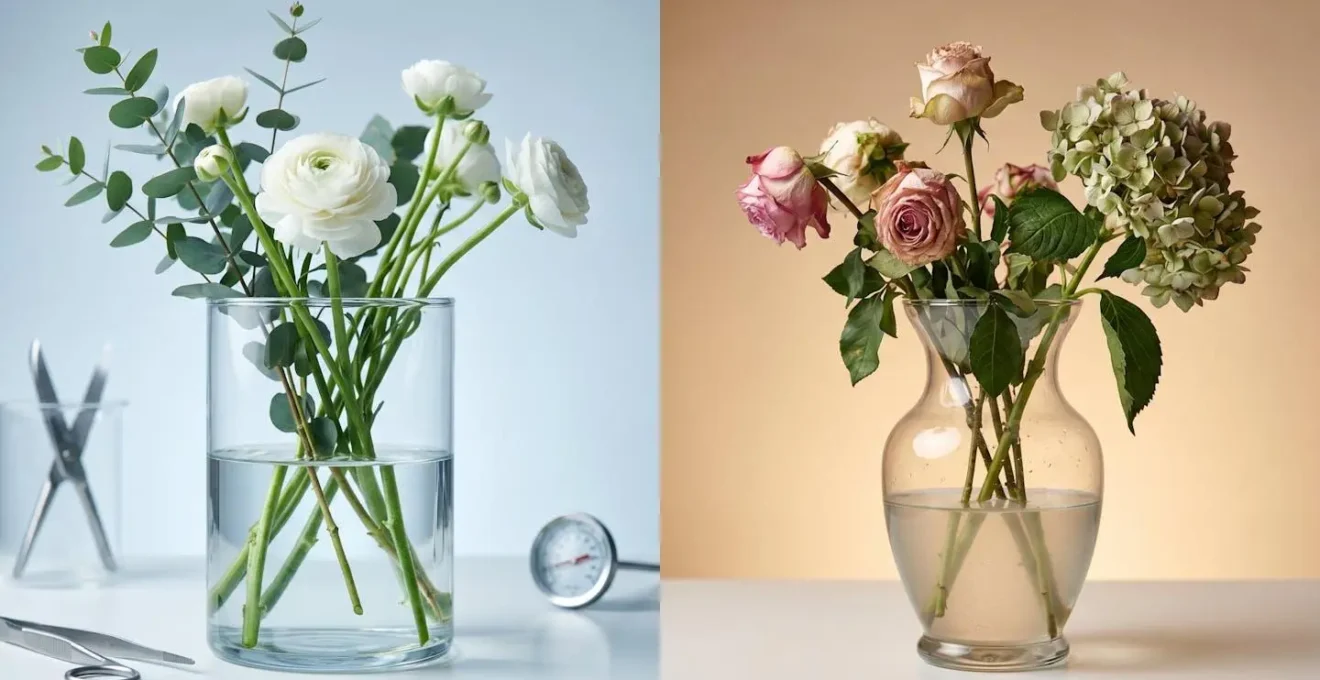
Your flowers don’t die from old age; they’re suffocated and poisoned by an invisible microbial assault, a battle that is often lost within the first 48 hours in your home.
- Vase water isn’t just “dirty”; it becomes a bacterial soup where populations can exceed 10 million cells per millilitre, blocking stems like clogged arteries.
- Simple environmental factors, like room temperature fluctuations or a too-narrow vase, dramatically accelerate this process, turning a life-support system into a death trap.
Recommendation: Shift your focus from merely ‘feeding’ your flowers to aggressively managing their microscopic environment through rigorous sanitation, precise preparation, and strategic placement.
It’s a familiar and frustrating cycle for any UK flower buyer. You bring home a beautiful bouquet, follow all the standard advice—trim the stems, use the little sachet, change the water—yet within four days, the heads are drooping and the water is cloudy. Meanwhile, a professional florist’s arrangement seems to possess a magical longevity, remaining vibrant for a week, sometimes ten days. This vast difference isn’t due to magic, but to a deep, scientific understanding of what a cut flower is truly experiencing: a battle for survival on a microscopic scale.
The common wisdom about cutting stems at an angle or avoiding direct sunlight is not wrong, but it’s incomplete. These are just small tactical manoeuvres in a much larger biological war. The real reason for your bouquet’s premature demise lies in an environment you can’t see: a world of explosive bacterial growth, internal plumbing blockages (vascular occlusions), and accelerated hormonal aging triggered by your very own home. The florist isn’t just a shopkeeper; they are the commander of a cold chain and a master of microbial suppression.
But if the secret lies in science, it means it’s a secret that can be learned. The difference between a four-day disappointment and a ten-day delight is understanding the three invisible enemies: bacteria, air bubbles (embolisms), and ethylene gas. By thinking less like a home decorator and more like a post-harvest scientist, you can replicate a florist’s success.
This article will dissect the science behind flower longevity, moving beyond simplistic tips to explain the fundamental biological processes at play. We will explore why your vase water is a battlefield, how a flower’s internal plumbing works, and why environmental factors that seem benign are actually accelerating its decline. Prepare to learn the ‘why’ behind the ‘what’ and fundamentally change how you care for cut flowers.
Summary: The Science Behind a Long-Lasting Bouquet
- Why Bacteria Colonies Double Every 20 Minutes in Room-Temperature Vase Water?
- Woody Stems vs Soft Stems: Why Different Flowers Need Different Prep Methods?
- Why Tall Narrow Vases Cause Stems to Rot Faster Than Wide Bowls?
- Why Moving Flowers Between Warm Rooms and Cold Storage Shortens Their Life by Days?
- Why Direct Sunlight Fades Petals but Darkness Closes Blooms Permanently?
- The 3 Signs a Florist’s Stock Has Been Properly Cold-Stored
- How Bacteria Multiply From 100 to 1 Million Cells in 24 Hours in Warm Water?
- Why Does Your Vase Water Turn Cloudy and Smell After Just 2 Days?
Why Bacteria Colonies Double Every 20 Minutes in Room-Temperature Vase Water?
The moment you place a cut stem into water, an invisible countdown begins. Your vase, filled with seemingly pure tap water, is the perfect incubator. It contains organic debris from leaves, sugars leaching from the cut stem, and ambient bacteria. At a typical UK room temperature of 20°C, bacteria like Pseudomonas find these conditions ideal for exponential growth. Their population can double every 20 to 30 minutes. This isn’t just about the water getting “a bit dirty”; it’s a microbial explosion.
The primary damage occurs inside the stem. Flowers drink water through a network of microscopic tubes called the xylem. As bacteria multiply, they form a sticky, slimy layer known as a biofilm on the surface of the cut stem. This biofilm acts like a seal, physically blocking the entrance to the xylem. Furthermore, individual bacteria are drawn into the xylem vessels themselves, where they continue to multiply and create internal blockages. The flower is literally dying of thirst, even while sitting in a vase full of water.
The critical threshold for damage is surprisingly low. Post-harvest research shows that bacterial populations exceeding 10^7 colony forming units (cfu)·mL⁻¹ are sufficient to cause significant vascular blockage and shorten vase life. This level can be reached in less than 48 hours in an untreated vase. Florists combat this relentlessly with biocides in their flower food and an almost obsessive commitment to sanitation, knowing that controlling this initial bacterial bloom is the single most important factor in flower longevity.
Case Study: The Bacterial Takeover in Your Vase
A 2023 study published in PLOS ONE tracked the microbial community in the vase water of roses, gerberas, and lilies over seven days. Researchers found that while initial diversity was varied, the bacterial family Pseudomonadaceae—a notorious culprit in vascular blockage— significantly increased its dominance over time. This takeover coincided with a decrease in plant chloroplast material in the water, indicating the bacteria were actively feeding on the decaying flower tissue and forming robust biofilms, effectively choking the stems from the inside out.
Woody Stems vs Soft Stems: Why Different Flowers Need Different Prep Methods?
Not all stems are created equal, and treating a delicate tulip like a hardy lilac is a common mistake that drastically shortens vase life. The difference lies in their internal anatomy, specifically the structure and composition of their xylem—the water-conducting tissue. Soft-stemmed (herbaceous) flowers like tulips or poppies have relatively wide, unobstructed xylem vessels. Woody-stemmed flowers like roses, hydrangeas, or lilac have a much more complex structure.
Their stems contain lignin, a rigid polymer that provides structural support. As an expert from the Texas Gateway project notes, this is the key to their strength. The xylem in woody stems is a dense matrix of narrower vessels and reinforced cells called tracheids. While this makes the stem strong, it also makes it harder for water to be absorbed, especially once cut. According to research on xylem structure, tracheids in woody plants can be as narrow as 80 µm, whereas the primary vessels in some flowering plants can reach up to 0.5 mm (500 µm) in diameter. This difference in scale is enormous and requires different preparation.
The cells of the secondary xylem contain lignin, which provides hardiness and strength.
– Biology Educational Resources – Texas Gateway, Plant Structure and Function: Stems
For soft stems, a simple, clean cut with a sharp knife is sufficient to open up the wide vessels for maximum water uptake. For woody stems, this is not enough. The narrower, tougher pathways are prone to sealing or getting blocked by air (embolism). This is why florists employ more aggressive techniques for woody stems: cutting them longer and at a sharp angle to increase surface area, or even gently crushing the bottom inch of the stem with a mallet. This action, while seeming brutal, breaks apart the dense lignin structure and exposes more of the internal water-conducting tissues, bypassing any initial blockage and forcing hydration.
Your 5-Step Flower Longevity Audit
- Points of Contact: List all factors affecting vase life. This includes the water quality (bacteria), air quality (ethylene gas from ripening fruit), light (intensity and duration), temperature (room heat), and the container itself (cleanliness and shape).
- Existing Protocol Collection: Honestly inventory your current flower care routine. Do you just add water? Do you recut stems? Do you use the food sachet? How often do you change the water? Write it down.
- Scientific Cross-Check: Confront your routine with the key principles. Are you actively fighting bacteria with a sanitised vase and biocide (flower food)? Are you preventing air embolism by recutting underwater? Are you managing the environment by keeping flowers cool and away from fruit?
- Identify Weak Links: Pinpoint the single biggest failure point in your protocol. For most people, it’s vase sanitation. For others, it’s forgetting to use flower food, or placing the vase in a warm, sunny spot.
- Integration Plan: Implement one key change based on this article. Don’t try to do everything at once. This week, focus exclusively on starting with a surgically clean vase (washed with soap and hot water) and properly mixed flower food. Master one principle at a time.
Why Tall Narrow Vases Cause Stems to Rot Faster Than Wide Bowls?
The choice of vase is often seen as purely aesthetic, but from a scientific perspective, its geometry has a profound impact on flower longevity. A tall, narrow vase, while elegant, can create a micro-environment that accelerates decay. The primary issue is the restriction of air and the depletion of oxygen in the water.
In a wide, open bowl, the large surface area of the water allows for continuous oxygen exchange with the air. This oxygen is crucial for the health of the submerged stem tissues and helps to suppress the growth of certain types of bacteria. In a tall, narrow vase, the situation is reversed. The stems are tightly packed, reducing water circulation, and the water’s surface area is minimal. Oxygen in the lower portion of the water column is quickly consumed by the respiring stem cells and aerobic bacteria. This creates an anaerobic (oxygen-deprived) environment at the base of the vase.
This lack of oxygen is a death sentence. It triggers the proliferation of anaerobic bacteria, which are responsible for the foul, “rotten egg” smell of old vase water. These bacteria release metabolic byproducts, such as organic acids, that are directly toxic to the plant tissues, causing the stems to soften, turn brown, and rot. The tightly packed nature of the narrow vase also traps ethylene gas, a plant hormone that accelerates aging, right around the flower heads.
A florist will often choose a vase that allows stems to splay naturally, ensuring space for air circulation both above and below the water line. A wide, shallow bowl or a vase with a wider mouth is almost always a better choice for promoting a healthy, oxygenated environment that keeps the most destructive forms of rot at bay. The shape of the container directly influences the microbial ecosystem within it.
Why Moving Flowers Between Warm Rooms and Cold Storage Shortens Their Life by Days?
Florists operate on a principle known as the “cold chain,” a temperature-controlled journey from the grower to the shop. This isn’t just about keeping flowers “fresh”; it’s about controlling their metabolic rate. A flower is a living organism, and like all living things, it respires—it takes in oxygen and releases carbon dioxide, heat, and water. The rate of respiration is directly tied to temperature. For every 10°C increase in temperature, the respiration rate roughly doubles.
A high respiration rate is like a candle burning quickly. The flower is rapidly consuming its stored energy reserves (sugars) and aging faster. By keeping flowers in a cold environment (typically 2-4°C), a florist dramatically slows down this metabolic rate, effectively putting the flowers into a state of suspended animation. When you bring flowers into your warm home (around 20°C), their metabolic rate skyrockets. This sudden acceleration is a major shock to their system.
Even worse is temperature fluctuation—moving flowers from a cool conservatory at night to a warm, sunny living room during the day. This cycling causes immense stress. The rapid warming encourages the flower’s stomata (pores on the leaves) to open wide, leading to a massive increase in water loss through transpiration. If the bacterial load in the vase is already high and water uptake is compromised, the flower cannot replace this lost water fast enough. The result is a sudden, catastrophic wilt from which the flower may never recover. This temperature-induced imbalance between water loss and water uptake is a primary cause of premature wilting in the home environment.
Case Study: The Direct Cost of Warmth on Lilies
A 2025 study on cut lilies highlights the devastating effect of temperature on bacterially-infected flowers. When placed in water containing bacteria at a room temperature of 20°C, the flowers’ longevity was directly and negatively correlated with the duration of exposure. The research demonstrated that the bacterial population, thriving in the warm conditions, caused severe vascular blockage. This blockage led to a linear decrease in cumulative water uptake, resulting in smaller flower diameters and a significantly shorter vase life. It proved that warmth acts as a powerful catalyst, turning a minor bacterial presence into a fatal condition.
Why Direct Sunlight Fades Petals but Darkness Closes Blooms Permanently?
Light is a double-edged sword for cut flowers. While the plant was growing, light was its source of life, powering photosynthesis to create energy. Once cut, however, the flower has only the finite energy stored in its stem and petals. Its relationship with light becomes far more complex and perilous.
Direct sunlight presents two major problems. The first is heat, which, as we’ve discussed, dramatically increases the flower’s respiration and transpiration rates, leading to rapid dehydration and aging. The second is the light itself. The intense energy of UV rays in direct sunlight can physically break down the delicate pigment molecules in the petals, a process called photodegradation. This is why flowers placed in a sunny window will literally have their colour bleached out, appearing faded and washed-out long before they wilt.
So, is the answer complete darkness? Absolutely not. Many flowers exhibit a behaviour called nyctinasty, or “sleeping,” where they close their petals at night. This is a natural rhythm controlled by their internal clock and light cues. While a short period of darkness is normal, prolonged darkness can be fatal. Without any light signal, the flower’s metabolic processes can slow to a dangerous degree. More importantly, many flowers, like roses, may fail to re-open after being in darkness for too long, a response that is not fully understood but is linked to a disruption in the water pressure (turgor pressure) within the petal cells that controls their opening and closing. The bloom can become “stalled” and will never open fully again.
The florist’s secret is finding the balance: bright, but indirect light. This provides enough of a light cue to maintain the flower’s natural daily rhythm and encourage buds to open, but without the intense heat and UV radiation of direct sun that would accelerate their demise. It’s about providing a gentle, stable environment, not one of extremes.
The 3 Signs a Florist’s Stock Has Been Properly Cold-Stored
When you buy flowers, you’re not just buying a product; you’re buying the time that has been preserved within it. The effectiveness of the cold chain—the unbroken line of refrigeration from grower to florist—is the biggest determinant of that stored time. A savvy buyer can learn to spot the tell-tale signs of flowers that have been managed with scientific precision versus those that have been languishing in a warm environment.
First, examine the leaves and stems. Look for high turgor pressure. This is the scientific term for crispness. The leaves should be firm and almost snap if you try to bend them. The petals should feel cool and waxy, not soft or papery. This turgidity is a direct indicator of excellent hydration and a low respiration rate. A flower that has been kept warm will have lost water through transpiration, resulting in soft, slightly floppy leaves—the very first sign of stress, even if the bloom itself still looks okay.
Second, assess the colour. Look for vibrant, saturated hues. Colours should be deep and true, not faded or developing a translucent, “watery” look at the edges of the petals. Proper cold storage significantly slows the production and effects of ethylene, the aging hormone that not only causes wilting but also triggers the breakdown of pigments. Bright, clear colour is a sign that the flower’s hormonal aging process has been successfully held in check.
Third, and most critically, look at the stage of the blooms. A professional florist receives and sells flowers that are still in bud or are only just beginning to open. They know that cold storage has paused development, not stopped it. Selling a rose that is already fully “blown” is the mark of poor stock management, as the flower has already spent a significant portion of its decorative life in the shop. A properly managed flower should be purchased at a point where you, the customer, get to enjoy its entire opening process in the vase. This is the time you have paid for.
Key Takeaways
- Flower death is a biological process, not a random event. The primary cause is vascular blockage by bacteria, preventing water uptake.
- Temperature is the accelerator. Warm rooms double the rate of bacterial growth and flower respiration, rapidly depleting energy and water.
- Sanitation is paramount. A clean vase and the use of a biocide (in flower food) are more critical than any other ‘home remedy’ for combating the microbial assault.
How Bacteria Multiply From 100 to 1 Million Cells in 24 Hours in Warm Water?
The speed of bacterial colonisation in a vase is difficult to comprehend. It isn’t a linear process; it’s an exponential explosion. Let’s start with a hypothetical but realistic scenario: a clean vase and a freshly cut stem introduce just 100 bacterial cells into the water. In the cool, controlled environment of a florist’s shop, their growth would be slow. But in your 20°C kitchen, the process is frighteningly fast.
Assuming a doubling time of just 20 minutes, the mathematics of this growth are stark.
- Time 0: 100 cells
- 20 mins: 200 cells
- 40 mins: 400 cells
- 1 hour: 800 cells
After just three hours, you would already have over 6,400 bacteria. After six hours, that number exceeds 500,000. And within seven hours, you have surpassed the 1 million cell mark. By the time 24 hours have passed, the number is not in the millions, but in the billions or even trillions—a dense, thriving microbial culture in what was once clean water.
This rapid proliferation is precisely why the first 24 hours are so critical. It’s the window of opportunity to prevent the bacterial population from reaching the critical mass needed to form a destructive biofilm. A florist’s flower food is not just “food”; its most important ingredients are a biocide to kill bacteria and an acidifier (like citric acid). Bacteria struggle to multiply in a slightly acidic environment (pH 3.5-5.0), which is also the optimal pH for water uptake by the stem. By creating an environment that is both lethal and inhospitable to bacteria from the very first minute, you can break the cycle of exponential growth before it even begins. Without this intervention, you are giving the microbes a 24-hour head start they will never relinquish.
Why Does Your Vase Water Turn Cloudy and Smell After Just 2 Days?
The cloudy, foul-smelling water that appears in your vase after a couple of days is not just an unpleasant side effect of aging flowers; it is the macroscopic, visible evidence of your loss in the microscopic war. It is the direct and predictable outcome of the biological processes we have discussed, a sign that the flower’s life support system has catastrophically failed and has instead become a microbial swamp.
The cloudiness itself is the bacterial bloom made visible. It is a suspension composed of billions upon billions of free-floating bacteria, fragments of the biofilm that have sloughed off the stems, and decaying plant cells. The water has become so saturated with microbial life that it is no longer transparent. This is the physical manifestation of a bacterial population that has long surpassed the threshold needed to block the flower’s xylem, confirming that the stems are no longer capable of effective hydration.
The foul smell is the signature of anaerobic activity. As oxygen in the crowded, stagnant water was depleted, anaerobic bacteria took over. Their metabolic processes do not produce harmless carbon dioxide, but rather a cocktail of volatile, noxious compounds, including hydrogen sulfide (the “rotten egg” smell) and other organic acids. This smell is a chemical confirmation that the environment at the base of the stems has become toxic, actively poisoning the very tissues that are supposed to be absorbing water.
Seeing cloudy, smelly water is the equivalent of a post-mortem examination. The battle is over. At this point, simply changing the water is a futile gesture. The flower’s internal plumbing is likely permanently blocked, and the stem tissues are already damaged by bacterial toxins. The only solution is prevention: using the scientific principles of sanitation, proper preparation, and environmental control from the very first hour to ensure this microbial swamp never has the chance to form.
You now possess the fundamental scientific knowledge that separates a frustrated flower buyer from a confident floral custodian. The power to extend the life and beauty of your bouquets lies not in folklore or guesswork, but in the consistent application of these principles: control the bacteria, ensure hydration, and manage the environment. Start by implementing just one of these strategies, and you will see a remarkable difference.