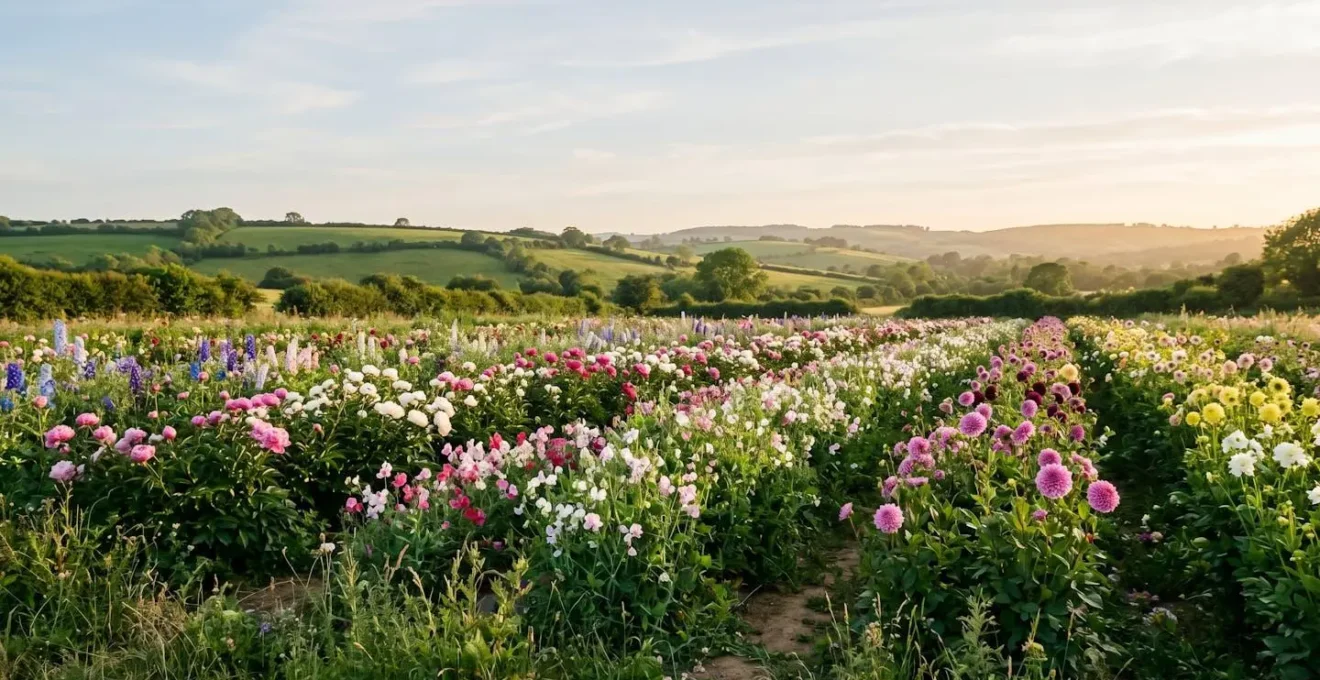
The true value of British flowers isn’t just about being ‘local’; it’s about embracing superior quality, character, and scent that mass-produced imports simply cannot match.
- Choosing flowers in their natural UK season means they are at their peak of beauty, scent, and vitality, often costing less.
- Imported flowers are bred for durability and long-distance travel, sacrificing the very fragrance and delicate forms that make flowers special.
Recommendation: Instead of asking for a specific flower year-round, ask your florist “What’s British and in season this week?” to get the best possible blooms.
There’s a familiar sense of disappointment that comes with a bunch of supermarket flowers. They look passable under the fluorescent lights, but once home, they seem to lack soul. They have little to no scent, and they often begin to wilt and droop within a couple of days. We’re told the solution is simple: “buy local.” It’s become a well-meaning but vague mantra. We know we should, but the real reasons why it makes such a profound difference often get lost.
The conversation around flowers often revolves around “food miles” or supporting local businesses, which are valid points. But this only scratches the surface. The true story is far more compelling. It’s a story of biology, logistics, and a fundamental choice between two different philosophies of beauty: the engineered uniformity of a global commodity versus the vibrant, characterful, and ephemeral beauty of something grown in harmony with its surroundings. The secret to better, longer-lasting, and more meaningful flowers doesn’t lie in a specific variety, but in understanding and embracing our own British seasonal rhythm.
But what if the most popular imported flowers, like Kenyan roses, have a lower carbon footprint than some European alternatives? This is where the story gets interesting, and where understanding the details becomes crucial. This guide will not just give you lists; it will arm you with the ‘why’. We’ll explore the real costs of out-of-season demands, uncover the underrated gems of the British countryside, and explain how to align your flower-buying with the seasons for bouquets that are not just beautiful, but truly alive.
To help you navigate this journey from a confused consumer to a connoisseur of British blooms, we have broken down the key questions and concepts. This guide will walk you through the specifics of our local seasons, the complexities of flower ethics, and the practical joy of choosing the right flower at the right time.
Summary: Why British-Grown Flowers Offer More Beauty and Value Than Imports
- What Flowers Can You Actually Grow in Britain Each Month of the Year?
- Why Kenyan Roses Have a Lower Carbon Footprint Than Dutch Greenhouse Tulips?
- The 5 Underrated British Flowers Florists Rarely Stock but Should?
- Why Asking for Peonies in December Costs 4x More and Delivers Half the Quality?
- How to Design a Monthly Flower Subscription That Changes With British Seasons?
- When Are British-Grown Garden Roses Available and Why Does It Matter?
- When Exactly Are British Peonies in Season: The May-June Window Explained?
- Why Are Peonies Only Available for 6 Weeks and How to Make Them Last?
What Flowers Can You Actually Grow in Britain Each Month of the Year?
The first step to smarter flower buying is to sync with the UK’s own glorious seasonal rhythm. Unlike the monotonous, year-round offering in supermarkets, British flower farms offer a constantly shifting tapestry of colour and scent. Embracing this calendar means you’re always getting flowers at their absolute peak of freshness and vitality. As the growers at Flowers from the Farm put it, “Everything has its natural season – when the weather and length of daylight hours combine to produce the perfect environment for growing and for glorious blooms.”
Here is a taste of what the British flower year looks like:
- Winter (Dec-Feb): A time of quiet beauty. Look for the architectural elegance of Hellebores (Christmas roses), delicate snowdrops, and fragrant winter shrubs like sarcococca. Forced bulbs like hyacinths bring early indoor scent, all supported by a backbone of rich evergreen foliage.
- Spring (Mar-May): The great awakening. This is the season of jewel-like anemones and ranunculus, carpets of native bluebells, and the joyful trumpets of narcissi and tulips. Scent is everywhere, from hyacinths to blossoming cherry and magnolia branches.
- Early Summer (Jun): The season of romance. June is the heart of the British flower season, bursting with fragrant garden roses, fluffy peonies, sweet peas, and towering spires of delphiniums and lupins.
- High Summer (Jul-Aug): A riot of colour and texture. Meadows and flower fields are buzzing with life, offering everything from cosmos and dahlias to architectural achillea, larkspur, and cheerful sunflowers.
- Autumn (Sep-Nov): The rich, final flourish. Dahlias are the undisputed queens of autumn, accompanied by asters, rudbeckia, and late-flowering chrysanthemums. This season is also about texture: sculptural seedheads, jewel-toned berries, and the magnificent colours of turning foliage.
By learning this natural flow, you’ll start to anticipate the arrival of your favourites, making the experience of buying flowers a joyful, seasonal event rather than a routine purchase.
Why Kenyan Roses Have a Lower Carbon Footprint Than Dutch Greenhouse Tulips?
The ethics of “flower miles” can be surprisingly complex and counter-intuitive. It’s easy to assume that any imported flower carries a heavy environmental price tag, but the reality is more nuanced. The key factors aren’t just distance, but also heat and light. Flowers grown in equatorial countries like Kenya can be cultivated outdoors year-round, harnessing the free and abundant power of the sun.
In contrast, many flowers from the Netherlands, particularly out of their natural season, are grown in vast, gas-heated greenhouses. The energy required to heat and light these structures on an industrial scale is enormous, giving them a disproportionately high carbon footprint. As Melanie Dürr of Fairtrade International notes, the carbon footprint of flowers from cooler countries requiring heated greenhouses can be over 5.5 times greater than those from equatorial regions. This is why a naturally sun-grown Kenyan rose can be a lower-carbon choice than a Dutch tulip forced in a heated greenhouse in February.
However, this doesn’t tell the whole story. The most sustainable choice is almost always a British flower grown in its natural season, without heated greenhouses. The difference is staggering; a groundbreaking study found that an imported mixed bouquet produces 10 times greater carbon emissions than a bouquet of seasonal British flowers. The data speaks for itself.
| Bouquet Type | Composition | Carbon Footprint (Kg CO2) |
|---|---|---|
| Kenyan/Dutch Mixed | 5 Kenyan roses + 3 Dutch lilies + 3 Kenyan gypsophila | 31.132 |
| Dutch Mixed | 5 Dutch roses + 3 Dutch lilies + 3 Kenyan gypsophila | 32.252 |
| UK Commercial | 5 UK snapdragons + 3 UK lilies + 3 UK alstroemeria | 3.287 |
| UK Field-Grown Local | 15 stems mixed outdoor UK flowers, locally sold | 1.71 |
| Source: Rebecca Swinn MSc Dissertation, Lancaster University (2017) | ||
The conclusion is clear: while some imports are better than others, nothing beats flowers grown locally and in season. The field-grown local bouquet isn’t just slightly better; it’s in a different league entirely.
The 5 Underrated British Flowers Florists Rarely Stock but Should?
The global flower trade has a homogenising effect. Flowers are “engineered,” not just grown. They must be bred to withstand long journeys, refrigeration, and rough handling. This process strips them of their individuality. As Days of Dahlia Flower Studio explains, “Imported flowers are grown for their sameness and robustness… The manufacturing of imported flowers removes any character or quirkiness.” The result is bouquets of perfectly straight, scentless, and soulless stems.
In contrast, British flower farms are a treasure trove of unique and characterful blooms that often don’t travel well and are therefore ignored by large-scale florists. These are the flowers that dance, that have natural curves, and that possess a delicate, fleeting beauty. They tell the story of the field they grew in. Seeking them out is a way to access a whole new world of floral design.
Here are five underrated stars you should ask your local grower about:
- Scabious (Pincushion Flower): With their delicate, frilly petals and long, wiry stems that seem to dance in a vase, scabious add movement and a touch of wildness to any arrangement. They come in shades from deep blackberry to pale lavender.
- Ammi Majus (Bishop’s Flower): Often mistaken for cow parsley, this is its more refined, elegant cousin. Its large, lacy umbels create a soft, airy, meadow-like feel, acting as a beautiful “filler” that is a feature in its own right.
- Phlox: A classic cottage garden flower, phlox is often overlooked in modern floristry. But its clusters of starry flowers provide an incredible, heady scent that can fill a room—a sensory experience entirely absent from imported blooms.
- Centaurea (Cornflower): The intense, true blue of the cornflower is rare in the flower world. While the classic blue is a marvel, they also come in shades of pink, white, and deep maroon. They are the epitome of country charm.
- Clematis Seedheads: After their beautiful flowers fade, many varieties of clematis produce stunning, silky, smoke-like seedheads in autumn. These textural wonders add a unique, ethereal quality to arrangements and last for ages.
Why Asking for Peonies in December Costs 4x More and Delivers Half the Quality?
The demand for specific “must-have” flowers year-round, fuelled by social media, has created a costly and unsustainable market. The peony is the perfect example. A quintessentially British early summer flower, its fleeting season is part of its charm. Yet, it’s possible to buy them in winter. These are not British peonies; they are expensive imports flown thousands of miles from the Southern Hemisphere, from countries like Chile or New Zealand.
This long-haul journey comes at a significant cost, both financially and in terms of quality. The price is often quadrupled, but you are getting a vastly inferior product. These flowers are harvested prematurely and refrigerated for extended periods. This stresses the bloom, dramatically shortening its vase life and often preventing it from opening properly at all. You pay a premium for the high probability of disappointment. As seasonal flower sourcing data indicates, winter imported peonies tend to be more expensive and have a shorter vase life.
Furthermore, these flowers have been bred for the journey, not for your enjoyment. The focus is on durability, not beauty. This leads to a crucial trade-off, as florist Olivia Wilson points out:
Flowers grown to be exported must be sturdy enough to survive transit. To allow for this, flowers are deliberately bred to have ruler-straight stems and be fragrance-free; the biological effort required to smell sweet, using up energy that could otherwise prolong vase life.
– Olivia Wilson, Founder of Wetherly
When you buy a British peony in June, you are buying a flower at the peak of its powers: fully hydrated, bursting with energy, and ready to unfurl its hundreds of fragrant petals. When you buy an imported peony in December, you are buying a tired, stressed traveller that has had its scent and vitality bred out of it. The choice is clear.
How to Design a Monthly Flower Subscription That Changes With British Seasons?
A truly seasonal flower subscription is a wonderful way to connect with the British flower year. It’s a commitment to surprise and delight, moving away from the rigid expectation of year-round roses and lilies. The best models are not about delivering a fixed product, but about curating the very best of what the fields have to offer in any given week. This approach guarantees unparalleled freshness and a lower carbon footprint.
The key is transparency and a focus on local sourcing. Instead of a centralised warehouse, a successful seasonal subscription relies on a network of growers. This model is exemplified by the Flowers from the Farm network, which connects customers directly with local producers.
Case Study: The Flowers from the Farm Network Model
Flowers from the Farm operates as an online directory connecting consumers with over 1,000 local independent British flower growers nationwide. Members grow mainly outdoors without additional light or heat, choosing flowers suited to their specific growing conditions. The network model demonstrates how connecting small-scale growers (most operating on plots measured in acres rather than hectares) can transform the cut flower industry while supporting rural economies and promoting seasonality transparency.
When choosing a subscription, you should look for one that celebrates this philosophy. They should be proud to tell you where the flowers were grown and what makes them special that week. The vase life of these flowers is a direct reflection of this freshness. As the growers at Days of Dahlia state, “Naturally grown flowers are harvested from our flower field 24-48 hours before they reach our customers and have a vase life of approximately 3-14 days depending on the variety.” This is a world away from the week-long journey of an imported bloom.
Your Checklist for Choosing a Seasonal Subscription
- Grower Identity: Can they tell you the name of the farm or grower providing the flowers this week? Look for specific, local names, not just “sourced from the UK.”
- Seasonal Honesty: Does their marketing feature flowers that are actually in season now? Be wary of subscriptions showing peonies in their October advertising.
- Variety & Surprise: Does the service promise a “grower’s choice” or “best of the field” selection? This is a great sign they are prioritising quality and seasonality over a rigid, repeatable formula.
- Packaging: Do they use minimal, compostable, or recyclable packaging? Brown paper is a much better sign than layers of single-use plastic.
- The “Imperfection” Test: Do their example photos show flowers with character—naturally curved stems, varied sizes, and delicate petals? This is a hallmark of authentic, field-grown blooms, not a flaw.
When Are British-Grown Garden Roses Available and Why Does It Matter?
There is perhaps no greater difference between an industrial import and a local bloom than in the world of roses. The typical imported rose is a testament to durability: it has a long, ruler-straight stem, a tight, uniform bud, and zero fragrance. It has been bred to be a shipping container-friendly commodity. A British garden rose, in contrast, is an experience.
Available from roughly late May through to September, garden roses are grown for their beauty, not their resilience. They have softer, more delicate petals, often arranged in complex ‘cupped’ or ‘quartered’ forms. Their stems may have a natural, gentle curve. But most importantly, they have a scent. This is the crucial element that is deliberately bred out of most commercial, long-haul roses. The reason is a simple biological trade-off. Producing the complex volatile compounds that create fragrance uses a lot of energy. As flower breeding research demonstrates, there is a direct link between flowers with fragrance and vase life; the more fragrant a flower, the shorter its life span after cutting.
This is precisely why buying local matters so much. A British garden rose doesn’t need to survive for two weeks in transit. It can be picked at its peak, fully hydrated, and be in your vase within 48 hours. It can afford to “spend” its energy on creating a breathtaking scent, because it doesn’t need to save that energy for a long journey. You might get a few fewer days of vase life compared to a scentless imported rose, but the quality of those days is infinitely richer. It’s the difference between a picture of a rose and the rose itself.
When Exactly Are British Peonies in Season: The May-June Window Explained?
The peony season in the UK is a short, glorious, and much-anticipated affair. It is the epitome of seasonal flower buying. While you might see imported peonies earlier, the true British season begins in earnest from late April and hits its crescendo in a spectacular six-week window. Professional florist Tatiana confirms this, stating, “Peonies are most readily available for purchase from late April through to the end of June. This is the heart of their natural blooming season, when they’re at their fullest, most fragrant, and easiest to find.”
For growers and avid fans, the timing is even more precise. The absolute peak for most varieties falls in a very specific period. According to regional UK blooming data, most British peony varieties peak between May 15 and June 10. This is when you will find the widest selection, the best quality, and the most reasonable prices.
The season isn’t one monolithic event, but a gentle wave that travels up the country, starting in warmer regions like Cornwall and finishing in Scotland about two weeks later. Savvy growers also extend this window by planting a strategic mix of varieties that bloom at slightly different times. This allows for a continuous supply throughout the six-week period.
- Early Bloomers (late April-early May): Varieties like ‘Coral Charm’ are among the first to appear, opening with intense coral tones that fade to a beautiful antique cream.
- Mid-Season (mid-May to early June): This is the time for the classics. The iconic ‘Sarah Bernhardt’, with its huge, ruffled, blush-pink petals, is the star of the show, offering peak fragrance and form.
- Late Bloomers (early June to mid-June): Varieties such as ‘Festiva Maxima’, a stunning double white peony with flecks of crimson, help to extend the season, providing a final, glorious flourish.
Knowing this progression allows you to enjoy the full spectrum of peony season, from the first exciting buds of the early bloomers to the last luxurious petals of the late varieties.
Key Takeaways
- Embracing the British flower calendar is the key to quality; seasonal flowers are fresher, more vibrant, and better value.
- A flower’s carbon footprint is complex. While “flower miles” matter, locally grown, non-heated flowers are almost always the most sustainable choice by a huge margin.
- True luxury in flowers is scent and character, not sterile uniformity. British growers prioritize these qualities, which are often bred out of imported blooms for durability.
Why Are Peonies Only Available for 6 Weeks and How to Make Them Last?
The fleeting nature of the peony season is central to its magic. This isn’t a marketing ploy; it’s a biological necessity. Peonies are hardy perennials that need a period of cold winter dormancy to set their buds for the following year. They gather energy all year for one short, explosive, and spectacular flowering display. A single established peony bush will typically only produce blooms for about 7 to 10 days. The reason we get a “season” of up to six weeks is purely down to growers planting a mix of early, mid, and late-season varieties.
This brief but brilliant performance is what makes them so special. It’s a reminder that some of the most beautiful things in life are fleeting. Unlike a rose that can produce flushes of flowers throughout a summer, a peony gives its all in one go, and then it’s over for another year. This natural cycle is something to be celebrated, not circumvented with refrigerated, out-of-season imports.
The goal, then, is not to wish for peonies in December, but to make the absolute most of them when they are here in their rightful season. With a little knowledge, you can extend their beauty and ensure every precious bloom reaches its full potential. The key is to buy them at the right stage—when the bud feels soft and yielding like a marshmallow—and to care for them properly once you get them home.
Your next step is simple and powerful. The next time you want to buy flowers, don’t just grab a generic bunch. Seek out your local florist, visit a farm shop, or look up a grower in the Flowers from the Farm directory. Then, ask the magical question: “What’s British and in season today?” Embrace the seasonal rhythm, and you will rediscover what a real flower is supposed to look, feel, and smell like.
Frequently Asked Questions about Why Are Peonies Only Available for 6 Weeks and How to Make Them Last?
Why do peonies need such a short season?
Peonies are perennials that require a period of cold dormancy (winter chill) to set buds and gather energy for their explosive but brief flowering display. This biological requirement means they cannot bloom year-round in the UK climate.
Do ants really need to be on peony buds for them to open?
No, this is a myth. Ants are attracted to the sweet nectar on peony buds, creating a symbiotic relationship where ants eat the nectar, but they are not necessary for blooms to open. A gentle rinse to remove ants is fine but not essential.
How can I extend the vase life of cut peonies?
Cut peonies when buds are at the ‘soft marshmallow’ stage – firm but slightly yielding to gentle pressure. For special events, wrap unopened but soft buds in newspaper and refrigerate for up to a week to pause development. Change water regularly and keep in cool location away from direct sunlight.