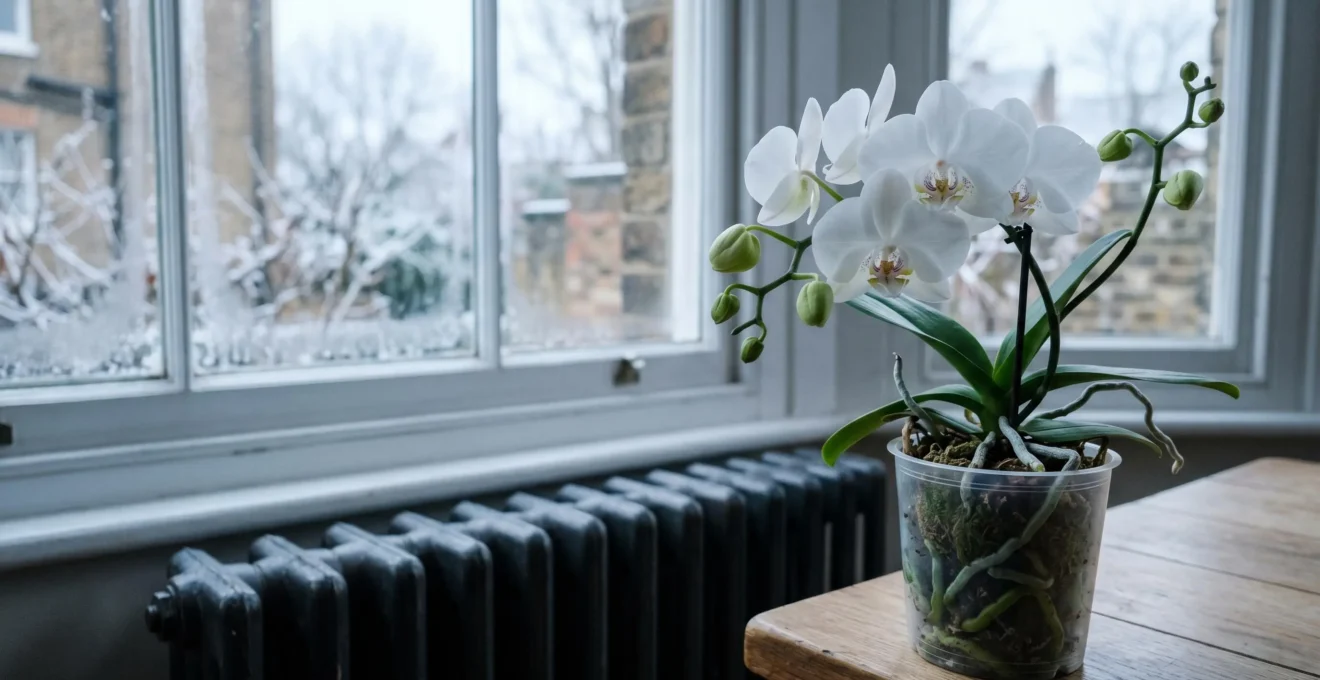
The frustrating drop of your orchid’s buds is rarely due to a single mistake, but to an invisible environmental conflict happening in your home.
- Central heating creates a ‘humidity deficit’, silently stressing your plant’s roots faster than you can water it.
- Many orchids sold in the UK are ill-suited for draughty homes, and often hide a ‘death plug’ that guarantees failure.
Recommendation: Shift your focus from a simple watering schedule to becoming a diagnostician of your plant’s micro-environment, starting with root health and humidity.
It is one of the most disheartening experiences for any plant lover. You have nurtured your Phalaenopsis orchid for months. It produced a strong, healthy flower spike, and a row of beautiful, promising buds began to swell. Then, just as the first flower is about to open, the buds turn yellow, become papery, and fall to the floor. You followed the care advice scrupulously—you didn’t overwater, you provided light, you avoided obvious drafts. Yet, failure. This cycle leaves many UK orchid owners feeling frustrated and confused, often blaming themselves for a lack of a ‘green thumb’.
The common advice to “check your watering” or “give it more light” often misses the real culprits. These platitudes fail to address the specific, insidious environmental warfare that plays out in a typical British home between October and April. The real problem isn’t your commitment; it’s the unseen environmental stressors that standard advice overlooks. But what if the key wasn’t about following a generic set of rules, but about learning to diagnose the specific conditions of your home and your plant’s real-time needs?
This guide moves beyond the basics. We will dissect the hidden conflict between your orchid’s tropical biology and the realities of a centrally-heated UK winter. We will explore the critical role of humidity, how to choose the right orchid for your home’s specific character, and teach you the diagnostic skills to spot problems at the root level, long before they become fatal. By understanding the ‘why’ behind the bud blast, you can finally provide the targeted care your orchid needs to thrive, not just survive.
Summary: Uncovering the Real Reasons for Orchid Bud Drop in British Homes
- Why Central Heating Kills Orchid Roots: The 40% Humidity Problem
- How to Build a £10 Humidity Tray That Saves Your Orchid Collection?
- Phalaenopsis or Dendrobium: Which Orchid Survives a Draughty British Home?
- The Mushy Root Test: How to Spot Orchid Rot Before Leaves Turn Yellow?
- When to Repot Your Orchid: The Post-Bloom Window Most Growers Miss
- Why Do 70% of Houseplants Die Within 6 Months in UK Homes?
- Why Anthuriums Need 60% Humidity: The Bathroom Placement Strategy
- Why Do Anthuriums Turn Brown Within Weeks Despite Being Sold as Long-Lasting?
Why Central Heating Kills Orchid Roots: The 40% Humidity Problem
The primary, and most misunderstood, antagonist in your orchid’s winter story is your central heating. While it keeps you comfortable, it wages a silent war on your tropical plants. Phalaenopsis orchids evolved in environments with 60-80% relative humidity. When you turn on the radiators, you create an ‘environmental conflict’. As orchid care specialists often note, “Central heating systems push out hot, dry air hour after hour,” creating a significant humidity deficit. The air in your home becomes desert-like for your plant.
This dry air drastically increases the rate of transpiration—water loss—from the orchid’s leaves and, crucially, its exposed aerial roots. The silvery-white coating on the roots, called velamen, is designed to absorb moisture from humid air. When the air is too dry, it cannot function. The plant loses water to the atmosphere faster than its roots can absorb it from the potting medium. This creates a chronic state of dehydration, even if your watering routine is perfect. The plant, sensing this life-threatening water stress, makes a survival decision: it aborts its most resource-intensive project, the flowers and buds.
Research confirms that as winter approaches and the heating kicks in, humidity in UK homes can plummet. It is not uncommon for the relative humidity in a heated room to fall below 40%, creating conditions that are actively hostile to an orchid’s root system. This isn’t a problem you can solve by watering more; in fact, that often leads to the next fatal problem: root rot. The solution lies in modifying the plant’s immediate micro-environment.
How to Build a £10 Humidity Tray That Saves Your Orchid Collection?
If central heating creates a humidity deficit, the logical solution is to create a localised pocket of humidity right where your orchid needs it most. This is where a humidity tray becomes the single most effective tool in your winter arsenal. Forget expensive humidifiers; a simple, passive tray is often all that’s required to counteract the dry air and prevent bud blast. You can easily construct one for under £10 using materials readily available from UK garden centres.
The principle is simple: create a reservoir of water that evaporates around the plant, raising the local humidity without waterlogging the roots. The key is to ensure the pot sits above the water, not in it. Placing a pot directly in water is a guaranteed path to root rot. The tray creates a stable micro-climate, a small bubble of tropical air that buffers the plant against the dry conditions of the wider room.
Here is a simple, step-by-step guide to creating your own effective humidity tray:
- Source a lightweight plastic tray from a UK garden centre like B&Q; it should be 2-3 inches deep. You’ll also need a grid or a layer of pebbles to elevate the pot.
- Fill the tray with a porous material like horticultural grit, Leca clay pebbles, or perlite. These offer a much larger surface area for evaporation than simple stones.
- Add water to the tray until it sits just below the surface of your chosen pebbles or grit. The grid or pebbles keep the base of the orchid pot out of the water, preventing root rot.
- Group multiple orchids together on the tray. This creates a ‘community effect’ where the transpiration from all plants combines to significantly boost the local humidity.
- Top up the water level as it evaporates. To prevent algae growth in the still water, you can add a single drop of hydrogen peroxide to the reservoir once a month.
This simple, low-cost intervention directly addresses the environmental conflict caused by central heating. By providing a constant source of local humidity, you stabilise the plant’s environment, reduce water stress, and give it the security it needs to hold onto its precious buds.
Phalaenopsis or Dendrobium: Which Orchid Survives a Draughty British Home?
Not all orchids are created equal, and this is especially true when it comes to tolerating the unique challenges of a British home. While the common Phalaenopsis (Moth Orchid) is sold everywhere, it’s often one of the least suited to older, draughtier properties with significant temperature fluctuations. Choosing the right genus of orchid for your specific home environment can be the difference between success and repeated failure.
Standard Phalaenopsis are ‘warm-growing’ orchids that detest temperatures dropping below 15.5°C (60°F). A cold windowsill in a Victorian terrace on a winter’s night can easily fall below this threshold, causing the plant to drop its buds as a stress response. However, other types of orchids not only tolerate but actually require a cool period to initiate blooming. This makes them far more resilient and better adapted to a home with less-than-perfect insulation. Understanding the specific temperature tolerances is a key diagnostic skill.
The following table, based on data from orchid experts, compares the needs of several common types, providing a clear guide for UK homes.
| Orchid Type | Minimum Night Temperature | Cold Tolerance | UK Home Suitability |
|---|---|---|---|
| Phalaenopsis (standard) | Above 60°F (15.5°C) | Least tolerant – will drop buds below threshold | Modern insulated homes only; avoid draughty windows |
| Phalaenopsis (high elevation species) | Around 50°F (10°C) | Moderately tolerant | Suitable for most UK homes; can tolerate Victorian terraces |
| Dendrobium phalaenopsis type | Above 60°F (15.5°C) | Cold sensitive – drops leaves when too cold | Requires warm, protected locations |
| Dendrobium Nobile type | 40s°F (6-9°C) | Highly tolerant – needs cool rest | Excellent for draughty UK homes; benefits from temperature drop |
| Cymbidium | 40s-50s°F (7-13°C) | Very tolerant of cool conditions | Ideal for unheated conservatories and cool windowsills |
As the data shows, a Dendrobium of the Nobile type or a Cymbidium is a far more sensible choice for a cool or draughty spot. In fact, they thrive on the temperature drop that would kill a standard Phalaenopsis’s buds. While research from BMC Plant Biology highlights that Dendrobium spp. are sensitive to low temperature in general, the key is matching the specific type (like the cool-resting Nobile) to the environment. This strategic choice is a form of proactive care.
The Mushy Root Test: How to Spot Orchid Rot Before Leaves Turn Yellow?
When an orchid’s buds drop, our attention is on the flowers. But the problem almost always starts below the surface, in the pot. Root rot is the number one killer of orchids in amateur care, and it is the direct consequence of the watering mistakes we make trying to compensate for the dry air from central heating. By the time the leaves turn yellow and limp, the rot is often too advanced. The key is early diagnosis, using more than just your eyes.
Healthy orchid roots are firm and plump. When wet, Phalaenopsis roots are typically bright green; when dry, they are silvery-white. Rotting roots are a different story: they become brown or black, soft, and mushy. They lose their structural integrity. The primary culprits are fungal pathogens, with research identifying Pythium and Phytophthora as the most common offenders. These pathogens thrive in stagnant, low-oxygen conditions created by overwatering and decomposing potting mix. Learning to identify the signs of their presence before they overwhelm the plant is a vital diagnostic skill.
You must become a root detective, using a multi-sensory approach to check your plant’s health. Don’t wait for visible signs of distress on the leaves; perform regular check-ups at the root zone. The following protocol will help you catch rot in its earliest stages.
Your 5-Point Root Health Audit
- The Smell Test: Lift the pot and smell the drainage holes. Healthy roots have a fresh, earthy scent. Rotting roots emit a distinct, sour, or swampy odour that is often the very first sign of trouble.
- Visual Assessment: If you can, gently remove the plant from its pot. Look for roots that are firm and green (when wet) or silvery (when dry). Brown, black, and soft roots are a clear signal of rot.
- The Texture Test: Gently squeeze a suspect root between your thumb and forefinger. A healthy root feels firm and resilient. A rotting root will feel mushy, hollow, or collapse under light pressure like a wet paper towel.
- UK Hard Water Check: Don’t confuse a white, crusty buildup on roots with rot. This is often a mineral deposit from hard tap water, especially prevalent in London and the South East. This can be managed by occasionally flushing the pot with distilled or rainwater.
- Clear Pot Monitoring: Proactively use transparent orchid pots. They are not just for aesthetics; they are a critical diagnostic tool, allowing you to constantly monitor root health and colour without disturbing the plant.
When to Repot Your Orchid: The Post-Bloom Window Most Growers Miss
Repotting is a stressful event for an orchid, and timing is everything. The common advice is to repot after flowering when the plant is entering a new growth phase. While this is generally sound, it overlooks a critical, UK-specific issue that often requires immediate intervention: the hidden “death plug” in supermarket orchids. For many new orchid owners, the most important time to repot is the day you bring it home.
This isn’t about giving the plant a prettier container. It’s an emergency surgical procedure to prevent almost certain death from root rot a few months down the line. The problem lies hidden at the very centre of the root ball, as a detailed investigation reveals.
Case Study: The ‘Supermarket Death Plug’ Phenomenon
Many orchids from major UK retailers are initially grown in highly compressed plugs of sphagnum moss. When they are ‘potted on’ for sale, this dense plug is often left intact and surrounded by a looser orchid bark mix. This creates a deadly situation. The outer bark dries quickly, prompting the owner to water, but the central moss plug remains saturated, like a hidden sponge. It never dries out, suffocating the central roots and creating the perfect breeding ground for rot. This is why many supermarket orchids look great for 2-3 months, then suddenly collapse—the rot that started in the hidden plug has finally consumed the entire root system. As confirmed by an analysis of common retail practices, removing this plug upon purchase is a crucial preventative measure.
The best time to perform this ‘de-plugging’ is immediately. Don’t worry about sacrificing the current blooms; you are saving the plant’s life. For routine repotting (every 1-2 years), the ideal window is just after the last flower has fallen but before new roots or leaves have begun to grow significantly. During this brief dormant period, the plant can direct its energy to establishing itself in the new medium without the added stress of supporting flowers or producing major new growth. As the American Orchid Society notes, repotting is also essential because “cool and wet conditions can accelerate the breakdown of organic growing media,” which itself leads to root rot.
Why Do 70% of Houseplants Die Within 6 Months in UK Homes?
Now that we have diagnosed the specific issues facing your orchid, it is time to zoom out. It may be comforting to know that you are not alone in your struggle. The failure to keep houseplants alive is a widespread phenomenon in the UK, and your orchid’s bud blast is a symptom of a much larger problem. The environmental conflict we’ve identified—the mismatch between a plant’s native habitat and a modern British home—affects a huge range of popular houseplants.
The statistics are sobering. A comprehensive UK study revealed that over 50% of houseplant owners have accidentally killed an average of five plants. The single biggest admitted cause, cited by 54% of respondents, is overwatering. But as we’ve seen with orchids, this is often a misdiagnosis. The ‘overwatering’ is a desperate response to symptoms caused by other environmental factors, like the two major culprits in the UK: low light and low humidity.
The UK’s geographical location means our homes experience a significant ‘winter light deficit’. From October to March, the sun’s angle is low, the days are short, and skies are often overcast. A spot that seems bright in June might receive insufficient light for photosynthesis in December. A plant starved of light cannot use the water you give it, so the potting medium stays wet, the roots suffocate, and the plant rots. The owner sees a wilting plant, assumes it’s thirsty, waters it more, and accelerates its demise. The root cause was light, but the cause of death is recorded as ‘overwatering’.
Why Anthuriums Need 60% Humidity: The Bathroom Placement Strategy
The principles we’ve discussed for orchids are not unique to them. To reinforce this, let’s learn from a cousin in the tropical plant world: the Anthurium. Famous for its glossy, colourful spathes, it faces the exact same environmental conflict. Like orchids, Anthuriums thrive in humidity levels of 60% or higher. And, just like with orchids, the number one reason they fail in a UK home is the chronic dryness caused by central heating.
A common piece of advice for humidity-loving plants is to place them in the bathroom. The logic is sound: showers and baths release steam, creating a temporarily humid environment. This ‘bathroom placement strategy’ can be an excellent way to provide the conditions an Anthurium—or a Phalaenopsis orchid—needs to thrive. The warm, steamy air mimics their native tropical rainforest floor environment, helping to keep their leaves lush and prevent the dreaded crispy brown edges.
However, this strategy comes with a uniquely British caveat. As one UK-based orchid grower from ‘My Orchid Diary’ wisely points out in a blog post on humidity challenges, modern “UK building regulations often mandate powerful extractor fans that run for long periods, actively removing humid air.” Your well-intentioned placement can be completely undermined by an efficient extractor fan that vents all that beneficial moisture outside within minutes. A successful bathroom placement depends on it being a genuinely steamy room, not just a room with a shower in it. If your extractor fan is too efficient, a humidity tray next to the bath will be far more effective.
The core lesson is universal: you must accurately diagnose your own home’s environment. Don’t assume a room’s function guarantees the right conditions. Measure, observe, and adapt. The need for high humidity is a non-negotiable for most tropicals, and understanding that is key to their survival.
Key Takeaways
- Humidity is the key battlefield: The dry air from central heating is the silent killer, causing water stress that leads to bud drop. Active humidity management is not optional.
- Diagnose from the ground up: Forget the leaves for a moment. True plant health starts with the roots. Learning to spot the early signs of rot is the most critical skill.
- Buy for your home, not just the look: Many plants sold in the UK are not suited for the typical home environment. Choose species tolerant of your conditions and always check for hidden problems like the ‘death plug’.
Why Do Anthuriums Turn Brown Within Weeks Despite Being Sold as Long-Lasting?
Let’s conclude our ‘learning from cousins’ segment with a final, frustrating mystery: the brand new Anthurium that was perfect in the garden centre, but whose beautiful spathes and leaves start turning brown and mushy within weeks of arriving home. You’re following the care label, so what’s going wrong? This scenario, also common with orchids, often has nothing to do with your care. The damage was already done before the plant ever crossed your threshold.
The culprit is often acute thermal shock, a problem particularly prevalent for shoppers in the UK. We tend to buy plants as part of a larger shopping trip, often during the cooler autumn and winter months. The journey this plant takes is a series of environmental tortures.
Case Study: Cold Shock on the Retail Journey
Consider the plant’s journey: it sits in a warm, stable retail environment (18-22°C). It is then carried out into a cold car park, placed in a cold car boot, driven home, and then brought into a centrally-heated house. This series of rapid temperature fluctuations, especially the brief but intense exposure to cold (anything below 10°C for even 10-15 minutes), is enough to cause irreparable cellular damage to a tropical plant. The symptoms, however, are delayed. The browning leaves or decaying spathes only appear two to four weeks later. The owner, by now having forgotten the cold journey, incorrectly blames their watering, the light, or some other aspect of their care, never suspecting the real cause was locked in on the day of purchase.
This highlights a crucial aspect of plant diagnosis: considering the plant’s recent history. Before you blame your care routine, ask yourself: how did the plant get here? Could it have been exposed to a cold shock? This is a vital piece of the diagnostic puzzle. To prevent this, always make the plant shop your last stop, and protect the plant between the store and your warm car, wrapping it if necessary. This simple foresight can prevent weeks of heartache and misdiagnosis, for your Anthuriums and your Orchids alike.
Now that you are equipped with this diagnostic mindset, you can approach your plants not just as a carer, but as a skilled environmental manager. The next step is to apply these principles proactively to ensure long-term success.