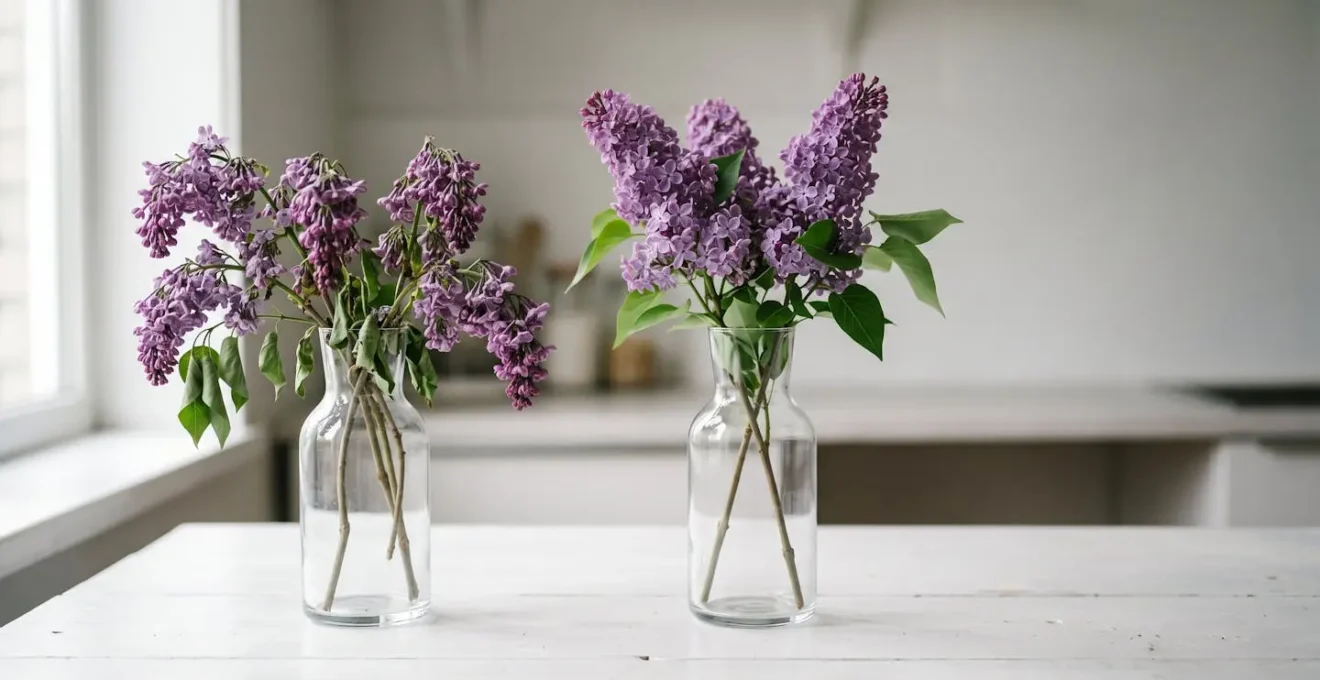
The belief that garden lilacs are naturally short-lived is a myth; their longevity is determined by a precise, science-backed post-harvest protocol, not folk wisdom.
- Rapid wilting is primarily caused by an air bubble (xylem embolism) blocking water uptake in the woody stem, a problem that simply re-cutting doesn’t solve.
- Common advice like smashing stems is destructive. The professional method involves splitting the stem vertically to maximise water absorption without damaging the vascular structure.
- Stripping all leaves—not just those below the waterline—is non-negotiable to dramatically reduce water loss through transpiration, forcing all hydration to the blooms.
Recommendation: Treat your garden lilacs with the scientific precision of a commercial grower, focusing on immediate hydration and advanced conditioning from the very moment you cut.
It is one of the most keenly felt disappointments for any British gardener. You step out into your garden on a perfect May morning, the air thick with that intoxicating scent, and cut a generous bunch of lilacs from a shrub you’ve nurtured for years. You bring them inside, arrange them beautifully, and for a day, they are glorious. By day two, they are a sad, drooping spectacle, their heavy heads bowed in defeat. Meanwhile, the lilacs at the florist stand proud for a week or more. This frustrating gap isn’t because your homegrown lilacs are inferior; it’s because commercial growers don’t rely on garden folklore. They use science.
You’ve likely tried the common advice: cutting in the cool of the morning, using flower food, maybe even the age-old trick of bashing the stems with a hammer. Yet, the results remain depressingly inconsistent. The key to unlocking a week of indoor beauty from your own garden lies not in these tips, but in understanding the unique physiology of a woody-stemmed flower like the lilac. The problem isn’t just about water; it’s about the plant’s reaction to being cut, a process involving air bubbles, hormones, and water pressure.
But what if the real solution wasn’t about a single trick, but a complete post-harvest protocol? What if, by adopting a few professional techniques, you could bridge that gap between garden disappointment and florist-quality longevity? This isn’t about magic; it’s about understanding the ‘why’ behind the wilt. It’s about tackling the core botanical challenges: ensuring massive water uptake, preventing air blockages in the stem, and managing the flower’s own aging process.
This guide will walk you through that professional process. We will dismantle the myths, explain the science, and provide a step-by-step framework to transform your fleeting garden beauties into long-lasting indoor treasures. We will explore the critical techniques for stem preparation, the importance of harvest timing, and even how to design your garden for a continuous supply of blooms.
This article breaks down the essential science and proven techniques used by professionals to dramatically extend the life of cut lilacs. From debunking common myths to providing a clear, step-by-step protocol, you’ll discover how to make your homegrown blooms last. The following table of contents outlines the key areas we will cover.
Summary: The Professional’s Guide to Long-Lasting Cut Lilacs
- Why Smashing Lilac Stems With a Hammer Actually Works to Extend Vase Life?
- Syringa Vulgaris or Syringa Meyeri: Which Lilac Lasts Longer in the Vase?
- Why Cutting Lilacs When 50% of Florets Are Open Extends Display by 3 Days?
- Why Stripping All Lilac Leaves Doubles Your Stem’s Vase Longevity?
- How to Force Lilac Branches Indoors 4 Weeks Before Outdoor Bloom?
- How to Stagger Sowings to Cut Fresh Flowers From May Through October?
- How a 45-Degree Cut Adds 3 Extra Days to Your Bouquet’s Lifespan?
- How to Design a Cutting Garden in a 6m x 4m British Back Garden?
Why Smashing Lilac Stems With a Hammer Actually Works to Extend Vase Life?
The title is a trick question: it doesn’t. Smashing lilac stems with a hammer is perhaps the most pervasive and destructive piece of advice in amateur floristry. The logic seems plausible—crush the woody end to “open it up” for more water. In reality, you are pulverising the very structures you need to transport that water: the xylem. This intricate network of microscopic tubes is the vascular system of the plant. Bashing them causes the tissue to collapse, blocking flow rather than improving it. This folk wisdom is a classic case of a well-intentioned but scientifically flawed technique.
As experts consistently point out, this method is counterproductive. The goal is to increase the surface area for water absorption without causing damage. As the Brooklyn Botanic Garden’s guidance clarifies:
Brooklyn Botanic Garden’s cut-flower care guide specifically recommends against smashing, noting that it destroys the vascular tissue you’re trying to open up.
– Brooklyn Botanic Garden, Cut-flower care guide
The real enemy of a cut woody stem is an air embolism. When cut in the air, a tiny bubble of air is instantly drawn into the xylem, creating a blockage that prevents water from travelling up the stem. This is why lilacs can wilt in a vase full of water—they are physically incapable of drinking. The professional solution is twofold. First, make the initial cut underwater to prevent the air bubble from forming. Second, instead of smashing, use sharp secateurs to make a clean vertical split, 1-2 inches up the centre of the stem. This dramatically increases the surface area of intact xylem available to the water, allowing for maximum hydration without destroying the transport system.
The visual difference is stark. A split stem reveals clean, fibrous tissue ready to drink, while a crushed stem is a mangled mess. This single change in technique, moving from a destructive myth to a constructive, scientific method, is the first and most critical step in extending vase life. Indeed, research on woody stem cutting demonstrates that flowers like roses and hydrangeas show a dramatic improvement when this principle of preventing xylem air embolism is followed.
Syringa Vulgaris or Syringa Meyeri: Which Lilac Lasts Longer in the Vase?
While proper conditioning is paramount, the variety of lilac you grow does play a significant role in its potential vase life. Not all lilacs (Syringa) are created equal when it comes to longevity after cutting. The common lilac, Syringa vulgaris, is beloved for its classic shape and powerful fragrance, but this intense perfume often comes at a cost. There’s a general correlation in the lilac world: the stronger the scent, the faster the decline in the vase. The volatile compounds that create the fragrance also contribute to a faster rate of senescence (aging).
The stronger the fragrance of your lilac blossoms, the shorter the vase life, so if you have the choice, pick your less-fragrant varieties for bringing indoors.
– Erin Benzakein, The Cut Flower Garden
Varieties like the dwarf Korean lilac, Syringa meyeri ‘Palibin’, or the late-blooming ‘Miss Kim’ (Syringa patula) are often reported by florists and gardeners to have a better vase life. Their fragrance is typically lighter and spicier than the heady scent of S. vulgaris, and their florets are often more resilient. Furthermore, ‘Palibin’ has the added benefit of sometimes producing a second, smaller flush of blooms later in the season, offering more opportunities for cutting.
Regardless of variety, professional conditioning can significantly boost performance. A study on the S. vulgaris cultivar ‘Andenken an Ludwig Spaeth’ showed the dramatic impact of using a proper floral preservative.
Study: The Power of Preservatives
In trials on the ‘Andenken an Ludwig Spaeth’ lilac, using commercial floral preservatives like Chrysal Professional 2 not only prolonged vase life compared to plain water but also increased the diameter of the individual florets and boosted overall water uptake. This confirms that providing the correct nutrients and anti-bacterial agents is far superior to DIY solutions like sugar or soda. Interestingly, the same study found that scalding stems in hot water was actively harmful, shortening the flower’s life—debunking another common myth.
So, while you can’t change the genetics of the lilac in your garden today, you can make informed choices for the future. If vase life is a top priority, consider planting a less fragrant but more durable variety like Syringa meyeri. For the common lilacs you already have, double down on a professional conditioning protocol using a proper preservative.
Why Cutting Lilacs When 50% of Florets Are Open Extends Display by 3 Days?
Timing is everything. When you harvest your lilacs is just as important as how you condition them. A common mistake is to wait until the flower heads are at their absolute peak on the shrub—fully open, gloriously fragrant, and looking perfect. Unfortunately, at this stage, they are already well on their way to senescence. The key to a long vase life is to cut them much earlier, when the flower head is still developing. This intercepts the natural aging process and allows the blooms to complete their opening indoors, giving you several extra days of enjoyment.
The aging of a cut flower is accelerated by the production of ethylene gas, a natural plant hormone that triggers ripening and, eventually, decay. The stress of cutting, dehydration, and temperature changes all signal the flower to ramp up ethylene production. By cutting the lilac when it is less mature, you are essentially starting with a flower that has a lower initial level of ethylene and more stored energy (carbohydrates) to sustain itself. This is why according to recent floral science research, managing ethylene is a cornerstone of post-harvest care for many flower types.
For lilacs, the optimal stage is when roughly three-quarters of the individual florets on the panicle (the flower cone) are still in bud, with only the bottom quarter starting to open. The buds should be showing full colour but not yet unfurled. At this “colour-break” stage, the stem has maximum potential. It will continue to open slowly in the vase over several days, creating a dynamic display. If you need the arrangement to look full immediately for an event, you can cut them when half the florets are open, but you sacrifice a few days of total vase life. Cutting when fully open should be avoided unless you only need them to look good for 24 hours.
- Longest Vase Life (7-10 days): Cut when only 10-25% of the florets at the bottom of the cone are open. The rest should be coloured buds. They will open gradually in the vase.
- Good Balance (5-7 days): Cut when 33-50% of the florets are open. This gives a fuller look on day one while still allowing for some development.
- Immediate Impact (1-3 days): Cut when 75% or more of the florets are open. Best for a dinner party or event where longevity is not the primary concern.
Why Stripping All Lilac Leaves Doubles Your Stem’s Vase Longevity?
Of all the conditioning steps, this is the one that feels most ruthless to gardeners, yet it is one of the most effective. The common advice is to remove any leaves that will be below the waterline in the vase. The professional advice is to remove every single leaf from the stem. The reason is simple, brutal, and has to do with the physics of water transport in a plant: transpiration.
A plant’s leaves are covered in tiny pores called stomata, which release water vapour into the air. This process, transpiration, is what pulls water up from the roots (or, in this case, the vase). However, the big, soft leaves of a lilac are incredibly thirsty. They will continue to transpire and lose water at a prodigious rate, competing directly with the delicate flower heads for the limited hydration the cut stem can provide. In this battle for water, the leaves almost always win, and the flowers are the first to suffer and wilt. By removing the leaves, you eliminate the primary source of water loss, directing all the available hydration straight to the blooms where you want it.
The argument that leaves below the waterline will rot and create bacteria is true, but it’s a secondary concern. The primary issue is the immediate and massive water deficit created by leaf transpiration. As floral science experts confirm, the foliage is the main culprit for water loss. In fact, FloraLife research confirms that most of the water inside a fresh-cut flower is lost through the leaves, not the petals. Removing them is the single biggest lever you can pull to correct this imbalance.
Remove every leaf from the stem before it goes into the vase — even leaves above the waterline. Foliage above water continues to transpire, competing directly with the flowers for the water the stem is drawing up.
– Blooming Expert, How to Cut Lilacs for a Vase guide
Think of it as a triage situation. Your goal is to keep the blooms hydrated. The leaves, while beautiful on the shrub, become a liability once the stem is cut. Strip them off cleanly at the stem, place your bare, conditioned stems in the vase, and then, if you want a leafy look, add separate, non-competing foliage to the arrangement.
How to Force Lilac Branches Indoors 4 Weeks Before Outdoor Bloom?
For the truly impatient gardener, there is a way to enjoy the scent and sight of lilacs long before they naturally bloom in the garden. This technique, known as “forcing,” tricks the dormant branches into flowering indoors. It requires selecting branches in late winter, after they have experienced a sufficient period of cold (the “chilling requirement”), which is essential for them to break dormancy. For most of the UK, cutting branches in late January or February is ideal.
The process involves a careful sequence of conditioning steps designed to simulate the arrival of spring. You are not just putting sticks in water; you are managing temperature, light, and hydration to coax the dormant flower buds into life. Look for branches with plump, rounded flower buds, which are larger than the slender, pointed leaf buds. The success of forcing depends heavily on the initial preparation of the stems to ensure they can absorb enough water to sustain the developing blooms over several weeks.
Using a professional method is key to success. This isn’t a process that can be rushed; it’s a slow, rewarding project that brings a welcome touch of spring into the home during the last grey days of winter. Patience is rewarded with delicate, often paler-coloured blooms than those that develop outdoors, with a fragrance that is all the more precious for its early arrival. Following a structured plan is the best way to ensure your efforts are not in vain.
Your Action Plan: Forcing Dormant Lilac Branches
- Choose a mild day in late winter (Jan/Feb) to cut dormant branches. Select stems with plenty of plump flower buds and bring a bucket of cool water with you to the shrub.
- Cut branches at least 1-2 feet long, placing them immediately into the water. Once inside, re-cut the stems underwater, strip all leaves, and create a 1-2 inch vertical split up the centre of each stem.
- Grasp one side of the sliced stem and twist it backward gently. This professional technique increases the surface area for water absorption even further than a simple split.
- Submerge the branches in a deep bucket of cool water in a cool, dark place (like a garage or cellar) for several hours or overnight. This is the critical initial hydration phase.
- Move the hydrated branches into a vase of fresh water and keep them in a cool room, away from direct sunlight. Change the water every 2-3 days, and watch over the next 2-4 weeks as the buds swell and finally burst into bloom.
How to Stagger Sowings to Cut Fresh Flowers From May Through October?
While the focus is often on the beloved common lilac (Syringa vulgaris), which has a relatively short bloom window in mid-to-late May, the lilac genus is diverse. A savvy gardener can design their garden to have lilac blooms available for cutting over a much longer period. This is the ultimate expression of seasonal planning: moving beyond a single burst of glory to a staggered succession of flowers. By selecting different species and cultivars with varying bloom times, you can effectively create a lilac season that stretches from early May right through to mid-June, and in some cases, even later.
The strategy involves planting early, mid-season, and late-blooming varieties. This not only extends your personal enjoyment in the garden but also provides a continuous supply for indoor arrangements. It begins with the early-blooming Syringa hyacinthiflora hybrids, which can start flowering two weeks before the common lilacs. Then comes the main show of S. vulgaris cultivars. Finally, late-blooming species like Syringa patula ‘Miss Kim’ or even the tree-like Syringa reticulata can extend the season into June and July.
This approach transforms the lilac from a fleeting treat into a reliable source for cut flowers for nearly a quarter of the year. The table below outlines a potential succession planting plan for a British garden, showcasing how different species can be combined to achieve a continuous harvest.
| Bloom Period | Species/Cultivar | Height at Maturity | Key Characteristics |
|---|---|---|---|
| Early May | Syringa hyacinthiflora | 8-12 feet | Early-blooming hybrids, fragrant, cold-hardy |
| Mid-May to Early June | Syringa vulgaris (Common Lilac) | 8-15 feet | Classic purple/white blooms, intensely fragrant |
| Late May to June | Syringa meyeri ‘Palibin’ (Dwarf Korean) | 4-5 feet | Compact growth, repeat bloomer, ideal for small spaces |
| Mid-June | Syringa patula ‘Miss Kim’ | 6-8 feet | Late-season bloomer, excellent disease resistance |
| Late June to July | Syringa reticulata (Japanese Tree Lilac) | 20-30 feet | Tree form, creamy white flowers, extended bloom |
Planning a garden with this diversity requires looking at catalogues and plant labels not just for colour, but for bloom time. As this comprehensive guide to lilac varieties shows, with a little forward-thinking, your cutting season can be dramatically extended, providing months of beauty instead of mere weeks.
How a 45-Degree Cut Adds 3 Extra Days to Your Bouquet’s Lifespan?
Cutting flower stems at a 45-degree angle is one of those pieces of advice that has become a platitude, repeated so often that the reason why is often forgotten. It’s not a magic trick, but simple physics. A flat, 90-degree cut allows the bottom of the stem to sit flush against the bottom of the vase, potentially sealing it off and severely restricting water intake. An angled cut ensures that no matter how the stem rests, there is always a part of the opening exposed to the water.
More importantly, an angled cut significantly increases the surface area of the xylem exposed to water. A 45-degree cut across a circular stem creates an elliptical surface that has a mathematically larger area than the circular cross-section of a straight cut. More exposed surface area means a greater capacity for water uptake—a critical factor for a thirsty woody stem like a lilac. While the “3 extra days” is an optimistic average, the principle is sound: maximising the potential for hydration at the point of entry is fundamental to extending vase life. This is why all cut flower best practices insist on this simple but effective step.
For lilacs, this technique should be combined with the more advanced methods. The ideal protocol is: make a 45-degree cut underwater, then, keeping the stem submerged, make the vertical split. This combination gives you the best of all worlds: no air embolism, maximum surface area from the angle, and even more surface area from the split. It turns a simple stem into a high-performance hydration machine.
The act of cutting underwater, as shown here, is the professional’s secret weapon against the instant wilting caused by air blockages. It ensures the first “breath” the cut stem takes is water, not air. This single habit, more than any other, separates the wilting bouquet from the long-lasting one.
Key takeaways
- Wilting is caused by air embolism (xylem blockage), not just thirst. The solution is to split stems vertically after cutting them underwater; never crush them.
- Strip every single leaf from the stem, even those above the waterline. Leaves are the primary source of water loss (transpiration) and compete directly with the blooms.
- Harvest timing is crucial for longevity. Cut your lilacs when only the bottom 25-50% of the florets on the cone are open for a vase life that can exceed a week.
How to Design a Cutting Garden in a 6m x 4m British Back Garden?
The dream of having a dedicated cutting garden often collides with the reality of the typical British back garden, where space is at a premium. A standard common lilac (Syringa vulgaris) can easily grow to 15 feet tall and wide, overwhelming a small plot. However, designing an effective cutting garden in a compact 6m x 4m space is entirely possible with smart plant selection. The key is to choose compact or dwarf cultivars that provide a generous supply of blooms without dominating the landscape.
For a small-space cutting garden focused on lilacs, the primary workhorse is the dwarf Korean lilac. This is where a specific cultivar choice makes all the difference.
Case Study: The Perfect Lilac for a Small UK Garden
The dwarf Korean lilac, specifically the cultivar Syringa meyeri ‘Palibin’, is an ideal candidate for a 6m x 4m British garden. It maintains a manageable size of around 4 to 5 feet tall and wide, making it a perfect fit. Unlike its larger cousins, it won’t cast excessive shade or require aggressive pruning to keep it in check. This compact stature offers excellent disease resistance and makes harvesting blooms significantly easier—no ladder required. It can be integrated as a central feature or part of a mixed border, serving as both a beautiful ornamental shrub and a reliable source of cut flowers throughout its blooming period.
In a 6m x 4m plot, you could dedicate a corner to a single ‘Palibin’ lilac. Around its base, you can plant other cutting garden staples that thrive in similar conditions (full sun, well-drained soil). Think about companion plants like tulips for spring, alliums, and then hardy annuals like cosmos and zinnias to take over in summer. This creates a multi-layered, productive space. The lilac provides the early-season, fragrant, structural blooms for arrangements, while the other plants fill in the gaps through to autumn. This is the essence of small-space design: making every plant justify its place with multiple functions—ornamental beauty and practical productivity.
By shifting the focus from large, traditional species to compact, high-performance cultivars, a small British garden can absolutely accommodate the luxury of a cutting patch. It’s not about having less; it’s about choosing smarter.
By applying these professional-grade techniques—from smart cultivar selection in your garden design to the precise, scientific conditioning of every stem you cut—you can finally close the gap. You can transform your fleeting garden treasures into magnificent indoor displays that last, bringing the beauty and scent of your own lilac shrub into your home for a week or more.