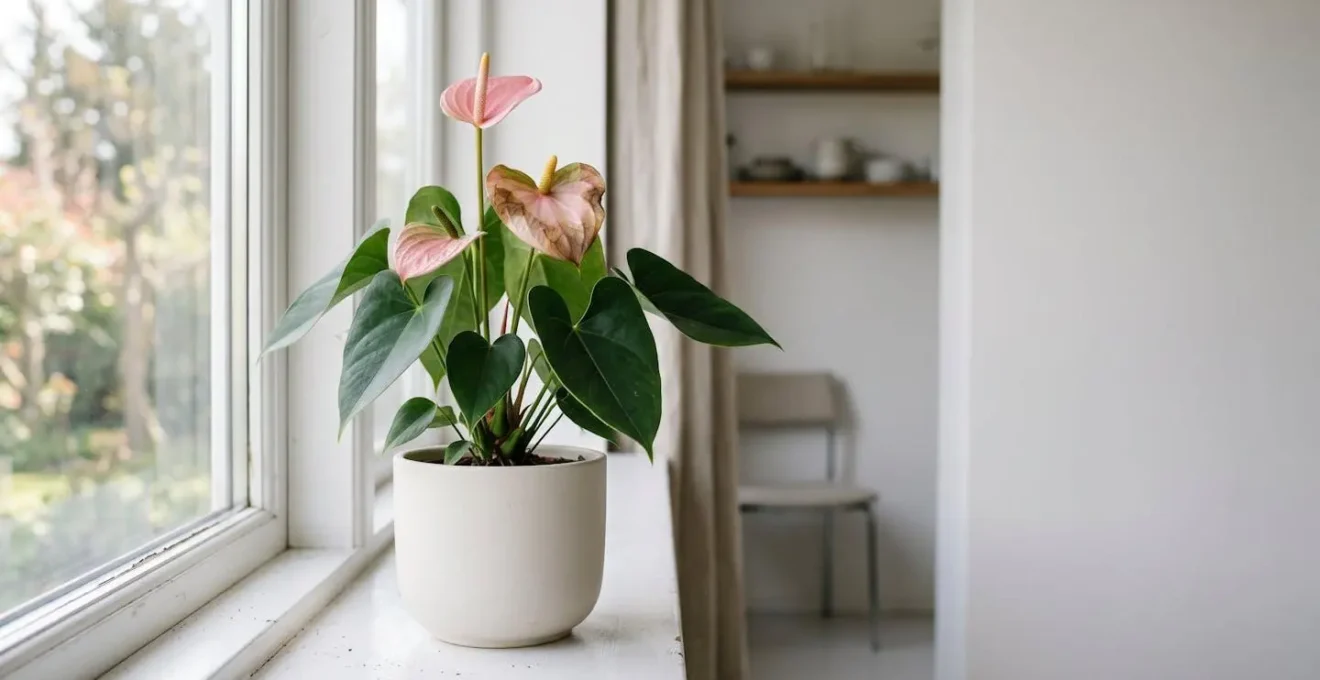
Your anthurium isn’t failing due to a lack of care; it’s experiencing ‘supply chain shock’ from the perfect greenhouse to your dry, centrally-heated UK home.
- The primary cause of brown, crispy leaves is a severe “humidity deficit,” not necessarily bad watering habits.
- Weekly watering is often too frequent for an anthurium struggling with low humidity, leading to a deadly root rot spiral.
Recommendation: Shift your focus from a rigid watering schedule to actively managing your home’s humidity, especially during winter.
It’s a familiar and frustrating story for many UK plant buyers. You bring home a stunning anthurium, its glossy, heart-shaped spathe a vibrant splash of red, pink, or white. It’s marketed as a long-lasting, minimal-care tropical beauty. Yet, within a few short weeks, the edges of its leaves begin to crisp and turn brown, the vibrant colour fades, and the plant looks like it’s in a rapid, irreversible decline. You followed the label’s advice, watering it diligently, but the problem only seems to worsen.
The common advice points to overwatering, underwatering, or light issues. While these factors play a role, they are often symptoms of a much larger, unseen problem. They fail to address the fundamental reason your plant is struggling so acutely, particularly in a British home during the colder months. These plants, along with their popular cousins like orchids, begin their life in near-perfect, computer-controlled conditions that are impossible to replicate domestically without a little knowledge.
But what if the key to success isn’t just about following generic care tips, but about understanding the dramatic journey your plant has taken? This isn’t an article about basic care; it’s a diagnostic guide. The true culprit is often a drastic environmental whiplash I call ‘supply chain shock’. The shift from a high-humidity Dutch glasshouse to the dry air of a centrally-heated UK home creates a profound ‘humidity deficit’ that triggers a cascade of stress responses, from browning leaves to root rot.
In this guide, we will diagnose the core issues by exploring the science behind your anthurium’s stress. We’ll examine why humidity is more critical than your watering can, compare the real-world value of different anthurium types, and provide you with the tools to help your plant not just survive, but truly acclimate and thrive in its new environment.
This article will break down the common failure points for anthuriums and similar tropical plants in UK homes, providing a clear path to success. The table of contents below outlines the key diagnostic stages we will cover.
Summary: Why Anthuriums Fail in UK Homes and How to Fix It
- Why Anthuriums Need 60% Humidity: The Bathroom Placement Strategy
- Red, Pink, or White Anthurium: Which Colour Lasts Longest in Cut Arrangements?
- Potted Anthurium or Cut Stem: Which Delivers Better Value Over 6 Months?
- The Root Rot Spiral: Why Weekly Watering Kills Your Anthurium?
- Why Winter-Purchased Anthuriums From Garden Centres Often Die Within Days?
- Why Central Heating Kills Orchid Roots: The 40% Humidity Problem
- Why Direct Sunlight Fades Petals but Darkness Closes Blooms Permanently?
- Why Does Your Orchid Drop Buds Every Winter Despite Following Care Advice?
Why Anthuriums Need 60% Humidity: The Bathroom Placement Strategy
The single most misunderstood aspect of anthurium care is humidity. These plants are native to the warm, humid rainforests of Central and South America, where air moisture is consistently high. They are biologically wired for it. When you bring an anthurium into a typical UK home, especially one with central heating running, the environmental shock is immense. During winter, indoor air can plummet to levels below 30% relative humidity (RH), creating a severe humidity deficit for a plant that craves at least 60%.
This dry air forces the plant to lose water through its leaves far faster than its roots can absorb it. To protect itself, the plant closes its stomata—tiny pores on the leaf surface. As Dutch breeding specialist Anthura explains, this is a survival mechanism with a devastating side effect: “If the plant loses too much water, the stomata will close with the result that photosynthesis stops.” This is the critical moment. The browning leaf edges you see are not just a sign of thirst; they are signs of cellular death in a plant that has essentially shut down its life-support system.
This is why simply placing your anthurium in a bathroom or kitchen, where steam from showers and cooking naturally raises the humidity, is often the most effective first-aid. Before you even think about your watering schedule, address the air. Grouping plants together or using a pebble tray with water can also create a more humid microclimate. The brown parts won’t turn green again, but addressing the humidity deficit is the only way to stop the damage from spreading and allow new, healthy growth to emerge.
Red, Pink, or White Anthurium: Which Colour Lasts Longest in Cut Arrangements?
When selecting an anthurium, it’s tempting to believe that the deepest red varieties might be hardier or longer-lasting than their pale pink or white counterparts. However, from a horticultural and botanical standpoint, the longevity of the colourful spathe (the waxy, modified leaf often mistaken for a flower) is determined more by its genetic makeup and physical structure than its specific pigment.
Breeders are not primarily focused on colour for longevity; their goal is universal durability across all cultivars. The official objectives listed in patent applications for new anthurium varieties consistently name “good inflorescence longevity” as a key breeding target, irrespective of colour. The real indicator of a long-lasting bloom is its substance—the thickness and texture of the spathe itself. A thicker, more leathery spathe will be more resilient to environmental stress and physical damage, and will naturally last longer both on the plant and in a vase.
Case Study: The Durability of ‘Pink Paradise’
An excellent example is the cultivar ‘Pink Paradise’. According to its official USPTO plant patent documentation, this pink variety demonstrates exceptional durability. Its spathes are documented to last for approximately six weeks even under stressful winter conditions, and can persist for up to three months in the more favourable conditions of summer. The patent attributes this remarkable vase life not to its pink hue, but specifically to the spathe’s “leathery, glabrous” texture, which makes it highly resistant to wilting and damage.
Therefore, when choosing an anthurium for longevity, don’t get caught up in the colour. Instead, gently feel the spathe. A plant with thick, robust, almost waxy-feeling spathes—regardless of whether it’s red, pink, or white—is your best bet for a display that will last for many weeks, or even months, to come.
Potted Anthurium or Cut Stem: Which Delivers Better Value Over 6 Months?
A single, high-quality cut anthurium stem can be a significant expense, often priced as a luxury flower. A potted anthurium plant might cost two to three times as much upfront, leading many to question which is the better investment. From a pure value-over-time perspective, the potted plant is the undisputed winner, provided you can successfully manage its acclimatisation.
Let’s break down the economics. A cut anthurium stem, even a very fresh one, has a finite lifespan, typically lasting two to four weeks in a vase. Over a six-month period (24 weeks), you would need to purchase between 6 and 12 individual stems to maintain a continuous display. The cost would quickly multiply, far exceeding the initial price of a single potted plant.
In contrast, a healthy potted anthurium is a bloom-producing factory. Each individual spathe on the plant has a remarkable persistence. As noted in cultivar breeding documentation, a single bloom can remain in pristine condition for 2-3 months while still attached to the plant. A mature, well-cared-for plant will typically have several blooms at different stages of development and will produce new ones sequentially throughout the year. A single plant can therefore provide you with a continuous, overlapping display of colour for the entire six-month period and beyond, for a one-time purchase price.
The caveat, of course, is care. The value proposition of the potted plant is entirely dependent on keeping it alive and healthy. If the plant succumbs to ‘supply chain shock’ within a month, the cut stem would have been the better short-term choice. However, by understanding the principles of humidity and proper watering discussed in this guide, you unlock the potted anthurium’s true potential as a long-term, high-value investment in continuous floral beauty.
The Root Rot Spiral: Why Weekly Watering Kills Your Anthurium?
“Water once a week” is perhaps the most common—and most lethal—piece of advice given to new plant owners. For an anthurium struggling with the low humidity of a UK home, this routine creates a devastating paradox. You see a plant with dry, crispy leaf edges and assume it’s thirsty. You water it, but the problem gets worse. This is the entry point to the root rot spiral, where the plant effectively drowns in soggy soil while its leaves are dying of thirst.
Here’s the mechanism: an anthurium’s roots are thick, fleshy, and adapted to the airy, well-draining environment of the rainforest floor, not dense, waterlogged potting mix. As the expert growers at Anthura note, due to their unique leaf structure, “The plant can only absorb a reduced amount of humidity and hence has less water evaporation than most plants.” When the surrounding air is dry, the plant closes its stomata to conserve water, as we’ve discussed. This dramatically slows down its water usage (transpiration). If you continue to water on a fixed schedule, you are adding water to a system that is no longer using it. The soil becomes saturated, oxygen is pushed out, and the roots begin to suffocate and decay. This is root rot.
The cruel irony is that rotting roots can no longer absorb water or nutrients, even if the soil is soaked. The plant now has no way to hydrate itself, and the leaves begin to yellow, wilt, and die more rapidly. The owner sees this, thinks the plant is even thirstier, and waters it again, accelerating its demise. To break this cycle, you must abandon the calendar. Water only when the top 50% of the soil is dry to the touch. It is always safer to let an anthurium get a little too dry than to keep it a little too wet. Let the plant’s actual needs, not the calendar, dictate your watering habits.
Why Winter-Purchased Anthuriums From Garden Centres Often Die Within Days?
Buying a vibrant tropical plant from a garden centre in the middle of a British winter is a gamble. The plant’s journey from a temperature-controlled lorry to the draughty entrance of a store and then into your car is a gauntlet of temperature shocks and stress. This is the peak of ‘supply chain shock’, and it’s the primary reason a seemingly healthy plant can go into a rapid decline upon arriving home.
These plants have been cultivated in perfect, stable, high-humidity environments. The sudden exposure to cold draughts, even for a few minutes, can be catastrophic. The plant’s cells are not prepared for the sudden temperature drop, leading to shock that manifests as leaf yellowing, browning, or sudden wilting within days. Furthermore, the dry air in most retail environments and homes exacerbates this stress. A 2024 study on indoor environments highlights this, showing humidity can be as low as 29% without plants, a hostile condition for a tropical species. The plant simply doesn’t have the time or the resilience to acclimate to such a rapid series of environmental assaults.
To give yourself the best chance of success, you must become a discerning shopper and inspect any potential purchase with a critical eye. A few moments of investigation at the garden centre can save you from the disappointment of bringing home a plant that is already on the verge of collapse. Use a pre-purchase checklist to assess the plant’s health and the conditions it has been subjected to before you commit to buying it.
Your Anthurium Pre-Purchase Inspection Plan
- Check for Condensation: Look for heavy condensation inside the clear plastic nursery pot. This often indicates it was watered heavily right before being shipped in the cold, a recipe for root shock.
- Examine Leaf Undersides: Gently turn over the leaves. Hidden brown spots, yellowing patches, or fine webbing can be early signs of stress or pests that were present before you saw the plant.
- Feel the Soil: The soil should be lightly moist, not soaking wet. A plant sitting in a pool of cold water in its decorative pot is a major red flag for impending root rot.
- Assess the Store Placement: Be wary of plants located near automatic doors, open entryways, or under heating/cooling vents. These are high-stress zones with constant draughts.
- Ask About Shipments: Politely ask a staff member when their last tropical plant delivery arrived. It’s best to avoid buying a plant on the same day it arrived, as it will still be in transport shock.
Why Central Heating Kills Orchid Roots: The 40% Humidity Problem
The silent killer of many epiphytic houseplants like anthuriums and orchids is central heating. While it keeps us comfortable, it acts like a dehumidifier, stripping moisture from the air. This creates an environment that is fundamentally hostile to plants that have evolved to absorb moisture not just through their roots in the soil, but also through their leaves and aerial roots in the humid air of a rainforest canopy.
The problem is a simple matter of physics and biology. Warm air can hold more moisture than cold air. When we heat cold winter air inside our homes, its relative humidity plummets. While the American Society of Heating, Refrigerating, and Air-Conditioning Engineers (ASHRAE) recommends an indoor relative humidity of 30-60% RH for human health and comfort, our homes often fall below this range during cold snaps. For a tropical plant, this is a desert. An environment of 40% humidity might feel comfortable to us, but it represents a significant and continuous stress for a plant that thrives at 60-80%.
In the case of orchids, the effect is visible on their aerial roots. In a humid environment, these roots are plump, green, and silvery. In the dry air created by central heating, they become shrivelled, brittle, and grey. They are no longer able to perform their secondary function of absorbing atmospheric moisture. For anthuriums, the effect is seen in the crispy brown edges of the leaves. In both cases, the plant is in a state of constant water-loss stress, which, as we’ve seen, leads to a shutdown of metabolic processes and makes it far more susceptible to problems like root rot from over-enthusiastic watering.
Combating the effects of central heating is crucial for winter houseplant care. A small, inexpensive hygrometer can tell you the actual humidity in your room. If it’s consistently below 50%, you must take action—using a humidifier, grouping plants, or using pebble trays—to create a survivable microclimate for your tropical collection.
Why Direct Sunlight Fades Petals but Darkness Closes Blooms Permanently?
Finding the right light for an anthurium is a delicate balancing act. The common advice is “bright, indirect light,” but what does that truly mean? Understanding the plant’s reaction to both extremes—too much and too little light—is key to positioning it for long-term health and vibrant colour.
Direct sunlight, especially the harsh midday sun through a south-facing window, is the enemy of an anthurium’s colour. The vibrant pigments in the spathe, known as anthocyanins, are sensitive molecules. Intense ultraviolet (UV) radiation can break them down, causing the brilliant reds and pinks to fade to a washed-out, pale version of their former selves. In severe cases, the sun will physically scorch the leaves and spathe, leaving permanent brown or bleached patches. Light provides the energy for photosynthesis, but as research on floral pigments confirms, maintaining the right conditions for anthocyanin accumulation is crucial for preventing colour fading. Too much intense light overwhelms this process.
Conversely, placing an anthurium in a dark corner is equally detrimental, though the symptoms are different. Without sufficient light, the plant cannot photosynthesise effectively. It lacks the energy needed to produce and sustain its colourful spathes. An existing bloom may close up or drop prematurely, and the plant will certainly not produce any new ones. The leaves may turn a very deep, dark green as the plant maximises its chlorophyll to capture every available photon, and they may become leggy, stretching out in a desperate search for a light source.
The ideal location is therefore a spot near an east-facing window that receives gentle morning sun, or a few feet back from a west or south-facing window, where the light is bright but diffused. The goal is to provide enough energy for vigorous growth and colour production without subjecting the plant to the damaging intensity of direct solar radiation.
Key takeaways
- The primary cause of anthurium decline is the ‘humidity deficit’ between the grower’s greenhouse and a dry, centrally-heated home.
- A weekly watering schedule is dangerous; water only when the top half of the soil is dry to prevent the root rot spiral.
- Longevity is determined by the spathe’s thick, leathery texture, not its colour. A potted plant offers far better long-term value than cut stems.
Why Does Your Orchid Drop Buds Every Winter Despite Following Care Advice?
The phenomenon of “bud blast”—where a seemingly healthy orchid suddenly drops its unopened flower buds—is deeply frustrating, especially when you feel you’ve followed all the care advice. This issue, common in both orchids and other sensitive flowering plants like anthuriums, is almost always a symptom of sudden environmental stress. The plant, sensing unstable conditions, decides to cut its losses and abandon its resource-intensive flowering process to focus on basic survival.
While a number of factors can trigger bud blast (draughts, temperature swings, ethylene gas from ripening fruit), the most common culprit in winter is, once again, the drastic drop in humidity. As horticultural specialists at Soltech point out, “Most indoor environments stay around 30-50%, which requires supplementation for tropical species.” This is a far cry from the ideal 60-80% humidity for tropical plants. A developing flower bud is one of the most sensitive parts of the plant. The rapid water loss caused by dry air signals to the plant that conditions are not favourable for successful reproduction, and it jettisons the buds.
This explains why a plant can look perfectly healthy but still fail to bloom. The established leaves may be tough enough to withstand the dry air, but the delicate, developing buds are not. It also highlights why following generic “watering advice” is not enough. You can be watering the roots perfectly, but if the air around the buds is too dry, the plant will still register a state of emergency. The solution lies in a holistic approach. It’s not just about one aspect of care, but about creating a stable, supportive environment that mimics, as closely as possible, the plant’s native habitat—especially during the stressful winter months.
By focusing on consistency—stable temperatures, high humidity, appropriate light, and careful watering—you provide the security the plant needs to commit its energy to a long-lasting and spectacular floral display. Don’t be discouraged by past failures; see them as diagnostic clues. Each dropped bud is a piece of data telling you that a sudden environmental shift occurred, and your job as a plant parent is to become a detective and stabilize that environment.
Now that you can diagnose the environmental stresses affecting your plant, the next logical step is to proactively create an environment where it can not just survive, but thrive. Start today by assessing your home’s humidity and adjusting your care routine accordingly.