Stop your expensive heliconia stems from toppling over with a simple shift from brute force to floral engineering.
- The secret isn’t a heavier vase; it’s a weighted anchoring system called a kenzan (pin frog) that provides a low centre of gravity.
- For UK buyers, understanding the cold chain is non-negotiable: a few hours below 12°C can irreversibly damage the flower’s structural integrity.
Recommendation: Master the kenzan and proper conditioning protocols. This investment in technique will unlock the true sculptural potential of these dramatic flowers and protect your purchase.
There is no greater disappointment for a lover of dramatic florals than the sound of a crash, only to discover your magnificent, expensive heliconia stem has taken a nosedive onto the floor. You followed the standard advice: you chose a heavy vase, maybe even added decorative stones or marbles for weight. Yet, the sheer top-heavy leverage of that glorious, sculptural bloom proved too much. This frustration is a common barrier for UK buyers wanting to bring these tropical statement pieces into their homes. The truth is, standard home-decorating tricks are no match for the unique physics of a heliconia.
The solution doesn’t lie in more brute force or a bigger vase. It lies in adopting the mindset of a professional floral designer—thinking not in terms of decoration, but of structural display expertise. It’s about mastering the mechanics of counter-balance and understanding the biological needs of an exotic import. The key is to move beyond simply ‘placing’ a flower in water and to start ‘engineering’ its display for stability, longevity, and maximum visual impact. This requires specific tools and knowledge that protect both your aesthetic vision and your financial investment.
This guide moves past the generic advice. We will deconstruct the problem of displaying heliconias, starting with the foundational mechanics of weighted anchoring. From there, we will explore how to select the right variety for your space, understand the complex economics of their pricing, and crucially, learn the cold-chain secrets that are vital for any UK-based enthusiast. Finally, we’ll expand this thinking to other statement flowers, culminating in an appreciation for why, in high-end floral design, less is often so much more.
This article provides a complete roadmap for the discerning buyer. It’s structured to build your expertise from the ground up, ensuring your next heliconia not only survives, but stands tall and commands the attention it deserves.
Summary: Mastering the Art of Heliconia Display
- Why Standard Vases Fail Heliconias: The Weighted-Base Solution?
- Hanging Lobster Claw or Upright Parrot: Which Heliconia Suits a Modern Interior?
- Why Heliconia Prices Triple in January and How to Find Affordable Alternatives?
- The 12°C Threshold: Why Your Heliconia Arrived Black and Mushy?
- How Many Days Before an Event Should You Receive Heliconias for Peak Impact?
- Which 5 Single-Stem Flowers Make a Statement Without Any Accompaniment?
- Which Flowers Create Drama Overhead Without Adding Dangerous Weight?
- Why Are Minimalist Arrangements With 3 Stems Priced Higher Than Overflowing Bouquets?
Why Standard Vases Fail Heliconias: The Weighted-Base Solution?
The fundamental flaw in using a standard vase for a heliconia is a misunderstanding of physics. While a heavy vase provides overall stability, it does nothing to counteract the specific, high-leverage point where the top-heavy flower head begins to tip. The stem acts as a long lever, and without a fixed pivot point at its base, it will inevitably find a way to topple. Filling the vase with stones or marbles is a clumsy attempt to solve this, but it offers no precision and can damage the stem.
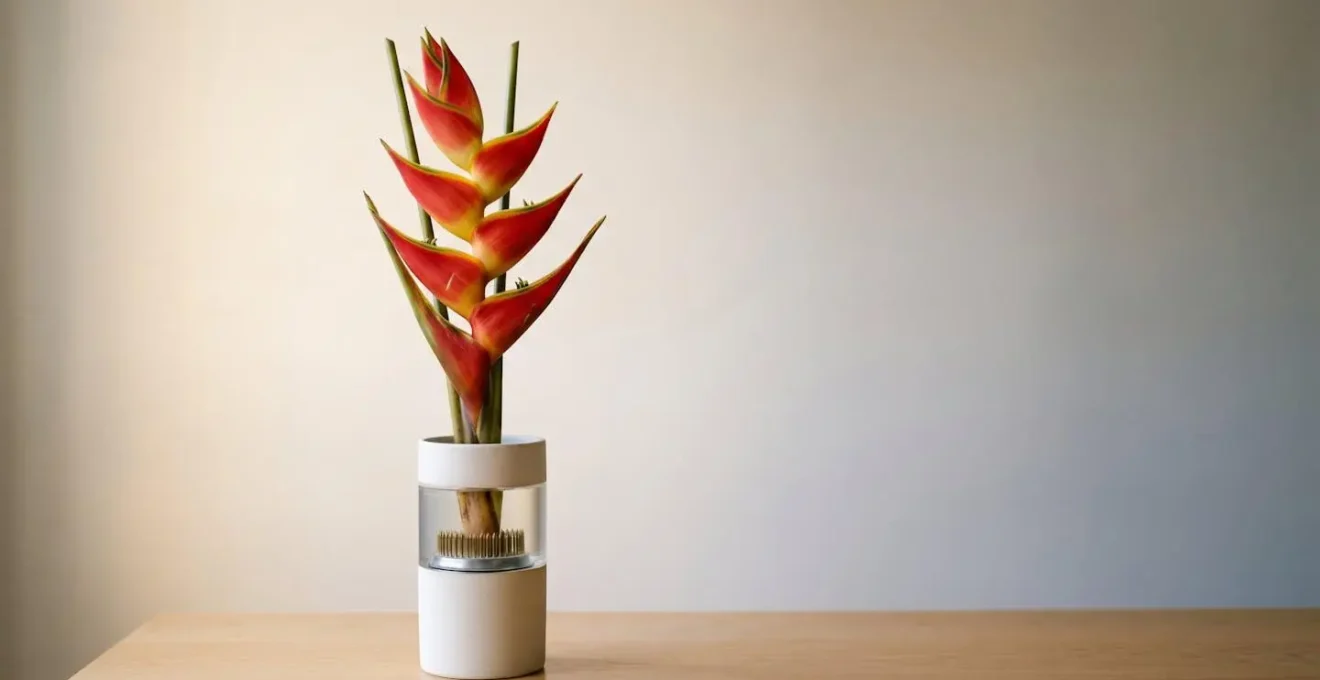
The professional solution is elegant and precise: weighted anchoring at the stem’s base. This is achieved using a kenzan, or Japanese pin frog—a heavy, lead or brass disc studded with sharp pins. This tool, central to the art of Ikebana, is secured to the bottom of the vase. The heliconia stem is then pressed firmly onto the pins. This single action achieves two things: it creates an incredibly stable, low centre of gravity, and it allows for precise, intentional angling of the stem. You are no longer just dropping a flower in a vase; you are engineering a sculpture. This is the secret to achieving those gravity-defying, minimalist arrangements.
The image above demonstrates this principle perfectly. The kenzan grips the stem at its widest point of contact, creating a solid foundation that makes the vase’s own weight almost secondary. While some designers resort to floral foam, a more sustainable approach is increasingly favoured. As the Floral Design Institute notes, even with foam, extra support like chicken wire is needed for such heavy stems, highlighting the inherent challenge. A kenzan, however, provides this support from the outset. For a heavy heliconia, choose a kenzan of at least 3-4 inches in diameter with a solid brass construction for maximum weight and stability.
Hanging Lobster Claw or Upright Parrot: Which Heliconia Suits a Modern Interior?
Once you’ve mastered the mechanics of displaying heliconias, the next step is curating the right form for your space. Not all heliconias are created equal. The genus boasts a vast range of sizes and growth habits, from pendulous, cascading “lobster claws” (like *Heliconia rostrata*) to sleek, vertical “parrot” types (*Heliconia psittacorum*). For a modern, minimalist interior, the choice between these forms is a critical design decision.
Hanging varieties are undeniably spectacular, but their drooping bracts require significant vertical and horizontal space to be appreciated, making them better suited for large, open foyers or spaces with vaulted ceilings. In a standard UK home or apartment, they can quickly overwhelm a room. In contrast, the upright parrot varieties offer a more contained and architectural aesthetic. Their clean lines and vertical interest provide a powerful sculptural focal point without demanding a large footprint. This makes them ideal for complementing minimalist décor, where the emphasis is on line, form, and quality over quantity.
A prime example is *Heliconia psittacorum* ‘Lady Di’, a favourite among interior design professionals. Its compact growth habit and dramatic, long-arching leaves create a tropical feel that is both sophisticated and manageable. As horticultural guides show, the difference is stark, with compact varieties standing at 3-6 feet versus large hanging species that can reach up to 10 feet. For a modern interior, the controlled verticality of a psittacorum type provides all the drama of the tropics without sacrificing precious floor space or visual clarity. It becomes a piece of living art, not just a plant.
Why Heliconia Prices Triple in January and How to Find Affordable Alternatives?
For any UK buyer, the sticker shock of heliconias, particularly in the winter months, is a real consideration. A price that seems high in summer can easily triple in January. This isn’t arbitrary; it’s a direct reflection of supply chain logistics. Heliconias are tropical flowers, grown in equatorial regions. In the northern hemisphere’s winter, the cost of heating greenhouses, reduced daylight hours slowing growth, and the increased complexity of cold-chain shipping all converge to drastically increase the base cost per stem.
However, when considering the price, it’s essential to perform a cost-benefit analysis based on vase life. A bouquet of common flowers might last a week, but a well-conditioned heliconia offers far greater longevity. Depending on the variety and care, industry research shows a vase life of 7-21 days, and sometimes longer. When a single stem can act as a sculptural centrepiece for three weeks, its cost per day can become surprisingly reasonable compared to less durable arrangements.
When the budget simply doesn’t allow for a winter heliconia, there are several alternatives that provide a similar statement-making impact and sculptural quality:
- King Protea (Protea cynaroides): A massive, architectural flower head that commands attention. Its greatest advantage is that it dries perfectly in place, offering months of display value.
- Bird of Paradise (Strelitzia): Offers a similar exotic, tropical aesthetic with a bold structure and vibrant colours, and is often more readily available and affordable year-round.
- Large Alliums (Globemaster or Schubertii): These create drama with their huge, spherical flower heads, providing architectural interest while being significantly lighter.
- Foxtail Lily (Eremurus): These towering spires replicate the vertical drama of upright heliconias, achieving impact through sheer scale.
The 12°C Threshold: Why Your Heliconia Arrived Black and Mushy?
You’ve sourced a beautiful heliconia, paid the premium price, and it arrives at your door. You unbox it with excitement, only to find the vibrant bracts are tinged with black, feel soft, and look… defeated. This is the devastating result of cold damage, or ‘chilling injury’, a critical concern for anyone importing tropical flowers into the UK’s temperate climate. Heliconias are extremely sensitive to cold, and their cellular structure begins to break down when exposed to low temperatures. This damage is irreversible.
The critical line is not freezing point, but a much higher temperature. According to professional floriculture standards, exposure to temperatures below 55°F (12.8°C) for even a few hours can cause this catastrophic damage. This could happen anywhere in the cold chain: on an airport tarmac, in an unheated delivery van, or even on your own doorstep if the box is left outside on a chilly day. The blackened, mushy tissue is a sign that the cell walls have ruptured, losing their structural integrity. The flower will not recover and will deteriorate rapidly.
To prevent this, always work with reputable suppliers who specialize in exotic flowers and have robust cold-chain protocols. Upon delivery, you must also follow a strict acclimatization process to avoid shocking the flower with a rapid temperature change. This careful transition is just as important as any other aspect of the flower’s care.
Your Action Plan: Slow Acclimatization Protocol
- Do NOT unbox flowers immediately upon delivery in cold weather – leave the sealed box intact to prevent rapid temperature shock.
- Place the unopened box in a transitional cool room (such as a utility room or garage) at a moderate temperature for 3-4 hours.
- After the acclimatization period, carefully unbox the flowers in the same moderate-temperature space and inspect for any signs of damage.
- Keep the flowers away from direct heat sources like radiators or vents for the first 12 hours to prevent thermal shock.
- Gradually move the arrangement to its final display location, allowing the flower to adjust to each new temperature zone.
How Many Days Before an Event Should You Receive Heliconias for Peak Impact?
When using a dramatic flower like a heliconia for a special event, timing is everything. The goal is to have the flower at its absolute peak of turgidity and vibrancy on the day. Ordering it too early risks it being past its prime, while ordering it too late means it may not have had time to properly hydrate and open after its long journey. This is where professional conditioning protocols become essential.
First, it’s important to understand their potential longevity. While often quoted at 7-21 days, some varieties can last even longer. As commercial floriculture research demonstrates, heliconias can enjoy a vase life of upwards of three weeks when properly cared for. This long life gives you a generous window, but for peak event impact, a more precise timeline is needed. The flower needs time to recover from the stress of shipping and fully hydrate, which allows the bracts to become firm and their colour to intensify.
Professional Event Timeline for Heliconia Conditioning
Research on heliconia varieties like Golden Torch and Red Torch, published in the Journal of Entomology and Zoology Studies, has demonstrated the importance of conditioning for event applications. The study showed that flowers achieved maximum water uptake and bract opening when given adequate hydration time in optimized vase solutions. This scientific evidence supports the professional recommendation for a 3-day conditioning period prior to a major event. Receiving the flowers 3 days in advance allows for a full 72 hours of uninterrupted hydration, ensuring they are fully turgid and displaying their most impactful, vibrant colour on the day of the event.
Therefore, the optimal strategy is to schedule your delivery for exactly three days before your event. Upon arrival, immediately unbox them (following acclimatization protocols if necessary), give them a fresh, sharp cut at the base, and place them in a deep container of fresh water in a cool, shaded area. This dedicated conditioning period is the professional’s secret to guaranteeing show-stopping performance.
Which 5 Single-Stem Flowers Make a Statement Without Any Accompaniment?
The principle of using a single heliconia stem as a sculptural element is a powerful design concept. It’s about celebrating the unique form, texture, and presence of a single, perfect specimen. This “less is more” philosophy can be applied to a range of other flowers that possess enough individual character to command a space on their own. Moving beyond heliconias, here are five other flowers that excel as solo performers, each bringing a distinct personality to a minimalist arrangement.
These flowers are chosen for their strong architectural form and ability to function as a piece of living art, demanding no accompaniment to make their presence felt. Each one tells a story through its structure and commands attention through its unique silhouette.
- King Protea (Protea cynaroides): Not simply a flower but a long-lasting sculpture. Its incredible vase life and ability to dry perfectly in place offer value and beauty for months rather than days, with a substantial form that commands attention.
- Foxtail Lily (Eremurus): An alternative form of drama through verticality and texture. A single spire composed of hundreds of tiny star-shaped flowers draws the eye upward, adding a sense of ethereal aspiration to any space.
- Globe Artichoke on Stem (Cynara cardunculus): An unexpected choice. A single large un-flowered artichoke head on a long stem creates a brutalist architectural statement with a unique silvery-green hue and tactile texture.
- Crown Imperial (Fritillaria imperialis): Truly regal and unusual. Its crown of downward-facing bells topped with a distinctive tuft of leaves creates a punk-rock edge, while its musky scent adds a compelling multi-sensory dimension.
- Heliconia (Various Species): The original inspiration. With nearly 200 species, a single heliconia stem provides tropical drama through its bold, waxy bracts and substantial presence.
Which Flowers Create Drama Overhead Without Adding Dangerous Weight?
The concept of floral engineering becomes most critical when designing for overhead installations. The goal is to create a sense of voluminous, immersive drama without introducing a dangerous amount of weight. A single fresh heliconia stem, saturated with water, can be surprisingly heavy. While suitable for a sturdy vase on a solid floor, suspending multiple heavy stems overhead requires significant structural reinforcement and poses inherent risks. The professional approach is to choose materials that have a high “grams-per-impact” ratio—flowers that look substantial and create massive visual volume but are, in fact, incredibly lightweight.
This is where dried and ethereal materials truly shine. They allow for the creation of large-scale, cloud-like installations that appear dense and dramatic but are virtually weightless. This approach not only ensures safety but also aligns with a more sustainable design ethos. As Dan Cooper Garden highlights, the tools often used for these arrangements, like flower frogs, are a vastly more sustainable choice than floral foam, which “readily disintegrates into polluting microplastics and should be avoided.” This philosophy of smart, safe, and sustainable material selection is the hallmark of an expert.
Here are some of the best lightweight options for creating breathtaking overhead drama:
- Dried Pampas Grass: The undisputed champion of voluminous, low-weight installations. Its plumes create a cloud-like effect with minimal structural load.
- Large-Scale Gypsophila (Baby’s Breath): When massed together, individual lightweight stems create an ethereal, dreamy volume perfect for suspended ceiling designs.
- Lunaria (Honesty Plant) Branches: The dried, translucent seed pods catch the light beautifully, appearing as floating silver discs that add substantial visual impact with remarkable lightness.
- Large Allium Seed Heads (Dried): The skeletal structures of dried ‘Globemaster’ or ‘Schubertii’ alliums are strong, architectural, and nearly weightless, creating firework-like effects when suspended.
- Delphinium Spires: While fresh flowers have some weight, the vertical drama of delphinium provides maximum visual impact relative to its mass, making it suitable for reinforced structures.
Key Takeaways
- Stop fighting gravity with a heavy vase; master it with a weighted kenzan (pin frog) for absolute stability.
- For UK buyers, the 12°C threshold is a hard line. Protect your investment by understanding cold damage and acclimatizing new arrivals slowly.
- The price of a statement stem reflects its entire journey and longevity. The highest value comes from curation and skill, not just the quantity of flowers.
Why Are Minimalist Arrangements With 3 Stems Priced Higher Than Overflowing Bouquets?
It’s a paradox that often confuses consumers: how can a sparse arrangement of just three stems cost more than a dense, overflowing bouquet packed with dozens of flowers? The answer lies in a fundamental shift in what you are paying for. With a bountiful bouquet, you are buying raw material—the sheer volume of flowers. With a minimalist arrangement, you are buying artistry, expertise, and curation.
This approach has its roots in the Japanese art of Ikebana, where the focus is on line, form, and, most importantly, negative space. The space around the flowers is as important as the flowers themselves. As experts at Teamflower emphasize, tools like the kenzan enable this art form by allowing for the precise placement needed to create balance and tension. This is a high-level design skill, far more complex than simply filling a vase. The price reflects the designer’s training, their eye for composition, and their ability to create a powerful emotional statement with very few elements. Every single stem must be perfect, as there is nowhere for a blemish or a broken leaf to hide.
Less is more when using a flower frog. Heed Coco Chanel’s advice about taking one thing off before leaving the house – often, the last stem you place is one too many.
– Dan Cooper Garden, Minimalist Floral Design Philosophy
This philosophy of restraint is the ultimate expression of confidence in floral design. It requires the curatorial skill to select three flawless specimens and the technical mastery to place them in a way that feels both intentional and effortless. You are not just buying three stems; you are buying the years of experience it took for the designer to know that only those three stems were needed. This is the pinnacle of floral engineering, where structure, biology, and art converge.
Now that you are equipped with the principles of floral engineering, from mechanical stability to the economics of artistry, you are ready to approach statement flowers with new confidence. The next step is to invest in the right tools and begin practicing these techniques to elevate your own displays from simple decoration to true sculptural art.