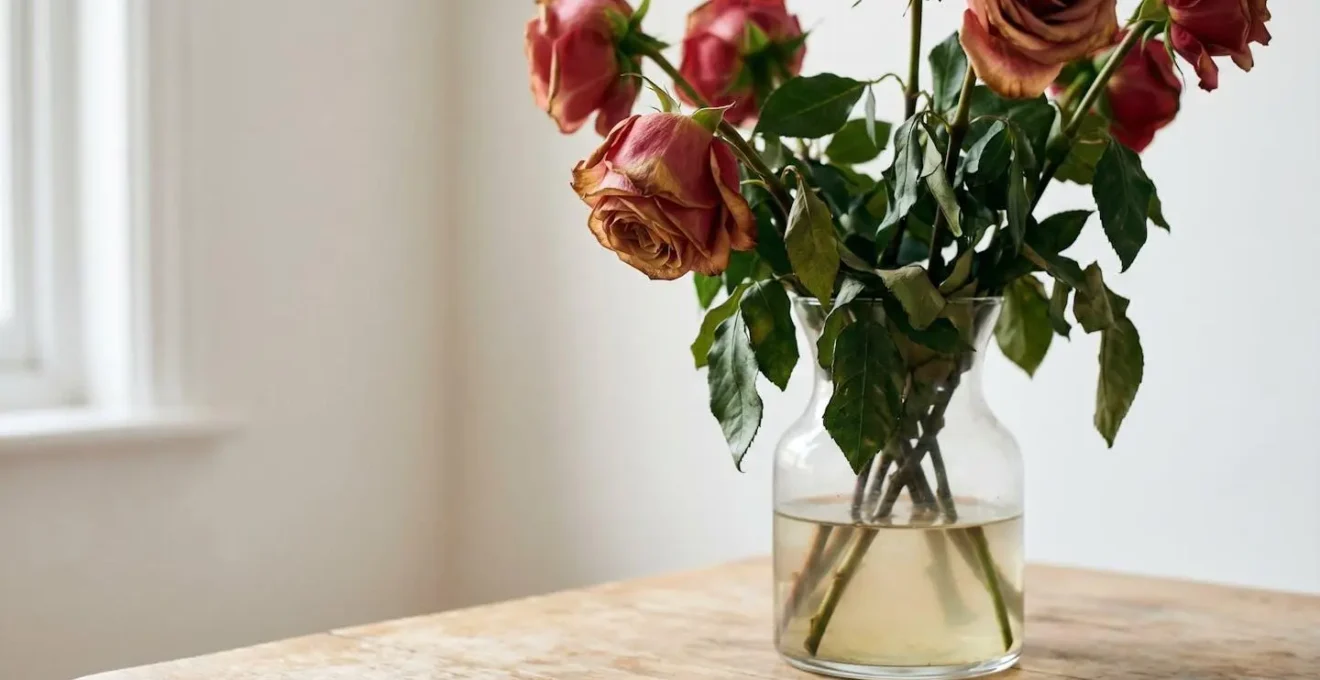
Contrary to popular belief, your premium flowers aren’t dying from bad luck; they’re losing a silent biochemical war being waged inside your home’s environment.
- Hard water chemistry, not just its presence, actively prevents flowers from drinking by raising the water’s pH and clogging their stems.
- Invisible ethylene gas from sources like fruit bowls and gas hobs acts as a plant-aging hormone, accelerating wilting dramatically.
Recommendation: Master the science of water acidity and ethylene control. This isn’t about general tips; it’s about precise, evidence-based interventions to disarm the threats and double your bouquet’s vase life.
The frustration is real and deeply familiar. You invest in a beautiful, premium £40 bouquet of roses, drawn in by the promise of at least a week, maybe even ten days, of vibrant colour. Yet, within four days, the heads begin to droop, the petals look tired, and the spectacle you paid for is over. It feels like a betrayal. The common advice—change the water, trim the stems—has been followed, yet the result is the same. This leads many to blame the florist or the quality of the flowers themselves.
But what if the problem isn’t the flowers, but the unseen environment of your home? What if your tap water, your fruit bowl, and even the air in your kitchen are launching a coordinated biochemical assault on your bouquet from the moment it arrives? The truth is, keeping cut flowers alive is less about generic care and more about understanding and counteracting a series of specific biological threats: nutrient starvation, bacterial warfare, and hormonal-induced aging.
This guide moves beyond the platitudes. We will delve into the science that governs a cut flower’s lifespan. We’ll explore why the mineral content of water in Southern England is a particular challenge, how a simple 45-degree cut can biologically extend hydration, and why the little sachet of flower food is a masterclass in plant science that homemade concoctions can’t replicate. By understanding the ‘why’ behind the wilting, you gain the power to stop it. You’re not just a flower owner; you are the manager of a delicate ecosystem, and these are the rules of engagement.
This article breaks down the science into actionable steps. The following sections will guide you through the critical factors that determine vase life, from water chemistry to the invisible gases in your home.
Contents: The Science of Making Your Bouquet Last
- Why Hard Water in Southern England Clogs Stems and Kills Flowers Faster?
- How a 45-Degree Cut Adds 3 Extra Days to Your Bouquet’s Lifespan?
- Flower Food Sachets or Homemade Mix: Which Actually Extends Vase Life?
- The Fruit Bowl Mistake That Wilts Your Tulips in 48 Hours
- How Often to Change Vase Water: The 48-Hour Rule Most People Ignore?
- Sprite, Bleach, and Vinegar Mixes: Do Homemade Flower Foods Actually Work?
- Fruit Bowls, Gas Hobs, and Ripe Tomatoes: The Hidden Ethylene Sources Killing Your Flowers?
- Why Does the Little Sachet Actually Add 5 Days to Your Flowers’ Life?
Why Hard Water in Southern England Clogs Stems and Kills Flowers Faster?
The first and most critical element for a cut flower is water, but not all water is created equal. If you live in Southern England or another hard water area, your tap water is actively working against your bouquet. Hard water is alkaline, meaning it has a high pH (typically above 7.0). This alkalinity is a major problem for cut flowers, whose water-conducting tissues, the xylem, are designed to absorb water most efficiently under acidic conditions.
Think of the xylem as tiny drinking straws. In alkaline water, these straws don’t function well. Furthermore, the high mineral content, particularly calcium, can physically precipitate and block these delicate vessels, a process akin to limescale in a kettle. This double-whammy of poor pH and physical blockage means your flowers are thirsty even when sitting in a full vase. They simply cannot drink fast enough to replace the moisture they lose through their petals, leading to rapid wilting.
The science is clear on this: research demonstrates that flowers held in acidic water (around pH 3) absorb up to 70% more water than those in neutral or alkaline water. This is why commercial flower food is so effective; a primary component is an acidifier that instantly corrects the water’s pH. A FloraLife study on roses in hard water found that simply softening the water wasn’t the answer, as it didn’t reduce the alkalinity. The most effective strategy was diluting the hard tap water with an equal part of deionized or distilled water before adding flower food. This simple dilution can be the difference between a four-day disappointment and a ten-day display.
How a 45-Degree Cut Adds 3 Extra Days to Your Bouquet’s Lifespan?
Once you’ve addressed the water quality, the next step is ensuring the flower can actually drink it. When a flower is out of water, even for a few minutes during transport, it can draw tiny air bubbles into its stems. This creates an air lock, or embolism, that blocks the xylem and prevents water uptake. Furthermore, the cut end of the stem begins to heal and seal itself, and bacteria start to colonize the surface. Simply placing it in a vase is not enough; you must re-cut the stem.
The angle of this cut is not an old wives’ tale; it is rooted in fluid dynamics. Cutting the stem at a sharp 45-degree angle significantly increases the surface area available for water absorption compared to a flat, 90-degree cut. More importantly, it prevents the stem from sitting flush against the bottom of the vase, which would effectively seal it off and block water flow entirely. This simple technique ensures the drinking straws remain wide open and have maximum contact with the water.
This action must be performed with a sharp, clean knife or floral shears, not with household scissors which can crush the delicate xylem vessels. Crushing the stem is as bad as not cutting it at all, as it damages the very structures needed for hydration. According to research, if more than 50% of the stem is blocked, either by an air bubble or physical damage, it can significantly harm the flower’s lifespan. A clean, angled cut is your primary weapon against this immediate threat.
Flower Food Sachets or Homemade Mix: Which Actually Extends Vase Life?
That small sachet that comes with your bouquet is the single most important factor in achieving the promised 10-day vase life. It is not a gimmick; it is a precisely formulated life-support system. To understand why it works so well, and why most homemade alternatives fail, you need to know what’s inside. Commercial flower food contains three essential components that wage a three-front war against flower decay.
These components are:
- Sugar (Carbohydrate): Once cut from the mother plant, the flower is severed from its energy source. The sugar in the sachet provides the essential nutrients it needs to continue to open its buds and maintain its cellular functions, preventing starvation.
- Acidifier: As we saw with hard water, flowers drink best in an acidic environment. The acidifier immediately lowers the water’s pH to an optimal level (around 3.5), maximising water uptake through the freshly cut stems.
- Biocide: This is the secret weapon. A biocide, a type of disinfectant like a very small, controlled amount of bleach, kills the bacteria that inevitably grow in vase water. This prevents the “bacterial soup” that clouds the water, smells unpleasant, and creates a biofilm that clogs the stems.
The results of using a properly formulated sachet are not subtle. A 2023 vase life study showed that FloraLife Flower Food increased the vase life of roses by a staggering 90% compared to plain water. Homemade recipes attempt to replicate this, but they lack the precise balance and can often do more harm than good by getting the dosage wrong.
The Fruit Bowl Mistake That Wilts Your Tulips in 48 Hours
After mastering the vase environment, you must turn your attention to the air itself. The most common and devastating mistake is placing your beautiful bouquet near a fruit bowl. It may look aesthetically pleasing, but you are exposing your flowers to their most potent invisible enemy: ethylene gas. As the Plants & Flowers Foundation Holland explains, “Ripening fruit releases ethylene gas, which causes flowers to ripen and wilt.”
Ethylene is a natural plant hormone that regulates the process of ripening and, ultimately, aging (senescence). Flowers are extremely sensitive to it. Even small concentrations in the air trigger a rapid aging cascade, causing them to drop their petals, lose colour, and die prematurely. A bouquet that should last a week can be ruined in two days by a bunch of ripening bananas next to it. Not all fruits are equal offenders, however. Knowing which produce emits the most ethylene is crucial for protecting your floral investment.
This table, based on data from plant physiology research, provides a clear guide to which fruits are the most dangerous to keep near your flowers. The data shows a clear hierarchy of risk, as highlighted in a comprehensive analysis of plant hormones.
| Ethylene Emission Level | Fruits & Produce | Safe Distance from Flowers |
|---|---|---|
| High Emitters (Avoid) | Apples, Bananas, Avocados, Tomatoes, Peaches | Keep in separate room |
| Moderate Emitters (Caution) | Melons, Pears, Plums, Mangoes | At least 3 meters away |
| Low Emitters (Safer) | Citrus fruits (Oranges, Lemons), Berries, Cherries, Grapes | 1-2 meters minimum |
How Often to Change Vase Water: The 48-Hour Rule Most People Ignore?
Even with the initial use of flower food, the vase is a battlefield. Any organic debris, such as leaves or pollen falling into the water, becomes food for bacteria. These bacteria multiply rapidly, creating a cloudy, smelly biofilm that clogs the flower stems and prevents water uptake. Ignoring the vase water is like allowing the enemy to regroup and build fortifications. Therefore, regular water changes are non-negotiable.
The widely accepted guideline among floral professionals is the 48-hour rule. You must change the water completely every two days. This isn’t just about topping it up; it’s about removing the old water, which is becoming a bacterial soup, and replacing it with a fresh solution. Crucially, each time you change the water, you should also add a new, correctly-dosed measure of flower food to replenish the nutrients and biocides.
This process should also include a quick re-trim of the stems. Removing another centimetre from the bottom at a 45-degree angle removes any new bacterial growth that may have started to clog the cut end. Furthermore, it’s best practice to quickly wash the vase with soap and water to remove any clinging biofilm before refilling. Authoritative sources confirm this frequency; according to University of Illinois Extension guidelines, you should “change the water in the vase every two to three days, or when it becomes cloudy.” By adhering strictly to this 48-hour refresh cycle, you continually reset the battlefield in your favour.
Sprite, Bleach, and Vinegar Mixes: Do Homemade Flower Foods Actually Work?
The internet is filled with DIY recipes for flower food, often involving common household items. The most popular of these, as noted by sources like MasterClass, suggests a mix of “three parts water, one part Sprite (for sugar), and a few drops of bleach to kill bacteria.” Others advocate for adding vinegar for acidity or even a copper penny. While these recipes are based on a kernel of scientific truth—flowers need sugar, acidity, and a biocide—they almost always fail in practice for one critical reason: incorrect dosage.
The formulation of commercial flower food is a precise science. The amount of sugar is balanced to provide energy without promoting excessive bacterial growth. The acidifier is potent enough to lower the pH of a standard volume of water to the optimal range. The biocide is strong enough to inhibit bacteria but not so strong that it becomes toxic to the flower itself. Achieving this balance with household measuring spoons and inconsistent products like Sprite (whose sugar content can vary) is nearly impossible.
The consequences of getting it wrong can be severe. Too much sugar can actually accelerate bacterial growth. Too much bleach can be phytotoxic, effectively poisoning the flower. Too little of any component renders the mixture ineffective. As FloraLife research warns that “too much flower food can decrease vase life, while too little can promote stem blockage decreasing vase life.” This “Goldilocks” principle is where DIY solutions fall short. You are far more likely to harm your flowers with a poorly mixed homemade concoction than you are to help them. Sticking to the professionally formulated, pre-measured sachet removes the guesswork and guarantees the correct, life-extending dosage every time.
Fruit Bowls, Gas Hobs, and Ripe Tomatoes: The Hidden Ethylene Sources Killing Your Flowers?
The fruit bowl is the most well-known source of ethylene gas, but it is far from the only one. To truly create a “safe zone” for your flowers, you must conduct an audit of your entire home for these hidden, hormone-releasing culprits. Ethylene-induced senescence is a powerful biological process, and understanding its mechanism reveals why vigilance is so important.
Case Study: The Ethylene “On Switch”
Researchers at the Salk Institute pinpointed the exact mechanism of ethylene’s action. They identified a central protein called EIN2. In the absence of ethylene, this protein is constantly being destroyed by the plant cell. However, when ethylene gas is present in the air, it stabilizes the EIN2 protein. This stabilized protein then sends a signal throughout the plant, effectively flipping a switch that puts its entire physiology on fast-forward, triggering ripening and aging. This explains why flowers in a kitchen with a gas hob, which can produce ethylene from incomplete combustion, experience accelerated wilting and petal drop, even if they are far from any fruit.
This “on switch” can be triggered by a surprising number of household sources. Any form of combustion or decomposition can release ethylene. Your vigilance needs to extend beyond the kitchen counter. Identifying and mitigating these sources is a crucial step in floral preservation.
Your 5-Point Home Ethylene Audit
- Map Your Sources: Systematically list all potential ethylene-emitting items in the rooms where you display flowers. This includes fruit bowls, vegetable racks (especially with tomatoes or potatoes), gas appliances, fireplaces, and ashtrays.
- Inventory High-Risk Items: Take a specific count of “high emitter” fruits like apples, bananas, and avocados currently in your home. Note their stage of ripeness, as riper fruit emits more gas.
- Check for Proximity: Compare the location of your flowers to your mapped sources. Are they in the same airspace? A bouquet in the living room can still be affected by a very ripe fruit bowl in an open-plan kitchen.
- Identify the “Silent Killers”: Look for less obvious sources. Are there any other houseplants with decaying leaves or flowers? Do you open windows that face a busy road with car exhaust? Is there a smoker in the household?
- Create an Action Plan: Based on your audit, implement changes. Move the fruit bowl to a separate, well-ventilated room. Ensure your gas hob has proper ventilation. Be meticulous about removing any wilting blooms from the bouquet itself, as they also release ethylene.
Key Takeaways
- The longevity of cut flowers is determined by a scientific battle against stem blockage, bacterial growth, and ethylene gas.
- Commercial flower food is a non-negotiable, three-part life support system (sugar, acidifier, biocide) that homemade mixes cannot reliably replicate.
- Your home environment, especially hard water chemistry (pH) and invisible ethylene sources (fruit, gas hobs), poses a greater threat than the quality of the flowers themselves.
Why Does the Little Sachet Actually Add 5 Days to Your Flowers’ Life?
We’ve established that the flower food sachet is superior to DIY mixes, but let’s circle back to its profound impact. Why can this small packet of powder so dramatically extend vase life? The answer lies in addressing the fundamental crisis a flower faces the moment it is cut: nutrient starvation. As FloraLife, a leader in post-harvest care, states, “Once cut from the plant, flowers have no source of nutrients, leading to starvation, wither, and premature death.”
The sachet is the emergency ration that prevents this. The sugar provides the raw energy for the flower to maintain its metabolic processes. Without this energy, it cannot sustain the turgor pressure that keeps its stems and leaves rigid, nor can it fuel the opening of its buds. But the sugar would be useless if the flower couldn’t drink it. This is where the other two components create the perfect delivery system. The acidifier corrects the water’s pH, opening up the xylem for maximum hydration, while the biocide keeps those same pathways clear of bacterial blockages.
It’s a perfectly synergistic system: the biocide clears the way for the acid-optimized water, which then effectively delivers the life-sustaining sugar. The impact of this system is massive and quantifiable. Tests at FloraLife testing facilities found that the vase life increases of using flower food versus plain water ranged from 19% to 123% across different rose varieties. For a £40 bouquet, achieving that upper range means getting more than double the life—turning a four-day disappointment into a 9 or 10-day spectacle. The sachet isn’t magic; it’s simply the precise application of plant science.
By moving beyond generic tips and applying these evidence-based principles, you can take control of your bouquet’s destiny. The power to achieve that 10-day vase life is not in the hands of the florist, but in your understanding of the science. Start implementing these strategies today to ensure your next floral investment pays the beautiful, long-lasting dividends you deserve.