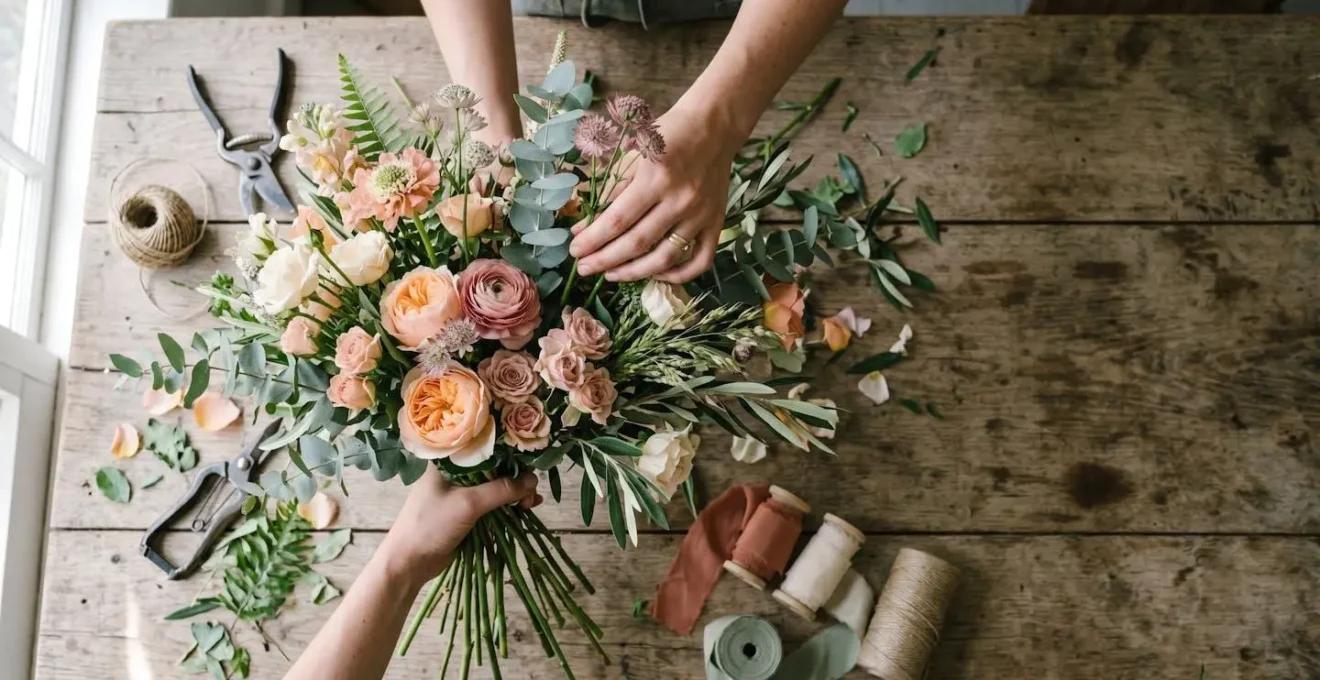
That ‘wild, just-gathered’ look in an artisan bouquet isn’t random; it’s a masterclass in hidden structure and classical design theory.
- Odd numbers of flowers (3, 5, 7) are used not for tradition, but because the brain perceives them as more dynamic and natural than static, even-numbered pairs.
- The hand-tied spiral technique is the invisible architecture that provides both a full, rounded silhouette and ensures every stem has room to drink, extending the bouquet’s life.
Recommendation: Stop trying to arrange flowers by chance and start thinking like a painter, applying deliberate principles of visual weight, colour weaving, and gestural lines to create intentional imbalance.
Have you ever stood before two bouquets and known, instinctively, that one is superior? One is a tight, predictable bundle of stems from a supermarket. The other, often from an artisan florist, seems to breathe. It’s loose, wild, and looks as if it were scooped from a meadow, yet it possesses a flawless sense of balance. As a design enthusiast, you appreciate this difference, but articulating *why* it works can be elusive. You might hear generic advice like “use a variety of flowers” or “add plenty of greenery,” but this fails to capture the artistry involved.
The truth, as we teach at our London academy, is that the coveted ‘unstructured’ look is anything but. It is a deliberate and masterful application of classical design principles, cleverly disguised as wild spontaneity. It’s the thoughtful use of mathematics, the sophisticated understanding of colour theory, and the structural engineering hidden within the hand. It is not an accident of nature; it is artifice at its most beautiful. This is the secret that separates the amateur from the artisan: knowing the rules so well that you can make it look like there are none.
In this guide, we will deconstruct the magic. We will move beyond the surface-level tips and delve into the core techniques and design philosophies that allow floral artists to achieve that perfect state of imbalance. From the psychology of odd numbers to the economics of a single £8 garden rose, you will learn to see bouquets not just as collections of flowers, but as carefully composed works of art.
Summary: Unlocking the Secrets of Artisan Floral Composition
- Why Florists Use 3, 5, or 7 Focal Blooms: The Psychology of Odd Numbers
- Hand-Tied Spiral or Parallel Build: Which Technique Creates a Fuller Silhouette?
- How to Add Drama to a Bouquet Using Foliage and Seedpods Instead of More Flowers
- The Colour-Block Mistake That Makes Expensive Bouquets Look Amateur
- Why Including Buds Alongside Open Blooms Extends Your Bouquet’s Display Life
- Why Pairing Garden Roses With Eucalyptus Creates the Perfect English Garden Look
- Which 5 Old-Fashioned Flowers Instantly Create a 1920s English Garden Feeling
- Why Do Garden Roses Cost £8 per Stem When Standard Roses Cost £1?
Why Florists Use 3, 5, or 7 Focal Blooms: The Psychology of Odd Numbers
The first principle in escaping rigid symmetry is the embrace of odd numbers. An artisan florist will almost never use two, four, or six dominant flowers. Instead, you’ll find groupings of three, five, or seven. This isn’t just an old tradition; it’s a subtle manipulation of human psychology. Our brains are wired to find patterns. When we see an even number of items, we instinctively pair them up, creating a sense of static, predictable order. The composition feels closed and less engaging.
Odd numbers, however, resist this easy pairing. The eye is forced to move around the composition, creating a sense of visual tension and dynamism. One element is always left ‘unpartnered,’ which encourages the viewer’s gaze to travel and explore the arrangement. This creates the illusion of naturalness, as perfect symmetry is rarely found in nature. As one professional floral designer puts it, this principle is rooted in how our brains process information.
The human eye finds odd-numbered groupings more natural and dynamic than even numbers. The brain processes odd numbers as groups + individual, creating visual interest. Even numbers are perceived as static pairs.
– Professional Floral Designer, Reema Florist Nashville – Mathematical Principles in Floral Design
By using an odd number of focal blooms—say, three large peonies or five garden roses—the florist establishes a foundational asymmetry. This simple mathematical choice is the first and most crucial step in building a bouquet that feels alive, balanced, and intentionally unstructured.
Hand-Tied Spiral or Parallel Build: Which Technique Creates a Fuller Silhouette?
If you’ve ever tried to create a loose bouquet and ended up with a stiff, upright bundle or a floppy mess, the issue likely lies in your technique. A parallel build, where stems are held vertically, creates a dense, columnar shape. For the airy, domed silhouette of an artisan bouquet, the hand-tied spiral technique is non-negotiable. This is the hidden architecture that provides stability and volume, allowing the flowers to fan out naturally.
The technique involves adding each new stem at a consistent, slight angle across the previous one, gradually rotating the bouquet in your hand. This creates a spiral at the binding point, which acts as a self-supporting vortex. The stems are not crushed together; instead, they have space, which allows the flower heads to sit at different heights and face different directions, creating that coveted ‘just-gathered’ fullness. This method is the fundamental difference between a bunch and a bouquet.
Beyond the aesthetic fullness, this structural choice has a crucial practical benefit, as it directly impacts the bouquet’s health and longevity. It is the secret to a display that not only looks good but lasts.
The Spiral Technique’s Hidden Benefit for Vase Life
As a professional florist from Fiore Designs explains, the spiral build is more than just an aesthetic trick. The interlocking stems create a ‘lock’ at the binding point, which holds the bouquet’s shape even when you put it down. Crucially, this structure ensures that when placed in a vase, every single stem has an unobstructed path to water. In a parallel bunch, stems can be squeezed together, blocking their ability to hydrate. The spiral gives flowers the room they need to open naturally and drink efficiently, making the entire arrangement last longer.
How to Add Drama to a Bouquet Using Foliage and Seedpods Instead of More Flowers
A common misconception is that a luxurious bouquet is defined by the sheer number of expensive flowers it contains. In truth, artisan florists know that drama, texture, and movement often come from what lies *between* the blooms. Foliage, grasses, and seedpods are not mere ‘fillers’; they are essential design elements that can create more impact than another rose or peony. They provide the supporting cast that makes the star flowers shine even brighter.
Instead of just adding generic greenery, an artist thinks about the ‘gesture’ of a branch. A long, arching piece of eucalyptus or a delicate fern frond acts like a brushstroke, guiding the viewer’s eye through the arrangement and creating a sense of line and movement. Dark, glossy leaves, like Fatsia, can be used to create areas of deep shadow, a technique akin to the ‘chiaroscuro’ in painting. This contrast makes the lighter, brighter flowers pop with incredible vibrancy. It’s about using foliage to paint with light and shadow, not just to plug gaps.
Furthermore, incorporating varied textures like the fuzzy pods of Scabiosa, the spiky globe of an Eryngium (sea holly), or the delicate rattle of a dried Briza grass adds a tactile dimension that elevates the entire composition from purely visual to multi-sensory.
Your Action Plan: Auditing Foliage for Dramatic Effect
- Points of contact: List all the elements you have. Are there just flowers, or do you have foliage, branches, or seedpods?
- Collecte: Inventory your foliage. Identify their ‘gesture’—are they arching, upright, or trailing? (e.g., arching eucalyptus, vertical grasses).
- Coherence: Does the foliage support the bouquet’s theme? (e.g., silvery eucalyptus for a cool palette, dark Fatsia for dramatic contrast).
- Mémorabilité/émotion: Assess the textures. Do you have a mix of matte, glossy, spiky, and soft elements to create interest?
- Plan d’intégration: Intentionally place foliage to create lines of movement and areas of shadow, rather than just filling empty space.
The Colour-Block Mistake That Makes Expensive Bouquets Look Amateur
One of the most telling signs of an amateur arrangement is ‘colour-blocking’—grouping all the pink flowers in one spot, all the white in another. While this may seem organised, it creates a static, heavy-handed look that lacks sophistication. Professional florists practice what can be described as ‘colour weaving’. This involves distributing colours throughout the bouquet in a way that feels rhythmic and natural, creating harmony and encouraging the eye to dance across the entire piece.
Imagine threading colours through a tapestry. A touch of pale blue from a delphinium here, echoed by a tiny forget-me-not there. A pop of coral from a ranunculus on one side is balanced by a softer peach tone from a garden rose on the other. This technique creates a cohesive whole that feels more like a painterly composition than a simple collection of flowers. It requires a deeper understanding of colour theory, specifically the concept of visual weight.
Not all colours are perceived equally. Hot, vibrant colours have more visual weight than cool, pale ones. An expert florist knows this and uses it to achieve balance.
A small amount of a ‘hot’ colour like red has more visual weight than a large area of a ‘cool’ colour like pale blue. Artisans balance weight, not just hue.
– Professional Floral Design Studio, Reema Florist – Color Weight and Temperature in Floral Design
By balancing visual weight rather than just symmetry of colour, the florist creates a composition that feels both dynamic and perfectly poised—the hallmark of an unstructured yet balanced bouquet.
Why Including Buds Alongside Open Blooms Extends Your Bouquet’s Display Life
A bouquet that contains a mix of fully open flowers, semi-open blooms, and tightly closed buds is not a sign that the florist is trying to save money with unripe stems. On the contrary, it is a sign of a highly sophisticated design philosophy: designing with the fourth dimension, time. This technique transforms the bouquet from a static object into a dynamic, living installation that evolves day by day.
When you receive a bouquet like this, you are not just getting a single composition; you are getting a narrative. On the first day, the fully open blooms are the stars. By day three, as some of the initial flowers begin to fade, the semi-open buds start to unfurl, revealing their beauty and creating a new focal point. By day five, the tightest buds may open, offering a final, beautiful surprise. This creates a continuous, engaging experience for the owner, inviting them to observe and appreciate the life cycle of the flowers.
The Fourth Dimension in Floral Design: Time as a Design Element
According to expert florists featured by Homes & Gardens, the inclusion of buds is a core artistic choice. The bouquet becomes a performance that unfolds over a week. There is a sense of narrative tension and anticipation as you watch the buds swell and begin to show colour. Each morning offers a slightly different arrangement as the bouquet lives and breathes in your home. This approach elevates the bouquet from a simple decoration to an interactive experience, connecting the owner more deeply to the natural process.
This method not only extends the practical display life of the arrangement, but it also imbues it with a sense of poetry and movement that a bouquet of uniformly open flowers can never achieve.
Why Pairing Garden Roses With Eucalyptus Creates the Perfect English Garden Look
The combination of blowsy, romantic garden roses and the silvery-green foliage of eucalyptus has become synonymous with the modern English garden aesthetic, and for good reason. This pairing is a masterclass in contrasting textures, colours, and forms that complement each other perfectly. It’s a combination that speaks of relaxed elegance, a core tenet of the unstructured style.
Garden roses, especially heirloom varieties or those bred by David Austin, are known for their high petal count, cupped or rosette shapes, and complex fragrances. They are soft, velvety, and romantic. Eucalyptus, by contrast, offers a matte, often slightly dusty finish. This textural opposition is where the magic happens. The flat, non-reflective surface of the eucalyptus leaves makes the rich, saturated colours of the rose petals appear even more lush and velvety by comparison.
The silvery-blue, matte finish of eucalyptus leaves makes the soft, velvety colours of the rose appear richer and more saturated by comparison. The eucalyptus reflects light differently, creating a shimmering backdrop.
– Design Theory in Floral Composition
Furthermore, the structure of the two plants works in harmony. The soft, often nodding heads of the garden roses provide the romantic focal points, while the more rigid, architectural branches of the eucalyptus provide the framework and ‘gestural lines’ that create the bouquet’s loose, airy shape. It’s a partnership where each element enhances the other’s best qualities.
Which 5 Old-Fashioned Flowers Instantly Create a 1920s English Garden Feeling
To evoke the specific romance of a bygone era, like a 1920s English country garden, a florist relies on a carefully curated botanical vocabulary. The style popularized by legendary garden designer Gertrude Jekyll was not about rigid formality but about painterly ‘drifts’ of colour and texture. To capture this feeling in a bouquet, an artisan florist will turn to a specific cast of old-fashioned, characterful flowers.
The key is selecting blooms that carry the right nostalgic connotations in both form and fragrance. Modern, tightly-budded hybrid tea roses will not do; the effect relies on the charm of heirloom varieties. The five essential players for this aesthetic are:
- Garden Roses: Specifically heirloom or David Austin types, with their high petal count, strong ‘old rose’ scent, and soft, cupped shapes.
- Delphiniums: Their tall, elegant spires provide verticality and a source of true blue, a colour central to Jekyll’s garden philosophy.
- Sweet Peas: The ultimate flower for nostalgia, offering an ethereal, unforgettable scent and a delicate, climbing form.
- Scabiosa: Known as ‘pincushion flowers,’ they add a whimsical, airy texture and a sense of movement.
- Authentic Foliage: The supporting cast is just as important. Sprays of Lady’s Mantle (Alchemilla mollis), delicate Love-in-a-Mist (Nigella), and fragrant jasmine are essential for period authenticity.
This selection is about more than just picking ‘old’ flowers; it’s about understanding the artistic philosophy of the era. As historic experts note, Jekyll’s work was deeply intentional.
Gertrude Jekyll championed ‘drifts’ of colour and texture. The chosen flowers weren’t just from the period; they were central to her philosophy of a romantic, painterly garden. Large herbaceous beds with drifts of flowering plants moving from cold whites and blues to warm oranges and reds and back again.
– Gertrude Jekyll, Historic England – Gertrude Jekyll’s Garden Design Philosophy
Key Takeaways
- The ‘Maths of Beauty’: The unstructured look begins with a conscious rejection of symmetry, using odd numbers of focal blooms to create dynamic, natural-looking compositions.
- The Hidden Architecture: The hand-tied spiral technique is the invisible engineering that provides both a full, airy silhouette and structural integrity, allowing every flower to thrive.
- The Value of Artistry: The price of premium flowers like garden roses reflects the complex economics of breeding, intellectual property, and the high-maintenance ‘diva factor’ required to produce their unique beauty.
Why Do Garden Roses Cost £8 per Stem When Standard Roses Cost £1?
Finally, we must address the elephant in the room: the price. When you see a garden rose priced at £8 a stem while a standard rose is £1, it’s easy to assume it’s simply a luxury markup. However, the price difference reflects a complex reality of art, science, and economics. You are paying for much more than just a flower; you are paying for intellectual property, a high-maintenance ‘diva’, and the artistry of a breeder.
Many of the most desirable garden roses, like the famous David Austin varieties, are patented breeds. This means the price of each stem includes a royalty fee paid back to the breeder, much like licensing software. This fee funds years, sometimes decades, of research and development required to create a rose with the perfect fragrance, colour, and high petal count. But the cost goes far beyond patents.
The Economics of the ‘Diva’ Rose
As The Bouqs Co. explains in their analysis, standard roses are workhorses bred for one purpose: to be tough, uniform, and easy to ship long distances. Garden roses are the opposite; they are divas. They typically have a lower yield per plant, are more susceptible to disease, have more fragile petals, and require intensive manual harvesting. Their soft, nodding stems make them difficult to pack and transport, leading to higher spoilage rates and specialised handling costs. They are, by nature, a less efficient and more costly product to bring to market.
Ultimately, the price reflects the value placed on the unique characteristics that make these flowers special. You are paying for a multi-sensory experience that a standard rose cannot provide.
You’re paying for the ‘art’ of the hybridizer. The price reflects the complex fragrance, high petal count, and unique shapes that make artisan bouquets special. It’s a feature, not just a flower.
– Luxury Floral Market Analysis
Now that you can deconstruct the art and science behind the perfect unstructured bouquet, the next step is to put this knowledge into practice. Approach your next floral purchase or arrangement not just as a consumer, but as an informed connoisseur. Look for the spiral, count the focal blooms, and appreciate the masterful weave of colour and texture. Begin to apply these rules of ‘perfect imbalance’ to your own creative endeavours.