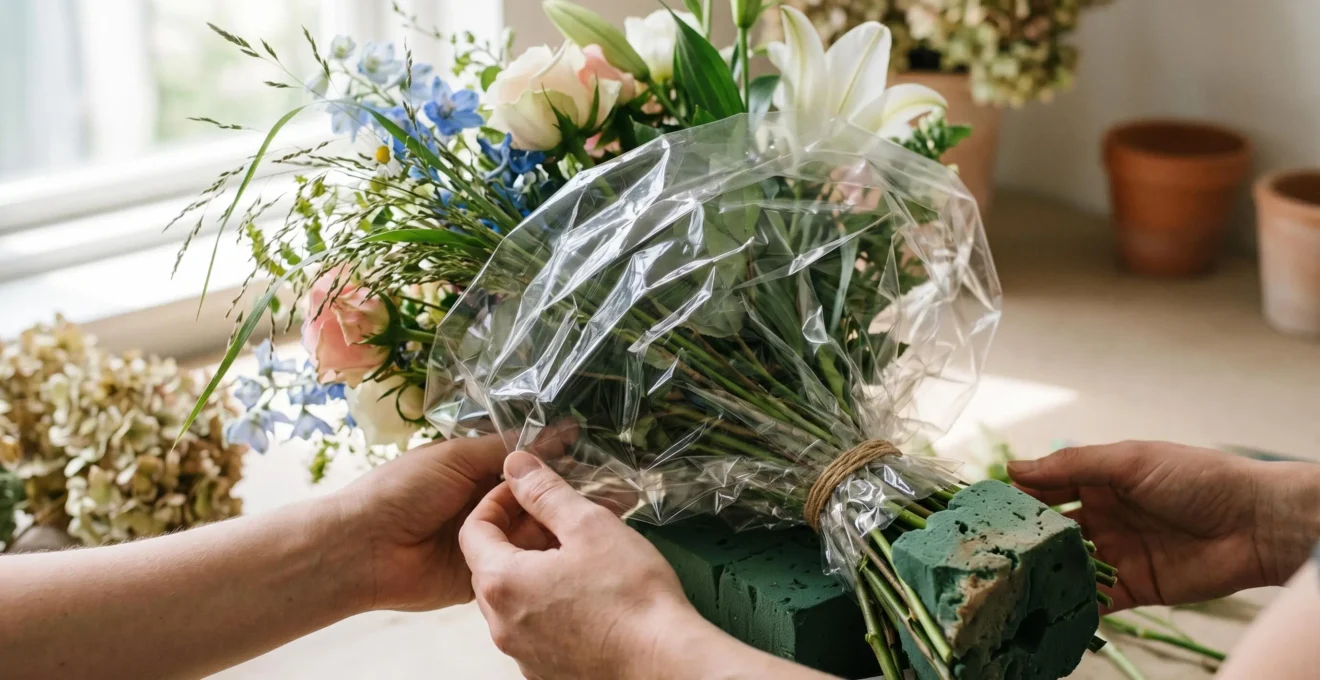
The “eco-friendly” label on flowers often hides a complex reality; true sustainability lies in understanding the system, not just the marketing.
- An air-freighted Kenyan rose can have a lower carbon footprint than a locally grown Dutch flower from a heated greenhouse due to the “carbon paradox”.
- Many letterbox flower services, despite their “fresh” image, contribute significantly to plastic waste through hidden packaging.
Recommendation: Shift your focus from simple rules like “buy local” to asking critical questions about growing methods, transport, and packaging to identify genuinely sustainable British growers.
You’ve made a conscious choice. You’ve bought a bouquet labelled “eco-friendly” or “sustainably sourced.” Yet, when you unwrap it, you find a block of green, crumbly foam, cellophane wrap, and blooms that have travelled thousands of miles. It’s a frustratingly common experience for the environmentally-aware consumer in the UK. You’re trying to do the right thing, but the floral industry is rife with greenwashing, making it nearly impossible to distinguish a truly green choice from a clever marketing tactic.
The common advice is to “buy local” and “avoid foam,” but this is an oversimplification. These rules of thumb fail to capture the nuances of global supply chains and horticultural science. What if a flower flown from Kenya could, paradoxically, be a greener choice than one grown in a neighbouring country? What if the convenient online flower box delivered to your door generates more plastic waste than a traditional florist’s bouquet? The truth is, the environmental impact of flowers is a complex web of carbon, water usage, waste, and ethics.
But what if the key wasn’t about following simplistic rules, but about understanding the hidden systems at play? This guide is designed to empower you with that knowledge. We won’t just tell you what to avoid; we will delve into the science and logistics behind the blooms. We’ll investigate the carbon paradox, dissect the packaging problem, and equip you with the tools to find genuinely sustainable flowers grown here in the UK.
This article provides a roadmap to navigate the complexities of the floral industry. By exploring the practical alternatives, hidden impacts, and true cost of beauty, you’ll be able to make choices that are not only beautiful but genuinely better for the planet.
Contents: Decoding the Sustainable Bouquet
- Chicken Wire, Kenzan, or Moss: Which Foam-Free Mechanic Works Best for Beginners?
- Why Kenyan Roses Can Be Greener Than Dutch Greenhouse Flowers: The Carbon Paradox?
- Where to Find British Flower Farms That Deliver Directly to Consumers?
- Why Online Flower Boxes Generate 500g of Plastic Waste: The Hidden Packaging Problem?
- How to Compost Roses, Lilies, and Chrysanthemums Without Contaminating Your Heap?
- Why Kenyan Roses Have a Lower Carbon Footprint Than Dutch Greenhouse Tulips?
- Sprite, Bleach, and Vinegar Mixes: Do Homemade Flower Foods Actually Work?
- Why Are British-Grown Summer Flowers Cheaper and Longer-Lasting Than Imports?
Chicken Wire, Kenzan, or Moss: Which Foam-Free Mechanic Works Best for Beginners?
The first step in breaking free from unsustainable floristry is to ditch the floral foam. This single-use plastic, made from phenol and formaldehyde, crumbles into microplastics, pollutes our waterways, and is non-biodegradable. But what do you use instead? The answer lies in reviving age-old techniques known as floral mechanics. For beginners, the choice can seem daunting, but each method excels at a different task.
For large, expressive arrangements in an opaque vase, a crumpled ball of chicken wire is your best friend. It’s reusable for years, recyclable, and incredibly forgiving, allowing you to reposition stems easily. For a more precise, minimalist aesthetic, especially in shallow dishes, the kenzan or pin frog is an indispensable tool. This heavy, pin-cushion-like device, central to the Japanese art of Ikebana, holds stems firmly in place and is a permanent, beautiful object in its own right. Finally, for a rustic, naturalistic base, a combination of locally foraged moss and twigs is both effective and fully compostable.
As the image shows, the kenzan allows for deliberate and architectural placement, turning the mechanics into part of the art. Choosing the right mechanic depends entirely on your desired style, your vessel, and your budget. Understanding these options is the foundational skill for creating arrangements that are both beautiful and genuinely foam-free.
To help you choose the right tool for your next project, this table breaks down the pros and cons of each beginner-friendly mechanic.
| Mechanic | Best For (Arrangement Type) | Initial Cost | Reusability | Maintenance Effort | End-of-Life | Beginner-Friendly |
|---|---|---|---|---|---|---|
| Chicken Wire | Large, wild arrangements in opaque vases; loose, organic styles | Low ($5-15) | High (reusable for years) | Medium (requires reshaping, rust prevention) | Recyclable metal | High (forgiving, flexible) |
| Kenzan (Flower Frog) | Minimalist, precise ikebana-style designs in shallow bowls; architectural arrangements | High ($20-60) | Infinite (lasts decades) | Low (simple cleaning) | Permanent tool | Medium (requires precise stem placement) |
| Moss/Twigs | Naturalistic bases in compotes; woodland-themed centerpieces; textured, seasonal designs | Very Low ($0-10, foraged/purchased) | Single-use (moss) / Medium (twigs) | Low (minimal prep) | Fully compostable | Very High (intuitive, forgiving) |
Why Kenyan Roses Can Be Greener Than Dutch Greenhouse Flowers: The Carbon Paradox?
The advice to “buy local” seems like environmental common sense, but in the global flower industry, the truth is often counter-intuitive. This is perfectly illustrated by the “carbon paradox”: the surprising fact that a rose grown thousands of miles away in Kenya and air-freighted to the UK can have a smaller carbon footprint than a rose grown much closer in a Dutch greenhouse. This challenges our entire perception of what “local” and “sustainable” mean.
The key factor is energy. Kenyan flower farms benefit from a consistent equatorial climate, with abundant natural sunlight and warmth year-round. This means roses can be grown outdoors or in simple polytunnels with minimal energy input for heating or lighting. In contrast, the Netherlands’ cooler, darker climate necessitates vast, energy-intensive greenhouses. The result is a staggering difference in emissions. A Cranfield University study revealed that, before transportation, producing 12,000 rose stems in Kenya resulted in 2,200kg of CO₂ emissions, whereas the equivalent in the Netherlands yielded 36,000kg CO₂ — a sixteen-fold increase.
Even after accounting for air freight, the Kenyan roses often come out on top. A comprehensive study on Fairtrade roses found that air-freighted Kenyan stems produced 2.9 times lower greenhouse gas emissions than Dutch ones. The advantages extend beyond carbon: the same study found Kenyan roses used 65% less water and had a significantly lower impact on local ecosystems. Of course, this doesn’t mean all imported flowers are superior. It highlights that true sustainability requires a deeper look into the system footprint—evaluating the entire life cycle, from water and energy use at the farm to transport and social conditions, rather than relying on the single, often misleading metric of “food miles”.
Where to Find British Flower Farms That Deliver Directly to Consumers?
After navigating the complexities of the carbon paradox, the appeal of genuinely local, seasonal British flowers is clearer than ever. When grown outdoors in their natural season, British flowers boast a tiny fraction of the carbon footprint of heated-greenhouse or air-freighted imports. But the question for many UK consumers is: where do you find them? They are rarely found in supermarkets, which rely on the year-round consistency of global industrial suppliers.
The answer lies in connecting directly with the growers. The UK is home to a vibrant and growing network of small-scale flower farmers dedicated to sustainable, seasonal floristry. The most powerful resource for consumers is Flowers from the Farm, a non-profit association with a searchable directory of hundreds of grower-members across the country. Their website allows you to enter your postcode and find local farms offering everything from bouquet subscriptions and DIY flower buckets to wedding florals. This direct connection guarantees freshness, supports the local economy, and ensures complete supply chain transparency.
Beyond dedicated directories, finding local growers requires a bit of detective work. Farmers’ markets are a fantastic starting point, allowing you to speak directly with the people who grew the flowers. Don’t be afraid to ask your local florist clarifying questions: “Are these British-grown?” or “Do you source from local farms during the summer?” A truly sustainable florist will be proud to share the provenance of their blooms. By actively seeking out these connections, you not only get beautiful, long-lasting flowers but also become a vital part of a more sustainable floral future in the UK.
Your Action Plan: Finding Genuine British Flowers
- Use targeted search keywords in your region: ‘CSA for flowers’, ‘flower subscription box [your city]’, ‘u-pick flowers near me’, or ‘British grown flowers’.
- Explore dedicated British grower directories like Flowers from the Farm, the Flower Grower Collective, and the Grown In England network.
- Visit farmers’ markets and ask: ‘Which farm grew these?’, ‘How far did they travel?’, and ‘Are they seasonal or from heated greenhouses?’.
- Verify ‘local’ claims with florists using this script: ‘I’m trying to support local growers—are these from a nearby farm or the wholesale auction?’.
- Join online communities by searching for ‘[your region] local flowers’ groups on social media to discover hidden growers and pop-up sales.
Why Online Flower Boxes Generate 500g of Plastic Waste: The Hidden Packaging Problem?
The rise of online, letterbox flower delivery services has been a revolution in convenience. Marketed with images of dewy, farm-fresh blooms, they promise a direct connection to nature. However, this modern convenience comes with a significant and often overlooked environmental cost: plastic packaging. An investigation into a typical online flower box reveals a surprising amount of single-use plastic, often totalling over 500g per delivery, much of which is non-recyclable.
The scale of this issue is enormous. Globally, the fresh flower industry produces an estimated 100,000 tons of plastic waste each year, and the direct-to-consumer model contributes heavily. The problem is a matter of function. To survive a journey through the postal system, each stem must be protected and hydrated. This leads to a checklist of plastics: non-recyclable cellophane wrap to maintain humidity, individual plastic water vials for each stem, polymer-based hydration gel packs, foil-and-plastic flower food sachets, and polyester ribbons for presentation. Each element, designed for a single use, adds up.
This creates a classic case of greenwashing. A company can claim its flowers are from “sustainable farms” while ignoring the mountain of waste generated by its delivery model. The beautiful, compostable flowers arrive in a package that will contribute to plastic pollution for centuries. This is a critical greenwashing red flag for consumers. When choosing a flower delivery service, it’s vital to look beyond the marketing slogans and scrutinise the packaging. A truly sustainable company will be transparent about its packaging materials and actively use compostable or easily recyclable alternatives, such as glassine paper, reusable-by-return containers, or natural raffia ties.
The breakdown of waste in a typical box is revealing:
- Non-recyclable soft plastic wrap (cellophane): ~150-200g
- Single-use plastic water vials: ~80-120g
- Non-compostable gel/foam hydration packs: ~100-150g
- Plastic flower food sachet: ~20-30g
- Plastic ribbons and ties: ~50-80g
How to Compost Roses, Lilies, and Chrysanthemums Without Contaminating Your Heap?
Composting your wilted bouquet seems like the perfect final act of sustainability, returning organic matter to the earth. However, for many commercially grown flowers, especially imported roses, lilies, and chrysanthemums, this can be a problematic step. These flowers are among the most heavily treated in the industry, often sprayed with a cocktail of fungicides, insecticides, and preservatives to withstand long-distance travel and maintain their “perfect” appearance. When you add these flowers to your home compost heap, you risk introducing these synthetic chemicals into your soil.
The core of the problem lies in the difference between industrial and home composting. As the Sustainable Floristry Network points out, the process used to break down these chemicals is heat-dependent.
hot composting can break down many chemicals, but the average home cold compost pile cannot
– Sustainable Floristry Network, Floral foam disposal and composting guidelines
Most home compost bins operate on a “cold composting” system, which rarely reaches the high temperatures (55-65°C) needed to neutralise persistent pesticides. Consequently, these chemical residues can linger in your finished compost, potentially harming beneficial soil organisms or being absorbed by vegetables you later grow in that soil. It’s a bitter irony: in trying to be green, you could inadvertently contaminate your own garden.
So, what’s the solution? The safest approach is to only compost flowers that you know are grown without synthetic chemicals. This is another powerful argument for buying from local, organic, or low-intervention British growers who can tell you exactly how their flowers were raised. If you receive a bouquet of unknown origin, especially one containing the “big three” (roses, lilies, chrysanthemums), the most responsible, albeit disheartening, choice is to dispose of them in your general waste bin rather than your compost. It’s a clear demonstration of how decisions made far up the supply chain have a direct impact on our actions at home.
Why Kenyan Roses Have a Lower Carbon Footprint Than Dutch Greenhouse Tulips?
To fully grasp the carbon paradox, we must look closely at the single biggest factor in the flower industry’s carbon footprint: energy. The reason a Kenyan rose can be “greener” than a Dutch tulip is that the energy source for the former is the sun, while for the latter, it is often fossil fuels. Growing flowers out of their natural season or in an inhospitable climate requires a massive, sustained energy input to simulate the perfect growing conditions.
Dutch horticulture is a technological marvel, but this efficiency comes at a high energy cost. The Netherlands’ agricultural sector is dominated by its vast greenhouse operations, which require constant heating and, crucially, artificial lighting to compensate for the short, dark days of Northern European winters. This reliance on artificial conditions is profoundly energy-intensive. In fact, research shows that around 79% of the energy consumed by Dutch agriculture is attributed to the operation of greenhouses. This energy is predominantly generated from natural gas, directly linking the production of a seemingly innocent flower to the burning of fossil fuels.
The image above captures this reality perfectly: an industrial-scale operation where nature is replicated through an energy-hungry infrastructure of steel, glass, and electricity. While there is a growing movement towards using renewable energy sources for these greenhouses, the transition is slow and costly. In contrast, a flower farm in Kenya utilises the free and abundant solar energy of its equatorial location. This fundamental difference in the energy source is the engine of the carbon paradox. It forces us to ask a more sophisticated question: not “how far did it travel?” but “what energy was used to grow it?“
Sprite, Bleach, and Vinegar Mixes: Do Homemade Flower Foods Actually Work?
You’ve sourced the perfect sustainable bouquet, arranged it using foam-free mechanics, and now you want to make it last. The little plastic sachet of flower food is out, for reasons of waste. So, you turn to the internet, which offers a bewildering array of homespun recipes involving everything from lemonade and coins to bleach and vinegar. But do any of these DIY flower foods actually work, or are they just old wives’ tales?
To understand the answer, we first need to know what commercial flower food does. It’s not magic, but a simple, effective formula. As floristry experts explain, it serves three distinct purposes.
Commercial flower food has three key functions: a carbohydrate (sugar for energy), a biocide (to kill bacteria in the water), and an acidifier (to improve water uptake)
– Sustainable Floristry Researchers, Flower preservation science explainer
This three-part formula is the key to longevity. Sugar provides energy for the bloom to continue developing, but sugar also feeds bacteria. The biocide (like bleach) is crucial for keeping the water clean and the flower’s “veins” (xylem) from getting clogged. The acidifier (like citric acid or even lemon juice) lowers the water’s pH, making it easier for the stem to absorb. Many homemade recipes fail because they only address one component—for example, just adding sugar feeds bacteria and makes the water cloudy and smelly within a day. A recipe using a fizzy drink like Sprite or 7-Up can be moderately effective because it contains both sugar (the carbohydrate) and citric acid (the acidifier), but it often lacks a sufficient biocide.
The best way to find out what works is to conduct your own experiment. It’s a simple, fun way to see the science in action and determine the best method for the flowers you love and the water in your area. This simple test will give you definitive proof of what works best in your home.
Your Action Plan: Test Your Own Flower Food
- Preparation: Get 12 identical flower stems (like carnations). Prepare four identical, clean vases.
- Vase 1 (Control): Fill with 500ml of plain tap water. Add 3 stems.
- Vase 2 (Commercial): Dissolve 1 packet of commercial flower food in 500ml of water. Add 3 stems.
- Vase 3 (Bleach/Sugar Mix): Mix 500ml water + 1 tsp sugar + 3-4 drops of household bleach. Add 3 stems.
- Vase 4 (Eco-Friendly Mix): Combine 500ml water + 1 tsp sugar + 1 tsp lemon juice + 2 drops of thyme essential oil. Add 3 stems.
- Observation: Record water clarity, petal condition, and stem firmness daily for a week. The results will speak for themselves!
Key takeaways
- True sustainability in floristry requires looking beyond simple labels and understanding the entire system of carbon, water, and waste.
- The “carbon paradox” shows that energy source is more important than distance; a sun-grown Kenyan rose can have a lower footprint than a heated Dutch greenhouse flower.
- Connecting with local, seasonal British growers via networks like Flowers from the Farm is the most effective way to ensure low-carbon, fresh, and transparently-sourced flowers.
Why Are British-Grown Summer Flowers Cheaper and Longer-Lasting Than Imports?
When all the conditions are right, choosing British-grown flowers isn’t a compromise—it’s an upgrade. During their natural growing season, typically from April to October, flowers from a local UK farm are often demonstrably superior to their imported counterparts in cost, longevity, and of course, environmental impact. This trifecta of benefits makes a powerful case for embracing seasonality.
The most dramatic advantage is the reduced carbon footprint. A landmark study from Lancaster University provided clear data: it showed that a locally grown British bouquet had a carbon footprint of just 1.71kg CO₂, compared to over 31kg CO₂ for an equivalent imported bouquet. That’s a reduction of over 90%. This is achieved by eliminating air freight and the energy-intensive heating and lighting required for out-of-season production.
The cost savings are a direct result of a simplified supply chain. An imported flower passes through multiple hands: the grower, an exporter, a cargo airline, an importer, the auction house, a wholesaler, and finally the florist. Each step adds a margin. A locally grown flower often goes from the farm, to a van, to your vase. This disintermediation means a larger portion of your money goes to the grower, yet the final price can be lower. Finally, longevity is a gift of freshness. A flower from a local farm may have been cut just the day before you buy it. An imported flower has endured a long, cold, and dark journey, often lasting a week or more, which depletes its energy reserves. The local bloom, having suffered less transit stress, will last significantly longer in the vase, offering better value and prolonged enjoyment.
Now that you are equipped with the knowledge to see past the greenwashing, the next step is to put it into action. Start by asking questions, seeking out your local growers, and experimenting with foam-free techniques. By making these informed choices, you are not just buying flowers; you are casting a vote for a more beautiful, transparent, and genuinely sustainable floral industry.