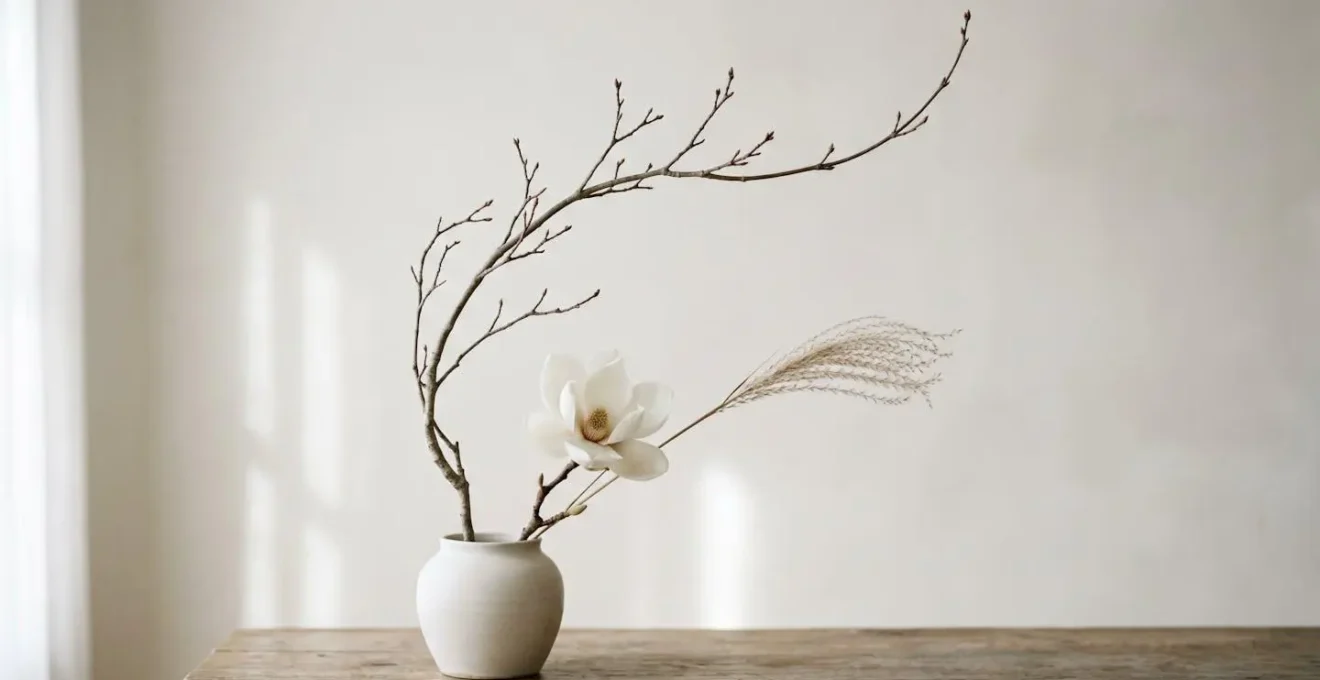
You’ve seen it at a design fair, in a high-end hotel lobby, or on a contemporary florist’s feed: a stark, sculptural arrangement featuring just a handful of stems in a beautifully crafted vessel. Then you see the price tag and feel a sense of dissonance. Are you being asked to pay more for less? This confusion is understandable, born from a culture where value is often equated with abundance—a bursting, bountiful bouquet overflowing with colour and life. The conventional wisdom suggests that more flowers should equal more value.
But what if that framework is the wrong tool for measurement? What if the premium isn’t an arbitrary markup for a “trend,” but a reflection of a completely different set of values rooted in fine art, design philosophy, and even cognitive science? The sparse arrangement isn’t an empty version of a full one; it is a different medium entirely. It asks the viewer to lean in, to contemplate form, and to appreciate the profound beauty of a single, perfect botanical specimen. It trades the joyful noise of a garden for the quiet, confident statement of a sculpture.
This is not about the absence of flowers, but the curation of perception. The artist is not simply filling a vase; they are designing an experience, guiding your eye with deliberate lines and celebrating the space *between* the elements as much as the elements themselves. The value proposition shifts from quantity to intention, from decorative filler to architectural statement.
This guide will deconstruct the premium price of minimalist floristry. We will explore the Japanese aesthetic principles that celebrate emptiness, differentiate between a mass-market bloom and a ‘specimen-grade’ botanical, and unpack the design philosophies that prioritise line and form over sheer volume. By the end, you will not only understand the price but see these arrangements with an entirely new appreciation for their complexity and artistic merit.
Contents: The Anatomy of Minimalist Floral Value
- Why the Empty Space in Your Ikebana-Style Arrangement Is Not a Mistake?
- Which 5 Single-Stem Flowers Make a Statement Without Any Accompaniment?
- Ikebana, Sogetsu, or British Floristry: How Do Design Philosophies Differ?
- The 5-Element Limit: Why Adding More Varieties Weakens Your Design?
- When to Source Bird of Paradise and Protea for Architectural Arrangements in the UK?
- Why Floral Foam Alternatives Are Better for Structured Grid Arrangements?
- Hanging Lobster Claw or Upright Parrot: Which Heliconia Suits a Modern Interior?
- How to Build a Grid-Structure Arrangement That Stays Perfectly Symmetrical?
Why the Empty Space in Your Ikebana-Style Arrangement Is Not a Mistake?
The most confronting element of a minimalist arrangement for the uninitiated eye is the ’emptiness’. In Western design, we are conditioned to fill spaces. Emptiness often implies something is missing or incomplete. However, in Japanese aesthetics, from which much of contemporary minimalism draws its inspiration, empty space is a powerful and active component. This concept is known as Ma (間), which roughly translates to ‘gap’, ‘pause’, or ‘the space between’.
Ma is not a void; it is the silent interval that gives shape and meaning to sound, the unpainted part of a scroll that draws focus to the brushstroke. In floral art, it is the air around the branches and blooms that allows each element to be seen and appreciated in its own right. It provides a visual pause, a moment for contemplation. Without Ma, the eye is overwhelmed, and the unique character of each stem is lost in the crowd. As research on Japanese aesthetic principles demonstrates, this intentional use of emptiness creates balance and harmony by allowing the viewer to focus on the essential forms.
Think of a piece of music. The notes are important, but it is the rests between them that create rhythm and feeling. The empty space in an Ikebana-style arrangement functions in the same way. It is the deliberate silence that makes the notes sing. The floral artist is not just placing flowers; they are sculpting with space, using Ma to define form, create movement, and direct the viewer’s gaze. This is a highly calculated skill, and it is a fundamental part of what you are paying for.
Which 5 Single-Stem Flowers Make a Statement Without Any Accompaniment?
Not all flowers are created equal. The ability for a single stem to command a space relies on its inherent botanical architecture—its line, texture, silhouette, and character. This is where the crucial industry distinction between ‘Specimen Grade’ and ‘Bouquet Grade’ comes into play. The latter are grown for volume and colour mass, often with shorter stems or smaller blooms, destined for dense, mixed bouquets. ‘Specimen Grade’ flowers, however, are cultivated and selected for their individual perfection and structural integrity. They are the lead actors, not the chorus line.
This selection process is rigorous. Growers and floral artists look for a flawless form, an interesting curve in the stem, exceptional size, or unique textural details. Sourcing a single, perfect stem often requires more investment in cultivation, timing, and post-harvest care than a whole bunch of standard flowers. This differentiation in quality and care is a primary driver of the premium price. You are not buying a generic flower; you are acquiring a curated botanical sculpture.
Five flowers renowned for their ability to stand alone as powerful statements include:
- King Protea (Protea cynaroides): With its massive, textural bloom and goblet-like shape, it has an almost prehistoric grandeur.
- Anthurium (Anthurium andraeanum): Its glossy, heart-shaped spathe and clean lines give it a sleek, modern, almost artificial perfection.
- Fritillaria imperialis (Crown Imperial): A dramatic whorl of bell-shaped flowers topped with a crown of leaves, offering height and a truly regal silhouette.
- Allium ‘Globemaster’: A perfect sphere of tiny purple flowers on a long, straight stem, it’s a work of pure geometry.
- Phalaenopsis Orchid: A single, cascading stem with its delicate, butterfly-like blooms is the epitome of elegance and controlled line.
Ikebana, Sogetsu, or British Floristry: How Do Design Philosophies Differ?
The confusion over the value of a sparse arrangement often stems from judging it by the standards of a different art form. A lush, symmetrical British garden-style bouquet and a minimalist Ikebana arrangement have fundamentally different goals, rooted in opposing philosophies. As the M Florist HK Comparative Study highlights, “Ikebana embodies Eastern philosophical concepts of simplicity, asymmetry, seasonal awareness, and spiritual discipline… Western floristry reflects… abundance, symmetry, decoration, and celebratory display.”
Ikebana embodies Eastern philosophical concepts of simplicity, asymmetry, seasonal awareness, and spiritual discipline, treating flower arrangement as a meditative art form. Western floristry reflects Western aesthetic values of abundance, symmetry, decoration, and celebratory display, approaching flowers primarily as decorative elements.
– M Florist HK Comparative Study, A Comparative Study: Japanese Ikebana and Western Floristry
One philosophy seeks to paint a scene of abundance, using flowers as colour and mass to create a feeling of joy and celebration. The other seeks to create a contemplative experience, using nature to represent a landscape, a feeling, or the passage of time. In Ikebana, the artist’s role is that of a curator, honouring the natural lines of a ‘flawed’ branch that a Western florist might discard. In contrast, the garden-style florist often acts as a painter, demanding flawless blooms to create a dense tapestry of colour.
These differing worldviews are clearly illustrated by comparing their core design tenets. The following table breaks down these foundational differences, making it clear why applying the values of one to the other is like judging a poem by the rules of an instruction manual.
| Design Element | Ikebana (Japanese) | Western Floristry (British Garden Style) |
|---|---|---|
| Philosophical Foundation | Rooted in Zen Buddhism emphasizing spiritual discipline, meditation, and harmony with nature | Grounded in decorative arts focused on aesthetic beautification and celebratory display |
| Artist’s Role | Curator of nature creating meditative experience; arrangement is spiritual practice | Painter creating lush scene; flowers as decorative elements for abundance |
| Use of Space | Celebrates empty space (ma) as essential element; asymmetry preferred | Emphasizes fullness, boldness, and abundance; symmetrical arrangements |
| Material Selection | Values imperfect, natural lines (wabi-sabi); may use ‘flawed’ branches Western florists discard | Demands abundance of flawless blooms; prioritizes perfection and color combinations |
| Stem Visibility | Stems, branches, and leaves are featured elements; visible mechanics | Stems hidden below vase surface; emphasis on flower heads and color masses |
| Underlying Goal | Creates transient representation of landscape and passage of time | Symbolizes abundance, celebration, and creates visual impact for events |
The 5-Element Limit: Why Adding More Varieties Weakens Your Design?
The principle of “less is more” in minimalist design isn’t just an aesthetic preference; it’s grounded in the science of how our brains process information. This is explained by Cognitive Load Theory, a concept from educational psychology that is now central to user experience (UX) design. The theory posits that our working memory has a limited capacity. When presented with too much information at once—too many colours, shapes, and textures—our brain becomes overwhelmed. This is called extraneous cognitive load.
In the context of floral art, an overflowing bouquet with a dozen different varieties can create high cognitive load. The eye flits from one point to another, unable to rest or appreciate the individual character of any single element. It becomes visual noise. A minimalist arrangement, by contrast, deliberately limits the number of elements—often to just one, three, or five varieties—to reduce this cognitive load. This act of reduction is an act of clarification. It creates a clear visual hierarchy, allowing the brain to process the composition effortlessly.
By removing visual clutter, the artist elevates the remaining elements. Your attention is guided, not scattered. You are free to appreciate the graceful curve of a single poppy stem or the intricate texture of a protea head. As research in cognitive load theory demonstrates, a design that lightens this load is inherently more pleasing and effective. The designer’s skill lies in knowing what to take away. Every element that remains has been judged as essential, and this rigorous editing process is a form of labour that is factored into the cost.
When to Source Bird of Paradise and Protea for Architectural Arrangements in the UK?
Beyond the artistic principles, a very pragmatic factor influences the price of architectural flowers in the UK: logistics. Flowers like Bird of Paradise (Strelitzia) and Protea are native to tropical and subtropical climates, such as South Africa and South America. They are not grown commercially at scale in the UK. Therefore, every single stem you see at a London flower market or in a designer’s studio has been imported, often by air freight.
The cost is directly tied to a complex global supply chain. While these flowers are often available year-round due to global cultivation, their price fluctuates based on their natural peak seasons in their countries of origin. Sourcing them “out of season” means relying on regions where they might be blooming, but potentially at a higher production cost which is passed down the chain. For example, Proteas have a main flowering season in the Southern Hemisphere’s spring and summer (our autumn and winter). Sourcing them at this time might be more cost-effective than in late spring, when supply is scarcer.
Furthermore, these are not delicate, bunchable flowers. Their size, weight, and need for careful packing to protect their unique forms add to shipping costs. A box that could hold hundreds of roses might only fit a few dozen proteas. This principle of seasonal and commercial availability dictates that the convenience of having these exotic, architectural stems available in the UK comes at a premium. The price reflects not just the flower itself, but the journey it took and the systems required to deliver it in perfect condition.
Why Floral Foam Alternatives Are Better for Structured Grid Arrangements?
The mechanics—the hidden structure that holds an arrangement together—are fundamental to the design’s success and also reflect its underlying philosophy. For decades, the industry standard was green floral foam, a single-use plastic that provides water and stability. However, it is an environmental dead-end, breaking down into microplastics and offering no creative flexibility once pierced. For a precise, structured art form, it is a blunt instrument.
Contemporary and minimalist floral artists have returned to more sustainable and precise traditional techniques. The most important of these is the kenzan, also known as a floral frog. This is a heavy metal base with a series of sharp pins onto which stems are secured. It is placed in a vessel of water and becomes the invisible anchor for the entire design. As noted in a tutorial by Homey Oh My, the kenzan is the MVP because “rigid structures like metal kenzans offer superior stem repositioning, allowing the designer to adjust angles and lines—something impossible once foam is pierced.”
This ability to adjust is critical. Creating a perfectly balanced asymmetrical arrangement is a process of tiny movements and angle shifts. The kenzan allows for this dialogue between the artist and the materials. Furthermore, it allows the mechanics themselves to be a thing of beauty. A kenzan in a clear glass vessel with clean water becomes part of the aesthetic, a celebration of transparency and honest construction. This contrasts sharply with the need to hide foam, which encourages dense arrangements to cover the mechanics. The choice of a reusable, precise, and beautiful tool like a kenzan over disposable foam is a deliberate investment in quality, control, and sustainability.
Hanging Lobster Claw or Upright Parrot: Which Heliconia Suits a Modern Interior?
The choice of a statement stem like a Heliconia is not just about adding an exotic touch; it’s an architectural decision. The form of the flower must complement the space it inhabits. The Heliconia family offers two dramatically different forms that serve distinct purposes in a modern interior: the pendulous ‘Hanging Lobster Claw’ (Heliconia rostrata) and the upright ‘Parrot’s Beak’ (Heliconia psittacorum).
The Hanging Lobster Claw is all about dramatic, cascading weight. Its large, brightly coloured bracts hang in a chain, creating a powerful downward line. This makes it an exceptional choice for spaces with verticality. Placed on a high mantle or in a tall vessel in a room with a double-height ceiling, its form draws the eye downwards, anchoring the space and adding a theatrical splash of colour. Its visual weight requires a heavy, stable vessel and minimal accompaniment. It is a solo performer.
In contrast, the Upright Parrot’s Beak is about delicate, vertical energy. Its smaller, bird-like bracts sit atop a slender stem, creating a sense of upward movement. These are best used in groups of three or five stems of varying heights to create a rhythmic, flame-like effect. They work beautifully on a slim console table or a sideboard in a minimalist interior, where their clean lines and vibrant colour provide a focal point without overwhelming the space. Their more delicate structure allows for pairing with fine foliage to create a more complex, layered arrangement while still maintaining a sense of lightness.
Key Takeaways
- Minimalist floral art’s value is in the curation of form, line, and space, not the volume of flowers.
- The concept of ‘Ma’ (negative space) is an active and essential design element that gives each stem meaning and focus.
- ‘Specimen-grade’ flowers are selected for their unique botanical architecture and have a distinct, higher-cost supply chain than mass-market ‘bouquet-grade’ blooms.
How to Build a Grid-Structure Arrangement That Stays Perfectly Symmetrical?
A common misconception, reinforced by the term ‘grid-structure’, is that the goal is perfect symmetry. In fact, most sophisticated minimalist arrangements, particularly those influenced by Ikebana, actively avoid it. They strive for asymmetrical balance, which creates a more dynamic, natural, and engaging composition. Perfect 50/50 symmetry can feel static and lifeless. Asymmetrical balance, as Oishya’s design philosophy explains, often uses a 30/70 visual weight ratio. A single large flower on one side can be balanced by two smaller elements or even by carefully directed negative space on the other.
The key to building a stable structure that feels balanced yet dynamic is the ‘triangle of support’. This technique uses three main stems to create a stable, three-dimensional triangular shape that is visually pleasing from multiple angles. This is not about creating a flat triangle, but a spatial one where the stems lean and relate to each other, creating tension and harmony. The “grid” is not a physical grid, but the invisible geometric relationship between these primary lines.
Achieving this requires precision, a good eye, and the right mechanics. A heavy kenzan is essential to act as a stable anchor, allowing you to position stems at seemingly gravity-defying angles without the arrangement toppling over. The following plan outlines the basic steps to create this foundational triangular structure.
Action Plan: The Triangle of Support Technique
- Establish the Primary Line (Heaven): Choose your tallest stem. It should measure about 1.5 to 2 times the height or width of your vessel. Position it firmly in the centre-back of the kenzan, standing straight or with a slight tilt.
- Create the Secondary Line (Man): Cut your second stem to approximately two-thirds the height of the primary stem. Place it in the front-left portion of the kenzan and tilt it forward and to the left at a 45-degree angle.
- Set the Tertiary Line (Earth): Cut your third and shortest stem to about one-third the height of the primary stem. Position it in the front-right of the kenzan and tilt it forward and to the right at a 60- to 75-degree angle.
- Verify the Asymmetrical Balance: Step back and view the arrangement. The tips of the three stems should form a dynamic, asymmetrical triangle. Adjust the angles to create a sense of movement and harmony, ensuring the stems don’t cross.
- Anchor Securely: Ensure your kenzan is heavy enough for the stems and the vessel has a low centre of gravity. This mechanical stability is what allows for the creation of visually precarious but physically stable designs.
The next time you encounter a minimalist arrangement, look beyond the price tag and the number of stems. See the lines, feel the space, and try to read the quiet, confident story being told by the artist. Your journey into appreciating contemporary floral art has just begun.