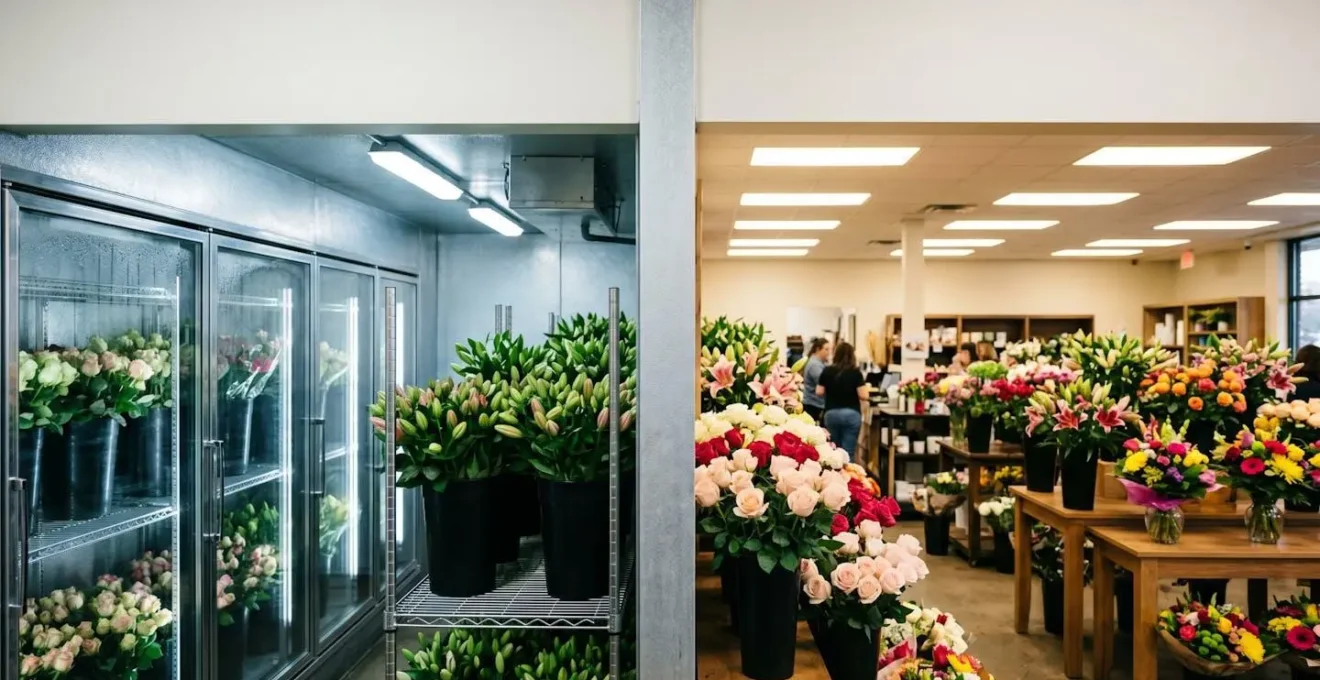
The longevity of your flowers has less to do with your care at home and more with their invisible journey from the farm.
- Florists’ flowers follow a strict, unbroken “cold chain” from harvest to shop, preserving their energy and hydration.
- Supermarket flowers often suffer from breaks in this chain (e.g., airport delays, warm storage), causing irreversible stress that dramatically shortens their vase life.
Recommendation: Learn to spot the signs of a respected cold chain to ensure your money is well spent on blooms that will truly last.
It’s a frustratingly common scenario for many UK households. You’re tempted by a vibrant, affordable bouquet of roses during your weekly shop. They look perfect in the trolley, and for two days, they brighten your kitchen table. Then, almost overnight, the heads begin to droop, the petals lose their lustre, and by day four, they are a sad, withered memory. In contrast, a bouquet from a dedicated florist, while more of an investment, often seems to defy time, lasting a week or even longer. You’ve diligently changed the water, re-cut the stems, and even used that little sachet of flower food. So why the stark difference?
The common assumption is that it comes down to simple “freshness” or “quality,” but these are vague terms. What if the fate of your flowers was sealed long before they reached the supermarket shelf or the florist’s bucket? The answer doesn’t lie in a single factor but in a complex, high-stakes logistical journey known as the cold chain. This is the invisible infrastructure, a refrigerated relay race against time, temperature, and biology, that dictates a flower’s potential from the moment it is cut in a field thousands of miles away.
This article will take you behind the scenes of the global flower industry. We will investigate the critical differences in this journey, expose the hidden failure points that cause premature wilting, and ultimately empower you with the analyst’s eye to differentiate between a bloom destined for a short life and one conditioned for longevity. By understanding the system, you can make more informed choices and finally get the vase life you pay for.
To navigate this complex journey from farm to vase, we will explore the critical stages that determine the fate of your flowers. This guide breaks down the hidden logistics, the science of preservation, and the practical signs of quality that separate a fleeting bloom from a lasting one.
Contents: Unpacking the Journey from Bloom to Vase
- How Does a Kenyan Rose Reach Your London Vase in Under 48 Hours?
- The Hidden Airport Delay That Destroys 30% of Imported Flowers Before Sale
- Air or Sea Freight: Why Your Colombian Carnations Took 3 Weeks to Arrive?
- The 3 Signs a Florist’s Stock Has Been Properly Cold-Stored
- Why Storing Flowers Near Fruit in Transit Cuts Their Lifespan by Half?
- Why Hard Water in Southern England Clogs Stems and Kills Flowers Faster?
- Sugar, Acid, and Biocide: What Each Ingredient in Flower Food Actually Does?
- Why Do Your £40 Roses Die in 4 Days When the Florist Promised 10?
How Does a Kenyan Rose Reach Your London Vase in Under 48 Hours?
The journey of a premium, florist-grade rose is a marvel of modern logistics, engineered with a single goal: to press pause on the flower’s life cycle. This process, known as the cold chain, begins the second a rose is harvested in a field near Lake Naivasha in Kenya. Once cut, the flower is no longer receiving water or nutrients from the plant, and a process called senescence—or aging—begins. The only way to slow this process is with cold.
Within minutes of being cut, the roses are taken to a packing house where they are plunged into a state of suspended animation. The priority is to remove “field heat” as rapidly as possible. The goal, according to industry cold chain protocols, is to reduce the core temperature of the blooms to between 0°C and 2°C within the first hour of processing. This immediate and drastic cooling significantly reduces the flower’s respiration rate. Think of it like putting the flower into a deep, energy-conserving sleep.
From this point on, maintaining that low temperature is non-negotiable. The flowers are graded, bunched, and boxed in refrigerated rooms. They are then loaded onto refrigerated trucks for the short journey to Jomo Kenyatta International Airport in Nairobi. They wait for their flight in specialized cold storage facilities before being loaded onto the aircraft. The entire pre-flight process is a race to keep the blooms within their optimal temperature window, ensuring they don’t wake up and start consuming their limited energy reserves before their journey has even truly begun.
The Hidden Airport Delay That Destroys 30% of Imported Flowers Before Sale
While the start of the journey is a model of efficiency, the cold chain is only as strong as its weakest link. One of the most significant and damaging breaks occurs at a logistical bottleneck that is largely invisible to the end consumer: the airport tarmac. After arriving at a destination airport like Heathrow, pallets of flowers must be unloaded from the plane and transferred to a refrigerated warehouse for inspection and sorting. This is a moment of extreme vulnerability.
Leaving a pallet of flowers on a sun- or rain-drenched tarmac for even 30-60 minutes can be catastrophic. The temperature inside the protective cardboard boxes can spike rapidly, causing the flowers to “wake up” from their cold-induced stasis. This sudden warming triggers a stress response, causing the blooms to rapidly lose moisture and begin respiring at a high rate. This burst of activity consumes the precious sugars stored in their petals, which are their only source of energy for the rest of their vase life. According to industry analysis, this type of non-refrigerated transportation exposure is a primary cause of up to a 30% loss rate from dehydration and overheating before the flowers even reach a wholesaler.
Case Study: The 2021 Valentine’s Day Crisis
The fragility of this system was starkly demonstrated during the 2021 Valentine’s Day rush. A perfect storm of high demand and logistical bottlenecks meant that Ecuadorian flower exporters lost 12% of their shipments specifically due to airport delays. This case highlights how breaks in cold chain continuity at critical transfer points can lead to millions of pounds in losses and are a direct cause of reduced quality and vase life for the consumer.
This “tarmac trauma” is a key differentiator. Premium supply chains, like those used by dedicated florists, have priority handling agreements and temperature-controlled dollies to move flowers directly from plane to cooler, minimising exposure. Bulk, lower-cost supply chains for supermarkets may not have this luxury, meaning their flowers have already had a significant portion of their life depleted before they even make it to the distribution centre.
Air or Sea Freight: Why Your Colombian Carnations Took 3 Weeks to Arrive?
Not all flowers arrive in the UK by a swift 48-hour air journey. A growing portion, especially for hardier varieties like carnations or chrysanthemums, travels by a much slower route: refrigerated sea containers. The choice between air and sea freight represents a fundamental trade-off in the floral industry between speed, cost, and environmental impact. For the consumer, it’s a trade-off that directly impacts the flower’s “age” upon arrival.
An air-freighted rose from Kenya might be in a London vase within two days of being cut. In contrast, a sea-freighted carnation from Colombia embarks on a journey that can take 21 to 28 days. To survive this extended trip, these flowers are put into an even deeper state of suspended animation. They are treated with specific anti-fungal agents and sealed in packaging that modifies the atmosphere to drastically lower oxygen levels, slowing respiration to an absolute minimum.
The motivation for this slower method is twofold. Firstly, cost. Shipping by sea is significantly cheaper than by air, allowing for a lower price point in the supermarket. Secondly, sustainability. Sea freight has an up to 90% lower carbon footprint than air freight, a factor of growing importance for large retailers aiming to meet environmental targets. While a noble goal, the consequence for the consumer is that they are buying a flower that is already three to four weeks old, even if it has been perfectly preserved.
This is a crucial piece of the puzzle. Florists almost exclusively rely on air-freighted flowers, prioritising speed and freshness to ensure maximum vase life for their customers. Supermarkets, balancing cost and volume, will often use a mix of air and sea freight. This means the bouquet of carnations you buy may have had a much longer and more arduous journey than the delicate roses next to them, predisposing them to a shorter display time in your home, regardless of how “fresh” they appear on the shelf.
The 3 Signs a Florist’s Stock Has Been Properly Cold-Stored
As a consumer, you can’t personally inspect the entire supply chain. However, you can learn to spot the tell-tale signs of a properly maintained cold chain versus one that has been compromised. The florist’s shop or the supermarket aisle is the final link, and the evidence is there if you know what to look for. A flower that has been kept consistently at its optimal temperature of 0°C to 1°C will look and feel fundamentally different from one that has endured temperature fluctuations.
Here are three key indicators of good cold chain management:
- Turgidity and Crispness: Gently touch the leaves and stems. A well-hydrated, properly stored flower will feel firm, cool, and crisp. The leaves should be a healthy green and show no signs of yellowing or wilting. If the petals or foliage feel limp, soft, or warm to the touch, it’s a red flag that the flower has spent time outside the cold chain and has begun to dehydrate.
- Perky, Upright Heads: Look at the “neck” of the flower, just below the bloom. A flower suffering from a broken cold chain or improper hydration will often show weakness here first, leading to a bent or drooping head. Flowers that are uniformly upright and strong are a good sign that they have not experienced significant stress.
- Lack of Condensation and “Sweating”: Check the plastic sleeves or wrapping. Excessive moisture or condensation inside the packaging is a major warning sign. It indicates the flowers were moved from a cold environment to a warmer one, causing them to “sweat.” This moisture is a breeding ground for Botrytis, a grey mould that is one of the biggest killers of cut flowers. Clean, dry packaging suggests a stable temperature journey.
Your Pre-Purchase Cold Chain Audit: 5 Points to Check
- Stem Condition: Are the bottoms of the stems clean and green/white, or are they brown, slimy, and discoloured? Slime indicates bacterial growth from poor water hygiene.
- Water Quality: Look at the water in the buckets. Is it clear and fresh, or is it cloudy and full of debris? Cloudy water is a sign of a bacterial buffet that will clog stems.
- Bud Stage: Are the flowers in tight bud or just beginning to open? This indicates they were harvested at the correct time and have their full vase life ahead of them. Avoid fully-blown, wide-open flowers.
- Physical Damage: Check for bruised or browning petal edges (“Botrytis” or bruising from poor handling). A well-managed supply chain minimizes physical damage.
- Shop Environment: Is the flower display located in a cool part of the store, away from direct sunlight, drafts, or ripening fruit displays? This shows an understanding of proper flower care at the retail level.
–
Why Storing Flowers Near Fruit in Transit Cuts Their Lifespan by Half?
The advice to keep your fruit bowl and your flower vase separate is well-known, but the reason behind it is a critical factor throughout the entire floral supply chain. The culprit is a tiny, invisible molecule: ethylene gas. This naturally occurring plant hormone acts as an aging signal, triggering processes like ripening in fruit and, crucially, senescence (aging and death) in flowers. Many flowers, including carnations, lilies, and delphiniums, are extremely sensitive to it.
While ripening fruit is a major source of ethylene, it’s not the only one. Stressed or damaged flowers produce ethylene themselves. This is where breaks in the cold chain become doubly dangerous. A pallet of flowers left on a hot tarmac not only suffers from dehydration but also begins to produce its own ethylene as a stress response. This single event can trigger a chain reaction, where the ethylene from a few stressed blooms signals to all the surrounding flowers to begin aging prematurely.
Professional floral supply chains go to extreme lengths to combat ethylene. This includes using ethylene-scrubbing filters in cold stores and treating flowers with anti-ethylene agents like 1-MCP, which block the flowers’ ethylene receptors. However, in mixed-produce distribution centres, such as those used by supermarkets, the risk of exposure is magnified. A pallet of flowers could be stored next to a pallet of apples or bananas, flooding the blooms with aging hormones. This cross-contamination is a silent killer of vase life.
Case Study: The Cross-Docking Temperature Spike
A supplier using temperature monitors discovered a hidden problem. Their flowers were being held at 12.8°C (55°F) for five hours during a re-palletization period at a cross-docking facility. This temperature spike was enough to cause the flowers to produce ethylene as a stress response. It illustrates how invisible logistical handoffs, far from any fruit, can create the very conditions that accelerate aging and dramatically reduce the flower’s eventual vase life.
Why Hard Water in Southern England Clogs Stems and Kills Flowers Faster?
Once the flower is in your home, the battle for longevity shifts to a new front: hydration. You can give a flower all the right food, but if it can’t drink, it will wilt. The ability of a flower to draw water up its stem is paramount, and this is where the specific water chemistry of your home tap comes into play, particularly for those living in hard water areas like London and Southern England.
Hard water is characterized by high levels of dissolved minerals, primarily calcium and magnesium carbonates. This gives it a high pH, making it alkaline. This alkalinity is a problem for cut flowers. The vascular system of a flower stem, the xylem, is most efficient at absorbing water when the water is slightly acidic. According to water quality research, a pH between 3.5 and 5.0 is the optimal range for maximizing water uptake. The alkaline nature of hard water (often pH 7.5 or higher) works against this, essentially making it harder for the flower to drink.
Furthermore, the high mineral content can directly cause physical blockages. Over time, mineral deposits can form at the cut end of the stem, creating a “vascular blockage” or clog that physically prevents water from being absorbed. This is compounded by the fact that bacteria thrive in alkaline water. These bacteria create their own slimy biofilm, further blocking the stem’s plumbing. Within a day or two, the stem is so clogged that even in a full vase, the flower head is dying of thirst.
The high alkalinity commonly associated with hard water can make it difficult for flower foods to reduce solution pH to the optimum range of 3.5 to 5.0 further compromising the uptake of water in the flower stem.
– FloraLife postharvest research, Why Hard Water Isn’t Easy – Research Update
This is a major reason why the sachet of flower food is so crucial. It doesn’t just feed the flower; a primary component is a citric acid-based acidifier designed specifically to lower the pH of your tap water, creating the ideal acidic conditions for uptake and fighting off those initial blockages.
Sugar, Acid, and Biocide: What Each Ingredient in Flower Food Actually Does?
That small, often-ignored sachet of powder that comes with your bouquet is not a gimmick. It is a scientifically formulated life-support system for your flowers, and understanding its three core components reveals exactly what a cut flower needs to survive. Using flower food is one of the most significant actions a consumer can take to maximize vase life, with controlled vase life studies demonstrating a 19% to 123% increase in longevity across different rose varieties compared to water alone.
Commercial flower food is a triple-action formula designed to tackle the three main reasons a cut flower fails:
- Sugar (The Energy): The primary ingredient is a form of sugar, usually sucrose or dextrose. A cut flower is separated from its energy source—the photosynthesizing plant. The sugar in the food provides a direct source of carbohydrates, giving the flower the energy it needs to stay turgid, develop its buds, and maintain its colour and fragrance. It is quite literally food for a starving organism.
- Acidifier (The Hydration Helper): As we’ve seen, flowers struggle to drink alkaline water. Flower food contains a mild acid, typically citric acid. This immediately lowers the pH of your tap water, bringing it into the optimal 3.5-5.0 range. This acidic environment not only helps the stem absorb water more efficiently but also helps keep the water-conducting vessels (xylem) open and clear.
- Biocide (The Plumber): A vase of plain water, especially if it contains decaying leaves, quickly becomes a breeding ground for bacteria. This bacteria creates a slimy biofilm that clogs the cut end of the stem, causing a vascular blockage and preventing water uptake. Flower food contains a biocide or clarifying agent, a mild disinfectant designed to inhibit microbial growth, keeping the water clean and the stems clear for longer.
In essence, the flower food creates a complete life-support solution. It provides food, ensures the flower can drink, and protects its plumbing from getting clogged. Skipping the flower food or using home remedies like aspirin or lemonade simply cannot replicate this balanced, multi-pronged approach. You are leaving your flowers to starve in dirty water they can’t even properly drink.
Key takeaways
- The “cold chain”—an unbroken refrigerated journey—is the single biggest factor in flower longevity.
- Supermarket flowers often suffer from breaks in this chain (tarmac heat, storage issues), accumulating “degree hours” of damage that is invisible at purchase.
- Florist-grade flowers command a higher price because they represent a more reliable, professionally managed cold chain, ensuring the bloom’s energy is preserved for your vase.
Why Do Your £40 Roses Die in 4 Days When the Florist Promised 10?
We can now answer the core question. The £40 you spend at a florist is not just for the flowers themselves; you are paying for the integrity of the cold chain. You are buying blooms that have, in all likelihood, been kept in a state of suspended animation from the moment they were cut, their precious energy reserves conserved for their final performance in your home. The florist’s promise of a 10-day vase life is built on the confidence of a well-managed, temperature-controlled supply chain.
The supermarket bouquet, on the other hand, represents a gamble. It has likely endured more stress and temperature fluctuations. Every hour spent above the optimal temperature contributes to a flower’s “degree hours”—a metric used in logistics to quantify cumulative heat exposure. According to cold chain performance standards, for every 500 degree hours accumulated, a flower can lose a full day of its vase life. A few hours on a warm tarmac or a day in a poorly chilled distribution centre can easily shave days off the flower’s potential before you even see it.
A rose held consistently at 35°F may last 7–10 days longer than the same rose exposed to repeated temperature fluctuations during transport.
– Mayesh Wholesale Florist, The Cold Chain Explained – Industry Guide
The difference in price reflects this difference in risk and management. The supermarket model is built on volume and efficiency, where a certain percentage of loss or reduced quality is factored into the business model. The independent florist model is built on reputation and quality, where the primary goal is delivering a premium, long-lasting product. The £40 rose dies in four days because its life was already 70% spent by the time you bought it. It arrived in the store with an invisible debt of degree hours and ethylene exposure that no amount of care at home could repay.
Now armed with this knowledge, you are no longer just a passive buyer. The next time you choose your flowers, you’ll be reading a story written in logistics, temperature, and time. Make your next bouquet a conscious choice for quality and longevity.